
Buying Guide · Updated November 2026
Best 400 Watt Solar Panel 2026: Single Panels vs 2×200W Sets
For most buyers, the best 400 watt solar panel is a pair of 200W N-type panels, and the Callsun 400W bifacial set is our pick. Its series voltage of about 54.6V fits many 60V power stations. The ECO-WORTHY 4×100W set is the budget choice. If you want one true 400W panel for a ground mount, the BougeRV 400W is the one to get. A 400W panel makes roughly 900–1,800 Wh on a clear day. Below are five panels scored on cell type, price per watt, published build and warranty, size, and voltage compatibility, plus the wiring math.
As an Amazon Associate, SolarGenAdvisor earns from qualifying purchases made through links on this page, at no additional cost to you.
 By
Quick Verdict: Which 400W Solar Panel Should You Buy?
Charging a portable power station: the Callsun 2×200W set. Currently $319.99 on Amazon, it can run as one series string under a 60V input in mild weather. Cheapest 400W: the ECO-WORTHY 4×100W set. Van with a 24V battery: the Renogy 2×200W. Shady campsites: Renogy ShadowFlux. Ground mount or shed: the single BougeRV 400W panel.
| Panel | Config | Voc per Panel | Size & Weight (each) | Our Score | Price |
|---|---|---|---|---|---|
| Callsun 400W N-Type Bifacial Solar Panel (2 x 200W) Best 400W Solar Panel Overall |
2 × 200W bifacial | 27.31V | 51.3 x 30.3 x 1.4 in, 23.8 lb | 77/100 | $319.99 |
| ECO-WORTHY 400W N-Type Solar Panels (4 x 100W) Best Budget 400W Set |
4 × 100W | 22.7–25.2V* | Not listed | 58/100 | $229.59 |
| Renogy 400W N-Type Solar Panels (2 x 200W, 24V) Best for Vans and Tight Roofs |
2 × 200W (24V-class) | 37.44V | 49.7 x 30.1 x 1.2 in, 23.4 lb | 74/100 | $352.99 |
| Renogy 400W ShadowFlux N-Type Solar Panels (2 x 200W) Best for Partial Shade |
2 × 200W ShadowFlux | 36.5V | 49.69 x 30.08 x 1.18 in, 23.8 lb | 73/100 | $465.99 |
| BougeRV 400W N-Type Bifacial Solar Panel (single panel) Best Single 400W Panel |
1 × 400W bifacial | 39.7V | 67.8 x 44.6 x 1.4 in, 44.4 lb | 65/100 | $459.99 |
*Not stated on the ECO-WORTHY listing; range taken from ECO-WORTHY’s own pages for its 100W N-type and bifacial panels. Scores are editorial ratings synthesized from published specs and logged Amazon prices. We did not test these panels. Prices update from Amazon; a “Check price” link means no live price was available.
How We Score Solar Panels
Our panel scores are AI-synthesized from manufacturer spec sheets, Amazon listing details and the Amazon prices we checked on November 1, 2026. We did not install, measure or test these panels. We don’t score Amazon customer reviews, because we have no reliable review data for these listings, and a spec the maker doesn’t publish earns no credit. Each panel gets a 0–100 score on five weighted factors:
- Efficiency and cell type (22.2%): published cell efficiency, plus credit for N-type cells and bifacial or shade-tolerant designs.
- Value per watt (22.2%): the lowest Amazon price per watt in this group divided by this panel’s price per watt.
- Build and warranty, as published (22.2%): glass front, IP rating, load ratings, and a power-output warranty the manufacturer actually states.
- Weight and size (16.7%): the heaviest single piece you have to lift: 25 lb or less scores highest.
- Connectors and compatibility (16.7%): published open-circuit voltage and short-circuit current, and whether the whole set runs as one series string under a 60V power-station limit.
Power stations are rated on a different six-factor matrix, explained on our methodology page.
The 5 Best 400 Watt Solar Panels for 2026
1. Best 400W Solar Panel Overall

Callsun 400W N-Type Bifacial Solar Panel (2 x 200W)
2 × 200W bifacial · N-type 16BB bifacial · 27.31V Voc per panel · Score 77/100
Price: $319.99
Two 200W N-type bifacial glass panels. Callsun’s listing gives the series figures directly: 47.48V at maximum power and 54.62V open-circuit, about 27.3V per panel. That is the rare 400W set that can go into a 60V power-station input as one series string on a mild day. Each panel is 51.3 × 30.3 × 1.4 in and 23.8 lb (Amazon listing; the weight matches independent review listings), so one person can lift each half onto a roof. Callsun also publishes a −0.30%/K temperature coefficient, a 25-year commitment of at least 84.5% output, and a split-cell layout that keeps half of each panel working when the other half is shaded.
Pros
- Series Voc of 54.6V suits many 60V power stations
- Bifacial N-type cells with a published 25.6% cell efficiency
- Two 23.8 lb panels are easier to handle than one 44 lb panel
Cons
- Little cold-weather margin under a 60V limit when wired in series
- In parallel, the two panels push about 17A of operating current, more than some station inputs accept
- The low price we logged on Nov 1 was a Prime-exclusive offer
Buy it if: Owners of a 60V-input power station who want 400W from one cable run, and van or RV roofs with room for two mid-size panels.
Skip it if: You camp in freezing weather with a 60V station. Wire in parallel or pick a panel with more voltage headroom.
2. Best Budget 400W Set

ECO-WORTHY 400W N-Type Solar Panels (4 x 100W)
4 × 100W · N-type 16BB · Score 58/100
Price: $229.59
Four 100W N-type 12V-class panels at the lowest price per watt of anything we track at 400W (see the table for today’s price). ECO-WORTHY lists 16BB cells at up to 25% efficiency, IP68 junction boxes with bypass diodes, 35-inch leads and a 1.18-inch frame. The catch is documentation. The listing doesn’t state the open-circuit voltage or weight, and ECO-WORTHY’s own pages for its 100W N-type and bifacial panels show 22.7V and 25.2V for different revisions. Plan your wiring around the higher figure and read the label on the panels you receive.
Pros
- Lowest cost per watt of the five picks
- Small panels fit around roof vents, hatches and AC units
- 12V-class output works with almost any charge controller
Cons
- Voc and weight not stated on the listing
- Four panels mean more brackets, connectors and wiring
- Ships in two boxes that may arrive on different days
Buy it if: DIY builders on a budget, sheds and cabins, and RV roofs too cluttered for large panels.
Skip it if: You want one clean panel and minimal wiring. A single 400W panel is simpler.
3. Best for Vans and Tight Roofs

Renogy 400W N-Type Solar Panels (2 x 200W, 24V)
2 × 200W (24V-class) · N-type 16BB · 37.44V Voc per panel · Score 74/100
Price: $352.99
Two compact 24V-class 200W N-type panels that Renogy says are 7.5% smaller and 11.7% lighter than the model they replace. Each measures 49.7 × 30.1 × 1.2 in and weighs about 23.4 lb (Renogy’s regional product page and the Amazon listing). Electrical specs per panel are 37.44V open-circuit, 6.85A short-circuit and 31.03V at maximum power, consistent across Renogy’s pages and retailer spec tables. That voltage matters: two in series reach about 75V, which is over the 60V limit of most portable power stations, so parallel wiring is the usual answer there. Renogy publishes a 25-year, 80% output warranty.
Pros
- Compact footprint marketed for Class B vans
- Published 25-year, 80% output warranty
- Higher per-panel voltage cuts current on 24V battery banks
Cons
- Must be wired in parallel for most 60V power stations
- Not bifacial
- Costs more per watt than the ECO-WORTHY and Callsun sets
Buy it if: Camper vans and RVs with a 24V house battery or an MPPT controller rated for 100V or more.
Skip it if: You plan to series-wire into a 60V power station. Choose the Callsun set instead.
4. Best for Partial Shade

Renogy 400W ShadowFlux N-Type Solar Panels (2 x 200W)
2 × 200W ShadowFlux · N-type 16BB, ShadowFlux anti-shading · 36.5V Voc per panel · Score 73/100
Price: $465.99
Renogy’s ShadowFlux panels use an anti-shading cell layout meant to hold output when part of the panel is shaded by a tree branch, roof vent or snow edge. Per panel, Renogy and CleanTechnica both list 36.5V open-circuit, 6.86A short-circuit, 49.69 × 30.08 × 1.18 in and about 23.8 lb. Note the efficiency wording: Renogy advertises 25% cell efficiency, while CleanTechnica lists 20.7% module efficiency, which is the more useful number for roof-space planning. Renogy lists a 5-year material and workmanship warranty and a 25-year, 80% output warranty, and an IP67 rating.
Pros
- Designed to lose less power under partial shade
- Both material and output warranty terms are published
- Same compact size as Renogy’s standard 200W N-type panel
Cons
- Highest price per watt of the five picks
- Series Voc of about 73V is too high for 60V power stations
- Shade tolerance isn’t a substitute for unshaded placement
Buy it if: Campers who park under trees and roofs with unavoidable shadows from AC units or racks.
Skip it if: Your panels sit in full sun all day. Standard panels cost less for the same output.
5. Best Single 400W Panel
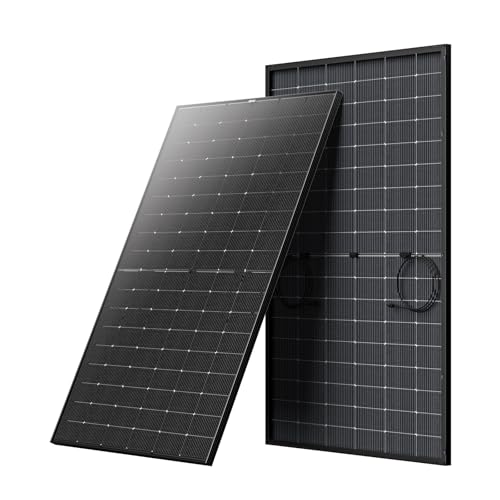
BougeRV 400W N-Type Bifacial Solar Panel (single panel)
1 × 400W bifacial · N-type TOPCon 16BB bifacial · 39.7V Voc per panel · Score 65/100
Price: $459.99
If you want one panel that is actually rated at 400 watts, this is it. BougeRV’s spec table lists 400W, 33.16V and 12.36A at maximum power, 39.7V open-circuit and 13.5A short-circuit, a 20A series fuse rating, 67.8 × 44.6 × 1.4 in and 44.4 lb. The Amazon listing gives the same size and weight. One panel at 39.7V fits under a 60V station limit with room to spare, even on a cold morning. The weak points are current and bulk: 13.5A short-circuit is more than some station inputs allow, and a 21-square-foot, 44 lb glass panel is a two-person lift. BougeRV’s site lists a 10-year material and 30-year linear output warranty; the Amazon listing mentions only 10 years of tech support, so confirm the warranty terms at purchase.
Pros
- One panel, one pair of leads, one set of brackets
- 39.7V Voc fits any 60V input with cold-weather headroom
- N-type bifacial cells can add output over light-colored ground
Cons
- 44.4 lb and 67.8 × 44.6 in, too big for most van roofs
- 13.5A short-circuit current exceeds some power-station inputs
- Amazon showed very limited stock on Nov 1, 2026
Buy it if: Ground mounts, sheds, cabins and large RV roofs where one big panel means less hardware.
Skip it if: You have to lift it onto a roof alone, or your station’s solar input is capped below 13.5A.
Want a folding 400W panel instead? These are rigid glass panels for roofs and racks. For a 400W panel you set up at the campsite and pack away, the EcoFlow 400W Portable Solar Panel is already in our portable solar panel guide. Curved roofs need a flexible solar panel instead.
400W in One Panel vs 2×200W (or 4×100W)
Most listings titled “400 watt solar panel” are actually sets of smaller panels, and that is often the better buy. Total output is the same 400W at standard test conditions. What changes is handling, wiring and fit:
| 1 × 400W | 2 × 200W | 4 × 100W | |
|---|---|---|---|
| Typical size, each | ~68 × 45 in (BougeRV) | ~50 × 30 in (Renogy, Callsun) | Smallest; fits between vents |
| Typical weight, each | ~44–50 lb, two-person lift | ~23–24 lb | Light (ECO-WORTHY doesn’t list it) |
| Wiring | One pair of leads | Series or parallel to match the input | Most flexible: series, parallel or 2S2P |
| Current | Highest (BougeRV: 13.5A short-circuit) | Half per panel; doubles in parallel | Lowest per panel |
| Shade | One shadow affects the whole 400W | Can place panels to avoid shadows | Easiest to spread around obstacles |
| Best for | Ground mounts, sheds, big flat roofs | Vans, RVs, power stations | Budget builds, cluttered roofs, 12V systems |
More panels means more MC4 connections and more brackets, and every connection is a potential failure point. Fewer panels means heavier lifts and less flexibility. For most vans, RVs and power stations, two 200W panels are the sweet spot.
How Big Is a 400 Watt Solar Panel? Size and Weight for Roofs and Ground Mounts
A single 400W rigid panel is about the size of a residential rooftop module. BougeRV’s is 67.8 × 44.6 × 1.4 in, roughly 21 square feet, and weighs 44.4 lb. That is fine on a ground rack or a shed roof. It’s a different story on a van roof, where it may not fit between the fan and the roof rails and has to be lifted by two people up a ladder.
- Van and RV roofs: measure the clear space between vents, fans, the AC shroud and any rack before you buy. Two 200W panels of about 50 × 30 in (Renogy and Callsun) fit more layouts than one 68 × 45 in panel, and each half weighs about 23–24 lb. Check your RV maker’s guidance on roof load and mounting points.
- Ground mounts: a single large panel needs only one set of rails or tilt legs. Tilting the panel toward the sun usually beats lying it flat, and a tilted ground mount is also where bifacial panels can pick up reflected light. Our solar panel setup guide covers angle and placement.
- Wind: a large flat panel catches a lot of wind. Look for published wind and snow load ratings (often 2,400 Pa wind and 5,400 Pa snow on rigid panels) and follow the manual’s mounting points.
Voltage: Will a 400W Panel Work With Your Power Station or Charge Controller?
Watts aren’t the limit that bites. Open-circuit voltage (Voc) is the voltage a panel produces with nothing connected, and it is the number that must stay under your input’s maximum. Panels in series add their voltages; panels in parallel add their currents. Most 1 kWh-class power stations top out at 60V:
- EcoFlow Delta 3 Plus: two inputs, each 11–60V, 15A, 500W max (retailer spec sheets and StorageReview).
- Bluetti Elite 100 V2: 12–60V, 20A, 1,000W max (Bluetti).
- Anker SOLIX C1000 Gen 2: 600W at up to 60V (Anker).
- Victron SmartSolar MPPT 100/30 charge controller: 100V maximum PV open-circuit voltage (Victron datasheet), the kind of controller used on RV house batteries.
| Panels & Wiring | Voc (standard test) | 60V Power Station | 100V MPPT Controller |
|---|---|---|---|
| BougeRV 400W, single panel | 39.7V | Voltage OK with margin. Short-circuit current is 13.5A: under the Delta 3 Plus’s 15A and the Elite 100 V2’s 20A, but check lower-current inputs. | OK |
| Callsun 2×200W, series | 54.62V | Under 60V on a mild day, but cold raises Voc (see below). Borderline in freezing weather. | OK |
| Callsun 2×200W, parallel | ~27.3V | Voltage OK. Operating current doubles to about 17A (2 × 8.43A), above the Delta 3 Plus’s 15A per input but within the Elite 100 V2’s 20A. | OK |
| Renogy 2×200W (24V), series | 74.9V | Too high | OK, with room for cold |
| Renogy 2×200W (24V), parallel | 37.44V | OK. Short-circuit current 13.7A (2 × 6.85A) fits a 15A input. | OK |
| Renogy ShadowFlux 2×200W, series | 73.0V | Too high; wire in parallel (36.5V, 13.7A) | OK |
| ECO-WORTHY 4×100W, 2 series × 2 parallel | ~45–50V | OK, if the panel label confirms Voc of 25.2V or less | OK |
| ECO-WORTHY 4×100W, all 4 in series | ~91–101V | Too high | At or over the 100V limit; don’t |
Cold weather raises voltage. A panel’s Voc climbs as cell temperature drops, so a string that reads 54V on a spring afternoon can read several volts higher at sunrise in freezing weather. In the US, the National Electrical Code (NFPA 70, Section 690.7) requires calculating maximum PV voltage at the lowest expected temperature for fixed installations. Our rule of thumb for portable setups is to keep the string’s rated Voc at least 10–15% under the input limit. That puts a 60V station’s comfortable ceiling around 51–54V. Use the panel’s published Voc temperature coefficient and your station or controller manual for the exact limits. We don’t publish wiring diagrams; follow the manuals, and use a qualified electrician for anything connected to home wiring.
Connectors: all five picks use MC4-style connectors. Most power stations use smaller XT60-style or brand-specific inputs, so plan on an MC4 adapter cable, and reviewers note the Jackery Explorer 1000 V2 uses Jackery’s own solar connector, so third-party panels need Jackery’s adapter. The Jackery’s 400W solar input also means a 400W array has no headroom on that station.
Monocrystalline, N-Type and Bifacial: What the Labels Mean
- Monocrystalline panels use single-crystal silicon cells. Every pick on this page is mono; older polycrystalline panels are less efficient and rarely worth buying now.
- N-type (often TOPCon) is the newer mono cell design. Brands pitch it on efficiency and degradation: Renogy lists 1% or less in year one and 0.4% or less a year after that for its N-type 200W panels, and BougeRV lists 25% cell efficiency against 23% for its older P-type panels. Treat those as manufacturer figures.
- Cell vs module efficiency: “25%” on a listing is almost always cell efficiency. Module efficiency, which counts the frame and gaps between cells, is lower. CleanTechnica lists 20.7% for Renogy’s 200W ShadowFlux panel. Module efficiency is the number that sets watts per square foot of roof.
- Bifacial panels have a clear back sheet and collect light reflected onto their rear side. Gains depend on what’s underneath and how high the panel sits. A tilted panel over white gravel or snow benefits; a panel flat on an RV roof barely does. Brand gain claims (BougeRV markets up to 30% on Amazon and up to 80% in “high-reflectivity” settings on its site) are best cases, so don’t count on them in sizing math.
- Heat: panels lose output as they warm up. BougeRV publishes a −0.32%/K temperature coefficient and Callsun −0.30%/K. A cell running 40°C above the 25°C test temperature, which is common on a summer roof, loses about 12–13% of rated power (40 × 0.32%).
How Much Power Does a 400 Watt Solar Panel Produce per Day?
Daily energy is rated watts × peak sun hours × about 0.75. The 0.75 covers heat, sun angle, dust and wiring losses. NREL’s solar resource maps put most of the continental US at roughly 3 to 6 peak sun hours a day on an annual average, higher in the desert Southwest and lower in the Pacific Northwest and in winter (NREL solar resource maps). For your own address, NREL’s free PVWatts calculator gives month-by-month estimates.
| Peak Sun Hours | Typical Situation | 400W × Hours × 0.75 |
|---|---|---|
| 2 | Northern winter, overcast stretches | ~600 Wh |
| 3 | Northern states in spring and fall, cloudier regions year-round | ~900 Wh |
| 4 | Much of the Midwest and Northeast | ~1,200 Wh |
| 5 | Southeast, Texas, much of the Mountain West | ~1,500 Wh |
| 6 | Desert Southwest in summer | ~1,800 Wh |
What One Day of 400W Solar Can Run
Panels charge a battery; the battery runs your loads. Take a 5-sun-hour day (about 1,500 Wh stored) and allow for inverter and conversion losses with Wh × 0.85 ÷ load watts:
| Load | Average Draw | Runtime from 1,500 Wh |
|---|---|---|
| 12V compressor fridge | ~50W | ~25 hrs |
| CPAP, no humidifier | ~40W | ~32 hrs |
| Laptop | ~60W | ~21 hrs |
| TV | ~100W | ~13 hrs |
| Full-size refrigerator | ~150W averaged over its cycle | ~8.5 hrs |
| Microwave | ~1,000W | ~75 min, if the inverter can supply it |
To store a full day of 400W harvest you need about 1,500 Wh of battery, which is why 400W pairs well with 1–2 kWh power stations. For the full sizing walk-through, use our solar size calculator; for winter numbers, see do solar generators work on cloudy days.
Rigid 400W Panels vs Folding Panels and Roof Kits We’ve Rated
A rigid 400W set costs far less per watt than a folding portable panel, but it needs a mount and an adapter cable. Here is how our top pick compares with three products already scored on the site:
| Product | Type | Watts | Weight | Our Score | Price |
|---|---|---|---|---|---|
| Callsun 400W N-Type Bifacial Solar Panel (2 x 200W) | Rigid glass, 2 panels | 400W | 23.8 lb each | 77/100 | $319.99 |
| EcoFlow 400W Portable Solar Panel | Folding portable (400W) | 400W | 35.3 lb | 91/100 | $699.00 |
| Bluetti PV350 350W Solar Panel | Folding portable (350W) | 350W | 30.6 lb | 86/100 | $649.00 |
| Renogy 400W Premium Solar Kit (40A MPPT) | Roof kit: 4 × 100W + 40A MPPT | 400W | Not listed | 84/100 | $639.99 |
Folding panels and kits are scored on their own rubrics, so compare scores within a category rather than across it.
If you also need the charge controller, brackets and cables for an RV house battery, a complete kit is simpler; see our best RV solar kit picks. If you’d rather carry a smaller folding panel to camp, our best 200W portable solar panel guide covers that size. For a matched station-plus-panel bundle, see solar generator kits.
Who Should Buy a 400W Solar Panel, and Who Should Skip One
Buy one if you…
- Own a 1–2 kWh power station with 400W or more of solar input
- Run a 12V fridge, CPAP or laptops off-grid every day
- Have a roof, rack or yard spot where panels can stay mounted
- Want the lowest cost per watt and don’t mind an adapter cable
Skip it if you…
- Have a small station capped at 100–200W of solar input
- Need to set up and pack away at camp every day (buy a folding panel)
- Have a curved or weight-limited roof (buy flexible panels)
- Want solar to run an air conditioner all day
400 Watt Solar Panel FAQ
How much power does a 400 watt solar panel produce per day?
Roughly 900 to 1,800 Wh on a clear day. Multiply 400W by your peak sun hours, then by about 0.75 to allow for heat, angle and wiring losses. NREL solar resource data puts most of the continental US at roughly 3 to 6 peak sun hours a day, so 400W x 5 hours x 0.75 is about 1,500 Wh. Winter and cloudy days can cut that in half or more.
What can a 400 watt solar panel run?
A day of good sun stores about 1,500 Wh, enough to run a 12V compressor fridge averaging 50W for about a day, a CPAP without humidifier for more than a night, plus phones, laptops and lights. Solar panels do not run appliances directly; they charge a battery or power station, and the battery and inverter run the loads.
Is one 400W solar panel better than two 200W panels?
Not automatically. One 400W panel means fewer connections and brackets and suits ground mounts and large roofs. Two 200W panels are easier to lift, fit more roofs, and can be wired in series or parallel to match a power station or charge controller. For vans, RVs and most power stations, two 200W panels are usually the more practical choice.
How big is a 400 watt solar panel and how much does it weigh?
A single 400W rigid panel is typically about 68 x 45 inches and 44 to 50 pounds. BougeRV lists 67.8 x 44.6 x 1.4 inches and 44.4 lb for its 400W panel. A 2 x 200W set covers a similar total area but splits it into two panels of roughly 50 x 30 inches and 23 to 24 lb each.
Can I connect a 400W solar panel to a portable power station?
Yes, if the open-circuit voltage, current and connector match the station. Most 1 kWh-class stations accept up to 60V; the EcoFlow Delta 3 Plus is listed at 11-60V and 15A per input. A single 400W panel at about 40V fits, but check its short-circuit current. Two 24V-class 200W panels in series can exceed 60V, so wire them in parallel. You will usually need an MC4 adapter cable for the station.
Do I need an MPPT charge controller for a 400W solar panel?
For a 12V or 24V battery bank, yes in practice. Most 400W panels and 24V-class 200W panels run at 30V or more at maximum power, which a PWM controller cannot convert efficiently for a 12V battery. Size the controller for current (400W divided by battery voltage) and keep the panels below its maximum PV voltage. Portable power stations have an MPPT controller built in.
Are bifacial 400W solar panels worth it?
Sometimes. A bifacial panel collects extra light reflected onto its back, which helps on a tilted ground mount over light gravel, concrete or snow. Mounted flat on an RV roof, the back sees little light and the gain is small. Manufacturer gain figures are best-case marketing numbers, so treat bifacial output as a bonus rather than part of your sizing math.
The Bottom Line
Check your station’s or controller’s voltage and current limits first, then choose the panel layout. For most power-station owners that means two 200W panels; for ground mounts, one 400W panel. Budget for an MC4 adapter, and expect about 1,200–1,500 Wh on a good day.