
Buying Guide · Updated November 2026
Best 400 Watt Solar Panel Kit (2026), Plus 100W, 200W and 1000W Kits Sized by Daily Wh
Short answer
A 400 watt solar panel kit with an MPPT controller makes roughly 1,200–2,000 Wh on an average day in the US cities we checked: enough for a 12V fridge, lights, phones and a laptop on one 12V 100Ah battery. Our pick is the Renogy 400W Premium Kit, whose controller can later grow to about 1,000W on 24V. The ECO-WORTHY 400W Premium Kit is the value pick.
As an Amazon Associate, SolarGenAdvisor earns from qualifying purchases made through links on this page, at no additional cost to you. Scores are AI-synthesized from manufacturer specs, Amazon listing contents, logged Amazon prices and Amazon customer reviews; we did not install or test these kits.
 By
Solar Panel Kits by Wattage: Comparison
This page compares complete panel kits (panels plus a charge controller and the cables to connect them) at 100W, 200W, 400W and 1,000W. If you want a single panel or a pair of panels to add to gear you already own, our best 400 watt solar panel guide covers that. If you want a power station with folding panels and no wiring, see our solar generator kits. Prices load live from Amazon.
| Kit | Panels | Controller | Battery / inverter | ~Wh / day at 4.5 sun hrs | Price |
|---|---|---|---|---|---|
| Renogy 400W Premium Solar Kit (40A MPPT) (84/100) | 4 × 100W rigid | 40A MPPT, Bluetooth | Not included | ~1,350 | Check price at Amazon → |
| ECO-WORTHY 400W Premium Solar Kit (40A MPPT) (83/100) | 4 × 100W rigid | 40A MPPT, Bluetooth | Not included | ~1,350 | Check price at Amazon → |
| ECO-WORTHY 400W Complete Kit (Battery + 2000W Inverter) (82/100) | 4 × 100W rigid | 40A MPPT, Bluetooth | 2,560 Wh LiFePO4 / 2,000W inverter | ~1,350 | Check price at Amazon → |
| ECO-WORTHY 200W Solar Kit (20A Bluetooth MPPT) (76/100) | 2 × 100W rigid | 20A MPPT, Bluetooth | Not included | ~680 | $271.99 |
| Renogy 200W Solar Starter Kit (30A PWM) (76/100) | 2 × 100W rigid | 30A PWM | Not included | ~680 | Check price at Amazon → |
| Renogy 100W Solar Starter Kit (30A PWM) (72/100) | 1 × 100W rigid | 30A PWM | Not included | ~340 | $151.99 |
Kit scores use the same rubric as our best RV solar kit guide (controller and harvest 25, value 20, kit completeness 15, panel build 15, expandability 15, documentation and Amazon customer reviews 10), AI-synthesized from specs, listing contents and logged prices. All six kits showed in stock on Amazon when we checked on November 8, 2026. Daily Wh uses Chicago’s annual average (4.5 sun hours) and our 0.75 loss factor; PWM kits will land somewhat lower.
The 3 Best 400 Watt Solar Panel Kits
400W is the size most RVs, vans, boats and off-grid sheds end up at: four 100W panels and a 40A MPPT controller, about one 12V 100Ah battery’s worth of energy on an average day. Two of the three ship without a battery or inverter, so each card says what to add.
#1 · Best 400W Kit Overall · 84/100

Renogy 400W Premium Solar Kit (40A MPPT)
In the box: 4 x 100W rigid panels, Rover 40A MPPT controller, Bluetooth module, adaptor kit, tray cable, Z-brackets
Add: A 12V 100Ah LiFePO4 battery, fuses, and an inverter if you want 120V outlets.
Four 100W rigid panels, Renogy’s Rover 40A MPPT controller, a Bluetooth module, cabling and Z-brackets, per the Amazon listing; Renogy’s product page also lists a short fuse cable. It scores highest of the kits here in our rubric because the parts are well documented and the controller has room to grow: Renogy rates the Rover 40A for 520W of panels on a 12V battery and 1,040W on 24V, with a 100V PV input limit. That makes this the one 400W kit on the page that can become a 1,000W RV system later on the same controller (see the 1000W section).
- MPPT controller and Bluetooth module in the box
- Same controller handles about 1,000W on a 24V battery
- Rigid glass panels with Z-brackets
- No battery or inverter
- Costs more per watt than the ECO-WORTHY 400W kit at our November 8 price check
- Only about 120W of headroom at 12V
#2 · Best Value 400W Kit · 83/100

ECO-WORTHY 400W Premium Solar Kit (40A MPPT)
In the box: 4 x 100W rigid panels, 40A MPPT controller, BT-02 Bluetooth module, 16ft cables with Y branches, Z-brackets
Add: A 12V 100Ah LiFePO4 battery, fuses, and an inverter if you want 120V outlets.
Four 100W mono panels, a 40A MPPT controller, ECO-WORTHY’s BT-02 Bluetooth module, Z-brackets and 16 ft cables with Y-branch connectors, per the Amazon listing. The listing also gives 3.2 mm glass and 2,400 Pa wind / 5,400 Pa snow load ratings. It has the same layout as the Renogy kit at a lower price per watt, which is why it sits one point behind in our scoring. ECO-WORTHY’s listing says the kit averages about 1.6 kWh a day; our sun-hour math below puts a 400W kit nearer 1.2–2.0 kWh depending on where you live, so treat the 1.6 kWh as a sunny-site figure.
- Lowest price per watt of the 400W kits here
- MPPT plus Bluetooth monitoring
- Published wind and snow load ratings
- No battery, inverter or fuses listed
- ECO-WORTHY doesn’t publish the controller’s 24V panel limit on the listing
- Y-branch cables put all four panels in parallel unless you rewire
#3 · Best 400W Kit With Battery and Inverter · 82/100

ECO-WORTHY 400W Complete Kit (Battery + 2000W Inverter)
In the box: 4 x 100W bifacial panels, 40A MPPT controller, 2000W pure sine inverter, 2 x 12V 100Ah lithium batteries, Bluetooth module
Add: Fuses, a DC disconnect and somewhere safe to mount two batteries.
The complete version: four 100W bifacial panels, a 40A MPPT controller, a 2,000W pure sine inverter, two 12V 100Ah lithium batteries with a built-in BMS and a Bluetooth module, per the Amazon listing; the product images label the batteries 12.8V 100Ah LiFePO4, about 2,560 Wh in total. The “1.6KWH” in its title is ECO-WORTHY’s claimed daily solar output, not battery capacity. Pick it if you want one order and one set of instructions. ECO-WORTHY sells several similar complete kits, so check the listing contents before you buy.
- Panels, controller, storage and inverter in one order
- About 2.5 kWh of storage and 2,000W of AC
- MPPT with Bluetooth
- Needs a permanent install with proper fusing
- Inverter surge rating not published on the listing
- Contents come from the Amazon listing only
Kit Size From Daily Wh: The Sun-Hour Math
Pick a kit wattage from the watt-hours you use in a day, not from the roof. Panel output depends on peak sun hours: the day’s solar energy expressed as hours of full 1,000 W/m² sun. We pulled average daily figures for four cities from the National Solar Radiation Database through the Solar Resource API of the National Laboratory of the Rockies, the DOE lab formerly called NREL (NSRDB), for a panel tilted at the local latitude. We then budget 75% of rated watts for heat, angle, wiring and controller losses, the same factor as our RV kit guide:
Daily Wh from solar ≈ kit watts × peak sun hours × 0.75
Kit watts needed ≈ daily Wh ÷ (peak sun hours × 0.75)
| City | Sun hrs: year / June / Dec | 100W kit: year / Dec | 200W kit: year / Dec | 400W kit: year / Dec | 1,000W kit: year / Dec |
|---|---|---|---|---|---|
| Phoenix, AZ | 6.68 / 7.30 / 5.53 | ~500 / ~410 Wh | ~1,000 / ~830 Wh | ~2,000 / ~1,660 Wh | ~5,010 / ~4,150 Wh |
| Atlanta, GA | 5.09 / 5.71 / 3.79 | ~380 / ~280 Wh | ~760 / ~570 Wh | ~1,530 / ~1,140 Wh | ~3,820 / ~2,840 Wh |
| Chicago, IL | 4.50 / 5.59 / 2.65 | ~340 / ~200 Wh | ~680 / ~400 Wh | ~1,350 / ~800 Wh | ~3,380 / ~1,990 Wh |
| Seattle, WA | 3.98 / 5.43 / 1.65 | ~300 / ~120 Wh | ~600 / ~250 Wh | ~1,190 / ~500 Wh | ~2,990 / ~1,240 Wh |
Source: NSRDB averages (kWh/m²/day, latitude tilt) returned by the NLR Solar Resource API for each city’s coordinates, queried November 8, 2026. A flat RV roof gets less, especially in winter. For your own location, use PVWatts, the lab’s free calculator. Harvest columns are our calculation.
Which Kit Wattage for Your Daily Wh
The same math in reverse. Sunny-season use (Phoenix’s annual average stands in for a summer trip in most of the country) needs far less panel than a northern winter:
| Daily use | Sunny (6.68 sun hrs, Phoenix year) | Average (4.50, Chicago year) | Winter (2.65, Chicago Dec) |
|---|---|---|---|
| 300 Wh | ~60W → 100W kit | ~89W → 100W kit | ~151W → 200W kit |
| 600 Wh | ~120W → 200W kit | ~178W → 200W kit | ~302W → 400W kit |
| 1,000 Wh | ~200W → 200W kit | ~297W → 400W kit | ~504W → 1,000W kit |
| 1,500 Wh | ~300W → 400W kit | ~445W → 1,000W kit | ~755W → 1,000W kit |
| 2,500 Wh | ~500W → 1,000W kit | ~741W → 1,000W kit | ~1,258W → Beyond 1,000W |
Pair the kit with a battery that holds at least one day of use. A 12.8V 100Ah LiFePO4 battery stores 1,280 Wh, about 1,088 Wh usable at our 85% planning factor, so it suits a 200W–400W kit. Our solar size calculator adds up your appliances for you.
What Each Kit Size Runs: 100W, 200W, 400W and 1000W
Here is what a day of average sun (4.5 hours) realistically powers at each size. Load figures are published values where one exists: Dometic’s 11.8W average for its CFX3 35 12V fridge at 90°F (about 280 Wh a day; see our best 12V fridge guide), a 25–40W average for a Starlink Mini (spec sheet), and appliance ranges from Virginia Cooperative Extension (laptop 50W, window fan 55–250W, coffee maker 900–1,200W, microwave 750–1,100W). Hours of use are our assumptions.
| Kit | ~Wh / day | Realistically runs | Won’t run on solar alone |
|---|---|---|---|
| 100W | ~340 | Battery top-up for LED lights, phones and a fan; or a 12V fridge in sunny weather; or a Starlink Mini for 8 hours (200–320 Wh) | A fridge through cloudy days; anything on a 120V inverter for long |
| 200W | ~680 | A 12V fridge (~280 Wh) plus lights, phones and 3 hours of a laptop (~150 Wh) | Coffee makers, microwaves, heaters |
| 400W | ~1,350 | The 200W loads plus a Starlink Mini around the clock (600–960 Wh); or 10 minutes of coffee maker a day on a 2,000W inverter (~150–200 Wh) | Daily microwave cooking plus Starlink plus fridge in winter |
| 1000W | ~3,380 | All of the above, short microwave and coffee runs, a TV, and enough surplus to refill the battery after a cloudy day | A rooftop air conditioner for hours; electric space heat |
Air conditioning is a separate scale of problem; our solar generator for an RV air conditioner guide runs those numbers. For a Starlink-centered setup, see power stations for Starlink.
200 Watt Solar Panel Kit Picks: MPPT or PWM
A 200 watt solar panel kit makes about 600–1,000 Wh on an average day across the cities above, enough for a van or small trailer with a 12V fridge. Both kits below score 76 in our rubric for different reasons: the ECO-WORTHY kit has MPPT and an app but almost no room to grow; the Renogy kit is cheaper and its controller takes 400W, but it uses PWM.
#1 · Best 200W Kit (MPPT) · 76/100

ECO-WORTHY 200W Solar Kit (20A Bluetooth MPPT)
In the box: 2 x 100W rigid N-type panels, 20A MPPT controller with built-in Bluetooth, mounting brackets, cables, connectors
Add: A 12V 100Ah LiFePO4 battery and fuses; an inverter only if you need 120V.
Current price on Amazon: $271.99
Two 100W N-type rigid panels and a 20A MPPT controller with Bluetooth built in, plus brackets, 16.4 ft and 4.92 ft cables and connectors, shipped in two boxes, per the Amazon listing. MPPT at this size helps most in winter and low light. A 20A controller tops out around 280W on a 12V battery (20A × ~14V), so this is a kit you size right once rather than grow.
- MPPT and app monitoring at the 200W size
- Brackets and cables included
- Works with 12V or 24V batteries, per the listing
- Little room to add panels at 12V
- No battery or inverter
- Specs come only from the Amazon listing; we couldn’t cross-check a second source
#2 · Best Budget 200W Kit (PWM) · 76/100

Renogy 200W Solar Starter Kit (30A PWM)
In the box: 2 x 100W rigid panels, Wanderer 30A PWM controller, adaptor kit, tray cable, Z-brackets
Add: A battery; skip the inverter if every load is 12V DC.
Two 100W rigid panels, a Wanderer 30A PWM controller, cables and Z-brackets. Renogy’s listing says the Wanderer can take up to 400W of the same panels, so you can double the kit later without a new controller. PWM is the trade-off: it holds the panels at battery voltage, so it harvests less than MPPT, and there’s no app. It suits a trailer or boat that tops up a battery in warm weather more than a cold-climate setup that runs every day.
- Lowest price of the 200W kits here
- Controller handles 400W, so you can add two panels
- Lithium charge mode
- PWM harvests less than MPPT
- No Bluetooth or app
- No battery or inverter
Solar Panel Kit 100 Watt: Who It’s For
A 100W kit is a battery maintainer and a small-load charger: a boat or trailer battery that sits between trips, a gate opener, lights in a hunting blind, or a Starlink Mini for part of the day. At about 300–500 Wh on an average day it won’t carry a fridge through a cloudy week. Buy one whose controller can grow, so the 100W kit becomes the first panel of a 200W or 400W system instead of a dead end.
#1 · Best 100W Kit · 72/100

Renogy 100W Solar Starter Kit (30A PWM)
In the box: 1 x 100W rigid panel, Wanderer 30A PWM controller, cables, Z-brackets
Add: A small 12V battery (a 50–100Ah LiFePO4 is typical) and an inline fuse.
Current price on Amazon: $151.99
One 100W rigid mono panel, a Wanderer 30A PWM controller, cables and Z-brackets, per the Amazon listing, with the same contents on Renogy’s own kit page (Renogy) and a reseller listing (Solartown). The listing gives a 22.5% cell efficiency, UL 61730 certification and 2,400 Pa wind / 5,400 Pa snow load ratings. The 30A controller handles up to 400W of panels, so this is a starter kit you can grow to 200W or 400W. Renogy’s listing says the kit averages about 500 Wh a day; our sun-hour math gives 300–500 Wh across the cities below.
- Cheapest way into a roof-mount kit from a major brand
- Controller takes 4× the panel, so the kit can grow
- Lithium, AGM, gel and flooded charge modes
- PWM, not MPPT
- Bluetooth needs the BT-1 module, sold separately
- Newest kit added to our kit rubric
For a 100W panel you can carry to a campsite instead of bolting down, our best portable solar panels guide compares folding panels.
1000 Watt Solar Panel Kit for RV: Build It on 24V
We didn’t find a 1,000W boxed kit we could recommend on November 8, 2026: ECO-WORTHY’s 1000W 24V kit (a 60A PWM controller) showed as currently unavailable on Amazon, and the other 1,000W listings we found didn’t publish enough specs to check. A 1,000W RV array is also where the controller math changes, so it is usually better built from parts:
- Controller amps decide the voltage. A controller’s rating is current on the battery side, so 1,000W into a 12V battery charging at about 14V is roughly 70A, and into a 24V bank at about 28V roughly 35A. Renogy rates its Rover 40A for 1,040W at 24V but only 520W at 12V (Renogy).
- Route A: grow the Renogy 400W kit. Its Rover 40A already covers 1,000W at 24V. Move to a 24V battery (or two matched 12V batteries in series, if the battery maker allows it), add six more of the same 100W panels, and wire ten panels as five strings of two in series. Two 12V-class panels in series stay well under the controller’s 100V limit; check the Voc on your panel labels.
- Route B: 24V-class 200W panels. Two in series reach about 75V. Two strings of two (800W) fit a Rover 40A at 24V; three strings (1,200W) need a controller rated for that much, such as a larger MPPT.
- Roof space. Renogy’s 200W N-type panel measures 49.7 × 30.1 in, about 10.4 sq ft, so five or six of them need 52–62 sq ft of clear roof around vents, the AC and the antenna.
- Parallel strings need protection. With several strings in parallel, a fault in one string can be fed by the others. A combiner with a fuse or breaker per string, sized to the panel label’s maximum series fuse rating, is the usual approach; Victron’s wiring guide covers fusing (Victron Wiring Unlimited).
Panels: 2 × 200W N-type (24V-class) · 74/100 (panel rubric)

Renogy 400W N-Type Solar Panels (2 x 200W, 24V)
Renogy lists a 37.44V open-circuit voltage per panel, 49.7 × 30.1 in and about 23.4 lb each, with a 25-year, 80% output warranty. Two in series reach about 75V, inside a 100V MPPT controller’s limit; three in series (about 112V) would exceed it. Buy two sets for an 800W array wired 2-series, 2-parallel, or three sets for 1,200W wired 2-series, 3-parallel on a controller rated for it. These are not PWM panels: on a 12V PWM controller most of their voltage would be wasted.
Controller: Rover 40A MPPT (12V/24V) · 81/100 (controller rubric)
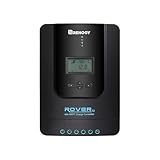
Renogy Rover 40A MPPT Charge Controller
The same controller family as the Renogy 400W kit. Renogy rates the Rover 40A for 520W of panels at 12V and 1,040W at 24V, with a 15–100V PV input range (Renogy). The listing adds a backlit LCD, DC load terminals and lithium charging; Bluetooth needs the BT-2 module, sold separately.
When we checked on November 8, 2026, Amazon listed this controller with a future availability date rather than in stock. The Renogy 400W kit above includes a Rover 40A, which is the simpler way to get one.
Our best RV solar kit guide covers roof mounting, flexible panels and the Victron controller; our 400 watt solar panel guide lists open-circuit voltages for more panels.
PWM vs MPPT Charge Controllers
Every kit here includes one of two controller types, and it is the biggest difference between a cheap kit and a good one.
PWM: a switch
A PWM controller connects the panels to the battery and pulses the connection to regulate charging, so the panels run at battery voltage. Morningstar, which makes both types, says PWM controllers work best with nominal 36-cell panels (12V-class) on a 12V battery and are often a poor fit for 60-cell panels (Morningstar). That is the setup in the Renogy 100W and 200W starter kits. The extra voltage a panel makes above battery voltage is lost.
MPPT: a converter
An MPPT controller finds the panel voltage that gives the most power and converts the surplus voltage into extra charging current. That lets you use 24V-class panels or series strings on a 12V battery, run a long cable at higher voltage, and recover more energy in cold weather, when panel voltage rises. The trade-off is cost. ECO-WORTHY’s listings claim MPPT is “40% more efficient” than PWM; ECO-WORTHY doesn’t say how that was measured, and the real gap depends on panel voltage and temperature.
Our rule: PWM is fine for a 100W–200W kit of 12V-class panels in parallel, in warm weather, on a budget. Choose MPPT at 400W and up, with 24V-class panels, for winter use, or if the panels will be wired in series. Whichever you choose, set the controller’s LiFePO4 profile to match the battery; our guide on how to charge a LiFePO4 battery lists the charge voltages battery makers publish.
What’s in the Box, and What Isn’t
“Kit” usually means the charging half of a system. From each Amazon listing (“not listed” means the listing doesn’t mention it):
| Kit | Mounting | Cables | Monitoring | Fuse | Battery | Inverter |
|---|---|---|---|---|---|---|
| Renogy 400W Premium Solar Kit (40A MPPT) | Z-brackets | Adaptor kit + tray cable | Bluetooth module | Short fuse cable (Renogy page) | No | No |
| ECO-WORTHY 400W Premium Solar Kit (40A MPPT) | Z-brackets | 16 ft cables, Y-branches | BT-02 module | Not listed | No | No |
| ECO-WORTHY 400W Complete Kit (Battery + 2000W Inverter) | Not itemized | “Other accessories” | Bluetooth module | Not listed | 2 × 12V 100Ah | 2,000W pure sine |
| ECO-WORTHY 200W Solar Kit (20A Bluetooth MPPT) | Brackets | 16.4 ft + 4.92 ft | Built-in Bluetooth | Not listed | No | No |
| Renogy 200W Solar Starter Kit (30A PWM) | Z-brackets | Adaptor kit + tray cable | None | Not listed | No | No |
| Renogy 100W Solar Starter Kit (30A PWM) | Z-brackets | Cables | Optional BT-1 (extra) | Not listed | No | No |
- Battery. A 12V 100Ah LiFePO4 is the usual partner for a 200W–400W kit. Our best 12V lithium battery guide compares BMS ratings, low-temperature charging cut-offs and size.
- Fuses and a disconnect. LiTime’s battery manual says to install an appropriate fuse or breaker close to the battery positive (LiTime manual), and Victron’s wiring guide says every circuit connected to a battery needs its own fuse in the positive cable (Victron). Most kits don’t include them. A DC breaker between the panels and the controller gives you a way to switch the array off.
- Inverter. Only if you need 120V outlets. Size it to your largest load: a 1,000W inverter covers a laptop and a fan, not a 1,200W coffee maker. Our best power inverter guide compares pure sine models.
Installing in a shed or garage rather than a vehicle? Our solar kit for a shed or garage guide covers grounding, NEC 690 and permit questions.
Series vs Parallel Wiring
Renogy’s wiring guide sums it up: in series the voltage adds and the current stays the same; in parallel the current adds and the voltage stays the same; series-parallel does both (Renogy). What that means for a kit:
| Series | Parallel | |
|---|---|---|
| Controller | MPPT only | PWM or MPPT |
| Cable to the controller | Lower current, so thinner wire or a longer run | Higher current, so thicker wire and a short run |
| Partial shade | One shaded panel drags down the string | Unshaded panels keep producing |
| Limit to check | String Voc under the controller’s max PV voltage, with cold-weather margin | Total current under the controller and connector ratings; string fusing with 3+ strings |
| Typical kit use | Two 12V-class panels per string on a 40A MPPT | All panels on the Y-branch cables most kits ship with |
Panel voltage rises as the panel gets colder, so a string that measures under the limit on a summer afternoon can exceed it on a frosty, bright morning. Leave real headroom below the controller’s maximum, and use the cold-temperature Voc from the panel maker if one is published. For a 400W kit on an MPPT controller, two strings of two (2S2P) is a common compromise: higher voltage than all-parallel, less shade loss than all-series. Our solar panel setup guide has diagrams for portable setups.
12V vs 24V for Larger Arrays
Up to about 400W, 12V is simpler: most RVs, vans and boats already run 12V lights, pumps and fans, and 12V batteries and chargers are everywhere. Past that, a 24V battery bank starts to pay off, because the same controller and the same cables carry twice the power:
| 12V bank | 24V bank | |
|---|---|---|
| Renogy Rover 40A rating | 520W of panels | 1,040W of panels |
| Victron SmartSolar 100/30 rating | 440W | 880W |
| Controller current for 1,000W | ~70A (1,000 ÷ ~14V) | ~35A (1,000 ÷ ~28V) |
| Battery current, 2,000W inverter at full load | ~170A or more | ~85A or more |
| Running 12V RV loads | Direct | Needs a 24V-to-12V converter |
Controller ratings: Renogy Rover 40A page and Victron’s SmartSolar datasheet (as cited on our RV kit guide). Current figures are our arithmetic (watts ÷ volts), before inverter losses, which push battery current higher.
Lower current means smaller cables and less voltage drop; Victron’s wiring guide notes that the higher the system voltage, the lower the voltage drop for the same power (Victron). The costs of 24V are a converter for the 12V loads, 24V versions of the battery charger and alternator charger (our DC-DC charger guide notes which models support it), and, if you build the bank from two 12V batteries in series, following the battery maker’s rules for series wiring.
Panel Kit, Single Panel or Solar Generator Kit?
Buy a panel kit (this page) if…
- You are installing panels permanently on an RV, van, boat, cabin or shed
- You want the controller, cables and brackets matched for you
- You’ll add your own 12V battery and wire it to the manuals
Buy something else if…
- You already own a controller or power station: buy panels only (400W panels)
- You want no wiring and portable power: a solar generator kit
- It is for an RV roof and you want flexible panels compared: RV solar kits
- It is for a shed or garage: our shed kit guide
Who should skip a kit altogether: renters who can’t mount anything, anyone who needs heat or air conditioning from solar, and buyers who won’t fuse and wire a battery properly or hire someone who will. If you want the battery and inverter in the same box as the panels, our DIY solar panel kit guide compares complete off-grid kits from 12V to 48V.
Solar Panel Kits by Wattage: FAQ
How much power does a 400 watt solar panel kit produce per day?
Multiply 400W by your peak sun hours and by about 0.75 for heat, angle and wiring losses. With NSRDB annual averages for a panel tilted at latitude, that is about 2,000 Wh a day in Phoenix, 1,530 Wh in Atlanta, 1,350 Wh in Chicago and 1,190 Wh in Seattle. December output is lower: about 500 Wh in Seattle and 800 Wh in Chicago. Enter your address in the free PVWatts calculator for a site-specific figure.
What will a 200 watt solar panel kit run?
At 4.5 peak sun hours a 200W kit makes about 680 Wh a day. That covers a 12V compressor fridge (Dometic publishes an 11.8W average for its CFX3 35 at 90F, about 280 Wh a day), LED lights, phone charging and a few hours of a 50W laptop. It will not run a coffee maker, microwave or space heater from solar alone, because those draw 750 to 1,500 watts.
Is a solar panel kit 100 watt enough?
For a small job, yes. A 100W kit makes roughly 300 to 500 Wh on an average day in most of the US, which keeps a 12V battery topped up for lights, phones, a fan or a Starlink Mini for part of the day (25 to 40W average on its spec sheet). It is too small to run a 12V fridge through cloudy days or a northern winter on its own. Pick a 100W kit whose controller can take more panels, such as Renogy's Wanderer 30A, so you can grow it.
What do I need for a 1000 watt solar panel kit for an RV?
A 24V battery bank or a big controller. A charge controller's rating is in amps on the battery side, so the same controller handles twice the panel watts at 24V: Renogy rates its Rover 40A for 520W at 12V and 1,040W at 24V, and Victron rates the SmartSolar 100/30 for 440W at 12V and 880W at 24V. On a 12V bank, 1,000W needs a controller of roughly 70A or more. You also need about 50 to 60 square feet of clear roof for five or six 200W panels, string fusing where strings run in parallel, and a 24V-to-12V converter if your RV's lights and pump run on 12V.
Do solar panel kits come with a battery and inverter?
Most do not. Panel kits usually include panels, a charge controller, cables and mounting brackets; the battery, inverter and most fuses are extra. Of the six kits on this page, only the ECO-WORTHY 400W complete kit includes batteries (two 12V 100Ah) and an inverter (2,000W). Plan on a 12V 100Ah LiFePO4 battery for a 200W to 400W kit, a main fuse near the battery positive, and an inverter only if you need 120V outlets.
Should I wire my solar kit panels in series or parallel?
It depends on the controller. Series adds the panels' voltage and parallel adds their current. A PWM controller holds the panels at battery voltage, so 12V-class panels on a PWM kit go in parallel. An MPPT controller can take series strings, which lowers the current in the cable to the controller and suits long runs, as long as the string's open-circuit voltage stays under the controller's limit (100V on the Rover 40A) with margin for cold mornings. Parallel holds up better when one panel is shaded.
Most RVs and vans: a 400W MPPT kit and one 12V 100Ah battery. Small jobs: 100–200W. Past 1,000W: go 24V.
Solar kit prices move often, and like other solar gear they have historically dipped during Prime Day and Black Friday events. Every price on this page loads live from Amazon.