
Brand Guide · Updated October 2026
Ryobi, DeWalt & Milwaukee Power Stations: Are Tool-Battery Power Stations Worth It?
Short answer
A Ryobi, DeWalt or Milwaukee power station is an 1,800W inverter that runs on the tool batteries you already own. It has no battery of its own. It is worth it if you already have four or more large packs and need jobsite power for tools. It is a poor buy for home backup. Four common 5Ah DeWalt packs hold only about 360 Wh, and the DeWalt DCB1800 puts out a modified sine wave that DeWalt says is not for medical or critical devices. If you don't already own the batteries, a 1 kWh LiFePO4 power station holds about three times the energy of four 5Ah packs. Compare the live prices below.
As an Amazon Associate, SolarGenAdvisor earns from qualifying purchases made through links on this page, at no additional cost to you. Ryobi products are sold through The Home Depot, and we earn nothing on them.
 By
What a Tool-Battery Power Station Actually Is
DeWalt, Milwaukee and Ryobi all sell a box that turns the cordless tool packs you already own into 120V AC power. Each one is really an inverter and charger with empty battery bays. The capacity depends entirely on which packs you slide in. A standard portable power station, like the ones in our 1000Wh guide, has a large LiFePO4 battery built in, plus solar input and usually a UPS mode.
That difference drives everything below. Tool-battery stations are quick to swap on a jobsite, because a dead pack goes on the charger and a fresh one goes in. They are quiet and emission-free indoors. They also put very little energy in a box. The math is simple: watt-hours = pack amp-hours × the pack's nominal voltage. DeWalt states its 20V MAX packs are 18V nominal (DeWalt DCB612 page). A 5Ah pack therefore holds about 90 Wh, and four of them hold about 360 Wh.
Not the Same Thing: DeWalt's Jump Starter "Power Station"
Search "DeWalt power station" and you will also find the DXAEPS14. That is a car jump starter with a 120 psi air compressor, USB ports and a small 500W inverter, all powered by its own built-in sealed lead-acid battery (ProTool Reviews; Home Depot listing). It does not take 20V MAX packs and cannot run 15A tools. This guide covers the DCB1800, the 1,800W unit that runs on tool batteries.
DeWalt Power Station (DCB1800): Specs, Battery Math and the Sine-Wave Catch
The DCB1800 is DeWalt's only tool-battery inverter in the 15A class. DeWalt rates it at 1,800W (15A) continuous and 3,600W peak from four 20V MAX packs, FLEXVOLT included. It weighs 18 lb without batteries and charges all four packs at once when plugged into the wall (DeWalt product page; DCB1800 manual; ProTool Reviews). It sells as a bare tool or in kits, and on Amazon the bare unit ships with no batteries or extension cord.
| DeWalt DCB1800 spec | Figure | Source |
|---|---|---|
| Output | 1,800W continuous (15A) / 3,600W peak | Manual, dewalt.com |
| Waveform | Modified sine wave | Manual (safety instructions) |
| Batteries needed | Four DeWalt 20V MAX packs (FLEXVOLT fit); DeWalt recommends matched 3.0Ah or larger | Manual, dewalt.com |
| AC outlets | One power-out receptacle, 15A max | Manual |
| Charging | Charges up to four packs at once from a wall outlet or generator. AC output is off while charging. | Manual |
| Solar input / USB | None listed | Manual, dewalt.com |
| Weight | 18 lb without batteries | dewalt.com |
| Warranty | 3-year limited (DeWalt) | dewalt.com |
Read this before you plug in anything sensitive
DeWalt's manual says the station "outputs a modified sine wave." It tells you to check with your device's manufacturer and not to use the station if the device won't work properly on a modified sine wave. It also says, twice, that the unit is "not intended for powering medical or other critical devices" (DCB1800 instruction manual). Do not use a DCB1800 for a CPAP, oxygen concentrator or other medical equipment. Be cautious with laptops, TVs, audio gear and variable-speed motor controls. ProTool Reviews also notes that modified sine wave can make AC motors run hotter and less efficiently (ProTool Reviews). DeWalt designed this unit for tools: the manual describes it as a professional device for "temporary power in remote situations such as jobsites."
How Many Watt-Hours Does a DeWalt Power Station Have?
None of its own. The answer depends on the four packs you load. DeWalt's manual adds a catch: you can mix pack sizes, but "the unit will default to the lowest capacity battery and the lowest charged battery." Plan your runtime around your smallest, emptiest pack.
| Packs loaded | Wh per pack (Ah × 18V) | Effective total | Usable (~85%) | Note |
|---|---|---|---|---|
| 4 × 20V MAX 2.0Ah (compact) | 36 Wh | 144 Wh | 122 Wh | DeWalt warns compact 2.0Ah-or-smaller packs may not deliver enough output for high-power use. |
| 4 × 20V MAX XR 5.0Ah (DCB205) | 90 Wh | 360 Wh | 306 Wh | The pack set in the DCB1800B + 4 × 5Ah Amazon bundle. |
| DCB1800M3T1 kit: 3 × 4.0Ah + 1 × 6.0Ah FLEXVOLT | 72 / 108 Wh | 288 Wh | 245 Wh | 324 Wh on paper, but the station defaults to the lowest-capacity pack, so plan on 4 × 72 Wh. |
| 4 × FLEXVOLT 9.0Ah | 162 Wh | 648 Wh | 551 Wh | FLEXVOLT packs work in the station at their 20V setting. |
| 4 × FLEXVOLT 12.0Ah (DCB612) | 216 Wh | 864 Wh | 734 Wh | The practical ceiling, and an expensive set of packs to buy just for backup. |
Our calculation from DeWalt's published 18V nominal voltage. DeWalt does not publish a watt-hour rating for the station itself, and tool-pack inverter efficiency isn't published either, so treat the 85% factor as an estimate.

If you already own DeWalt 20V packs · 60/100 (tool-station score)
DeWalt DCB1800B Portable Power Station
Buy the bare unit only if you already have four matched 5Ah or larger packs. In that case, the station costs less than any 1 kWh LiFePO4 power station and turns batteries you own into jobsite power. Buying it in a battery kit to use as home backup is the expensive way to get a few hundred watt-hours.
Milwaukee Power Station: MX FUEL Carry-On (and the M18 Version)
Milwaukee sells two 15A "Carry-On" power supplies, and the right one depends on which battery platform you own.
MX FUEL Carry-On (MXF002). This one runs on Milwaukee's large MX FUEL equipment packs and is the model listed on Amazon. Milwaukee rates it at 1,800 running and 3,600 peak watts of pure sine wave power. It has a 120V 15A duplex outlet, is ground-fault isolated for jobsite use, and weighs 49.7 lb (Milwaukee announcement; milwaukeetool.com). It runs on one or two packs, and a second pack doubles the runtime rather than the output. ProTool Reviews puts two XC406 packs at 864 Wh (ProTool Reviews). Milwaukee lists a 2-year machine and 2-year battery warranty on its product page. Its current kit pairs the unit with a FORGE HD12.0 pack, and milwaukeetool.com lists the older two-XC406 kit as no longer available, so check the Amazon listing to see exactly which packs ship.
M18 Carry-On (2845-20). This is the one most M18 owners actually want. Milwaukee rates it at 1,800 running and 3,600 starting watts of pure sine wave power, with a 120V 15A duplex outlet plus USB-A and USB-C PD ports. It requires four M18 batteries to operate and weighs 28 lb without them (Milwaukee M18 Carry-On announcement). The Amazon listings we found for it showed no price or buy box on Oct 31, 2026, so we don't link to them here. Buy it from an authorized Milwaukee dealer.

For MX FUEL crews · 70/100 (tool-station score)
Milwaukee MX FUEL Carry-On 3600W/1800W Power Supply
It does everything the DeWalt doesn't: pure sine wave output, a duplex outlet and ground-fault isolation. It also shares packs with Milwaukee's MX FUEL cut-off saws, breakers and light towers. As a home backup battery, though, it is heavy and expensive for about 864 Wh. Buy it if your crew already runs MX FUEL.
Ryobi Power Station: 40V and 18V ONE+ Models (Home Depot Only)
Ryobi's power stations are marked "Only at The Home Depot" and are also sold on ryobitools.com. We don't sell them or earn on them. This section is here because "Ryobi power station" is the most-searched term in this category. Both current models are sold as pure sine wave units, which is a real advantage over the DeWalt.
| Ryobi model | Batteries | Output | Ports & extras |
|---|---|---|---|
| 40V 1800-Watt Power Station (RYi1802BT; kit RYi1802B6 adds two 40V 6Ah packs) | Up to four Ryobi 40V packs | 1,800W for 3 minutes, 1,600W continuous, 3,000W starting; pure sine wave | Three 120V outlets, four USB-A, two USB-C; 23.5 lb; parallel kit sold separately |
| 18V ONE+ 1800-Watt Power Station (RYi818BT; kit adds four 6Ah packs) | Up to eight Ryobi 18V ONE+ packs | 1,800W max running; pure sine wave | Charges up to eight packs in sequence; Ryobi says you can connect a solar panel through its USB-C port |
Sources: Ryobi 40V product page, Ryobi Canada 40V spec listing, Ryobi 18V ONE+ product page, SlashGear. Ryobi's pages don't give a watt-hour rating, so check the current Home Depot listing for outlet counts and warranty before you buy.
Capacity math for Ryobi. Like DeWalt and Milwaukee, the Ryobi stations store nothing on their own. SlashGear notes the 40V model has only four battery slots against the 18V model's eight, so the 18V version can hold more total energy if you own enough packs (SlashGear). Four 40V 6Ah packs come to about 864 Wh if you assume the 36V nominal voltage typical of "40V max" packs. That is our estimate, since Ryobi doesn't publish a nominal voltage or watt-hour figure on the pages we checked, and it puts the Ryobi in the same energy class as the DeWalt and Milwaukee units. If you don't own Ryobi packs, the comparison and LiFePO4 picks below apply equally to Ryobi.
Does Craftsman Make a Power Station?
Not one comparable to these. Craftsman's battery "V20 Portable Power Station/Inverter" (CMCB1150B) is a 150W inverter that snaps onto one V20 battery and has one AC outlet, one USB-A and one USB-C port. The battery and charger are sold separately, and Craftsman lists a 3-year limited warranty (Craftsman product page; Stanley Black & Decker launch release). It handles phones, a laptop or a small fan. It cannot run a saw, a fridge or a space heater. On the Craftsman pages we checked on Oct 31, 2026, we found no 1,800W-class Craftsman tool-battery station.
Tool-Battery Station vs LiFePO4 Power Station: Side by Side
The tool stations match a 1 kWh LiFePO4 power station on running watts. Where they fall behind is stored energy per dollar, waveform (DeWalt), and the ability to keep loads running while plugged in. Prices are live from Amazon. Capacities for tool stations assume the pack set shown.
| Unit | Energy | Output / peak | Waveform | Runs loads while charging | Weight | Price |
|---|---|---|---|---|---|---|
| DeWalt DCB1800B | 0 Wh built in; 360 Wh with 4×5Ah; 864 Wh max | 1,800W / 3,600W | Modified sine | No: output is off in charger mode (manual) | 18 lb + packs | Check price at Amazon → |
| Milwaukee MX FUEL Carry-On | About 864 Wh with 2×XC406 | 1,800W / 3,600W | Pure sine | Not stated by Milwaukee | 49.7 lb | Check price at Amazon → |
| Ryobi 40V 1800W (RYi1802BT) | Depends on 40V packs (4 slots) | 1,600W cont. / 3,000W start | Pure sine | Not stated on Ryobi's page | 23.5 lb + packs | Home Depot only |
| Anker SOLIX C1000 Gen 2 (92/100) | 1,024 Wh built in (LiFePO4) | 2,000W / 3,000W | See our review | Yes, under 10 ms UPS (Amazon listing) | 24.9 lb | $529.99 Check Price → |
| Jackery Explorer 1000 V2 (93/100) | 1,070 Wh built in (LiFePO4) | 1,500W / 3,000W | Pure sine (Amazon listing) | See our review | 23 lb | $559.00 Check Price → |
| EcoFlow Delta 3 Plus (89/100) | 1,024 Wh built in (LiFePO4) | 1,800W / 2,400W | See our review | Yes, 10 ms UPS (Amazon listing) | 26 lb | $719.00 Check Price → |
| Bluetti Elite 200 V2 (91/100) | 2,074 Wh built in (LiFePO4) | 2,600W / 3,900W | See our review | See our review | 48.5 lb | $899.00 Check Price → |
Tool-station scores (DeWalt, Milwaukee) use the rubric further down this page. LiFePO4 station scores use our 6-dimension power-station matrix, so don't compare the two numbers directly.
How Long Will a DeWalt or Milwaukee Power Station Run?
Runtime = watt-hours × 0.85 ÷ load in watts. The 0.85 covers inverter and conversion losses. Tool packs also lose capacity in the cold, and DeWalt's manual says the station may not run near or below freezing until the packs warm up. Use these as planning numbers, not guarantees. For a breakdown of what common tools draw, see our job site power station guide.
| Load | DeWalt DCB1800 + 4×5Ah (360 Wh) | DeWalt DCB1800 + 4×12Ah FLEXVOLT (864 Wh) | Milwaukee MX FUEL + 2×XC406 (864 Wh) | Anker SOLIX C1000 Gen 2 (1,024 Wh) | Bluetti Elite 200 V2 (2,074 Wh) |
|---|---|---|---|---|---|
| LED work lights (~60W) | 5.1 hr | 12.2 hr | 12.2 hr | 14.5 hr | 29.4 hr |
| Full-size fridge (average draw) (~150W) | 2.0 hr | 4.9 hr | 4.9 hr | 5.8 hr | 11.8 hr |
| 15A circular saw, cutting continuously (~1,400W) | 13 min | 31 min | 31 min | 37 min | 1.3 hr |
| 1,500W space heater (~1,500W) | 12 min | 29 min | 29 min | 35 min | 1.2 hr |
Saws and drills run in short bursts, so a day of trim work uses far less energy than the "cutting continuously" row suggests. That is why tool stations make sense on a jobsite. Backup at home is different. A fridge, furnace blower or space heater draws power for hours, and a few hundred watt-hours of tool packs runs out fast. For outage planning, start with our winter storm backup guide and the what can a solar generator run load list.
If You Don't Already Own the Batteries: Buy a LiFePO4 Power Station Instead
Buying a tool station in a battery kit pays tool-battery prices for every watt-hour. A LiFePO4 power station packs its energy into one battery built for the job. It typically lasts thousands of cycles (see our LiFePO4 guide), charges from solar, and on many models doubles as a UPS. At $529.99 on Amazon right now, the Anker SOLIX C1000 Gen 2 holds more energy than a DeWalt station with four 12Ah FLEXVOLT packs. These four are already scored on our site:
Best if you own no packs · 92/100
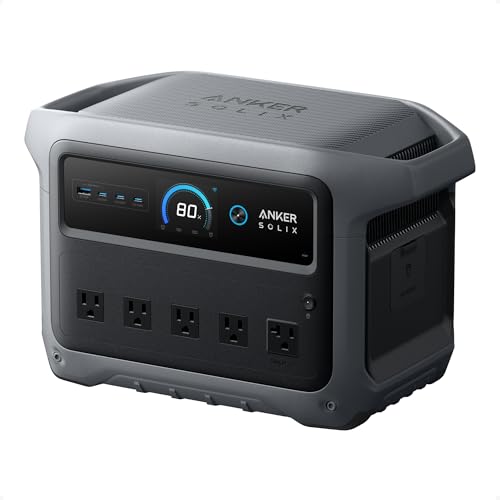
1,024 Wh · 2,000W (3,000W peak) · 24.9 lb · 600W solar
Current price on Amazon: $529.99
It stores 1,024 Wh in its own LiFePO4 battery and puts out 2,000W (3,000W peak). That is more energy than a DeWalt station loaded with four 12Ah FLEXVOLT packs, and the Amazon listing claims a full recharge in 49 minutes. Anker also lists a sub-10 ms UPS switchover, so it can stay plugged in and take over when the grid drops. The DeWalt cannot do that.
Lightest 1 kWh option · 93/100

1,070 Wh · 1,500W (3,000W peak) · 23 lb · 400W solar
Current price on Amazon: $559.00
1,070 Wh and 1,500W in a 23 lb box, with three pure sine wave AC outlets per the Amazon listing. It fits crews and homeowners who want one unit for the truck, the campsite and an outage, with no tool platform involved.
Most solar input · 89/100

1,024 Wh · 1,800W (2,400W peak) · 26 lb · 1,000W solar
Current price on Amazon: $719.00
1,024 Wh and 1,800W continuous, which matches the tool stations' running output. It adds 1,000W of solar input and a 10 ms UPS mode listed on Amazon. It also expands to about 3 kWh with an add-on battery, a growth path no tool-pack station offers.
Most energy per dollar · 91/100

2,074 Wh · 2,600W (3,900W peak) · 48.5 lb · 1,200W solar
Current price on Amazon: $899.00
With 2,073.6 Wh and 2,600W (3,900W lifting power), it holds well over twice the energy of a Milwaukee MX FUEL Carry-On with two XC406 packs, and it charges from solar. It weighs about 48.5 lb, close to the Carry-On's 49.7 lb.
Still weighing a gas generator for the jobsite? See solar generator vs gas generator. Need a station that catches outages for a desk setup? See power station vs UPS.
Who Should Buy a Tool-Battery Power Station, and Who Should Skip It
Buy one if…
- You already own four or more 5Ah-plus packs on one platform and need 15A tool power where there's no outlet.
- You work indoors or in occupied buildings where a gas generator's fumes and noise aren't acceptable.
- You want packs that rotate between the station, the charger and your tools all day.
- You're on Milwaukee MX FUEL or Ryobi and want pure sine wave output.
Skip it if…
- You'd have to buy the batteries. A LiFePO4 station gives more watt-hours per dollar.
- You need power for a CPAP or other medical device. DeWalt's manual rules the DCB1800 out.
- You want backup that switches over automatically. The DeWalt can't run loads while plugged in.
- You want to recharge from solar. None of the DeWalt or Milwaukee units lists a solar input.
Pros
- 1,800W running and 3,000–3,600W peak, enough for most 15A tools
- Uses batteries you already own, so the bare unit is the only cost
- Doubles as a multi-pack charger
- No fumes or pull-start
Cons
- No built-in battery, and typical pack sets hold 300–900 Wh
- DeWalt: modified sine wave, no pass-through, one receptacle
- Milwaukee MX FUEL: about 50 lb and expensive
- Locked to one tool brand's battery platform
How We Score Tool-Battery Stations
Our 6-dimension power-station matrix assumes a built-in battery, so it doesn't fit these units. We use a separate rubric instead. The scores are AI-synthesized from manufacturer specs and manuals, published third-party figures, logged Amazon prices and Amazon customer reviews. We did not test these units. We score Ryobi only in text because it isn't sold on Amazon.
| Dimension | Weight | DeWalt DCB1800B | Milwaukee MX FUEL Carry-On |
|---|---|---|---|
| Output & surge | 20% | 85 | 85 |
| Waveform & device compatibility | 20% | 40 | 90 |
| Cost per watt-hour (with packs) | 20% | 55 | 50 |
| Usable energy ceiling | 15% | 60 | 75 |
| Portability | 10% | 85 | 50 |
| Charging & convenience | 15% | 45 | 60 |
| Weighted score | 100% | 60/100 | 70/100 |
Why the gap: the DeWalt loses most of its points on waveform (modified sine, with no medical or critical devices per its manual) and convenience (no pass-through, no USB, one receptacle). The Milwaukee loses points on weight and price per watt-hour.
Tool-Battery Power Station FAQ
Is the DeWalt power station pure sine wave?
No. DeWalt's DCB1800 manual says the unit outputs a modified sine wave. It tells owners to check with the device manufacturer and not to use the station with anything that will not work properly on a modified sine wave. Milwaukee's MX FUEL Carry-On and both Ryobi 1,800W stations are sold as pure sine wave.
Can the DeWalt DCB1800 power station run a CPAP?
DeWalt says not to. The DCB1800 manual states it is not intended for powering medical or other critical devices, and its output is a modified sine wave. For a CPAP, use a pure sine wave LiFePO4 power station and follow our CPAP power guide.
Can a DeWalt power station run a refrigerator?
It can start one, because it has 3,600W of peak power, but it will not run it for long. Four 5Ah packs hold about 360 Wh. At a 150W average fridge draw that is roughly 2 hours (360 x 0.85 / 150). DeWalt's manual also says to check the appliance maker on modified sine wave compatibility. For outage duty, a 1 kWh LiFePO4 station runs the same fridge for about 5 to 6 hours. See can a solar generator run a refrigerator.
How long does a DeWalt power station last on one charge?
It depends on the packs. DeWalt 20V MAX packs are 18V nominal, so watt-hours equal amp-hours times 18. Four 5Ah packs give about 360 Wh, and four 12Ah FLEXVOLT packs give about 864 Wh. Multiply by about 0.85 and divide by your load in watts to get hours. The station uses the smallest pack's capacity if you mix sizes.
Can I buy a Ryobi power station on Amazon?
Ryobi lists its 40V and 18V ONE+ 1,800W power stations as "Only at The Home Depot," and also sells them through ryobitools.com. We do not link to any Amazon listing for them. If you do not already own Ryobi batteries, compare them against a LiFePO4 power station with a built-in battery.
Is the Milwaukee MX FUEL Carry-On worth it?
It is worth it for crews already running MX FUEL equipment who need pure sine wave, ground-fault-isolated 15A power that swaps packs with their other tools. For backup at home it is a poor value. It weighs about 50 lb, two XC406 packs hold about 864 Wh, and a 2 kWh LiFePO4 station of similar weight holds more than twice that at a lower cost per watt-hour.
Does Craftsman make a power station?
Not in the 1,800W class. Craftsman's battery "Portable Power Station/Inverter" (CMCB1150B) is a 150W inverter that snaps onto a V20 battery and has one AC outlet, one USB-A port and one USB-C port. It is useful for charging phones and running a small fan, but it cannot run power tools or appliances.
Is the DeWalt jump starter the same as the DeWalt power station?
No. The DXAEPS14 is a car jump starter with an air compressor, USB ports and a small 500W inverter, powered by its own built-in sealed lead-acid battery. The DCB1800 is an 1,800W inverter with no built-in battery that runs on four DeWalt 20V MAX or FLEXVOLT tool packs.
Own the packs? Get the station. Don't own them? Get a LiFePO4 power station.
Check live prices on the two paths, and compare more options in our best 1000Wh power stations guide.