
RV Electrical Basics · Updated November 2026
RV Converter vs Inverter: What Each Does and Which You Need
The short answers
- Converter
- Turns 120V AC from shore power or a generator into 12V DC. It runs the RV’s 12V lights, pump and fans and charges the house battery. Almost every RV has one [1][2].
- Inverter
- Does the opposite: turns 12V battery power into 120V AC so outlets and a microwave work with no hookup. Many RVs don’t have one, or have a small one wired only to the fridge [1][2].
- Inverter charger
- One box that does both jobs and switches between shore and battery power on its own [13][2].
- Which you need
- Plugged in at campgrounds: the converter you already have. Boondocking with AC loads: add an inverter, or carry a power station.
Jump to what runs on 12V vs 120V, how big an inverter you need or inverters, chargers and stations.
As an Amazon Associate, SolarGenAdvisor earns from qualifying purchases made through links on this page, at no additional cost to you.
 By
Converter vs Inverter at a Glance
An RV has two electrical systems: a 12-volt DC system like a car’s and a 120-volt AC system like a house’s. Keystone’s owner’s manual puts it in one line: an inverter “does just the opposite of a Converter” [1]. Winnebago’s manual describes the same two systems and the same two boxes [2].
| Converter | Inverter | Inverter charger | |
|---|---|---|---|
| Converts | 120V AC → 12V DC | 12V DC → 120V AC | Both directions |
| Works when | Plugged in, or the generator is running | Any time the battery has charge | Always; switches source automatically |
| Runs | 12V lights, water pump, fans, appliance controls | The outlets it is wired to, a microwave, a residential fridge | Both, plus pass-through shore power |
| Charges the battery? | Yes, on shore or generator power | No, it drains the battery | Yes, on shore or generator power |
| Typical location | Inside the power center, with the breakers and fuses | Its own compartment, near the battery | Its own compartment, near the battery |
| Standard on most RVs? | Yes | “If equipped” [1] | On some motorhomes and vans, such as Winnebago’s Ekko [2] |
What an RV Converter Does
A converter is the RV’s built-in power supply and battery charger. Keystone lists three jobs for its power center/converter once the RV is connected to shore power or a generator [1]:
- Power distribution: incoming power goes out through the 120V breakers and 12V fuses in the power center.
- Converting 120V to 12V: it runs the 12V side so you don’t use up the battery.
- Battery charging: it charges the house battery whenever the RV is plugged in.
Winnebago’s manual says the same: on shore power or the generator, everything normally powered by the house batteries “is then powered through the converter” [2]. The converter feeds RV loads first and the battery gets what is left, WFCO says, so switching loads off charges the battery faster [4].
How a converter charges
- WFCO: 13.6V “absorption” is the normal mode. When a low battery pulls the converter’s full current, it switches to a 14.4V bulk mode until current falls to about 5 amps or four hours pass, then returns to 13.6V. After about 44 hours with no significant change in load it drops to a 13.2V float [3][4].
- Progressive Dynamics Charge Wizard: 14.4V boost, 13.6V normal and 13.2V storage, with a 14.4V equalizing boost of about 15 minutes every 21 hours while in storage mode [5].
Converter ratings are DC amps, not hookup amps. WFCO’s WF-8935, for example, is rated 35A [3], which would put back 80Ah in about 2.3 hours with a lithium profile (our arithmetic, before loads). On the 120V side the converter is also a load: Keystone says it draws an additional 5–13 amps from the pedestal depending on the 12V load [1]. Our guide to how to keep an RV battery charged covers every other charging route.
What an RV Inverter Does
An inverter takes 12V DC from the house battery and makes 120V AC. Keystone says it “will allow you to use some 120 volt items from battery power,” and warns that off-grid you “will have to be selective” about what you run [1]. Winnebago describes its Ekko’s inverter the same way: 12V DC from the house batteries into 120V AC for the motorhome’s 120V equipment [2].
Two things catch new owners out:
- It may only feed a few outlets. Keystone says an inverter gives 120V power “to a specific number of outlets depending on your unit’s design” [1]. On RVs with a residential fridge, the factory inverter may be there just for the fridge: Keystone says its residential fridges come with an inverter sized for that job, its built-in outlet should not be used for anything else, and a fully charged deep-cycle battery can generally run the fridge for about 12 hours.
- It uses power while switched on. Renogy lists its Pro 2000W’s idle draw as under 9.6W [16]; left on all day that is up to about 230 Wh, close to a fifth of a 100Ah lithium battery (our arithmetic). Keystone and Winnebago both say to turn the inverter off when you aren’t using it [1][2].
Pure sine vs modified sine
A pure sine inverter makes AC shaped like grid power. A modified sine inverter approximates it with a stepped wave. Samlex, which makes both, says dimmers and motor speed controls may not work properly on modified sine, appliance clocks may not keep time, and motors and microwaves run hotter, while on pure sine they “run faster, quieter and cooler” [11]. Xantrex calls pure sine ideal for laptops, microwaves, medical devices and LED TVs, and says modified sine can cause buzzing or overheating in sensitive equipment [12]. Progressive Dynamics says pure sine suits “all types of loads including refrigerators, motors, power tools” [10]. For an RV, buy pure sine; every inverter on this page is. For a CPAP, follow the device maker’s power guidance. More detail is in our best power inverter guide.
What Runs on 12V vs 120V in an RV
This is the question that decides whether you need an inverter. Keystone says “almost all equipment except the microwave and roof air conditioner operate using 12 volt” [1]. Winnebago lists the air conditioner, microwave and anything plugged into the 120V outlets as “entirely dependent on 120-volt current” [2]. So with no hookup and no inverter, the 12V side still works from the battery; the outlets, microwave and AC don’t.
12V DC: battery, or the converter when plugged in
- Interior lights
- Water pump
- Range hood fan and light (Keystone)
- Controls and ignition for LP appliances: Keystone notes an LP-gas fridge needs 12V to light
- 12V compressor fridges, where fitted
Exactly which circuits are 12V varies by RV; your owner’s manual and the fuse labels in the power center are the authority [1].
120V AC: shore power, generator, or an inverter
- Roof air conditioner: Keystone says most draw up to 15 amps
- Microwave: about 10 amps, per Keystone
- Wall outlets (coffee maker, hair dryer, TV, laptop chargers)
- A residential fridge, and the electric mode of fridges and water heaters that have one
- The converter itself
Amp figures from Keystone’s manual [1]. At 120V, 10 amps is about 1,200W.
If your 120V wish list is short (a laptop, a TV, a CPAP), a small inverter or a power station is plenty. If it includes the microwave or a coffee maker, size for those. The roof AC is the hard one; see the AC FAQ below and our best generator for RV guide.
Inverter Chargers and Transfer Switches
An inverter charger replaces both boxes. Victron describes its MultiPlus as “a powerful true sine wave inverter, a sophisticated battery charger … and a high-speed AC transfer switch in a single compact enclosure” [13][14]. When shore or generator power disappears it takes over the loads in under 20 milliseconds, which Victron says is fast enough that computers keep running [13]. For scale, the 12V MultiPlus 12/2000/80 is rated 1,600W continuous at 25 °C, charges at up to 80A and passes through up to 50A on its transfer switch [13][14]. Victron’s PowerAssist feature also tops up a weak pedestal or small generator from the battery during short peaks [13][14].
Winnebago fits a 2,000W pure sine inverter/charger in its Ekko. On 120V external power it recharges the house batteries with a three-stage charger and supplies the 12V equipment, the job a converter does in other RVs [2].
The transfer switch
Any RV with both shore power and an inverter needs something that picks one source, so they are never connected together. It can be built into the inverter or separate:
- Keystone says the residential-fridge inverter is wired to a transfer switch, internal on some models, that “defaults to shore power when available” [1].
- Progressive Dynamics’ PD1200 inverter has an automatic transfer switch built in, with a transfer time under 50 ms and 15A of pass-through [10].
- Winnebago’s automatic power transfer switch moves the coach to the generator about 30 seconds after it starts, so the generator starts without load [2].
One layout detail matters. In Progressive Dynamics’ RV wiring diagrams for the PD1200, the converter sits on the main panel’s “shore/generator only” circuits, while the inverter feeds a sub-panel of selected outlets [10]. That keeps the inverter from running the converter, which would just turn battery power back into battery charging with losses each way. The same guide warns never to connect any AC source to the inverter’s AC output [10].
How to Size an RV Inverter
Two numbers set the size: continuous watts (everything you’ll run at once) and surge watts (the biggest start-up). Generator charts use the same rule: add the highest starting watts to the total running watts [25]. Then check the battery can deliver the current.
- Add the input watts of everything you’ll run at the same time. Use the label’s input rating, not the cooking or output power: a microwave sold as 1,100–1,200W cooking lists 1,480–1,500W input, and GE rates one over-the-range model at 1.58 kW [22][23][24].
- Add the largest surge. Compressor fridges and pumps need a short burst to start. Check the inverter’s surge figure and how long it lasts: Renogy lists 4,000W for 150 ms on its Pro 2000W, Giandel 6,100W for 2 seconds on its 3000W [16][17].
- Pick the next size up, then work out the battery current:
The 0.9 is a planning figure: makers list peak efficiencies of 90% (Progressive Dynamics PD1200), over 91% (Giandel), up to 92% (Renogy Pro) and 92–93% (Victron MultiPlus 12V) [10][17][16][13]. The 0.85 runtime factor is our site-wide allowance for losses, not a measured figure. To convert other loads, use the watts to amps calculator.
| Inverter load | Battery current at 12V | Runtime on one 100Ah LiFePO4 (1,280 Wh) | What it covers |
|---|---|---|---|
| 300 W | ~28 A | ~3.6 h | Laptop, TV, phone and camera chargers |
| 1,000 W | ~93 A | ~65 min | Laptops, TV and a small kitchen load up to about 1,000W; about the limit of one 100Ah battery with a 100A BMS |
| 1,500 W | ~139 A | ~44 minAbove a 100A BMS: needs a bigger battery or bank | A full-size microwave (1,480–1,580W input on the labels below) |
| 2,000 W | ~185 A | ~33 minAbove a 100A BMS: needs a bigger battery or bank | Microwave plus a few small loads; needs a battery or bank rated 200A |
| 3,000 W | ~278 A | ~22 minAbove a 100A BMS: needs a bigger battery or bank | Two kitchen loads at once; needs about 280A of battery current and heavy cable |
Our arithmetic. Runtime is for a continuous load; a microwave or coffee maker runs for minutes, so the real limit for kitchen loads is usually the battery’s current rating, not its capacity. Check your battery’s continuous BMS rating: a 100A BMS covers roughly a 1,000W inverter at full load.
Worked example: a microwave with a 1,500W input label [22] pulls about 139A from a 12V battery. One 100Ah battery with a 100A BMS will shut it off, even though 10 minutes of heating uses only about 294 Wh. A 2,000W inverter on a battery or bank rated 200A handles it. Our best LiFePO4 battery for RV guide lists BMS ratings for each pick.
Wiring and Fusing: Have It Installed
A 2,000W inverter moves close to 200 amps on its battery cables, and a converter or inverter charger lives inside the RV’s 120V distribution panel. This is the place to hire a qualified RV technician or electrician. What the makers say:
- Use the manual’s cable and fuse sizes. Victron says all its manuals give the DC battery cable size and fuse size for the product, that the fuse goes in the positive cable, and that a DC system should always contain a main fuse. It says a cable that is too thin hurts performance and makes heat [15].
- Protect the AC side too. Progressive Dynamics says hard-wired AC input and output must have properly sized fuses or breakers, and that all wiring must follow local and national electrical codes [10].
- Converter work is panel work. WFCO’s manual says its converters should be installed and serviced by a certified or licensed electrician [3].
- Never backfeed. No AC source (generator or shore power) should ever connect to an inverter’s output [10]. That is the transfer switch’s job.
Plug-in inverters for a 12V socket are a different case: a vehicle socket is a small fused circuit, so they suit laptops and phone chargers only. Our power inverter guide covers socket limits.
Upgrading to Lithium: Check the Converter
The converter, not the inverter, is what usually needs attention when you swap to LiFePO4. Battle Born recommends a 14.4V bulk and absorption charge for its LiFePO4 batteries (14.2–14.6V range) [8]. A lead-acid converter spends most of its time at 13.6V and only goes to 14.4V while the current is maxed out, for no more than four hours on WFCO’s design [3]. Keystone’s manual says that if the converter doesn’t support lithium, the maximum charge a lithium battery can receive is approximately 80% [1].
Three fixes:
- Use a lithium setting. Keystone says some of its power centers have a DIP switch or auto-detect for lithium [1]. WFCO’s auto-detect (-AD) converters boost to 14.6V for one to four hours for lithium, then hold 13.6V [3].
- Swap the converter. Progressive Dynamics’ two-stage lithium models charge at 14.4V, then idle at 13.6V [6], and it says it can supply lithium models to replace most lead-acid converters in the field [7]. A technician does this one.
- Add a plug-in LiFePO4 charger and leave the converter alone, like the 14.6V chargers below. Plug it into an outlet when you need a full charge.
If you also fit a bigger inverter, size the new battery bank to its current (see the table above), and check that the inverter has a lithium setting or a low-voltage cutoff that suits your battery’s BMS. Giandel, for example, lists a LiFePO4 battery-type setting on its 3000W [17]. Battery picks are in our RV LiFePO4 battery guide.
Campervan Builds: Inverter First
Vans are usually wired the other way round. They spend more time off-grid than plugged in, so the inverter matters more than a converter, and the battery is charged mostly by solar and the engine. Winnebago’s Ekko shows the pattern: a 2,000W pure sine inverter/charger handles both 120V output and shore charging, and Winnebago notes the inverter can be used while driving because the alternator charges the batteries [2].
- Driving: for a lithium house battery, Battle Born calls a DC-DC charger the best alternator charging solution for most vehicles, because it limits current, applies a lithium profile and protects the alternator and wiring [9]. See our best DC-DC charger guide.
- Parked: roof solar and a charge controller.
- Plugged in: an inverter charger, or a simple LiFePO4 charger on a shore inlet.
- Inverter size: 1,000W covers laptops, a TV and small kitchen gear on one 100Ah battery; go to 2,000W only if you’ll run a microwave or kettle, and size the battery to match.
Keep 12V loads on 12V. A fan, lights and a 12V compressor fridge running straight from the battery skip the inverter’s losses and its idle draw.
Power Station: The Plug-and-Play Alternative
A portable power station is a battery, a pure sine inverter and a charger in one box, with no cables to size and nothing to fuse. It suits renters, short trips and anyone who doesn’t want to open the power center. There are two ways to use one in an RV:
- Plug devices into it directly. The Anker SOLIX C1000 Gen 2 has 1,024 Wh and 2,000W of output [29], so it can run a microwave for short bursts, a laptop and a CPAP. The RV’s 12V system stays on the house battery.
- Plug the RV into it. A station with a TT-30 outlet, such as the Jackery HomePower 3000, takes the 30 amp shore cord like a pedestal [31][32]. The RV’s outlets work and the converter charges the house battery, though that converter charging uses station energy you might want for other loads.
The trade-offs: it holds only its own capacity unless it is expandable, it has to be recharged separately, and a large one is heavy (the HomePower 3000 is 59.5 lb). Our best solar generators for RVs roundup compares the options.
Inverters, Chargers and Stations for RVs
Grouped by the job they do. Specs come from our product database, cross-checked against the maker pages cited. Inverters and chargers are scored on their own category rubrics and stations on our power-station matrix, so compare scores only within a group.
Inverters (12V DC to 120V AC)
Inverter for a Microwave or Coffee Maker

Renogy Pro 2000W Pure Sine Wave Inverter with Bluetooth · Our score 78/100
12V DC · 2,000W continuous · 4,000W peak · pure sine [16]
2,000W pure sine with GFCI outlets and an AC terminal block for hardwiring to an inverter sub-panel. Renogy lists an idle draw under 9.6W and up to 92% efficiency, the lowest idle figure of the inverters here. By our math it pulls about 185A from a 12V bank at full load.
Skip it if: Your battery is one 100Ah unit with a 100A BMS (that covers about 1,000W), or you want shore charging too; it has no charger or transfer switch.
Biggest 12V Loads
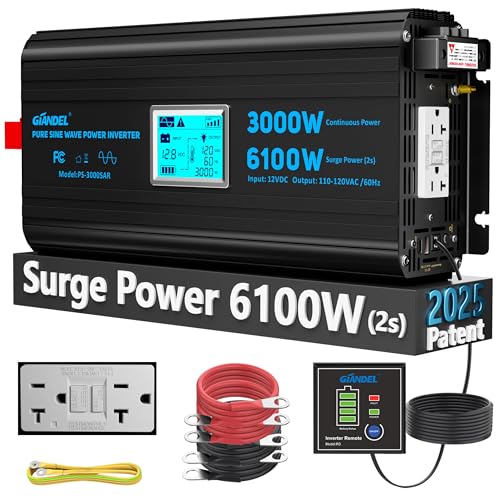
Giandel 3000W Pure Sine Wave Inverter (PS-3000SAR) · Our score 76/100
12V DC (9.8-16V) · 3,000W continuous · 6,100W peak · pure sine [17]
3,000W continuous and a 6,100W surge for 2 seconds, per Giandel, with two GFCI outlets, a hardwire terminal and a LiFePO4 battery-type setting. The two-second surge is longer than most 12V inverters list.
Skip it if: You can’t feed about 278A at full load (our math), or the inverter will sit on all day: Giandel lists 0.9–2.5A standby, roughly 11–30W.
Inverter Charger (Replaces Converter + Inverter)
All-in-One for Shore Power and Generators

Renogy REGO 12V 3000W Pure Sine Wave Inverter Charger
12V DC · 3,000W continuous · 9,000W peak · pure sine [18][19]
One box that inverts (3,000W pure sine, 9,000W surge), charges the bank when shore or generator power is connected, and switches loads over automatically through a 30A transfer switch in about 10 ms, per Renogy. Bluetooth is built in.
Skip it if: You only need AC outlets on battery, or you don’t want to rewire the RV’s 120V panel: this is a professional install, and at 3,000W it pulls about 278A from 12V (our math).
LiFePO4 Chargers (Converter Upgrade Without Rewiring)
Fast 14.6V Top-Up on Shore Power

Power Queen 12V 20A LiFePO4 Battery Charger (14.6V) · Our score 81/100
20A · 14.6V CC/CV, 2-stage (no float stage listed) [20]
Price on Amazon: $67.99
A 14.6V, 20-amp CC/CV charger for 12V LiFePO4 batteries. Plug it into an outlet on shore power or a generator when a lead-acid converter won’t fill a lithium battery. 20A puts back 80Ah in about 4 hours (our math), and its Pre-Charge mode can wake a battery whose BMS has shut off at 0V.
Skip it if: It has to live in a wet bay: Power Queen publishes no water rating.
Sealed Maintainer for Storage
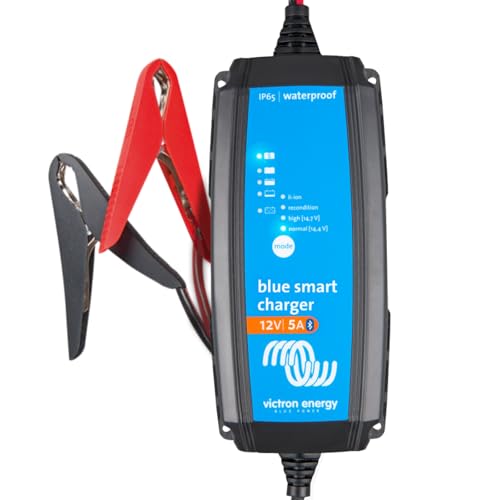
Victron Blue Smart IP65 12/5 Charger (12V 5A) · Our score 78/100
5A · Li-ion: 14.2V absorption, 13.5V float, 13.5V storage (Victron manual) [21]
IP65-sealed with Bluetooth and a Li-ion mode (14.2V absorption, 13.5V float) per Victron’s manual; it starts from 0V and also has lead-acid modes. Good for keeping a battery topped up in storage.
Skip it if: You want fast charging: 5 amps takes about 20 hours to refill a 100Ah battery.
Power Stations (No Install)
Van or Small Camper

Anker SOLIX C1000 Gen 2 · Our score 92/100
1,024 Wh · 2,000W continuous · 3,000W surge · 24.9 lb [29][30]
Price on Amazon: $469.99
Battery, 2,000W pure sine inverter and charger in one 24.9 lb box: no wiring, no fuses. It covers a 1,500W microwave for short runs, and Anker lists a 10 ms UPS switchover, so it can sit between an outlet and a CPAP or fridge.
Skip it if: You want the RV’s own outlets to run from it, or you need more than about 1 kWh a day.
30 Amp Trailer (TT-30 Outlet)

Jackery HomePower 3000 · Our score 87/100
3,072 Wh · 3,600W continuous · 7,200W surge · 59.5 lb [31][32]
3,072 Wh and 3,600W through a TT-30 outlet, so the RV’s 30 amp shore cord plugs straight in and the coach’s outlets, converter and battery charging run as if on a pedestal. Its 7,200W surge also covers a rooftop AC start on the published figures.
Skip it if: You need to carry it often (59.5 lb) or add batteries later; it cannot be expanded.
Side by side
| Product | Type | Charges battery on shore? | Install | Price | Link |
|---|---|---|---|---|---|
| Renogy Pro 2000W Pure Sine Wave Inverter with Bluetooth | 2,000W inverter | No | Hardwired to battery | Check price at Amazon → | View on Amazon → |
| Giandel 3000W Pure Sine Wave Inverter (PS-3000SAR) | 3,000W inverter | No | Hardwired to battery | Check price at Amazon → | View on Amazon → |
| Renogy REGO 12V 3000W Pure Sine Wave Inverter Charger | 3,000W inverter charger | Yes | Battery + 120V panel | Check price at Amazon → | View on Amazon → |
| Power Queen 12V 20A LiFePO4 Battery Charger (14.6V) | 20A LiFePO4 charger | Yes (plug-in) | None | $67.99 | View on Amazon → |
| Victron Blue Smart IP65 12/5 Charger (12V 5A) | 5A charger / maintainer | Yes (plug-in) | None | Check price at Amazon → | View on Amazon → |
| Anker SOLIX C1000 Gen 2 | 1 kWh power station | Its own battery | None | $469.99 | View on Amazon → |
| Jackery HomePower 3000 | 3 kWh station, TT-30 | Its own battery; RV via converter | None | Check price at Amazon → | View on Amazon → |
Want the full Renogy lineup, including 1000W models and a second inverter charger? See the Renogy inverter guide.
Verdict: Which One You Need
You already have a converter, and if you camp with hookups it is all you need: it runs the 12V side and charges the battery. Add an inverter when you want 120V outlets or the microwave on battery power, sized to your biggest load and matched to a battery that can supply the current. Choose an inverter charger if you are rewiring anyway and want shore charging and automatic switchover in one box. For a microwave, the Renogy Pro 2000W Pure Sine Wave Inverter with Bluetooth (our score 78/100) is the inverter we’d start with. It has the lowest idle draw of the inverters here. Going lithium on a lead-acid converter? A 14.6V charger such as the Power Queen 12V 20A LiFePO4 Battery Charger (14.6V) (81/100) fills the gap with no rewiring. If you’d rather not touch the wiring at all, a power station such as the Anker SOLIX C1000 Gen 2 does the inverter’s job from a box you carry in.
RV Converter and Inverter FAQ
What is the difference between an RV converter and an inverter?
Direction. A converter changes 120V AC from shore power or a generator into 12V DC, running the RV's 12V lights, pump and fans and charging the house battery. An inverter changes 12V DC from the battery into 120V AC so outlets and a microwave work with no hookup. Keystone's owner's manual says an inverter does just the opposite of a converter.
Does my RV have an inverter?
Nearly every RV with shore power has a converter or an inverter charger, but a plain inverter is usually optional. Check the owner's manual and look for an inverter switch or remote panel and a separate box near the battery. RVs with a residential fridge often have a small inverter wired only to the fridge through a transfer switch, per Keystone. If the outlets go dead when you unplug, there is no inverter feeding them.
Do I need an inverter in my RV?
Only if you want 120V power without a hookup or generator. Keystone says almost all RV equipment except the microwave and roof air conditioner runs on 12V, so lights, the water pump and fans work from the battery with no inverter. If you want the outlets, a microwave or a coffee maker while boondocking, add an inverter or carry a portable power station.
What size inverter do I need to run an RV microwave?
Usually 2,000W. Use the microwave's input rating, not its cooking power: models sold as 1,100 to 1,200W cooking list 1,480 to 1,500W input, and one GE over-the-range model is rated 1.58 kW. At 1,500W the inverter pulls about 139A from a 12V battery (watts ÷ 12 ÷ 0.9), which is more than a single 100A-BMS battery supplies, so plan on a battery or bank rated 200A.
Does an inverter charge the RV battery?
A plain inverter does not; it only drains the battery. An inverter charger does both: Victron's MultiPlus, for example, combines an inverter, a battery charger and an AC transfer switch, charging the battery on shore or generator power and taking over the loads in under 20 milliseconds when that power drops. In a standard RV, the converter charges the battery when you are plugged in.
Can an inverter run my RV air conditioner?
Only with a large inverter and battery bank. A 13,500 BTU rooftop unit runs at roughly 1,300 to 1,600W, and published starting figures run from about 2,800W (Micro-Air) to about 3,800W (etrailer). At 1,500W, a 12V system supplies about 139A for as long as the AC runs, so even a large bank lasts only hours. Most owners use shore power, a generator, or a large power station for air conditioning.
Will my RV converter charge a lithium battery?
It will charge it, but a lead-acid converter usually won't fill it. Battle Born recommends 14.4V (14.2 to 14.6V) for LiFePO4, while a WFCO lead-acid converter mostly holds 13.6V, and Keystone's manual says a lithium battery on a converter without lithium support reaches only about 80%. Use a converter's lithium setting if it has one, have a lithium-profile converter installed, or plug in a 14.6V LiFePO4 charger.
Should I leave my RV inverter on all the time?
No. An inverter uses power just by being on: Renogy lists under 9.6W idle for its Pro 2000W, which is up to about 230 Wh a day, and Giandel lists 0.9 to 2.5A standby for its 3000W. Keystone and Winnebago both say to turn the inverter off when it isn't in use. The exception is a factory inverter that powers a residential fridge while you travel.
Do I need a pure sine wave inverter for an RV?
Yes, for most RV use. Samlex says modified sine output can stop dimmers and motor speed controls working properly and makes motors and microwaves run hotter, and Xantrex recommends pure sine for laptops, microwaves, medical devices and LED TVs. Pure sine inverters are widely available at every size, and every inverter on this page is pure sine.
Is a portable power station better than installing an inverter?
It is simpler, not always better. A power station packs a battery, inverter and charger in one box with no cables or fuses to size, so it suits renters, short trips and vans. An installed inverter can be matched to a larger house battery bank and can feed the RV's own outlets. A station with a TT-30 outlet can also take the RV's 30 amp shore cord directly.
Sources
RV system descriptions come from Keystone’s and Winnebago’s owner’s manuals; converter charging figures from WFCO and Progressive Dynamics; inverter, inverter-charger and wiring guidance from Progressive Dynamics, Victron, Samlex and Xantrex; product specs from our product database, cross-checked against the maker and retailer pages listed. Amp draws, runtimes and charge times are our arithmetic on those figures. Nothing here was measured by us. Last reviewed November 18, 2026.
- Keystone RV, 2027 Owner’s Manual, ch. 8 Electrical System: 12V and 120V systems, power center/converter, inverter, residential-fridge inverter and transfer switch, lithium note, amp draws
- Winnebago, 2024 Ekko Operator’s Manual, Section 6 Electrical: converter, 120V-only equipment, 2000W pure sine inverter/charger, automatic power transfer switch
- WFCO, WF-8900-AD Series power converter operator’s manual (Forest River copy): charge modes, auto-detect lithium mode, WF-8935 35A rating, installation by a certified or licensed electrician
- WFCO, Converter FAQ: loads are supplied before the battery; open fuse or disconnect switch as a cause of no charging
- Progressive Dynamics, Charge Wizard: 14.4V boost, 13.6V normal, 13.2V storage modes
- Progressive Dynamics, Two-stage lithium converter technical sheet (14.4V charge, 13.6V idle)
- Progressive Dynamics, Lithium battery chargers (lithium converter models to replace most lead-acid units)
- Battle Born Batteries, Charging Battle Born LiFePO4 batteries (14.4V bulk/absorption; 14.2–14.6V range)
- Battle Born Batteries, Alternator charging RV lithium batteries (DC-DC charger recommendation)
- Progressive Dynamics, PD1200 Series pure sine wave inverter installation and operation guide (Forest River copy): 1,000W continuous, 2,000W peak, integrated transfer switch under 50 ms, 15A pass-through, 50A RV wiring diagram
- Samlex America, Pure sine wave versus modified sine wave inverters (FAQ)
- Xantrex, Choosing the right inverter for your RV: pure sine vs. modified sine
- Victron Energy, MultiPlus inverter/chargers 2 kVA and 3 kVA 120V datasheet: inverter + adaptive charger + AC transfer switch, takeover in under 20 ms, PowerAssist, 12/2000/80 specs
- Victron Energy, MultiPlus Inverter/Charger 2000VA 120V datasheet: 12/2000/80-50, 1,600W at 25 °C, 80A charger, 50A transfer switch
- Victron Energy, Wiring Unlimited, DC wiring chapter: manuals give cable and fuse size; fuse in the positive cable; main fuse
- Renogy, Pro 12V pure sine wave inverter with Bluetooth product page (2,000W, 4,000W for 150 ms, up to 92%, idle under 9.6W)
- Giandel, PS-3000SAR product page (3,000W, 6,100W for 2 s, over 91%, 0.9–2.5A standby, LiFePO4 battery-type setting)
- Renogy, REGO 12V 3000W pure sine wave inverter charger product page (3,000W, 9,000W surge, 30A automatic transfer, about 10 ms)
- Camping World, Renogy REGO 12V 3000W pure sine wave inverter charger listing (specifications)
- Power Queen, 14.6V 20A LiFePO4 battery charger product page
- Victron Energy, Blue Smart IP65 charger (120V) manual: Li-ion mode 14.2V absorption, 13.5V float; starts from 0V
- Toshiba, ML-EM34P(SS) owner’s manual, specifications: rated input power 1,500W, rated output 1,100W
- Panasonic support, NN-SN686SAZH specifications: microwave power 1,200W, consumption 1,480W
- GE JVM6175 over-the-range microwave owner’s manual: rated 120V, 13.5A, 1.58 kW
- Champion Power Equipment, Choosing a generator wattage chart: add the highest starting watts to the total running watts
- Micro-Air, What size generator do you need to run an RV air conditioner
- Furrion, Running RV AC on a generator
- etrailer, What size generator to run an RV AC
- B&H Photo spec listing, Anker SOLIX C1000 Gen 2 (1,024 Wh, 2,000W continuous, 3,000W surge)
- Anker SOLIX support, C1000 Gen 2 UPS ports and switchover time (10 ms)
- Jackery, HomePower 3000 product page (3,072 Wh, 3,600W, 7,200W surge)
- The Solar Lab, Jackery HomePower 3000 review
Lithium battery on a lead-acid converter? The Power Queen 14.6V 20A charger is currently $67.99 on Amazon.
Check Price on Amazon →Save to cart