
Buying Guide · Updated November 2026
Best Generator for RV 2026: 8 Picks Sized to Your AC and 30A or 50A Hookup
Short answer
The best generator for RV owners with 30A service and one 13,500 BTU air conditioner is the Champion 4500 Dual Fuel Inverter. Its TT-30R outlet takes your shore cord, and its 4,500 starting watts clear the AC's start-up surge. It also has CO Shield shutoff. For a 50A RV with two ACs, the Westinghouse WGen9500DFc has a 14-50R outlet and a CO sensor. Every gas generator runs outdoors, at least 20 feet from doors, windows and vents (CDC).
As an Amazon Associate, SolarGenAdvisor earns from qualifying purchases made through links on this page, at no additional cost to you. Ratings are AI-synthesized from manufacturer specs, published figures and logged Amazon prices; we did not test these generators.
 By
RV Generator Comparison: Hookup, AC Fit and Noise
All figures are manufacturer-published or from the Amazon listing, on gasoline unless noted. "AC fit" is our reading of each generator's starting watts against the published start-up ranges for rooftop units in the sizing section below. It is not a guarantee for your particular AC, so check its nameplate. Prices are live from Amazon.
| Generator | Running / starting W | RV hookup | AC fit | Noise | Weight | CO shutoff | Price |
|---|---|---|---|---|---|---|---|
| Champion 4500-Watt Electric Start Dual Fuel Inverter Generator (65/100) | 3,500 / 4,500 LP: 3,150 running |
TT-30R: a 30A RV cord plugs straight in | Starts one 13,500 BTU AC on its own | 61 dBA | 99.2 lb | CO Shield automatic shutoff | $999.00 Check Price → |
| Westinghouse iGen5000DFc Dual Fuel Inverter Generator (73/100) | 3,900 / 5,000 LP: 3,500 running |
TT-30R: a 30A RV cord plugs straight in | Starts one 13,500 BTU AC; most 15,000 BTU ranges | 52 dBA | 106 lb* | CO sensor with automatic shutdown | $999.00 Check Price → |
| Champion 2500-Watt Dual Fuel Inverter Generator with CO Shield (66/100) | 1,850 / 2,500 LP: 1,665 running |
5-20R only; TT-30R via the parallel kit | One unit: soft starter needed. Two in parallel: yes | 53 dBA | 43.2 lb | CO Shield automatic shutoff | $575.00 Check Price → |
| Honda EU2200i Inverter Generator (57/100) | 1,800 / 2,200 | 120V duplex; 30A via the Companion pairing | One unit: soft starter needed. Paired: up to 4,400W | 53 dBA | 46.5 lb | CO-MINDER automatic shutdown | Check price at Amazon → |
| WEN 56380i 3800-Watt Inverter Generator (55/100) | 3,400 / 3,800 | TT-30R: a 30A RV cord plugs straight in | 13,500 BTU: close to the top of the published ranges | 57 dBA | 99.2 lb | None listed (fuel shutoff only) | $699.99 Check Price → |
| Westinghouse WGen9500DFc Dual Fuel Generator with CO Sensor (70/100) | 9,500 / 12,500 LP: 8,500 running |
14-50R: a 50A RV cord plugs straight in | Two rooftop ACs plus house loads | 74 dBA | 212.1 lb | CO sensor with automatic shutdown | $1,049.00 Check Price → |
| Champion 12,500-Watt Tri Fuel Generator with CO Shield (66/100) | 10,000 / 12,500 LP: 9,000 running |
14-50R (120/240V, rated 42A by Champion) | Two rooftop ACs plus house loads | 74 dBA | 231 lb | CO Shield automatic shutoff | $1,259.99 Check Price → |
| DuroMax XP12000EH Dual Fuel Generator (51/100) | 9,500 / 12,000 LP: 9,025 running |
14-50R: a 50A RV cord plugs straight in (plus L5-30R and L14-30R) | Two rooftop ACs plus house loads | Not published | 238 lb | None listed on the Amazon listing | Check price at Amazon → |
Noise conditions: Champion measures at 23 ft. Honda's 53 dB and WEN's 57 dBA are at 1/4 load with no stated distance, and Westinghouse's 52 dBA is an "as low as" figure. *Westinghouse doesn't list the iGen5000DFc's weight on the spec page we could load, so the figure is a retailer's. Champion's 201323 page gives 43.2 lb in its description and 45.9 lb in its spec table for the 2500, so expect roughly 43 to 46 lb. Sources: Champion 201319, Champion 201323, Champion 201438, iGen5000DFc via Norwall, WGen9500DFc via Norwall, XP12000EH via Norwall, Honda EU2200i specifications, WEN 56380i spec summary, plus each product's Amazon listing.
What Size Generator for an RV Air Conditioner?
The rooftop AC is the load that decides your generator. Once its compressor is running it draws a modest amount. The problem is the second or two when it starts, when a fixed-speed compressor can pull two to three times its running wattage (Furrion). That brief spike is what the generator's starting (surge) watts rating has to cover. Published figures vary by source:
| RV air conditioner | Running watts | Starting watts | Generator size suggested |
|---|---|---|---|
| 13,500 BTU | About 1,300–1,600 (Furrion); about 1,500 (Micro-Air); about 1,300 (etrailer) | Up to 2,800 (Micro-Air); about 3,800 on average (etrailer) | At least 3,000W (Micro-Air) |
| 15,000 BTU | About 1,800 (Micro-Air); about 1,600 on average (etrailer) | Up to 3,500 (Micro-Air); about 5,100 on average (etrailer) | At least 4,000W (Micro-Air); "3,000W range often provides a safer margin" (Furrion) |
Sources: Micro-Air (soft-starter maker), Furrion (RV AC maker), etrailer. Your AC's nameplate or manual is the number that counts. Micro-Air's figure assumes no other big loads start at the same moment.
Here is how we read that for the picks. A generator with 4,500 or more starting watts (Champion 4500, Westinghouse iGen5000DFc) covers every 13,500 BTU figure above and most 15,000 BTU figures. The WEN's 3,800 starting watts is right at the top of the 13,500 BTU range. Compact 2,200–2,500W inverters can't start a rooftop AC alone, so they need either a soft starter or a second unit in parallel.
Soft starters: the cheap way to shrink the generator
A soft starter is a small module installed on the AC that ramps the compressor up gradually. Micro-Air, which makes the EasyStart, says a soft starter can cut an RV air conditioner's start-up surge by as much as 70%, and that with one "a 2,000-watt generator may be sufficient for a 13,500 BTU AC unit" (Micro-Air). That figure comes from a soft-starter maker, so treat it as a best case. Running watts don't change, so a single 1,800W inverter is still working near its limit with the AC and anything else on.
30 Amp vs 50 Amp: Match the Generator to Your RV's Plug
Your shore-power cord tells you which generator outlet you need and how many watts your RV can use:
| RV service | Plug | Max watts | Generator outlet | Our picks |
|---|---|---|---|---|
| 30A | 3-prong TT-30P: one 120V hot leg, neutral, ground | 30A × 120V = 3,600W | TT-30R | Champion 4500, Westinghouse iGen5000DFc, WEN 56380i; two Champion 2500s on the 30A kit |
| 50A | 4-prong 14-50P: two 120V hot legs, neutral, ground | 2 legs × 50A × 120V = 12,000W (6,000W per leg) | 14-50R | Westinghouse WGen9500DFc, Champion 12,500W Tri Fuel, DuroMax XP12000EH; two Champion 4500s on the 50A kit |
Sources: National RV Training Academy, Camping World. Camping World notes that if either side of a 50A panel goes over 50A, both sides trip.
- A 30A generator can run a 50A RV, at 30A. A 50A-to-30A adapter lets the 14-50P plug into a TT-30R, but the RV then gets 3,600W at most, so plan on one AC and not much else.
- The 50A generators here don't reach 12,000W. They are rated 9,500–10,000 running watts, and Champion rates its 14-50R at 42A. That is plenty for two rooftop ACs, the fridge and lights. It isn't enough for every 50A appliance at once, so stagger the water heater, microwave and dryer.
- Your shore cord plugs straight in. A TT-30P cord goes into a TT-30R outlet, and a 14-50P cord goes into a 14-50R outlet. If your shore cord can't reach a spot 20 feet from the RV's doors, windows and vents, use an RV extension cord rated for the same amperage.
Also feeding a cabin or house inlet from the same generator? Champion's 30 ft TT-30P to L5-30R cord (model 100827) runs from a generator's TT-30R outlet to a 120V L5-30 inlet box. Your RV doesn't need it, and it carries only one 120V leg. Check the Champion 100827 cord →
The 8 Best Generators for RVs in 2026
Picks 1–5 are inverter generators for 30A RVs (or 50A RVs on an adapter). Picks 6–8 are open-frame generators with a 14-50R outlet for 50A RVs. Each score uses the same gas-generator rubric as our best inverter generator and best propane generator guides, which weighs running output, value per running watt, runtime and fuel options, CO safety, noise and portability. The rubric is separate from our power-station matrix, so don't compare a generator's score with a battery station's. Within each group the list leads with the in-stock pick for that job, not strictly by score.
#1 · Best for 30A RVs (in stock) · 65/100

Champion 4500-Watt Electric Start Dual Fuel Inverter Generator
3,500W running / 4,500W starting · Dual fuel · 61 dBA · 99.2 lb
RV hookup: TT-30R: a 30A RV cord plugs straight in
Current price on Amazon: $999.00
Champion calls this an "RV Ready" inverter, and the spec sheet backs that up: a covered TT-30R outlet your 30A shore cord plugs into, 3,500 running and 4,500 starting watts on gasoline (3,150 running on propane), electric start, and CO Shield, which shuts the engine off if carbon monoxide builds up. 4,500 starting watts is above every published starting range we found for a 13,500 BTU rooftop unit, and 3,500 running watts uses nearly all of a 30A RV's 3,600W. Champion publishes 14 hours on gasoline and 21 hours on a 20-lb propane tank at 1/4 load. The costs: 61 dBA from 23 feet, the loudest inverter here, and 99.2 lb.
- TT-30R RV outlet + electric start
- 4,500 starting watts for a 13,500 BTU AC
- Dual fuel with CO Shield shutoff
- 50A ParaLINK parallel kit available
- 61 dBA from 23 ft, loudest inverter here
- 99.2 lb: wheels, not carrying
Specs: Champion 201319 page, Amazon listing.
#2 · Highest-Rated 30A Pick · 73/100

Westinghouse iGen5000DFc Dual Fuel Inverter Generator
3,900W running / 5,000W starting · Dual fuel · 52 dBA · 106 lb*
RV hookup: TT-30R: a 30A RV cord plugs straight in
Current price on Amazon: $999.00
The most output of the 30A inverters: 3,900 running and 5,000 peak watts on gasoline (3,500/4,500 on propane), and Westinghouse says the peak surge "starts electric motors like RV air conditioners." It has a TT-30R RV outlet, a CO sensor with automatic shutdown, an "as low as" 52 dBA rating and the longest published runtime here, 18 hours at 25% load on 3.4 gallons. The catches: it weighs over 100 lb, it is marked not for sale in California, and when we checked on November 8, 2026 the Amazon listing said it usually ships in 8 to 13 days, which is why the in-stock Champion 4500 leads this list.
- 3,900 running / 5,000 peak watts
- CO sensor with automatic shutdown
- 18 hr at 25% load (published)
- As low as 52 dBA
- About 106 lb by retailer figures
- Not sold in California
- Ships in 8-13 days (Amazon, Nov 8)
Specs: Westinghouse spec via Norwall, Amazon listing.
#3 · Lightest Dual Fuel (Pair Two for AC) · 66/100

Champion 2500-Watt Dual Fuel Inverter Generator with CO Shield
1,850W running / 2,500W starting · Dual fuel · 53 dBA · 43.2 lb
RV hookup: 5-20R only; TT-30R via the parallel kit
Current price on Amazon: $575.00
One Champion 2500 runs a fridge, lights, fans and chargers. It won't start a rooftop AC by itself: 2,500 starting watts sits below the published starting ranges unless you add a soft starter. Two of them on Champion's 30A ParaLINK kit (model 100740, which adds a standard 30A RV outlet) give you 3,700 running watts in two pieces you can lift. Each one is rated 1,850 running watts on gasoline (1,665 on propane), 53 dBA from 23 feet, CO Shield shutoff and 11.5 hours on gas or 25 hours on a 20-lb propane tank at 1/4 load.
- Lightest pick here
- 53 dBA from 23 ft
- Gas or propane, CO Shield shutoff
- Parallel kit adds a 30A RV outlet
- Can't start an RV AC alone without a soft starter
- No TT-30R on the unit itself
Specs: Champion 201323 page, Amazon listing.
#4 · Premium Compact Pick · 57/100

Honda EU2200i Inverter Generator
1,800W running / 2,200W starting · Gasoline · 53 dBA · 46.5 lb
RV hookup: 120V duplex; 30A via the Companion pairing
Honda rates the EU2200i at 2,200W max and 1,800W rated, 46.5 lb dry, 53 dB at 1/4 load and 62 dB at rated load, with 8.1 hours at 1/4 load on 0.95 gallons. The Amazon listing adds CO-MINDER automatic shutdown and Bluetooth app control. For RV air conditioning, Honda says the EU2200i Companion version paired with a regular EU2200i delivers up to 4,400 watts, and the Companion has a 30A receptacle for RV use that Honda says needs an optional adaptor. In our scoring it loses most of its points on price per running watt, and it runs on gasoline only.
- 46.5 lb, compact
- CO-MINDER shutdown + Bluetooth app
- Pairs with the Companion for up to 4,400W
- Highest price per running watt here
- Gasoline only
- Amazon listing shows it as unavailable to California buyers
Specs: Honda technical specifications, Honda EU2200i Companion page, Amazon listing.
#5 · Lowest Price per Running Watt (30A) · 55/100
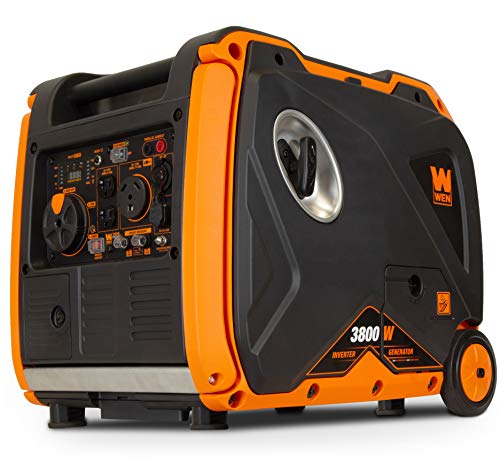
WEN 56380i 3800-Watt Inverter Generator
3,400W running / 3,800W starting · Gasoline · 57 dBA · 99.2 lb
RV hookup: TT-30R: a 30A RV cord plugs straight in
Current price on Amazon: $699.99
3,400 running and 3,800 surge watts with electric start and a TT-30R RV outlet, at the lowest price per running watt of the 30A inverters. WEN lists 57 dBA at 1/4 load and 8.5 hours at half load. 3,800 surge watts matches the top of the published starting range for a 13,500 BTU unit, so a soft starter is cheap insurance. A 15,000 BTU unit may be too much for it. It is the only 30A pick here whose Amazon listing names no CO shutoff sensor (only a fuel shutoff), and it has no propane option, which is why it scores lowest on safety in our rubric.
- Lowest cost per running watt (30A group)
- Electric start, TT-30R RV outlet
- EPA III compliant (listing)
- No CO shutoff sensor listed
- Gasoline only, no parallel listed
- Tight surge margin for a rooftop AC
Specs: spec summary citing wenproducts.com, Amazon listing.
#6 · Best for 50A RVs · 70/100

Westinghouse WGen9500DFc Dual Fuel Generator with CO Sensor
9,500W running / 12,500W starting · Dual fuel · 74 dBA · 212.1 lb
RV hookup: 14-50R: a 50A RV cord plugs straight in
Current price on Amazon: $1,049.00
A 50A RV cord ends in a 14-50P plug, and this generator has a 14-50R outlet (120/240V, 50A) along with an L14-30R and four GFCI household outlets. It is rated 9,500 running and 12,500 peak watts on gasoline (8,500/11,200 on propane), enough on paper to start and run two rooftop ACs with the fridge and lights on. It also has a CO sensor that shuts the engine down. Two caveats: 9,500 running watts is less than a 50A pedestal's 12,000W, so you can't run every 50A appliance at once, and this is an open-frame unit at a published 74 dBA, about 212 lb, not sold in California. It is a parked-RV or homestead generator, not a campground one.
- 14-50R outlet for a 50A RV cord
- 9,500 running W (8,500 on propane)
- CO sensor with automatic shutdown
- Remote key-fob + electric start
- 74 dBA, open frame
- About 212 lb
- Not sold in California
Specs: Westinghouse spec via Norwall, Amazon listing.
#7 · 50A Option with Tri Fuel · 66/100

Champion 12,500-Watt Tri Fuel Generator with CO Shield
10,000W running / 12,500W starting · Tri fuel · 74 dBA · 231 lb
RV hookup: 14-50R (120/240V, rated 42A by Champion)
Current price on Amazon: $1,259.99
Champion rates this tri fuel unit at 10,000 running and 12,500 starting watts on gasoline, 9,000 on propane and 8,000 on natural gas, with CO Shield automatic shutoff, electric start and a covered 14-50R. Champion lists that 14-50R at 42A, so a 50A RV gets the generator's full output but not a full 50A per leg. It is the most running watts on this list. Like the Westinghouse, it is a 74 dBA (at 23 ft), 231 lb open-frame generator. Champion also sells a 30 ft 50A RV cord (model 100828) for it.
- 10,000 running W on gasoline
- Gas, propane or natural gas
- CO Shield automatic shutoff
- 74 dBA from 23 ft
- 231 lb
- 14-50R rated 42A by Champion
Specs: Champion 201438 page, Amazon listing.
#8 · 50A Pick Sold in California · 51/100

DuroMax XP12000EH Dual Fuel Generator
9,500W running / 12,000W starting · Dual fuel · no published dBA · 238 lb
RV hookup: 14-50R: a 50A RV cord plugs straight in (plus L5-30R and L14-30R)
The other two 50A picks are marked not for sale in California. Norwall lists the DuroMax XP12000EH as EPA and CARB compliant and "for sale in all 50 states." It has a 14-50R (120/240V, 50A), L14-30R and L5-30R twist-locks and GFCI outlets, and is rated 9,500 running watts on gasoline and 9,025 on propane, the smallest propane derate here. It scores lowest in our rubric because the Amazon listing names no CO shutoff sensor and DuroMax publishes no noise rating. If you buy it, pair it with RV-listed CO alarms inside the coach.
- CARB compliant per Norwall
- 14-50R for a 50A RV cord
- Only about 5% less power on propane
- No CO shutoff sensor listed
- No published noise rating
- Open frame, heavy
Specs: DuroMax spec via Norwall, Amazon listing.
Quiet Generators for RV Campgrounds: Published Decibels
If you camp in public campgrounds, noise rules matter more than raw watts. National Park Service regulations prohibit running a generator louder than 60 dBA measured at 50 feet (36 CFR 2.12), and parks apply that standard to campsite generators (NPS, Everglades). Individual parks and private campgrounds often add generator hours on top. Check before you book.
The lowest published figures among our picks are Westinghouse's "as low as" 52 dBA (iGen5000DFc), Champion's 53 dBA from 23 feet (2500 Dual Fuel) and Honda's 53 dB at 1/4 load (EU2200i). Makers measure at different loads and distances, and every one of them gets louder as you add load. Honda, for example, lists 62 dB at rated load (Honda), which is what you'll hear with the AC compressor running. The open-frame 50A units are rated at 74 dBA from 23 feet. For campground use, the 30A inverters are the realistic choice. Our quietest generator for camping guide compares these figures with battery stations, whose only sound is a cooling fan.
Parallel Kits: Two Small Inverters Instead of One Big One
Pairing two matching inverters combines their output and often adds the RV outlet the small units lack. You carry two 45 lb boxes instead of one 100 lb one, and on mild days you run just one. What each maker states:
- Champion 2500 Dual Fuel: the optional 30A ParaLINK kit (model 100740) connects two parallel-ready Champion inverters and includes a standard 30A RV outlet (Champion). Two units come to 3,700 running watts, which covers a 30A RV's 3,600W.
- Champion 4500 Dual Fuel: the optional 50A ParaLINK kit (model 100319) connects two inverters and includes a standard 50-amp RV outlet (Champion). Two units come to 7,000 running watts for a 50A RV, quieter than an open-frame generator.
- Honda EU2200i: Honda says the EU2200i Companion connects with a regular EU2200i for up to 4,400 watts through a simple parallel cord, and the Companion's 30A receptacle is for RV use with an optional adaptor (Honda).
- Westinghouse iGen5000DFc: parallels with another Westinghouse inverter using optional 30A parallel cords (Norwall).
- WEN 56380i: parallel capability isn't listed, so we don't claim it.
RV Generator CO Safety: Distance, Exhaust and Alarms
Every generator here makes carbon monoxide, which you can't see or smell. CPSC says an average of nearly 100 people die in the U.S. each year from CO poisoning caused by portable generators (CPSC). An RV is a small, closed space next to the exhaust, so placement matters even more than at home:
- Never run a portable generator inside the RV, a storage bay, a garage or any other enclosed space (CPSC; Camping World).
- Keep it outside, at least 20 feet from doors, windows and vents (CDC). Camping World advises 20–25 feet from any open RV door, window or vent and, in an RV park, a full power-cord length from neighboring coaches.
- Point the exhaust away from your rig and your neighbors'. Camping World's rule is to make sure your generator isn't sending fumes into anyone else's home or RV.
- Use CO alarms made for RV use, installed according to their listing (Camping World), and test them before each trip. CDC also recommends battery-operated CO detectors (CDC). Our portable CO detector guide explains the UL 2034 alarm levels.
- CPSC recommends a generator with a CO shut-off safety feature. Six of our eight picks list one; the WEN 56380i and DuroMax XP12000EH listings don't. A shutoff is a backup: Champion says its CO Shield "is not a substitute for an indoor carbon monoxide alarm" (Champion).
Want power inside the coach with no exhaust at all? A battery power station makes no CO. See our indoor-safe generator guide.
What Makes a Good Generator for an RV?
A good RV generator has the right outlet for your cord and enough starting watts for your AC, and it is quiet enough for where you camp. The checklist we used:
- The right outlet. TT-30R for a 30A RV, 14-50R for a 50A RV. Skipping adapters means fewer connections to heat up and trip.
- Starting watts above your AC's start-up surge, or a soft starter on the AC. Running watts should stay comfortably above the AC plus the fridge, lights and fans.
- An inverter design for campgrounds. Inverter generators throttle down at light load, which makes them quieter and lighter than open-frame units, and they produce clean power for electronics (Champion lists less than 3% THD for the 4500). Open-frame generators give more watts per dollar, and the simplest 50A hookup, at a published 74 dBA.
- A CO shutoff sensor, as CPSC recommends.
- Dual fuel if you already carry propane. Your RV's propane can run it, at about 10% fewer running watts on the dual fuel picks here (for example 3,500W vs 3,150W on the Champion 4500).
- Weight you can actually move. 30A inverters with RV outlets weigh about 99–106 lb, so plan for wheels and a ramp or a hitch-mounted carrier. Two 45 lb units in parallel are easier to lift.
The Solar Alternative: A Power Station in the RV
We mostly cover battery power stations ("solar generators"), so here is the trade-off as evenly as we can put it. A battery runs silently inside the coach with no exhaust, recharges from rooftop or portable panels and isn't affected by generator hours. It can't match gasoline for hours of air conditioning, though. A 3,600W gas inverter refuels in minutes, and even a large battery holds only a few hours of compressor time. Many RVers carry both: the battery covers quiet hours, and the generator handles the AC and recharges the battery during the day.
How Long a Battery Runs RV Loads
Runtime = watt-hours × 0.85 ÷ load in watts. The 0.85 is our assumption for inverter losses.
| Load | Anker SOLIX F3000 (3,072 Wh) | EcoFlow Delta Pro 3 (4,096 Wh) |
|---|---|---|
| 13,500 BTU rooftop AC, compressor running (Micro-Air figure) (~1,500W) | 1.7 hr | 2.3 hr |
| Same AC with the thermostat cycling about half the time (our assumption) (~750W) | 3.5 hr | 4.6 hr |
| Fridge, lights, fans, water pump and chargers (our assumption) (~300W) | 8.7 hr | 11.6 hr |
The 1,500W AC figure is Micro-Air's running estimate for a 13,500 BTU unit (Micro-Air). The cycling and house-load figures are our assumptions, so substitute your own.
Runs one rooftop AC, silently · 93/100 (power-station score)

3,072 Wh · 3,600W (4,860W peak) · 91.5 lb
Current price on Amazon: $1,699.99
3,072 Wh with 3,600W continuous and 4,860W surge, and it is expandable with extra batteries. It starts a 13,500 BTU unit with no soft starter and can sit in a bay with no exhaust, but by our math one charge covers under two hours of continuous cooling.
Most headroom and runtime · 95/100 (power-station score)

4,096 Wh · 4,000W (8,000W peak) · 113.5 lb
4,096 Wh with 4,000W continuous and 8,000W surge. The surge rating removes the AC start-up question, and the capacity covers an evening of cooling with the thermostat cycling. At 113.5 lb it is for an RV that parks and stays.
Going further with batteries? Our solar generator for RV air conditioner guide works through rooftop AC sizing on battery power, the best solar generators for RVs roundup covers fridges and boondocking, and the best RV solar kit guide covers rooftop panels and charge controllers for keeping a battery topped up. The full fuel-vs-battery breakdown is in solar generator vs gas generator. Smaller rigs with no rooftop AC, such as camper vans, truck campers and pop-ups, can often skip fuel entirely; see our best solar generator for camper and van life picks.
Who Should Buy an RV Generator, and Who Should Skip It
Buy one if…
- You camp without hookups in hot weather and need the rooftop AC for hours.
- You can park it 20+ feet from your RV's and your neighbors' openings.
- You already carry propane and want a dual fuel option.
- You want backup power for the house when the RV is parked at home.
Skip it (or go battery) if…
- You mostly stay at campgrounds with hookups or with strict generator hours.
- Your loads are a fridge, lights, fans and devices, which a power station and solar cover quietly.
- You need power overnight for a CPAP beside the bed.
- You don't want to store fuel, change oil or lift 100 lb onto a carrier.
Running a rooftop AC on a food truck instead of a camper? The sizing problem is similar, but a steam table and fridges sit on top of it; see our best generator for food truck guide. Shopping for someone who already owns the rig? Our gifts for RV owners guide covers smaller power gear, and gifts for campers covers the tent crowd.
RV Generator FAQ
What size generator do I need for my RV?
Size it to your air conditioner and your hookup. For a 30A RV with one 13,500 BTU rooftop AC, look for about 3,000 to 4,000 running watts and at least 3,800 starting watts, which matches the top of the published starting ranges from Micro-Air and etrailer. Your 30A system tops out at 3,600W anyway. For a 50A RV with two ACs, you need a generator with a 14-50R outlet in the 9,500 to 10,000 running-watt class, or two parallel-capable inverters on a 50A parallel kit.
Will a 2,200-watt generator run an RV air conditioner?
Usually not by itself. A 13,500 BTU unit runs at roughly 1,300 to 1,600 watts, but published starting figures are 2,800 to 3,800 watts, above what a 2,200W inverter can surge. Micro-Air says a soft starter can cut the start-up surge by as much as 70% and that, with one, a 2,000-watt generator may be enough for a 13,500 BTU unit. The other route is pairing two small inverters, for example two Champion 2500s on Champion's 30A parallel kit, or an EU2200i with Honda's EU2200i Companion.
What is the quietest generator for an RV?
Among our picks, the lowest published figures are Westinghouse's "as low as" 52 dBA for the iGen5000DFc, 53 dBA from 23 feet for the Champion 2500 Dual Fuel and 53 dB at 1/4 load for the Honda EU2200i. Makers measure at different loads and distances, so the numbers are not strictly comparable, and all of them get louder as you add load. National Park Service rules cap generators at 60 dBA measured at 50 feet (36 CFR 2.12), and individual campgrounds often set generator hours.
What generator do I need for a 50 amp RV?
To use a 50A RV's two legs, you need a generator with a 14-50R outlet, such as the Westinghouse WGen9500DFc, the Champion 12,500-Watt Tri Fuel or the DuroMax XP12000EH, or two parallel inverters on a kit with a 50A RV outlet, such as Champion's 50A ParaLINK kit for the 4500. A 50A service can carry up to 12,000 watts and these generators supply 9,500 to 10,000 running watts, which is enough for two rooftop ACs. A 30A generator with a 50A-to-30A adapter works too, but it limits the RV to 3,600W, so plan on one AC at most.
Is an inverter generator better for an RV?
For most RVers, yes. Inverter generators are lighter and quieter than open-frame units of similar output, and they produce clean power for the RV's electronics: Champion lists less than 3% total harmonic distortion for its 4500 inverter. Open-frame generators deliver more running watts per dollar and are the simplest way to feed a 50A RV, but at a published 74 dBA they are better suited to a homestead or a parked rig than to a campground.
How far should a generator be from an RV?
CDC says to keep a generator at least 20 feet from doors, windows and vents, and CPSC says never to run one inside an enclosed space. Camping World advises 20 to 25 feet from any open RV door, window or vent, never running a portable generator inside the RV, and pointing the exhaust away from your rig and your neighbors'. Use CO alarms made for RV use inside the coach. A generator's CO shutoff is a backup, not a substitute; Champion says its CO Shield is not a substitute for an indoor CO alarm.
30A RV with one AC? A 3,500W+ inverter with a TT-30R. 50A RV with two ACs? A 14-50R generator or two inverters in parallel.
Check live prices, or compare more inverters in our best inverter generator guide first.