
Outdoor Power Guide · Updated November 2026
Solar Powered Outlet: 4 Ways to Get Outdoor Power Where There’s No Plug
Short answer
A solar powered outlet is a 120V outlet fed by solar panels, a battery and an inverter. The panel alone has no outlet. The easiest version is a portable power station plus a folding panel: no wiring, and it moves with you. For a permanent outlet at a shed, garden or gate, a fixed solar kit works, but the outdoor outlet has to meet code (GFCI, weather-resistant, in-use cover), so hire an electrician. Plug-in balcony solar gives you no outlet at all, and a GFCI outlet run from the house is often simplest if a circuit is close.
As an Amazon Associate, SolarGenAdvisor earns from qualifying purchases made through links on this page, at no additional cost to you. Scores are AI-synthesized from manufacturer specs, Amazon listing contents, logged Amazon prices and Amazon customer reviews; we did not install or test this equipment.
 By
The 4 Options Compared
“Solar outlet” gets used for four very different things. Only the first two give you a working outlet away from the house, and only the first one needs no wiring. Prices load live from Amazon for the example product in each row.
| Option | New outlet away from the house? | Works in an outage? | Wiring / permit | Best for | Example price |
|---|---|---|---|---|---|
| 1. Power station + folding panel | Yes, on the station | Yes, until the battery runs down | None | Patios, gardens, events, renters, anyone who also wants outage or camping power | $469.99 |
| 2. Fixed kit + outdoor outlet | Yes, where you wire it | Yes, it is off-grid | Yes: NEC applies; permit likely; electrician recommended | Sheds, garden beds, gates and barns that need power every day | $1,037.39 |
| 3. Plug-in (balcony) solar | No: it plugs into an outlet and feeds the house | No: it shuts off with the grid | No wiring, but only legal under a specific law in some states | Trimming the electric bill, not powering the yard | See kits |
| 4. GFCI outlet from the house (not solar) | Yes, within reach of a circuit | No | Yes: electrician, often a permit | High-watt or all-day loads near the house | Electrician quote |
Option 1: Power Station + Folding Panel
A portable power station is a battery, solar charge controller and inverter in one box with ordinary 120V outlets on the front. Plug a folding panel into its solar input, put the panel in the sun, and you have a solar powered outlet that needs no wiring, no permit and no landlord’s permission, and that comes inside with you for an outage or goes in the car for camping. This is the most flexible option, and for most yards the right one.
The honest limits: the station has to stay dry (see weatherproofing), so in practice it sits in a shed, garage or covered porch with an outdoor-rated extension cord out to the load; it is worth stealing, so it shouldn’t sit unattended in an open yard; and a single folding panel refills a 1 kWh station in a sunny day, not an hour. Specs below come from our product database; prices load live from Amazon.
Power stations
Best all-round outlet station · 92/100

Anker SOLIX C1000 Gen 2
1,024 Wh LiFePO4 · 2,000W AC · 600W max solar input · 24.9 lb
Current price on Amazon: $469.99
Enough battery for a fountain pump and an evening of string lights with plenty left over, enough AC output for corded tools, and 600W of solar input, so a single 200W panel never comes close to its limit. Anker’s C1000 manual tells you not to expose it to rain or snow, so it lives under cover with a cord run out to the load.
Most weather-resistant case · 82/100
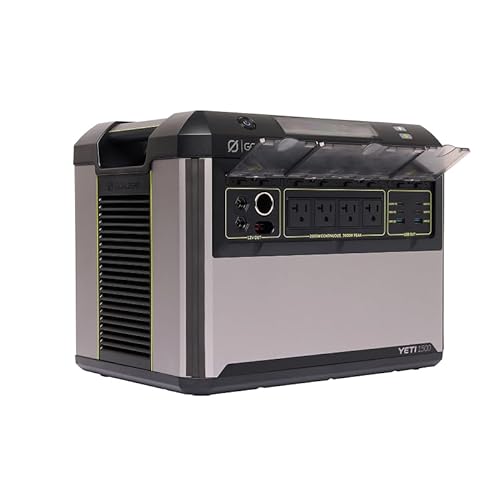
Goal Zero Yeti 1500 (6th Gen)
1,505 Wh LiFePO4 · 2,000W AC · 900W max solar input · 52.75 lb
Current price on Amazon: $1,499.95
The one station here built for outdoor knocks: an IPX4 rating (protected from splashes from any direction) and port doors. Goal Zero still says it is not fully waterproof and “strongly advise[s] against operating live loads in rain,” so treat IPX4 as protection from a surprise shower, not a reason to leave it out in the weather.
Most solar headroom per Wh · 90/100

Bluetti Elite 100 V2
1,024 Wh LiFePO4 · 1,800W AC · 1,000W max solar input · 25 lb
Up to 1,000W of solar input on a 1 kWh station at about 25 lb. That headroom matters if you want to leave two or more panels out and refill the battery in an afternoon, then run the outlet all evening.
Smaller IPX4 option · 76/100

Goal Zero Yeti 700
677 Wh LiFePO4 · 600W AC · 200W max solar input · 20.3 lb
Current price on Amazon: $699.95
A 677 Wh Yeti with the same IPX4 rating as its big sibling, for a fountain pump or a porch light display. Its 600W inverter and 200W solar input are modest, so it suits small loads, not tools.
Lightest for porch lights · 87/100

Jackery Explorer 300
292 Wh LiFePO4 · 300W AC · 100W max solar input · 7.5 lb
Current price on Amazon: $289.00
At about 7.5 lb this is the easy one to carry out at dusk and back in to charge. A 300W AC outlet is plenty for LED string lights or a small pump, and nothing more.
Weather ratings: Yeti 1500 IPX4 per Goal Zero and BioLite; Yeti 700 IPX4 per BioLite and B&H. Anker’s rain warning is from the SOLIX C1000 manual. Power station scores share one rubric, so compare them with each other, not with the panel and kit scores below.
Folding panels to pair with them
200W folding panel · 83/100

Anker SOLIX PS200 Bifacial Portable Solar Panel
200W rated · 10.6 lb · IP68
Current price on Amazon: $499.99
Anker lists IP68 on its Amazon listing and its Australian product page (some retailers list IP67). Its 57.6V open-circuit voltage suits stations with a 60V solar input, such as the C1000 Gen 2, one panel per input.
220W folding panel · 82/100

EcoFlow NextGen 220W Portable Solar Panel
220W rated · 15.9 lb · IP68
IP68 and an ETFE surface per EcoFlow and the Amazon listing, with a 30–60 degree kickstand. It ships with an XT60i cable; check your station’s connector and voltage window before pairing.
PS200 IP rating: IP68 on Anker Australia and the Amazon listing; Currys lists IP67 and notes the XT-60 port itself is not waterproof. NextGen 220W: IP68 per EcoFlow’s NextGen 220W spec page and the Amazon listing. More panels, with matching rules for each station, are in our best portable solar panels guide.
Option 2: A Fixed Solar Kit With an Outdoor Outlet
For a shed, a garden bed, a gate opener or a barn that needs power every day, a fixed system costs less per stored watt-hour than a power station and doesn’t have to be carried in. The parts are rigid panels on a roof or post, an MPPT charge controller, a 12V LiFePO4 battery, a pure sine inverter and, if the outlet is outside, a weatherproof receptacle wired from the inverter. The battery, controller and inverter go somewhere dry, usually inside the shed. Our solar kit for shed and garage guide sizes each part for 100–400W systems.
Complete kit with battery and inverter · 82/100

ECO-WORTHY 400W Complete Kit (Battery + 2000W Inverter)
In the box: 4 x 100W bifacial panels, 40A MPPT controller, 2000W pure sine inverter, 2 x 12V 100Ah lithium batteries, Bluetooth module
Current price on Amazon: $1,037.39
Four 100W panels, a 40A MPPT controller, two 12V 100Ah lithium batteries and a 2,000W pure sine inverter in one listing. By our math 400W of panels makes about 1,500 Wh on a 5-sun-hour day, more than a garden fountain and lights use. Third-party listings show other configurations, so check the contents on the listing before you order.
Panels + MPPT controller (add a battery) · 83/100

ECO-WORTHY 400W Premium Solar Kit (40A MPPT)
In the box: 4 x 100W rigid panels, 40A MPPT controller, BT-02 Bluetooth module, 16ft cables with Y branches, Z-brackets
Current price on Amazon: $459.99
Four 100W panels, a 40A MPPT controller, Bluetooth monitoring, cables and Z-brackets. It has no battery or inverter, so add a 12V LiFePO4 battery and an inverter; our shed and garage kit guide sizes both.
Inverter with GFCI outlets · 78/100

Renogy Pro 2000W Pure Sine Wave Inverter with Bluetooth
A 12V, 2,000W pure sine inverter whose Amazon listing shows GFCI-protected outlets and an idle draw under 9.6W. That idle figure matters: left on 24 hours a day it can use up to about 230 Wh before anything is plugged in, so switch it off when you don’t need the outlet.
Kit scores use the rubric on our best RV solar kit guide; the inverter score uses the rubric on our Renogy inverter guide. All are AI-synthesized from specs, listing contents and logged prices.
Outdoor outlet code basics (summary, not code advice)
In the US, electrical work follows the National Electrical Code, NFPA 70 (NFPA), in whatever edition your state or city has adopted (NFPA enforcement map). We aren’t electricians. At a summary level, an outdoor outlet at a home touches these rules:
- GFCI protection. NEC 210.8(A)(3) lists outdoor receptacles at dwelling units among the locations that need ground-fault circuit-interrupter protection, and 210.8(A)(2) does the same for garages and accessory buildings (IAEI, on NEC 210.8; IAEI, outdoor receptacles). An inverter with GFCI outlets protects what plugs into it; a separate outdoor receptacle wired from the inverter needs its own protection.
- Weather-resistant (WR) receptacle. Under NEC 406.9, nonlocking 15A and 20A, 125V and 250V receptacles in damp and wet locations must be a listed weather-resistant type (EC&M Code Q&A; IAEI).
- In-use (“bubble”) cover. In a wet location, NEC 406.9(B)(1) requires an enclosure that is weatherproof whether or not a plug is inserted, and an outlet box hood used for that must be listed and identified as extra-duty (Leviton; EC&M). A flip cover that only seals with nothing plugged in doesn’t meet it.
- The solar and battery side. PV wiring falls under NEC Article 690, which calls for a PV disconnect and PV-listed overcurrent protection (IAEI, on NEC 690), and in the 2020 edition Article 706 covers permanently installed energy storage over 1 kWh (Mike Holt, 2020 NEC). One 12V 100Ah battery is about 1.28 kWh.
Our recommendation: mount the panels and set up the battery and inverter yourself if you’re comfortable following the manuals, but have a licensed electrician wire any permanent outdoor receptacle, and ask your building department whether a fixed off-grid system on an accessory building needs a permit and inspection. Never connect a solar inverter or battery to your house wiring without a proper transfer switch; our transfer switch guide explains why.
Option 3: Plug-In (Balcony) Solar
Plug-in solar is the option people most often mistake for a solar outlet. It is one to six panels with a microinverter whose cord plugs into an existing outlet and pushes power into your home’s wiring, where your appliances use it before drawing from the grid. It does not give you a new outlet in the yard, and it is built to shut off when the grid goes down, so a kit without a battery provides nothing in an outage.
It is also not legal everywhere. As of October 31, 2026, ten states had a law specifically allowing it, most capping a system at 1,200W and requiring a lab-certified device; California’s SB 868, for example, takes effect January 1, 2027 (pv magazine USA). Our plug-in solar legal states tracker has the state-by-state table, and our best plug-in solar kits guide covers the few U.S. kits on Amazon. One warning from that guide worth repeating here: don’t plug a grid-tie microinverter into a power station’s outlet unless both makers say the pairing is supported.
Option 4: A GFCI Outlet Run From the House
This one isn’t solar, and it’s here because it is sometimes the right answer. If a circuit is within reach, an electrician can add a GFCI-protected, weather-resistant receptacle under an extra-duty in-use cover, the same code points as option 2. You get unlimited energy for high-watt loads such as a pressure washer, a heater or all-day corded tools, and no battery to look after. You lose outage power, and the cost of trenching to a far corner of the yard or a detached shed can climb fast. Get a quote and compare it with options 1 and 2; we don’t publish cost figures because they vary too much by distance, region and permit fees for us to verify.
What a Solar Outlet Can Run
Low-watt loads that run for hours are what solar outlets do well; high-watt loads that run for hours are what they don’t. Runtime below = station Wh × 0.85 (inverter and conversion losses) ÷ load watts, our standard formula. Check the label on your own device: watts = amps × 120.
| Load | Published watts | Typical use / day | 292 Wh station | 1,024 Wh station | 1,505 Wh station |
|---|---|---|---|---|---|
| LED string lights (porch or patio, ~4 sets) | ~25W (our Christmas lights guide) | 6 h (~150 Wh) | ~9.9 h | ~34.8 h | ~51.2 h |
| 400 GPH fountain or birdbath pump | 30W (Danner SP-400) to 33W (Beckett M400AS) | 8 h (~264 Wh) | ~7.5 h | ~26.4 h | ~38.8 h |
| Cordless tool battery charger | 210W (EGO standard charger) source | 1 h (~210 Wh) | ~1.2 h | ~4.1 h | ~6.1 h |
| LED display + one 6-ft inflatable | ~150W (our Christmas lights guide) | 6 h (~900 Wh) | ~1.7 h | ~5.8 h | ~8.5 h |
| Corded circular saw | 1,400–1,500W running, more to start (generator wattage chart) source | 15 min (~375 Wh) | Over its 300W limit | ~35 min | ~51 min |
| Portable space heater (on high) | 750–1,500W (Virginia Cooperative Extension) source | 1 h (~1,500 Wh) | Over its 300W limit | ~35 min | ~51 min |
Hours of use are our assumptions. The light and inflatable figures come from our solar generator for Christmas lights guide, which sources them to ENERGY STAR, Cornell Cooperative Extension and maker listings and has a full runtime table for holiday displays. A corded saw also needs surge headroom to start; check the station’s surge rating.
The takeaway: lights, fountain pumps, tool chargers, a radio and a Wi-Fi camera are easy. Corded tools work in short bursts from a 1 kWh-plus station. Heaters, pressure washers and anything that runs at 1,000W+ for hours drain any portable battery quickly; that is option 4 territory. For cameras specifically, a battery camera with its own small panel is often simpler than an outlet: see our best solar security camera picks.
Sizing: Wh per Day and Sun Hours
Two numbers size any solar outlet. First, the watt-hours your loads use per day (watts × hours, added up). Second, your peak sun hours. A panel makes about its rated watts × sun hours × 0.75, the loss factor our solar panel output calculator uses. So the panel you need = daily Wh ÷ (sun hours × 0.75).
Example garden outlet: LED string lights at 25W for 6 hours plus a 33W fountain pump for 8 hours = 414 Wh a day. Sun hours below are NASA POWER 2001–2025 averages for a panel tilted at latitude, the same figures as the calculator page:
| City | Sun hours (year) | Panel for 414 Wh (year) | Sun hours (Dec) | Panel for 414 Wh (Dec) |
|---|---|---|---|---|
| Phoenix, AZ | 6.45 | ~90W | 4.87 | ~120W |
| Denver, CO | 5.64 | ~100W | 4.17 | ~140W |
| Atlanta, GA | 4.83 | ~120W | 3.58 | ~160W |
| Chicago, IL | 4.18 | ~140W | 2.38 | ~240W |
| Seattle, WA | 3.78 | ~150W | 1.69 | ~330W |
So one 200W folding panel covers this garden outlet on an average day almost anywhere, and two are needed for a Seattle or Chicago December. Size the battery for the days without sun: 414 Wh a day on a 1,024 Wh station is about 2.1 days of reserve (1,024 × 0.85 ÷ 414). Shade from a tree or fence cuts output sharply, and a flat panel collects much less in winter than a tilted one; the calculator page covers both, and lets you enter your own loads and city.
Weatherproofing: IP Ratings and Rain
An IP rating (IEC 60529) has two digits: the first for dust and solids, the second for water. A 6 first digit means dust-tight; a second digit of 4 means splashing from any direction has no harmful effect, 7 means temporary immersion, and 8 means continuous immersion under conditions the maker specifies (Newark; Hammond Manufacturing). An “X” means that part wasn’t rated.
- Panels can live outside. Folding panels such as the Anker PS200 and EcoFlow NextGen 220W carry IP67–IP68 ratings from their makers. Connectors are the weak point: Currys notes the PS200’s XT-60 port is not waterproof, so keep connections off the ground and out of puddles.
- Most power stations can’t. Anker’s C1000 manual says “Do not expose the product to rain or snow” (manual), and Jackery’s FAQ says most of its stations are not waterproof because the outlets and vents are exposed (Jackery). Follow your own manual.
- IPX4 is splash protection, not rain duty. Goal Zero rates the Yeti 1500 IPX4 but says it’s “not fully waterproof,” advises against running live loads in rain, and says to keep the port doors closed outdoors (Goal Zero).
- The practical setup. Keep the station in a shed, garage or covered porch, or in a weatherproof box with ventilation (stations shed heat while charging and running). Run the panel cable in and an outdoor-rated extension cord out, with plug connections off the ground. Any permanent outdoor receptacle gets the WR, GFCI and in-use cover treatment in the code section.
- Cold weather. LiFePO4 stations generally shouldn’t charge below freezing; the Yeti 1500 is rated to charge between 32°F and 104°F (Popular Science; BioLite). Check your station’s range before you leave it in an unheated shed in winter.
Theft and Security
A power station and folding panel are light, valuable and easy to carry off, which is the downside of portable. Common-sense steps:
- Keep the station out of sight: in a locked shed or garage, with only the cord running out.
- Bring folding panels in at night if they’re visible from the street, or lock them to something solid with a cable lock through a frame or kickstand opening.
- On a fixed kit, mount panels on the roof rather than at ground level, and lock the shed that holds the battery and inverter.
- Note serial numbers and register the products with the maker; it helps with warranty claims and police reports.
- A solar camera watching the shed or gate needs no outlet at all; our solar security camera guide compares no-subscription options.
Which Option Fits You
Buy a power station + panel if…
- Your loads are lights, a pump, chargers or short tool use.
- You rent, or don’t want to wire anything.
- You also want outage or camping power.
- You have a dry spot for the station near the load.
Build a fixed kit if…
- The outlet is needed every day at one spot, like a shed or gate.
- You want the lowest cost per stored watt-hour.
- You’ll hire an electrician for the outdoor receptacle and check permits.
Skip plug-in solar if…
- What you want is a usable outlet outdoors, or outage power.
- Your state has no plug-in solar law yet.
Run a circuit from the house if…
- You need 1,000W+ for hours: heaters, pressure washers, all-day saws.
- The spot is close to the house and an electrician’s quote is reasonable.
Solar Powered Outlet FAQ
What is a solar powered outlet?
It is a standard 120V AC outlet whose power comes from solar panels through a battery and an inverter. You can buy that as one box, a portable power station with a folding panel, or build it as a fixed system of panels, a charge controller, a battery and an inverter wired to a weatherproof outlet. A solar panel on its own has no outlet: it makes DC power that has to go through a controller, battery and inverter first.
Can I install a solar powered outdoor outlet myself?
A power station with a folding panel needs no installation at all. A permanently wired outdoor outlet fed by a solar battery and inverter is electrical work that falls under the National Electrical Code (NEC), including its PV and energy storage articles, and many towns require a permit and inspection. We recommend a licensed electrician for any permanent wiring, and a call to your local building department before you buy.
Does an outdoor outlet need GFCI protection and a cover?
At a home in the US, yes under recent NEC editions. Section 210.8(A)(3) requires GFCI protection for outdoor dwelling receptacles, and Section 406.9 requires 15A and 20A, 125V and 250V receptacles in wet locations to be a listed weather-resistant type in an enclosure that stays weatherproof with a plug inserted, with the hood listed as extra-duty. That is the bubble or in-use cover. States adopt different editions, so check with your local inspector.
Can a solar outlet run a fountain pump all day?
Yes, small fountain pumps are one of the easiest loads. A 400 GPH fountain pump is listed at about 30 to 33 watts, so eight hours uses roughly 260 Wh. A 1,024 Wh power station covers that for about three days without sun, and one 200W panel at 5 sun hours makes about 750 Wh a day, more than the pump uses.
Can I leave a portable power station outside in the rain?
No. Anker's C1000 manual says not to expose the product to rain or snow, and Jackery says most of its stations are not waterproof. Even Goal Zero, whose Yeti 1500 and Yeti 700 carry an IPX4 splash rating, advises against running live loads in rain. Keep the station in a shed, garage, covered porch or ventilated weatherproof box, and run an outdoor-rated cord to the load.
Is there such a thing as a solar panel with an outlet?
Not on the panel itself. Listings sold as a solar panel with an outlet are kits: a folding panel bundled with a power station that has the AC outlets, or a panel kit with an inverter. The panel charges the battery and the battery and inverter power the outlet, which is why the outlet still works after dark.
Can plug-in balcony solar give me an outlet in the garden?
No. A plug-in solar kit works the other way around: its microinverter plugs into an existing outlet and feeds power into your home's wiring. It gives you no new outlet, it stops working when the grid goes down, and it is only allowed under a specific law in a handful of states. For a garden outlet you need a battery, either a power station or a fixed kit.
How big a solar panel do I need for an outdoor outlet?
Add up the watt-hours your loads use per day, then divide by your peak sun hours times 0.75. LED string lights for six hours plus a fountain pump for eight hours come to about 414 Wh a day; with 5 sun hours that needs about 414 / (5 x 0.75) = 110W, so a 200W panel covers an average day. December in Chicago, at about 2.4 sun hours, needs about 240W for the same loads.
Will a solar powered outlet work at night and in winter?
At night it runs on the battery, so it works until the battery is empty. In winter the panel makes much less: NASA POWER averages for a tilted panel drop from about 4.2 sun hours a day across the year to about 2.4 in December in Chicago, and lower still on a flat or shaded panel. Size the panel for winter if you need the outlet year-round, or plan to top up the station from a wall outlet.
Can I run Christmas lights from a solar outlet?
Yes, if they are LED. A small porch display of about four LED mini sets draws around 25 watts, so a 1,024 Wh station runs it for more than 30 hours. Incandescent strings draw several times more, and inflatables add about 100 watts or more each. Our Christmas lights guide has the full runtime table.
Lights, a pump or tool charging? A 1 kWh power station and one 200W panel. A shed or gate that needs power every day? A fixed kit, with an electrician for the outdoor outlet.
Power station and solar kit prices move often, and have historically dipped during Prime Day and Black Friday events. Every price on this page loads live from Amazon.