
Buying Guide · Updated November 13, 2026
Best Plug-In Solar Kits for U.S. Homes and Apartments
Plug-in solar is a small solar kit whose microinverter plugs into an ordinary 120V outlet and feeds your home’s wiring, cutting what you buy from the grid while the sun is up. Few U.S.-voltage kits are on Amazon today: in our November 12 check, the in-stock kits we found came from one seller, PLUGGEDSOLAR, while the EcoFlow listings were European-spec and unavailable. It is legal only where your state allows it, so most renters are better served by a portable power station charged by a balcony panel, which never connects to the wiring.
As an Amazon Associate, SolarGenAdvisor earns from qualifying purchases made through links on this page, at no additional cost to you.
 By Taylor Kim
Reviewed & approved by Juhi Sahni
|
Published: November 12, 2026
|
Updated:
|
Plug-in solar laws by state
Plug-In Solar Kits on Amazon: What Is Actually Sold in the U.S.
Search Amazon for “plug in solar” and you get three kinds of listing: complete U.S. kits, European balcony systems built for 230V outlets, and bare microinverters with no panels. Here is what we found on November 12, 2026, using Amazon’s own product data for stock and seller.
| Product | What it is | U.S. status | Amazon price |
|---|---|---|---|
| PLUGGEDSOLAR 800W Plug-in Balcony Solar Kit | 4 × 200W panels, APsystems microinverter, 50 ft cord to a 120V outlet. No battery. | In stock, sold by Plugged Solar. The listing claims UL 3700; no microinverter model is named. | Check price at Amazon → |
| PLUGGEDSOLAR 1200W Plug-in Balcony Solar Kit | 6 × 200W panels, same microinverter description and cord. | In stock, same seller. A 1,600W, 8-panel version is also listed. Both sit at or above the 1,200W cap most state laws set. | Check price at Amazon → |
| EcoFlow STREAM Ultra and PowerStream | Balcony systems with a battery. The Amazon.com listings describe 2,300W dual AC output or a German-style BKW cable, and one quotes bill figures in pounds, which marks them as European models. | “Currently unavailable” on Amazon. EcoFlow sells a U.S. STREAM Ultra directly and says it is “only available for sale and plug-and-play installation in Utah” (EcoFlow’s U.S. STREAM Ultra page). | Not available |
| Anker SOLIX Solarbank | Anker’s balcony battery line. | We found no Amazon.com listing. Anker markets it in Europe (Anker’s German store; pv magazine on the Solarbank Max AC launch). Anker’s U.S. home system is the E10, a wired whole-home battery, covered in our Anker SOLIX E10 review. | Not on Amazon.com |
| Bare 800W “grid tie” microinverters | An inverter with a U.S. plug and no panels, from a range of small sellers. | Not a kit. Before plugging any of these into a wall, look the exact model up in a certifier’s directory; we do not recommend any. | Not covered |
Stock, seller and listing text come from Amazon’s product data on November 12, 2026. Prices are live and change often.
The honest summary: as of this check, the only complete U.S.-voltage plug-in kits we found in stock on Amazon came from one seller, and kit-level certification is the open question for every brand. Some well-known U.S. options are sold direct, not on Amazon: EcoFlow’s STREAM (Utah only, per EcoFlow) and kits built on APsystems and Hoymiles microinverters from specialist retailers. That is why most of the picks below are the no-wiring alternative.
How Do Plug-In Solar Panels Work?
Plug-in solar panels work by turning sunlight into household AC power and pushing it into your home’s wiring through a wall outlet, where your appliances use it before they draw from the grid. Four parts do the work:
Panels make DC power
One to four panels on a railing, patio or wall. Kits on the U.S. market are typically 400 to 1,200W of panels, and most state laws cap a system at 1,200W.
A microinverter syncs it to the grid
The microinverter converts DC to 120V, 60 Hz AC that matches the grid. APsystems’ U.S. plug-in model, the EZ1-LV, is rated up to 900W of AC output (APsystems).
Power flows to the nearest loads first
The power feeds into the outlet and “first flows to any other devices plugged into the circuit,” then through your breaker panel to the rest of the home, and only leftover power goes out to the grid (Permit Power safety fact sheet (Jan 2026); EnergySage). Your meter simply records less purchased power.
It shuts off when the grid does
Grid-tied inverters stop producing as soon as the grid goes down, so they cannot energize lines that crews are working on (Permit Power safety fact sheet (Jan 2026)). APsystems says the EZ1 restarts only after grid power has been stable for five minutes (APsystems). A kit without a battery therefore gives you no power in a blackout.
Plug-in solar kit
- •Feeds your home wiring through an outlet
- •Lowers your bill only while the sun is up and you are using power
- •Off during an outage unless it has its own battery
- •Needs a state law, or a utility interconnection agreement
Power station + portable panel
- •Panel charges a battery; appliances plug into the battery
- •Small effect on your bill, because you run only what is plugged into it
- •Works in an outage, day or night
- •Never touches building wiring, so no law, utility or landlord wiring approval
Is Plug-In Solar Legal Where You Live?
As of our October 31, 2026 check, ten states had a law that specifically allows plug-in solar, most capping it at 1,200W and requiring a lab-certified device that shuts off in an outage, and several of those laws do not take effect until 2027. Everywhere else there is no plug-in-specific law, so a kit that feeds your wiring is generally treated like any other grid-connected generator until your utility says otherwise.
Wattage caps, start dates, renter rules and the source for each state: Is plug-in solar legal in your state?
Safety and Code: Backfeeding, UL 3700 and the NEC
This is the part most listings skip. None of it is legal advice; your utility, landlord and local building department each have a say.
Backfeeding through an outlet
A home branch circuit is built for power flowing one way, from the breaker to your appliances. A plug-in kit sends power the other way, so the breaker no longer sees the whole load. UL Solutions warns that “the combined current from the utility and PIPV source can exceed conductor ratings without tripping the circuit breaker” (UL Solutions; pv magazine USA). The CSA certificate for APsystems’ EZ1-LV microinverter is specific about this: it lists the model as “only intended for use on dedicated Circuits (Branch circuit breaker 10A),” with a listed bidirectional Class A GFCI required between the system and a non-dedicated circuit (CSA certificate 80310017, issued July 15, 2026). In practice, read the installation manual for the exact circuit it requires before you buy, and never use a male-to-male “suicide cord.”
Utility interconnection
Utilities normally require an interconnection agreement before anything that generates power is connected to the grid. Where no plug-in law exists, a utility may treat a plug-in kit like a rooftop array, which “can mean interconnection applications, fees, and wait times of weeks or months” (EnergySage, updated November 9, 2026). Permit Power’s fact sheet makes the same point: existing regulations “do not draw a distinction between traditional solar and plug-in solar” (Permit Power safety fact sheet (Jan 2026)). Even in some law states, power sent back to the grid earns no credit.
UL listings: UL 1741 vs UL 3700
UL 1741 is the long-standing standard for grid-tied inverters and covers the outage shutoff (Permit Power safety fact sheet (Jan 2026)). UL 3700, published December 11, 2025, is the first U.S. outline written for plug-in PV equipment and systems, and it adds plug-specific protections against overloads and live plug prongs (UL Solutions). Most state plug-in laws require certification by UL or another nationally recognized testing lab, and “some name UL 3700 outright” (Solar.com, Sept 22, 2026). Two cautions before you trust a listing:
- •Component is not kit. The EZ1-LV certificate covers the microinverter, and its first condition says a complete plug-in system needs its own evaluation (CSA certificate 80310017). A kit that “uses a UL 3700 inverter” is not automatically a UL 3700 kit.
- •“Compliant” is not “certified.” Hoymiles launched its HiFlow Pro in July 2026 as the first UL 3700-compliant plug-in microinverter (pv magazine USA). InsideEVs later corrected its coverage to say it “is not certified by UL Solutions, but designed to meet the UL 3700 standard.”
The PLUGGEDSOLAR listings say “UL-3700 certified for Plug-in” but do not name the microinverter model or a certificate number, so we could not match the kit to a directory entry. Ask the seller for the certificate number and look it up with UL, CSA or Intertek before you connect anything.
NEC 2026: no plug-in category yet
The 2026 National Electrical Code does not define plug-in solar. A proposal now before NFPA states that “no definition of a Plug-in Photovoltaic (PIPV) system exists anywhere in the 2020, 2023 & 2026 NEC” (NFPA proposed TIA 1951). NFPA published six proposed Tentative Interim Amendments, TIA 1951 to 1956, on October 22, 2026, with comments due November 20, 2026. They would add a plug-in section to Article 705, set receptacle limits and require labels (pv magazine USA (Oct 28, 2026)). They are proposals filed by a plug-in equipment maker and still need approval from Code-Making Panel 4 and the Correlating Committee, so nothing has changed in the code yet. The NEC still governs the home wiring a kit plugs into (Permit Power safety fact sheet (Jan 2026)).
How Much Does Plug-In Solar Power Produce and Offset?
Using NREL’s PVWatts calculator, Solar.com estimated a south-facing, unshaded 800W kit at the yearly output below. We multiplied each figure by the U.S. average residential rate for January to August 2026, 18.19¢ per kWh (EIA Electric Power Monthly, Table 5.3, preliminary), to show what that power is worth if you use all of it as it is made.
| City | Railing (kWh/yr) | Worth per year | Tilted 30° (kWh/yr) | Worth per year |
|---|---|---|---|---|
| Los Angeles | 794 | $144 | 1,366 | $248 |
| Denver | 889 | $162 | 1,316 | $239 |
| Salt Lake City | 800 | $146 | 1,219 | $222 |
| Baltimore | 745 | $136 | 1,139 | $207 |
| Newark, NJ | 711 | $129 | 1,072 | $195 |
Worth per year is our arithmetic: kWh × 18.19¢. Your own rate may be much higher or lower; multiply the kWh by the rate on your bill. Shade from a balcony above, an east or west aspect, or snow lowers every number.
- •An 800W kit is worth about $129 to $248 a year at the national average rate, depending on mounting and climate. That is in line with EnergySage, which estimates $13 to $21 a month for a typical kit and up to $50 in high-rate states.
- •Use it or lose it. Utah, Maine and Vermont exclude these kits from net metering, and Connecticut bills excess generation as usage without a net meter (details in our state-by-state plug-in solar law tracker), so exported power often earns nothing. A kit sized to your daytime base load (fridge, router, standby electronics) gets the most from every kWh.
- •Seller estimates run higher. The PLUGGEDSOLAR 800W listing estimates 1,500 kWh a year, above the highest of the five PVWatts results above (1,366 kWh, tilted in Los Angeles).
And a power station with a balcony panel?
Scaling the same PVWatts figures to one 200W panel gives about 178 to 342 kWh a year, or roughly 0.5 to 0.9 kWh on an average day. After about 15% conversion loss, that is worth around $27 to $53 a year, and only if you run something from the station every day. A station is bought for backup and portability, not to cut the bill.
Portable Solar Panels for Apartments: The No-Wiring Option
For renters, the setup that works in every state is a folding panel on the balcony charging a portable power station inside. The panel cable runs through the door to the station, and you plug a fridge, router or lamp into the station. Nothing connects to the building’s wiring, so no plug-in law, utility notice or electrician is involved; your lease still decides what can sit on the balcony. The table compares the plug-in kit with two stations we rate, using data from our product database.
| Spec | PLUGGEDSOLAR 800W kit | Anker SOLIX C1000 Gen 2 | Bluetti Elite 200 V2 |
|---|---|---|---|
| Amazon price | Check price at Amazon → | $529.99 | $898.99 |
| Panels included | 4 × 200W | None (add a panel) | None (add a panel) |
| Battery | None | 1,024 Wh LiFePO4 | 2,073.6 Wh LiFePO4 |
| Max solar input | Microinverter rating not stated | 600W | 1,000W |
| Power in an outage | No | Yes, 2,000W AC | Yes, 2,600W AC |
| Lowers your bill | Yes, while the sun is up | Slightly | Slightly |
| Needs a state law or utility OK | Yes | No | No |
| Weight | Not stated (ships in three boxes) | 24.9 lb | 53.4 lb |
| Runtime at 100W | — | ~8.7 h | ~17.6 h |
| Runtime at 300W | — | ~2.9 h | ~5.9 h |
| Our rating | Unrated (no battery to score) | 92/100 | 91/100 |
Runtime = rated Wh × 0.85 ÷ load. 100W is about a router, laptop and a few LED lights; 300W adds a fridge’s running draw on average. Real draw varies with the appliance.
What about the Delta Pro 3? It is our top-rated home backup unit, but at 113.5 lb with 240V output meant for a transfer switch, it is built for a house with a breaker panel you can wire into, not a rental. Renter-specific advice on fire safety, stairs and lease rules is in our solar generator for apartments guide, and more panels are compared in best portable solar panels.
Our Picks: Plug-In Kit and No-Wiring Setups
Each product below was in stock on Amazon when we checked on November 12, 2026. Ratings come from our scoring method, built from published specs, live prices and Amazon customer reviews.
Best for most renters: no wiring, works in every state
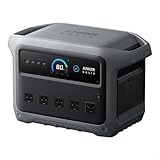
1,024 Wh · 2,000W output · LiFePO4 · 92/100 in our scoring
Current price on Amazon: $529.99
A 1,024 Wh LiFePO4 station with 2,000W of output and up to 600W of solar input. Pair it with one or two Anker PS200 panels on the balcony; our Anker SOLIX panel guide confirms the 48V PS200 suits the C1000 inputs. Nothing connects to the building’s wiring, so no plug-in law or utility notice applies, and the stored energy is there after dark and in an outage.
Best portable solar panel for an apartment balcony

Anker SOLIX PS200 Bifacial Portable Solar Panel
200W folding panel · 10.6 lb · 83/100 in our scoring
A 200W bifacial folding panel at 10.6 lb with an IP68 rating and an XT-60i cable in the box. Our scaling of Solar.com’s PVWatts figures puts one 200W panel at roughly 0.5 to 0.9 kWh on an average day, about half a C1000 Gen 2 refill. It sets up on a kickstand, so nothing hangs over the railing.
Smallest and lowest-cost start

Bluetti Elite 30 V2
288 Wh · 600W output · LiFePO4 · 86/100 in our scoring
Current price on Amazon: $289.99
288 Wh and 600W of output at 9.5 lb, with up to 200W of solar input and a 10 ms UPS mode for a router or CPAP. It runs a 100W load for about 2.4 hours. Bluetti lists its PV60L panel as the matching panel. Right for a studio and short outages, not a refrigerator overnight.
Most stored energy without an electrician

2,074 Wh · 2,600W output · LiFePO4 · 91/100 in our scoring
Current price on Amazon: $898.99
2,073.6 Wh and 2,600W through 120V outlets, enough for a fridge, router and lights through a long outage, with no hookup at all. The catch for apartments is weight: at 53.4 lb it is a two-hand carry, fine with an elevator and hard work on a walk-up. It is not expandable.
The grid-tied plug-in kit on Amazon (law states only)

PLUGGEDSOLAR 800W Plug-in Balcony Solar Kit
4 × 200W panels · no battery · unrated
Four 200W panels and an APsystems microinverter with a 50 ft cord that plugs into a 120V outlet and offsets what your home draws while the sun is up. The listing claims UL 3700 certification but names no microinverter model, so we could not match the kit to a certifier’s listing (see the UL 3700 section above). It has no battery, so it goes dark in an outage. Buy it only if your state has a plug-in law and your utility and landlord agree. Unrated: our rubric scores batteries, and this kit has none.
Who Should Buy a Plug-In Kit, and Who Should Skip
A plug-in kit makes sense if…
- •Your state’s plug-in law is in force and your utility has no objection.
- •You have an unshaded south-facing railing, patio or yard.
- •You use steady power during the day, so little is exported for nothing.
- •You can confirm the kit’s certification and have the circuit its manual requires.
Skip it, and get a station + panel, if…
- •Your state has no plug-in law, or its law starts in 2027.
- •You want power during outages. A battery-less kit shuts off with the grid.
- •Your lease bars attachments to the railing or work on the wiring.
- •You move often. A station and folding panel go with you in one trip.
Verdict: The Best Plug-In Solar Setup for Most People
If you live in a state with a plug-in law that is already in force, a grid-tied kit is the only product here that lowers your bill every sunny day, and the PLUGGEDSOLAR 800W kit is the one complete U.S. kit we found in stock on Amazon. Confirm its certificate number and your utility’s rules first. For everyone else, and for any renter who wants outage power, the Anker SOLIX C1000 Gen 2 with an Anker SOLIX PS200 Bifacial Portable Solar Panel is our pick, rated 92/100 in our scoring. Currently $529.99 on Amazon, it needs no law, no utility notice and no wiring work, and it moves with you.
Want a station sized to your appliances instead? The solar generator size calculator adds up your loads in a minute.
Plug-In Solar Kits FAQ
What is plug-in solar?
Plug-in solar, also called balcony solar, is one to four solar panels with a microinverter that plugs into a standard 120V wall outlet. It feeds power into your home’s wiring, where your appliances use it before drawing from the grid. Most state plug-in laws cap a system at 1,200W and require a lab-certified device.
How do plug-in solar panels work?
The panels make DC power, the microinverter converts it to grid-matched AC, and the cord sends it into an outlet. The power goes first to devices on that circuit, then to the rest of the home through the breaker panel, and any surplus flows to the grid. The inverter shuts off when the grid goes down, so a kit without a battery provides no power during an outage.
How much does plug-in solar power produce?
Solar.com’s PVWatts-based estimates for a south-facing, unshaded 800W kit range from about 711 to 889 kWh a year hung on a railing and 1,072 to 1,366 kWh tilted at 30 degrees, across five U.S. cities. At the 2026 U.S. average residential rate of about 18.2 cents per kWh, that is worth roughly $129 to $248 a year if you use all of it as it is produced.
Does Amazon sell plug-in solar kits for the U.S.?
A few. In our November 12, 2026 check, the complete U.S.-voltage kits in stock came from one seller, PLUGGEDSOLAR, in 800W, 1,200W and 1,600W sizes. The EcoFlow STREAM and PowerStream listings on Amazon.com were European models and unavailable, and we found no Anker Solarbank listing. Check any kit’s certification and your state’s law before you buy.
Is it safe to backfeed solar through a wall outlet?
Only with equipment certified for it and the circuit its manual requires. UL Solutions warns that combined current from the grid and a plug-in source can exceed a wire’s rating without tripping the breaker. The CSA certificate for APsystems’ EZ1-LV microinverter limits it to dedicated circuits with a 10A breaker, or a listed bidirectional GFCI on a shared circuit. Never use a male-to-male cord.
What are the best portable solar panels for apartments?
A light folding panel of 100 to 200W that stands on a kickstand, paired with a portable power station inside. Our pick is the Anker SOLIX PS200 with the Anker SOLIX C1000 Gen 2. Nothing connects to the building wiring, so it works in every state without a plug-in law, though your lease still decides what can go on the balcony.
How We Built This Page
Stock, sellers and listing claims come from Amazon’s product data, checked November 12, 2026. Specs and ratings come from our product database, and ratings are AI-synthesized from published specs, logged Amazon prices and Amazon customer reviews; we did not test these products. Production estimates are Solar.com’s PVWatts results, and the dollar figures are our arithmetic at the EIA average rate. Certification statements are quoted from the certificate or the manufacturer, and where a listing’s claim could not be matched to a certifier, we say so.