
Seasonal Guide · Updated October 8, 2026
Solar Generator for Christmas Lights: Power a Display Anywhere
No outdoor outlet at the end of the driveway? Decorating a fence line, a boat, an RV, or a spot far from the house? A small solar generator powers a full holiday light display for hours per charge — silently, safely, and with no extension cord snaking across the lawn. This guide covers the actual wattage math (it's lower than you think with LEDs), how long each battery size lasts, and the compact power stations we recommend for the job.
As an Amazon Associate, SolarGenAdvisor earns from qualifying purchases made through links on this page, at no additional cost to you.
 By
By How Many Watts Do Christmas Lights Actually Use?
Far less than most people assume — if they're LED. The type of lights matters enormously:
| Light Type | Typical Draw | Example Display | Runtime on 288 Wh |
|---|---|---|---|
| LED mini string (100 ct) | ~4–8W per string | 6 strings ≈ 30–50W | ~5–9 hours |
| LED C9 bulbs (25 ct) | ~2–3W per strand | 8 strands ≈ 20W | ~12+ hours |
| Inflatable decoration | ~50–150W each (fan) | 1 inflatable + LED strings ≈ 100–200W | ~1.5–2.5 hours |
| Incandescent C9 (25 ct) | ~175W per strand (7W/bulb) | 4 strands ≈ 700W | ~25 minutes — switch to LED |
The rule of thumb: an all-LED display of a few hundred lights draws 30–60W — a 288 Wh power station runs it for one or two full evenings on a timer, and a 1 kWh unit for a week. One incandescent strand uses more power than an entire LED house; switching pays for the power station in saved electricity. For the full appliance math, see what a solar generator can run.
Best Power Stations for Christmas Lights
Small, light, and affordable is the recipe here. Our picks, with current Amazon prices:

Bluetti Elite 30 V2 — Best for Most Displays
Current Price on Amazon: see current price on Amazon
288 Wh runs a typical 50W LED display for two full 6-hour evenings per charge, and the 600W output handles inflatables. Light, affordable, and useful for camping the rest of the year.

Anker SOLIX C300 DC — Budget Pick
Current Price on Amazon: see current price on Amazon
Our Best Budget 2026 winner. 288 Wh at 7.9 lb — easy to carry out to the yard each evening and back inside to charge. Ideal for LED-only displays without inflatables.

EcoFlow River 3 Plus — Fast-Recharge Pick
Current Price on Amazon: see current price on Amazon
286 Wh with a 1,200W outlet and sub-1-hour recharging — run the display all evening, top it up while you sleep, repeat all season.

Jackery Explorer 1000 V2 — Big Display Pick
Current Price on Amazon: see current price on Amazon
For large displays with multiple inflatables or mixed incandescent strings: 1,070 Wh runs a 150W setup for a full week of 6-hour evenings between charges.
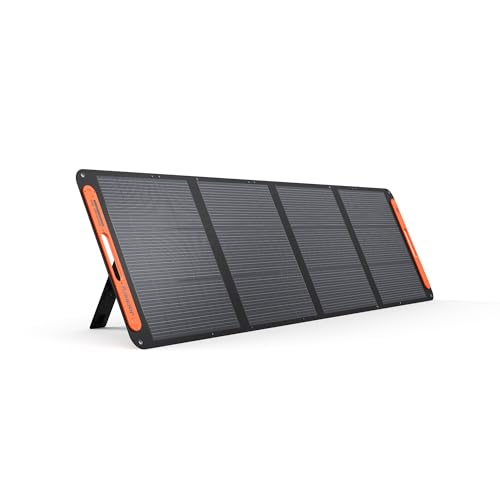
Jackery SolarSaga 200W Panel — Set-and-Forget Add-On
Current Price on Amazon: see current price on Amazon
Pair a panel with the power station and winter daylight recharges what the lights use each night — a self-sustaining display with no outlet and no running cost.
Shopping in November? All of these are on our Black Friday watchlist — and a compact power station makes a great holiday gift in its own right.
Setup Tips for an Outdoor Display
Shelter the Power Station
The lights are weatherproof; the power station usually isn't. Put it in a deck box, under a porch, or inside a garage with the cord running out — off the ground, away from snowmelt and sprinklers.
Use a Timer — It Triples Your Runtime
A $10 outlet timer (or the power station's app schedule on EcoFlow and Anker models) running 5pm–11pm instead of all night cuts consumption by more than half and keeps the display consistent all season.
Mind the Cold-Charging Rule
LiFePO4 batteries discharge fine in freezing weather but won't charge below 32°F / 0°C. Run the display outside, but bring the unit indoors (or into a heated garage) to recharge overnight. More in our winter power guide.
It Earns Its Keep After the Holidays
The same unit that runs your lights in December is your outage backup in January and your camping power in July — which is why we recommend a general-purpose model over a novelty solution.
Christmas Lights Power FAQ
How long will a solar generator run Christmas lights?
A typical all-LED display (several hundred lights, ~50W) runs 5–6 hours on a 288 Wh unit and about 20 hours on a 1 kWh unit. On a 6-hour nightly timer, that's one to three evenings per charge for small units, or most of a week for a 1 kWh model.
Can a power station run inflatable decorations?
Yes — inflatables use a small fan drawing 50–150W each. Any unit with 300W+ AC output handles one or two; count each inflatable as roughly triple the power of your entire LED light budget when sizing.
Can the solar panel keep the lights running indefinitely?
For LED displays, often yes. A 100–200W panel harvesting even 3–4 winter sun-hours generates 300–600Wh — more than a 50W display uses in a 6-hour evening. Cloudy stretches will need an occasional indoor top-up.
Can the power station itself stay outside in winter?
It can discharge outdoors in the cold (sheltered from moisture), but don't charge it below freezing — LiFePO4 batteries block charging below 32°F to protect the cells. The easy pattern: run outside in the evening, recharge indoors overnight.
Is this cheaper than hiring an electrician to add an outdoor outlet?
Usually, yes — a new exterior circuit typically costs several hundred dollars installed, similar to a compact power station that also serves as outage backup and camping power year-round. If you decorate the same far-from-the-house spot every year, the power station is the more flexible investment.