
Home Backup Guide · Updated November 2026
How to Connect a Generator to Your House Safely
The short answer: three legal ways
- 1. Extension cords to appliances
- Heavy-duty outdoor cords from the generator to a fridge, lamps or a router. No electrician needed [1][6].
- 2. Power inlet box + interlock kit
- An outdoor inlet plus a plate on your main panel so the main and generator breakers can never be on together. Any circuit can run [9].
- 3. Transfer switch
- A manual switch with a set of pre-wired circuits for a portable generator, or an automatic one for a standby generator [8][13].
Options 2 and 3 are licensed-electrician work, usually under a permit [7][6]. Never plug a generator into a wall or dryer outlet: that is backfeeding, and it can kill a lineworker.
As an Amazon Associate, SolarGenAdvisor earns from qualifying purchases made through links on this page, at no additional cost to you. Scores are AI-synthesized from manufacturer documents, listings and logged Amazon prices; we did not test or install this hardware.
 By Morgan Chen
Reviewed & approved by Juhi Sahni
|
Published: November 18, 2026
|
Updated:
|
Generator transfer switch guide
Never Backfeed: The Suicide Cord Warning
Do not do this
A cord with a plug on both ends, run from a generator into a wall outlet or the dryer outlet, is the “suicide cord” or “widowmaker” hookup [4]. The CPSC calls powering house wiring through a wall outlet backfeeding: it is extremely dangerous, puts utility workers and neighbors on the same transformer at risk of electrocution, and bypasses some of the house’s built-in circuit protection [1]. In 2026 the CPSC told consumers to stop using male-to-male extension cords and dispose of them, warning that using them to feed a generator into a home is a serious electrocution and fire risk [3][4].
Here is why it is so dangerous. Your house is still connected to the utility line, so generator power flows out through the meter and the transformer steps it up to line voltage. OSHA says a generator attached to a building without a properly installed transfer switch “can energize wiring systems for great distances” and puts utility workers at risk [6]. Electric cooperatives give their members the same warning: crews restoring power may run into high voltage they did not expect [11][12]. Oregon’s building officials add a risk to you: without a transfer switch, removing the connection once grid power returns endangers the owner and the property [7].
Switching off the main breaker by hand is not a substitute: code calls for transfer equipment that prevents the two sources from ever being connected together [9][8], not a step someone has to remember, and the CPSC tells anyone who owns a male-to-male cord to stop using it [3]. Every legal method below either keeps the generator off the house wiring entirely (cords) or uses equipment that cannot connect the generator and the grid at the same time.
The Three Legal Ways to Hook Up a Generator
They differ in what they can power and who installs them. Only cords need no electrician; the interlock and transfer switch both start with an outdoor inlet box and a locking generator cord.
| Method | What it powers | How changeover works | Who installs it | Published installed cost |
|---|---|---|---|---|
| 1. Extension cords | Plug-in appliances only, one cord each. Not a hardwired furnace, well pump or sump pump without a plug. | Unplug from the wall, plug into the cord | You | The cords only |
| 2. Inlet box + interlock kit | Any circuit in the main panel; you manage the load | Main breaker off, generator breaker on | Licensed electrician, usually with a permit | $300–$600 (one WA contractor) [21] |
| 3a. Manual transfer switch | A pre-wired set of circuits, often 6 or 10 [13] | Flip each circuit from LINE to GEN | Licensed electrician, usually with a permit | $700–$2,000 typical, about $1,200 average [20]; $800–$1,500 [21] |
| 3b. Automatic transfer switch | Selected circuits or the whole house | Automatic, nobody needs to be home | Licensed electrician (and gas work for a standby unit) | $1,500–$3,000, not including the generator [21] |
Costs are third-party published estimates, each labeled with its source; they are not our quotes. Labor, permit fees and panel condition vary from house to house, so ask for the device, inlet, wiring and permit as separate lines.
Option 1
Extension cords to appliances
The simplest legal hookup: the generator stays outside and each appliance plugs into a cord that runs to it. CPSC says to use heavy-duty cords designed for outdoor use, each rated above the total wattage plugged into it, long enough to keep the generator far from doors and windows, with all three prongs intact [1]. OSHA adds that underrated cords should be replaced with heavier-gauge ones [6]. Right for a fridge, a freezer, a few lamps and the router.
Option 2
Inlet box + interlock kit
A metal plate on the panel cover blocks the generator breaker whenever the main is on, so generator and grid can never be connected together. IAEI Magazine describes mechanical interlocks as one recognized form of transfer equipment [9]. Kits are panel-specific and your inspector decides which are accepted; our generator interlock kit guide sorts kits by panel brand.
Option 3
Manual or automatic transfer switch
A small sub-panel beside the main panel. Each circuit sits on LINE or GEN, never both, which is why it prevents backfeed [14]. Manual switches suit portable generators; automatic ones belong with permanently installed standby generators. Compare kits, 30A vs 50A, in our portable generator transfer switch guide.
Permits, NEC 702 and Who Does the Work
A generator feeding house circuits is an optional standby system under Article 702 of the National Electrical Code. The 2002 NEC added a requirement for a transfer switch whenever a fixed or portable standby generator is connected to a premises wiring system [8], and the job of that transfer equipment is to prevent inadvertent interconnection of the normal and standby sources [9]. Section numbers move between code editions, so the edition your jurisdiction has adopted, plus any local amendments, is the one that counts.
- State and local rules. Oregon is a clear example: its electrical code requires a transfer switch or other device to prevent back feeding, and its building officials say the work requires a permit and should only be done by a properly licensed electrician [7]. Your local building department can tell you what applies where you live.
- Federal safety guidance. OSHA says never to attach a generator to a building’s electrical system unless a qualified electrician has installed it with a transfer switch [6]. Honda says transfer switches and inlet boxes must be installed by a qualified electrician [15].
- Load selection. On a manual system, NEC 702 lets you, the user, choose which loads run, but the generator must cover everything you intend to run at once; automatic systems must carry the full transferred load or use load management [10].
- Tell your utility. Some electric cooperatives ask members to call before any generator transfer switch is installed [12].
What the electrician installs, and what you do
Electrician (under a permit)
- Mounts the transfer switch beside the panel, or fits the interlock and a generator breaker
- Mounts the outdoor inlet box and runs the wiring to it
- Handles grounding and the neutral to match your switch and your generator’s manual
- Labels the equipment and gets the inspection signed off
You
- List the circuits you need and note any that are 240V
- Check your generator’s outlet type before anything is bought
- Buy a cord that matches, long enough for the 20 ft rule
- Follow the start-up and shutdown order below, and practice it once
We deliberately publish no panel wiring steps. Code references here are for orientation only; the code edition your jurisdiction has adopted and your inspector’s decision govern every installation.
Match the Inlet and Cord to Your Generator Outlet
Before you or your electrician buys anything, look at the largest outlet on your generator. The generator outlet, the cord and the inlet box all have to match in plug type, amps and voltage, and that outlet caps what can reach the house, whatever the engine is rated for.
| Generator outlet | Rating | Cord | Inlet box | Most it can deliver |
|---|---|---|---|---|
| TT-30R (3-prong RV)Common on 120V inverter generators and power stations | 30A, 125V, 2-pole 3-wire [17] | TT-30P to L5-30R [23] | 120V L5-30 inlet | 30A × 120V = 3,600 W, 120V circuits only |
| L5-30R (3-prong locking) | 30A, 125V, 2-pole 3-wire [18][19] | L5-30P to L5-30R | 120V L5-30 inlet | 3,600 W, 120V circuits only |
| L14-30R (4-prong locking)The standard home-hookup outlet on 120/240V portables | 30A, 125/250V, 3-pole 4-wire [18][19] | L14-30P to L14-30R, 10-gauge minimum [13][15] | 30A L14-30 inlet, e.g. Reliance PB30 | 30A × 240V = 7,200 W; Reliance rates its 30A gear for generators up to 7,500 running W [13] |
| 14-50R (4-prong, 50A)On many generators of about 9,000 W and up | 50A, 125/250V, 3-pole 4-wire [18][19] | 50A cord, 6-gauge minimum [13] | 50A inlet (Reliance uses a CS6375) | 50A × 240V = 12,000 W; Reliance rates its 50A gear to 12,500 running W [13] |
Watt figures are amps × volts (our arithmetic) next to Reliance’s published ratings. A 120V source cannot feed 240V loads such as a well pump or central air, and adapters between 120V and 240V connectors are not a workaround. Your electrician confirms the exact cord and inlet for a 50A build.
Cord gauge by amps
Lower gauge numbers mean thicker wire. The rule from CPSC and OSHA is simple: the cord’s printed rating must exceed the load on it, and an underrated cord gets replaced with a heavier-gauge one [1][6]. For specific gauges:
| Cord use | Gauge | Source |
|---|---|---|
| 120V plug-in cord, up to 15A, 25–50 ft | 14-gauge carries 15A at 25–50 ft but only about 10A at 100 ft | WC Safety chart [16] |
| 120V plug-in cord on a 20A outlet | 12-gauge: 15–20A to 50 ft, 15A at 100 ft; 10-gauge for 20A at 100 ft | WC Safety chart [16]. Honda limits its EU2200i to a standard outdoor cord of 50 ft [15] |
| 30A locking cord (TT-30, L5-30, L14-30) | 10-gauge minimum | Reliance spec sheet [13]; Honda’s 30A 125/250V cords are 10-gauge [15] |
| 50A cord (14-50) | 6-gauge minimum | Reliance spec sheet [13] |
Gauge charts differ between publishers, and generator manuals often set their own limits. Where your generator’s manual gives a cord length or gauge, follow it. Keep cords out of standing water and protect them where they pass through a door or window [1].
Which House Circuits Your Generator Can Run
Start from the outlet ceiling above (3,600 W through a TT-30, about 7,200 W through an L14-30), then pick circuits that fit under it with room for one motor start. The usual essentials list on a 6-circuit switch is the refrigerator, the furnace blower, a well or sump pump, one lighting circuit and the router; a 240V well pump takes two switch positions because it uses a double-pole breaker [13]. Reliance’s manual says to alternate large loads such as furnace motors, well pumps and refrigerators to balance the generator, and to turn off any load the watt meters show as excessive [14].
For worked load plans, see what a 5000 watt generator can run: a fridge, freezer, sump pump, furnace blower, lights and router together, with conservative starting-watt checks. Choosing between engine types? Inverter generator vs conventional generator explains why most 2,000–4,000 W inverter models are 120V-only, which limits them to a TT-30 hookup.
From that guide’s load plans:
- Good fits for a 30A hookup: fridge, freezer, furnace blower, sump pump, lights, router, a microwave used on its own.
- Usually too big: central air, an electric range, an electric water heater or an electric dryer alongside anything else; leave those circuits off the switch.
Start-Up and Shutdown Order for Outage Day
This is the owner’s part, once a licensed electrician has installed the switch or interlock and the inlet box. The sequence below follows Reliance’s Pro/Tran 2 owner’s manual [14]; your switch’s or interlock’s own manual governs if it differs.
When the power goes out
- Place the generator outdoors, at least 20 feet from the house with the exhaust pointed away from doors, windows and vents [2][5].
- With every transfer switch circuit on LINE or OFF, plug the cord into the inlet box, then into the generator.
- Start the generator following its manual and let it warm up.
- Move the circuits you need to GEN, alternating the large motor loads. With an interlock, the plate enforces the order: main breaker off first, then the generator breaker on, then the branch circuits you need.
- Watch the watt meters or appliance nameplates and stay within the generator’s running watts.
When utility power returns
- Return every circuit selector to LINE. With an interlock: generator breaker off, then main breaker on.
- Turn off the generator following its manual.
- Unplug the power cord, and let the generator cool before refueling or storing it [6][1].
Refueling during a long outage
Shut the generator down and let it cool before adding fuel; gasoline spilled on hot engine parts can ignite. Store fuel outside living areas [6][1].
Carbon monoxide: alarms inside, generator outside
CPSC says never run a generator inside a home, garage, crawlspace or shed, even with doors and windows open, and to install battery-operated CO alarms or plug-in alarms with battery backup, tested monthly [1]. Interconnected alarms are best [2]. Our portable carbon monoxide detector guide compares battery alarms you can put near sleeping areas.
Hookup Parts by Type
These are the parts to bring to your electrician, grouped by what they do. All are listed on Amazon; specs come from our product database, cross-checked against the maker or a distributor in our transfer switch and interlock kit guides. Match the part to your generator’s outlet and your panel first; a part that does not fit is worthless at any price.
Generator cords
240V L14-30 cord, 25 ft · Our score 75/100

Conntek 20601 25 ft 30A L14-30 Generator Cord
L14-30P to L14-30R · 30A, 125/250V · up to 7,500 W · 25 ft, 10/4 STW
Price on Amazon: $51.95
For a generator or station with a 4-prong L14-30R outlet, running to an L14-30 inlet box. Conntek lists UL and C-UL plug and connector, 10/4 STW cable and a 7,500 W rating; it is usually sold by a third-party seller.
240V L14-30 cord, sold by Amazon
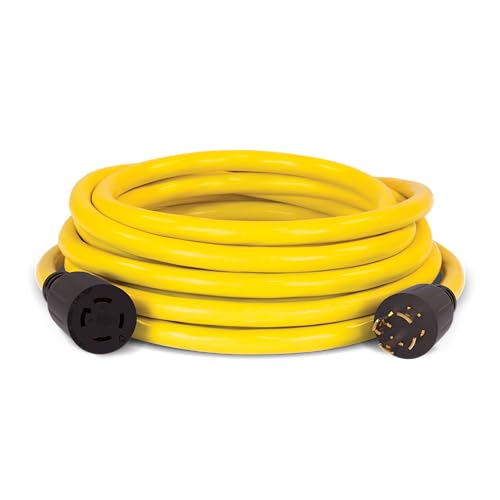
Champion 25 ft 30A L14-30 Generator Power Cord (100395)
L14-30P to L14-30R · 30A, 125/250V · up to 7,500 W · 25 ft, 10 AWG SJTW
Champion’s 25 ft, 10-gauge SJTW cord for the same L14-30 hookup, with a 1-year warranty per Champion.
120V TT-30P to L5-30R cord

Champion 30 ft 30A TT-30P to L5-30R Generator Cord (100827)
TT-30P to L5-30R · 30A, 125V · up to 3,750 W · 30 ft, 10/3 STW
For a 120V-only generator or power station with a TT-30R RV outlet, running to a 120V L5-30 inlet. It carries a single 120V leg, so it cannot feed 240V circuits.
Power inlet box
30A L14-30 inlet box
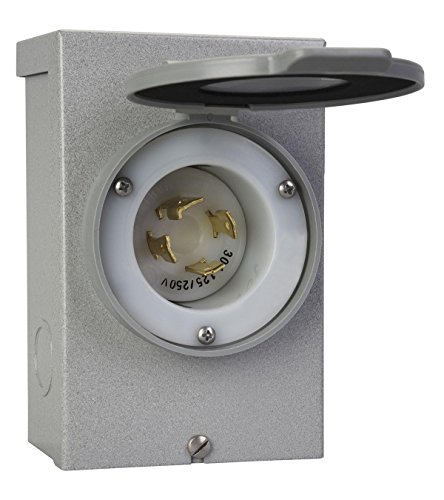
Reliance Controls PB30 30A Power Inlet Box (L14-30)
L14-30P inlet · 30A, 125/250V · up to 7,500 W
Price on Amazon: $59.98
The weatherproof socket your electrician mounts on the outside wall, so the cord plugs into the house instead of a window. It pairs with a transfer switch or an interlocked breaker.
Manual transfer switch kit
30A, 6-circuit kit with inlet box and cord

Reliance Controls 306CRK Pro/Tran 2 Transfer Switch Kit
L14-30 (PB30 inlet box + 10 ft PC3010 cord) · 30A, 125/250V · up to 7,500 W · 6 circuits
Switch with watt meters, a PB30 inlet box and a 10 ft cord in one box. Reliance’s spec sheet lists the Pro/Tran 2 series as UL 1008 listed and suitable for NEC Article 702 [13]. A 10 ft cord is short for a gas generator; most owners add a 25 ft cord to keep the 20 ft distance.
Interlock kit
Panel maker’s interlock: Siemens / Murray

Siemens ECSBPK01 Generator Standby Power Mechanical Interlock
Siemens or Murray load centers where the main is a 2-pole QP-type breaker opposite the standby breaker (QP or MP)
Price on Amazon: $38.33
Siemens’ own UL-listed interlock, for Siemens and Murray panels whose main is a 2-pole QP-type breaker opposite the standby breaker. It fits that arrangement only; kits for other panel brands are in our interlock guide.
Warranty terms differ between sources for some of these parts; our transfer switch and interlock guides note each conflict, so confirm the term with the maker. Neither the interlock nor the switch kit includes the generator breaker your panel may need.
No-Fumes Alternative: Power Station or Smart Panel
A battery power station makes no exhaust, so it can sit indoors next to the inlet, but it holds a fixed amount of energy. If it has a 30A TT-30 or L14-30 outlet, it uses the same switch, inlet and cord as a gas generator, and backfeeding from a battery is just as dangerous. Runtime is battery Wh × 0.85 ÷ load (0.85 is our planning allowance for inverter losses, not a measured figure).
120V station with a TT-30 outlet · Our score 87/100

3,072 Wh · 3,600 W continuous · 7,200 W surge · 59.5 lb · LiFePO4 · 120V only [22][24]
Its 30A TT-30 outlet carries the full 3,600 W, while its four household outlets share 2,400 W [24]. Jackery says it can run up to six essential circuits through a manual transfer switch [22], using a TT-30P to L5-30R cord into a 125V 30A switch with an L5-30 inlet [23], the same hookup the Champion TT-30 cord above serves. By our math it runs a 300 W essentials load for about 8.7 hours.
Skip it if: you need 240V for a well pump or central air, or outages that last days without sun or a generator to recharge it; it cannot be expanded.
| Circuits on backup (steady load) | Jackery HomePower 3000 (~2,611 Wh usable) |
|---|---|
| Fridge + router + LED lights (~300 W) | ~8.7 h |
| Above + furnace blower (~800 W) | ~3.3 h |
| Above + sump pump running (~1,500 W) | ~1.7 h |
| Price on Amazon | Check price at Amazon → |
Our arithmetic, using the same three loads as our transfer switch guide. Fridges and furnaces cycle, so real runtimes are usually longer than a constant-draw estimate. These are estimates, not test results.
240V stations with an L14-30 outlet
For 240V circuits, a station needs 120/240V split-phase output on an L14-30R, which then takes the same L14-30 cord, inlet and 30A switch as a 7,500 W gas generator. The EcoFlow Delta Pro 3 and Anker SOLIX S5000 both have one; neither showed in-stock Amazon availability at our last check, so we link their reviews instead: the EcoFlow Delta Pro 3 review and Anker SOLIX S5000 review. Our transfer switch for a solar generator guide covers which stations work with which switch.
Smart home panels: automatic changeover
A brand smart panel replaces the manual switch with automatic changeover, but only for that brand’s own stations, and it still needs a licensed electrician. The smart home panel guide compares the EcoFlow, Jackery and Anker panels in full.
Smart panel for EcoFlow DELTA Pro-series stations · Our score 82/100

EcoFlow Smart Home Panel 2
12 circuits · 120/240V · about 20 ms switchover [25]
Price on Amazon: $1,499.00
EcoFlow's 12-circuit smart sub-panel for the DELTA Pro Ultra and DELTA Pro 3 that switches to battery in about 20 ms, scales to three inverters and manages backup reserve, time-of-use and generator input in the app, but it is the most expensive panel here and needs a licensed electrician to install.
200A smart panel for DELTA Pro Ultra / Ultra X · Our score 78/100

EcoFlow Smart Home Panel 3
32 circuits · 120/240V or 120/208V · about 20 ms switchover [26]
Price on Amazon: $3,299.00
EcoFlow's 200A, 32-circuit smart panel for the DELTA Pro Ultra X and original DELTA Pro Ultra that can serve as a main panel or subpanel, switches to battery in under 20 ms and scales to 36 kW and 180 kWh, but it costs more than Smart Home Panel 2, does not support the DELTA Pro 3 and needs a licensed electrician to install.
EcoFlow also lists generator input on Smart Home Panel 2 for a 3–12 kW portable gas generator [25], so one panel can take a battery for short outages and a generator for long ones.
Verdict: Which Hookup Fits Your House
- •A fridge, lights and the router for a day or two: heavy-duty outdoor extension cords straight from the generator, sized to the load. No electrician, no permit.
- •Hardwired loads (furnace, well or sump pump) on a 120/240V generator: a 30A manual transfer switch with an L14-30 inlet, installed by a licensed electrician. The complete Reliance 306CRK kit is listed on Amazon. Pair it with a 25 ft L14-30 cord such as the Conntek 20601 (our score 75/100).
- •Every circuit available, and your panel has a listed kit: an interlock and inlet box, usually the lowest installed cost of the panel options in the published figures above.
- •No fumes, no fuel runs: a power station with a TT-30 or L14-30 outlet through the same switch, or a brand smart panel for automatic changeover.
Generator Hookup FAQ
How do I hook up a generator to my house safely?
Use one of three legal methods: run heavy-duty outdoor extension cords from the generator to individual appliances; have a licensed electrician install an outdoor power inlet box with an interlock kit on your main panel; or have one install a manual transfer switch (or an automatic one for a standby generator). Never plug a generator into a wall or dryer outlet, which backfeeds the utility lines.
Can I plug a generator into a wall outlet or dryer outlet?
No. The CPSC calls this backfeeding and says it is extremely dangerous: it puts utility workers and neighbors on the same transformer at risk of electrocution and bypasses household circuit protection. The double-male cords used for it are often called suicide cords, and in 2026 the CPSC told consumers to stop using and dispose of male-to-male extension cords.
Do I need a permit and an electrician to connect a generator to my house?
For an interlock or transfer switch, yes in most places. NEC Article 702 requires transfer equipment whenever a standby generator is connected to premises wiring, OSHA says never to connect a generator to a building unless a qualified electrician has installed it with a transfer switch, and Oregon, for example, says the work requires a permit and a licensed electrician. Ask your local building department. Extension cords to appliances need neither.
Transfer switch or interlock kit: which is better for a portable generator?
An interlock leaves every circuit in the panel available and one Washington contractor lists it at $300 to $600 installed, but it must match your exact panel and you manage the load yourself. A manual transfer switch mounts beside almost any panel and limits backup to a pre-wired set of circuits, often 6 or 10, which makes overloading harder; published 2026 figures put installation around $700 to $2,000. Your inspector decides which is accepted locally.
What cord do I need to connect my generator to an inlet box?
One that matches your generator's outlet and the inlet. A 4-prong L14-30R outlet (30A, 125/250V) takes an L14-30P to L14-30R cord of at least 10 gauge into an L14-30 inlet. A 3-prong TT-30R RV outlet (30A, 125V) takes a TT-30P to L5-30R cord into a 120V L5-30 inlet and can feed only 120V circuits. A 50A 14-50R outlet needs a 50A cord of at least 6 gauge and a 50A inlet.
What gauge extension cord should I use with a generator?
The cord's rating must exceed the total load plugged into it, and it should be a heavy-duty, outdoor-rated, three-prong cord. As a guide, one published chart rates 12-gauge cords at 15 to 20 amps up to 50 feet and 10-gauge at 20 amps at 100 feet. Reliance specifies at least 10 gauge for 30A generator cords and 6 gauge for 50A. Where your generator's manual sets a cord length or gauge, follow it.
How far from the house should a generator be?
At least 20 feet, according to both the CPSC and the CDC, with the exhaust pointed away from doors, windows and vents. Never run it in a garage, basement, crawlspace or shed, even with the door open. Install battery-operated or battery-backup carbon monoxide alarms inside, ideally interconnected, and test them monthly.
What order do I start and stop a generator on a transfer switch?
Reliance's Pro/Tran 2 manual says to set every circuit to LINE or OFF, connect the cord to the inlet and then the generator, start the generator outdoors, then move the circuits you need to GEN. When utility power returns, move every circuit back to LINE, turn off the generator, and unplug the cord. Follow your own switch's manual if it differs, and refuel only after the engine has cooled.
How much does it cost to install a generator transfer switch?
Cost to Renovate (updated April 2026) puts the national average around $1,200 with most projects at $700 to $2,000. Clarity Electric in Washington (March 15, 2026) lists $800 to $1,500 for a 6 to 10 circuit manual switch including the permit, $300 to $600 for an interlock kit, and $1,500 to $3,000 for an automatic transfer switch, not counting the generator. Get a local quote that itemizes the device, inlet, labor and permit.
Can a power station connect to my house instead of a gas generator?
Yes, through the same kind of transfer switch or inlet, if its outlet matches. A 120V station with a TT-30 outlet, such as the Jackery HomePower 3000, can feed up to six 120V circuits through a 30A manual switch, according to Jackery. A 240V station needs an L14-30R outlet. A station makes no exhaust, but it runs out: hours are roughly battery Wh times 0.85 divided by the load.
Sources
Safety and code statements come from CPSC, CDC, OSHA, Oregon’s Building Codes Division, two electric cooperatives and trade publications on NEC Article 702; outlet and cord ratings from Reliance, Honda, Leviton and NEMA connector charts; costs from dated third-party cost guides. Watt ceilings and runtimes are our arithmetic. Product specs come from our product database, cross-checked against the listed sources. Nothing here was measured or installed by us. Last reviewed November 18, 2026.
- CPSC Safety Alert 5123, Portable Generator Hazards: never backfeed through a wall outlet; heavy-duty outdoor cords rated above the connected load with all three prongs; battery or battery-backup CO alarms; refuel only when cool
- CPSC, Winter weather safety tips (March 16, 2026): run portable generators outside only, at least 20 feet from the house, exhaust pointed away; interconnected CO alarms
- CPSC, Warns consumers to stop using male-to-male extension cords (2026 news release; the page blocked our reader on Nov 18, wording confirmed through news coverage)
- ABC7 News (April 17, 2026): CPSC warning on male-to-male cords, often called “suicide cords” or “widowmakers”; serious risk of electrocution or fire
- CDC, Use a generator safely: keep it outside at least 20 feet from doors, windows and vents
- OSHA Fact Sheet FS-3286, Using Portable Generators Safely: never attach a generator to a building unless a qualified electrician has installed it with a transfer switch; grounded cords rated for the load; shut down and cool before refueling
- Oregon Building Codes Division, Electrical safety: Generator connections (April 2021): the state code requires a transfer switch or other device to prevent back feeding; the work requires a permit and a licensed electrician
- EC&M (Mike Holt), Installation and operation of optional standby systems: 2002 NEC Article 702 requires a transfer switch whenever a fixed or portable standby generator is connected to premises wiring
- IAEI Magazine, Transfer equipment used in optional standby systems: transfer equipment must prevent inadvertent interconnection of normal and alternate sources; mechanical interlocks are one recognized method
- EC&M, Code Q&A: sizing an optional standby generator (NEC 702.4: on manual transfer the user selects the load; automatic transfer needs full-load capacity or load management)
- Lake Country Power (electric cooperative), Portable generators: backfeeding is dangerous; crews restoring power may unexpectedly encounter high voltage
- GVEC (electric cooperative), Home generator transfer switch installs: backfeeding can lead to electrocution of line crews and the public
- Reliance Controls, Pro/Tran 2 spec sheet: 30A models 7,500 running watts, 10-gauge minimum cord; 50A models 12,500 running watts, 6-gauge minimum; UL 1008 listed, suitable for NEC Article 702
- Reliance Controls Pro/Tran 2 owner’s manual (ManualsLib copy), Using your transfer switch with a portable generator, and Transferring from generator power to utility power
- Honda Power Equipment, Transfer switch recommendations: transfer switches and inlet boxes must be installed by a qualified electrician; 30A 125/250V 10-gauge 4-wire cords; EU2200i: standard outdoor extension cord, 50 ft max
- WC Safety, Extension cord gauge chart (amps by gauge at 25, 50 and 100 ft, set by cord ampacity and a 5% voltage-drop budget at 120V)
- Leviton 7313: NEMA TT-30R receptacle, 30A, 125V, 2-pole 3-wire, for recreational vehicles
- Americord, NEMA charts: L5-30 is 125V 2-pole 3-wire grounding; L14-30 is a 125/250V 3-pole 4-wire locking plug for generators and transfer switches; 14-50 is 50A 125/250V
- Signal & Power, NEMA connector guide: L5-30P 125V 2-pole 3-wire; L14-30P 125/250V 3-pole 4-wire; 14-50P 125/250V 3-pole 4-wire
- Cost to Renovate, Generator transfer switch installation cost (updated April 2026): average about $1,200, most projects $700–$2,000, typically 3–5 hours
- Clarity Electric, Newcastle WA (March 15, 2026): manual transfer switch $800–$1,500 installed with permit; interlock kit $300–$600 installed; automatic transfer switch $1,500–$3,000 without the generator
- Jackery, HomePower 3000 product page: 3,072 Wh, 3,600 W, up to six home circuits with a manual transfer switch (checked Oct 31, 2026 for our review; rate-limited Nov 18)
- Jackery, Which Jackery products are compatible with a transfer switch: TT-30P to L5-30R cord to Jackery’s 125V 30A, 6-circuit switch with an L5-30 inlet (from Jackery’s pages as indexed Nov 18, 2026)
- The Solar Lab, Jackery HomePower 3000 review: 30A RV-style outlet rated 3,600 W continuous at 120V; four household outlets share 2,400 W
- EcoFlow, Smart Home Panel 2: 12-circuit sub-panel, 20 ms automatic switchover, up to three inverters, installation by certified electricians
- Solaris, EcoFlow Smart Home Panel 3 (EFSMARTHOMEPANEL3-32-US): 32 circuits, 200A max, under 20 ms switchover; DELTA Pro Ultra and DELTA Pro Ultra X inverters
Electrician booked? Bring the outlet type off your generator, your circuit list and the cord that matches. The Conntek 25 ft L14-30 cord is currently $51.95 on Amazon.
Check Price on Amazon →Save to cart