
Comparison Guide · Updated November 2026
Inverter Generator vs Generator: Which Do You Need?
Short answer
An inverter generator turns its engine’s output into DC and back into steady AC, so it can idle down with the load. That makes it quieter, lighter and cleaner-powered (makers publish under 3% THD), which suits camping, RVs and electronics. A conventional generator runs at a fixed speed and gives you more watts per dollar, plus 240V outlets for a transfer switch. Both burn fuel and must run outdoors. If you need power indoors or silently, a battery power station is the third option.
As an Amazon Associate, SolarGenAdvisor earns from qualifying purchases made through links on this page, at no additional cost to you. Comparisons use manufacturer specs and published figures; we did not test these generators.
 By Jordan Park
Reviewed & approved by Juhi Sahni
|
Published: November 18, 2026
|
Updated:
|
Gas vs solar
Side-by-Side Comparison
“Generator” here means a conventional portable generator, usually an open-frame unit. The inverter figures come from the Honda EU2200i and Champion 2500 and 4500; the conventional figures from the 9,500–12,500W dual and tri fuel models in our propane generator guide. Specs are the makers’ published figures and the cost row is from our own price checks; sources are under the table.
How it makes power
Alternator output is converted to DC, then an inverter builds new 120V AC
Alternator output goes straight to the outlets; the engine holds a fixed speed for 60 Hz
Power quality (THD)
Champion, Westinghouse and Generac publish 3% or less
Generac puts standard portables at 9–15%, some up to 30%; better alternators publish under 6%
Noise (published)
48–57 dB(A) for the Honda EU2200i; 53–61 dBA at 23 ft for Champion’s 2500 and 4500
74 dBA for the 9,500–12,500W open-frame models in our propane guide
Fuel at light load
Engine slows with the load (Eco-Throttle, Economy Mode); Honda says up to 40% less fuel
Engine stays at full speed even with a small load
Typical power range
About 900–3,900 running watts in the models we track; more with a parallel kit
9,500–10,000 running watts in the home-backup models we track
Weight
43.2 lb (Champion 2500) to about 99.2 lb (Champion 4500)
211–231 lb for the 9,500W-class models
Cost per running watt
Higher; premium compact models cost the most per watt
Lower; the cheapest per watt in our price checks was an open-frame model
240V / 30A outlets
Mostly 120V; larger models add a 120V TT-30R RV outlet
120/240V L14-30R and 14-50R on the 9,500W class, for a transfer switch or inlet
Parallel kits
Common: two units linked for more output (kit or cable sold separately)
Not offered on the open-frame models we track
CO shutoff
Available (Honda CO-MINDER, Champion CO Shield, Westinghouse CO sensor)
Available on some models (CO Shield, CO sensor “c” versions), not all
Sources: how each works and Eco-Throttle (Honda, inverter generator advantages; Honda, what is an inverter generator); THD (Generac, What Is THD; Norwall, generator THD; Champion 2500 Dual Fuel; Norwall iGen5000DFc); EU2200i noise, weight, runtime and parallel output (Honda EU2200i specifications; Camping World EU2200i listing); Champion noise, weights, TT-30R and ParaLINK (Champion 2500 Dual Fuel; Champion 4500 Dual Fuel); open-frame outlets and noise (Westinghouse WGen9500DF; Champion 12,500W Tri Fuel). Running-watt ranges and weights are from our product data. Cost per watt is from the Amazon price checks behind our gas-generator ratings (November 1, 2026); prices change, so check the live price before you buy.
How Each One Works
A conventional generator spins an alternator with a gas, propane or natural gas engine, and the alternator’s AC goes more or less straight to the outlets. Because the frequency of that AC is set by how fast the engine turns, the engine has to hold one speed. Honda puts it plainly: traditional generators “have to run at 3600 RPM to produce 60 hertz” electricity (Honda), and they “run at one speed regardless of the circumstances” (Honda resource hub). That means the same engine noise and similar fuel burn whether you are running a 5,000W well pump or a 60W phone charger.
An inverter generator adds electronics between the alternator and the outlets. The alternator makes high-voltage multiphase AC, which is converted to DC, then an inverter builds fresh 120V AC at 60 Hz and smooths it (Honda). Since the output frequency no longer depends on engine speed, the engine can slow down when the load is light. Honda calls this Eco-Throttle, Champion calls it Economy Mode (it “monitors the electrical load to reduce engine speed, noise, and fuel consumption,” Champion), and Westinghouse says its iGen2200 adjusts “its engine speed to produce only the amount of power needed” (Westinghouse).
One catch with eco mode: the engine needs a moment to speed up. Honda’s EB2800i owner’s manual says Eco-Throttle “is not effective for use with appliances or tools that require only momentary power,” and that appliances with large start-up demands may keep the engine from reaching normal speed, so it tells you to switch Eco-Throttle off for them (Honda EB2800i owner’s manual). If an air compressor or a well pump stalls the generator, turn eco mode off before you blame the generator’s size.
“Open frame” is not the same as “conventional”
Open frame describes the housing, a tubular steel frame with the engine exposed. Inverter describes the electronics. Most open-frame generators are conventional, but not all: Champion sells a 7,250 running-watt open frame inverter with under 3% THD, Economy Mode and 120/240V L14-30R and 14-50R outlets, and rates it at 72 dB(A) and 152.2 lb (Champion). Read the spec sheet for “inverter” and a THD figure rather than judging by the frame.
Clean Power: What THD Means
Total harmonic distortion (THD) measures how far a generator’s AC wave has been bent away from a smooth sine wave (Generac). Lower is cleaner. Generac says high THD can harm “sensitive electronics like computers, televisions, and cell phones.”
| Generator type | Published THD | Source |
|---|---|---|
| Champion inverters (2500, 4500, open frame 7,250W) | Less than 3% | Champion 2500; Champion 4500; Champion 9000W |
| Westinghouse iGen inverters | 3% or less | Westinghouse iGen2200; Norwall iGen5000DFc |
| Generac inverters | 3% or less | Generac |
| Honda inverters | No % on the EU2200i spec page; Honda says inverters give “less total harmonic distortion” | Honda; Honda EU2200i |
| Standard portable (conventional) | Typically 9–15%, some up to 30% | Generac |
| Better conventional alternators | Under 6% (Generac lists its XD, XG, XC, XT-EFI and GP-EFI lines; Norwall says “usually less than 5 or 6 percent”) | Generac; Norwall |
What under 3% means in practice: Norwall’s guide calls under 6% acceptable and 1–3% “close to ideal,” and notes that a UPS may drop to battery when distortion passes about 5–6% (Norwall). So an inverter generator is the safe default for laptops, TVs, phone chargers, gaming consoles, RV control boards and anything you would plug into a UPS. Power tools, lights, space heaters and many motors tolerate rougher power, which is why job sites have long run on conventional generators. Many conventional makers publish no THD figure at all; if the spec sheet is silent, assume it is not under 3%.
Noise: Published dB(A)
An inverter generator is quieter for two reasons: the engine slows at light loads, and most inverters sit inside a sound-damping shell. A conventional open-frame engine runs at full speed in the open. Here are the makers’ own figures; compare them only when the load and distance match.
| Generator | Type | Published noise | Measured how |
|---|---|---|---|
| Honda EU2200i | Inverter, 1,800W | 48 / 57 dB(A) | 1/4 load / rated load; distance not stated (Honda) |
| Champion 2500 Dual Fuel | Inverter, 1,850W | 53 dBA | From 23 ft (Champion) |
| Champion 4500 Dual Fuel | Inverter, 3,500W | 61 dBA | From 23 ft (Champion) |
| Champion 9000W open frame inverter | Open-frame inverter, 7,250W | 72 dB(A) | Distance not stated (Champion) |
| Champion 12,500W Tri Fuel; Westinghouse WGen9500DF | Conventional, 9,500–10,000W | 74 dBA | Champion states 23 ft (Champion; Westinghouse) |
The pattern is clear even with the caveats: the inverters here publish figures from 48 to 61, and the 9,500W-class open-frame units 74. Some of that gap is size, not technology: a bigger engine is louder. Whichever type you own, distance, eco mode and an open barrier do more than any add-on muffler, as our guide on how to make a generator quieter explains. If you camp, check campground quiet hours and generator rules, and see our quietest generator for camping guide for the quietest small inverters and battery options.
Fuel Use at Partial Load
Most of the time a generator runs well below its rating: a fridge, a few lights, a router and a fan. That is where an inverter’s variable engine speed pays off. Honda says Eco-Throttle cuts fuel use by up to 40% (Honda), and its EU2200i figures show why (Honda):
| Published point | Load | Runtime per tank | Gallons per hour (our math) |
|---|---|---|---|
| Honda EU2200i, 1/4 load | 450W | 8.1 h on 0.95 gal | About 0.12 |
| Honda EU2200i, rated load | 1,800W | 3.2 h on 0.95 gal | About 0.30 |
| Westinghouse WGen9500DF (conventional), 25% load | 2,375W | 12 h on 6.6 gal | About 0.55 |
| Westinghouse WGen9500DF (conventional), 50% load | 4,750W | 8 h on 6.6 gal | About 0.83 |
How to read it: a quarter of the load costs the Honda only about 40% of its full-load fuel per hour, because the engine slows down. Per kWh, though, a big engine doing real work is not wasteful: at a quarter load the Westinghouse makes about 4.3 kWh per gallon, against about 3.8 for the Honda (our arithmetic from the published runtimes). But the Westinghouse’s quarter load is 2,375W, and it burns about 4.7 times the Honda’s fuel per hour to get there. The inverter’s real advantage is that it is not oversized for small loads. Conventional makers rarely publish fuel use at a few hundred watts, so we can’t give a like-for-like figure, but a 9,500W engine held at full speed to run a fridge is the expensive case. Westinghouse figures from Westinghouse and our product data.
Size, Power and Cost per Watt
Weight: inverters for camping are built to be carried. Champion rates its 2500 Dual Fuel at 43.2 lb and Honda the EU2200i at 47.4 lb dry. Once you pass about 3,500 running watts, inverters become wheel-around units too: the Champion 4500 is 99.2 lb (Champion). The 9,500W-class conventional generators in our data weigh 211–231 lb, which makes them home-backup and job-site machines, not something you lift into a truck.
Power range: the inverter generators we track run from 900 to 3,900 running watts on gasoline; the conventional home-backup models run from 9,500 to 10,000. Bigger inverters exist (Champion’s open-frame inverter is 7,250 running watts), but at the top end conventional generators still give you the most watts for the money.
Cost per watt: we don’t print prices here because they move weekly, but the pattern in the Amazon price checks behind our gas-generator ratings (November 1, 2026) was consistent. The lowest price per running watt among the 10 gas generators we track belonged to an open-frame dual fuel model, and a premium compact inverter cost more than twice as much per running watt as a budget dual fuel inverter of similar output. Our best inverter generator and best propane generator guides show live Amazon prices for each model.
Parallel Kits, 240V and 30A
Parallel kits are the inverter answer to “I need more watts.” Honda says two identical EU2200i units on an optional cable deliver up to 4,400 watts (Honda), and Champion’s ParaLINK kit links the 4500 with another Champion inverter (Champion). Two small units are easier to carry than one big one, and you can bring just one when you need less. Honda notes the pair must be compatible models (Honda). None of the open-frame conventional models we track lists a parallel option.
30A is not always 240V. Two outlets cause most of the confusion:
- TT-30R: a 120V, 30A RV outlet. Champion lists it on the 4500 inverter (Champion), and Norwall lists it on the Westinghouse iGen5000DFc (Norwall). It feeds a 30A camper, not a house panel. See our best generator for RV guide for 30A vs 50A sizing.
- L14-30R: a 120/240V, 30A locking outlet, the usual hookup for a transfer switch or a generator inlet. The 9,500W-class open-frame models in our data have it alongside a 14-50R (Westinghouse; Champion), and so does Champion’s open-frame inverter (Champion).
So if your plan includes a 240V well pump or a transfer switch that wants 240V, check for an L14-30R or 14-50R before you buy. Most small inverters are 120V only (the EU2200i has a single 120V duplex, per Honda). Either way, connect to the house only through a transfer switch or interlock installed by a licensed electrician: plugging a generator into a wall outlet can backfeed the utility lines and endanger line workers (Lake Country Power; Minnesota State Fire Marshal).
CO Shutoff and Safety
Inverter or conventional, every gas, propane or natural gas generator makes carbon monoxide. Quieter does not mean safer. CPSC says nearly 100 Americans die each year from generator-related CO poisoning (CPSC), and both CPSC and CDC say to run a generator outdoors only, at least 20 feet from the house, with the exhaust pointed away from doors, windows and vents (CDC generator safety; CDC). Never run one in a garage, even with the door open (CPSC Portable Generator Safety Alert).
- CO shutoff is a feature, not a type. Inverters and conventional units can both have it: Honda’s CO-MINDER shuts the EU2200i down before CO near it gets dangerously high (Honda), and Champion’s CO Shield is on both its 2500 inverter and its 12,500W tri fuel (Champion; Champion). Westinghouse marks its CO-sensor versions with a “c” (iGen5000DFc, WGen9500DFc).
- Check the exact model. Some popular models are sold with and without a sensor. Our product data shows the WGen9500DF (no “c”) lists only a low-oil shutdown.
- Keep CO alarms indoors. Champion says CO Shield “is not a substitute for an indoor carbon monoxide alarm” (Champion). CPSC recommends battery-operated or battery-backup CO alarms (CPSC).
Need power inside the house, a tent or a camper? Only a battery has no exhaust. See our indoor-safe generator guide.
Which One for Your Use?
Match the generator type to the job. We don’t rank across types: an inverter, a conventional generator and a battery each win a different column.
| Use case | Usually the better fit | Why | Next step |
|---|---|---|---|
| Camping, tailgating | Inverter (1,800–2,500W class) or a battery | Lightest gas option, lowest published noise, clean power for phones and laptops; check quiet hours | Quietest for camping |
| RV (30A) | Inverter with a TT-30R, or two in parallel | 120V 30A RV outlet, clean power for the RV’s control boards | Best generator for RV |
| Home backup with a transfer switch | Conventional 9,500W class (or a large inverter with 240V) | Most watts per dollar, L14-30R/14-50R for 240V loads like many well pumps; installed by an electrician | Propane & dual fuel picks |
| Light home backup (fridge, lights, router) | 3,500–3,900W inverter, dual fuel | Sips fuel at light loads, quieter for neighbors, propane stores well | Best inverter generator |
| Job site | Conventional | Saws, compressors and lights tolerate higher THD; more running and starting watts for the money | High-output models |
| Sensitive electronics (computers, TVs, UPS) | Inverter, or a battery | Published THD of 3% or less; a UPS may reject rougher power | THD explained |
| Indoors, overnight, CPAP, apartment | Battery power station only | No exhaust and no CO; no generator can run indoors | Indoor-safe options |
Gas Generator Options
One example of each type discussed above, so you can see the trade-offs on a real spec sheet. They are grouped by type, not ranked; specs are from our product data and the makers’ published figures. For full comparisons, see our best inverter generator and best propane generator guides.

Honda EU2200i Inverter Generator
Gasoline only. Honda publishes 48 dB(A) at 1/4 load and 8.1 hours per 0.95-gallon tank at that load, plus CO-MINDER automatic shutdown and up to 4,400W with a second unit on a parallel cable. A 120V duplex, no RV outlet.
Price: $1,199.00

Westinghouse iGen5000DFc Dual Fuel Inverter Generator
Gasoline or propane, with a CO sensor that shuts the engine down, a TT-30R RV outlet and a published 18 hours at 25% load on 3.4 gallons (Norwall). It is not for sale in California, and at over 100 lb it rolls rather than carries.
Price: $999.00

Westinghouse WGen9500DFc Dual Fuel Generator with CO Sensor
The 240V option: an L14-30R and a 14-50R for a transfer switch or inlet, with a CO sensor that shuts the engine down. It is rated 74 dBA, weighs about 212 lb and is not sold in California.
Price: $1,049.00
Noise is the lowest figure each maker publishes: Honda at 1/4 load with no distance stated, no distance on the iGen5000DFc listing, and 74 dBA for the open-frame model. Sources: Honda; Norwall iGen5000DFc; Westinghouse WGen9500DF.
Smart Generators: Built to Recharge a Power Station
A newer type sits between the two: a fuel engine designed to charge a specific brand’s power station and to start itself when the battery runs low. You get a quiet battery indoors and a generator outside that runs only when needed. Like any engine, it makes carbon monoxide and must run outdoors.

Dual fuel. Charges an EcoFlow DELTA Pro 3 or DELTA Pro over a 3,200W DC cable and starts itself when the battery runs low; 3,200 running watts of AC on gasoline (2,900 on propane), app CO alerts with automatic shutdown, 83 lb, 70 dB at 7 m.

Anker SOLIX Smart Generator 5500 (Tri-Fuel)
Our score: 83/100Tri fuel (gasoline, propane or natural gas) in a NEMA 3R enclosure. DC-charges an Anker SOLIX E10 at up to 4,500W and starts on battery level; F3000 and F3800 owners get AC pass-through instead. 3,600W of AC output, CO protection, 110 lb.
Price: $1,999.00
Smart generator specs are from our product data, which records EcoFlow’s and Anker’s published specs and the Amazon listings; our EcoFlow Smart Generator review lists the sources. Smart generators are scored on their own rubric, so their scores are not comparable with the power-station scores on this page.
Where Power Stations Fit
A battery power station is the third answer to “generator or inverter.” It has its own built-in inverter, so its outlets give steady 120V AC, but there is no engine: no fuel, no exhaust, no carbon monoxide, and only fan noise. That makes it the one option you can run in a bedroom, a tent or a camper. The trade-off is runtime. A station stops when the battery is empty and needs a wall outlet, solar panels or a generator to refill, while a gas generator runs as long as you refuel it. Our solar generator vs gas generator comparison works through the running cost and the hybrid setup (generator by day, battery by night).
| Steady load | Anker SOLIX C1000 Gen 2 (1,024 Wh) | Jackery Explorer 2000 v2 (2,042 Wh) | Honda EU2200i, one tank |
|---|---|---|---|
| Fridge (average draw) (150W) | 5.8 hr | 11.6 hr | More than 8.1 hr; not published |
| Quarter load of a 1,800W inverter (fridge, lights, router, fan) (450W) | 1.9 hr | 3.9 hr | 8.1 hr (Honda) |
| Microwave or 1,500W space heater (1,500W) | 35 min | 1.2 hr | Between 3.2 and 8.1 hr |
Battery runtimes are our arithmetic: usable Wh = rated Wh × 0.85 for inverter losses, divided by the load. Capacities are from our product data. Honda publishes only the 1/4-load (8.1 h) and rated-load (3.2 h) runtimes (Honda); the generator keeps going if you refill the tank.
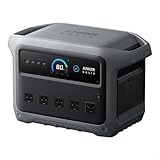
Gen 2 ultra-fast ~49-minute charging, 2,000W output, 600W solar input — premium mid-capacity portable power.
Price: $469.99

2,042Wh LiFePO4 with 2,200W output (4,400W surge) at 39.5 lb — a lighter, simpler alternative to the 2000 Plus, but not expandable and limited to 400W of solar input.
Price: $999.00
The Anker SOLIX C1000 Gen 2’s 2,000W output is in the same class as a 1,800W inverter generator, at 24.9 lb; the Jackery Explorer 2000 v2 gives 2,200W from about twice the battery. Neither replaces a generator for multi-day outages unless you add solar or a generator to recharge it. For more sizes, see our indoor-safe generator picks.
Power Inverter vs Inverter Generator
Searches for “power inverter generator” mix up two different products. A power inverter has no engine and no battery of its own. It converts 12V DC from a car, truck, RV or boat battery into 120V AC; Renogy’s 2000W model, for example, takes 12V DC in and puts out 120V AC (Renogy). It only runs as long as the battery lasts, and it needs proper cabling, fusing and a way to recharge the battery. An inverter generator makes its own electricity from fuel and uses an inverter inside to clean it up (Honda).
So: want to run a laptop or a small fridge from your vehicle’s battery? Get a pure sine power inverter; our best power inverter guide compares 12V models on surge, idle draw and safety listings. Want hours of power away from any battery or outlet? That’s a generator, or a power station, which is a battery and an inverter in one box.
Verdict: Match the Type to the Job
Buy an inverter generator if you camp, tailgate or run an RV, want clean power for electronics, or need light home backup with a neighbor nearby. You pay more per watt for lower noise, lighter weight and better fuel use at light loads. Our best inverter generator guide compares dual fuel and compact models with live prices.
Buy a conventional generator if you need 7,000W or more for a well pump, central air or a whole panel through a transfer switch, or you power job-site tools, and noise is not a concern. Look for 120/240V L14-30R or 14-50R outlets and a CO shutoff. Start with our best propane generator guide.
Buy a battery power station if any of your power has to be indoors, silent or fuel-free, or if your outages are a day or less. Many households end up with a generator and a battery.
Frequently Asked Questions
What is an inverter generator?
An inverter generator is a fuel-powered generator that converts its alternator’s AC output to DC and then back to steady 120V AC through an electronic inverter. Because the output frequency no longer depends on engine speed, the engine can slow down at light loads, which saves fuel and cuts noise. Champion, Westinghouse and Generac publish 3% THD or less for their inverters, which is clean enough for laptops, phones and TVs.
What is the difference between an inverter generator and a regular generator?
A regular (conventional) generator sends its alternator’s AC straight to the outlets, so its engine must run at a fixed speed (Honda says 3,600 RPM for 60 Hz). An inverter generator rebuilds the AC electronically, so its engine can throttle down. The result: inverters are quieter, lighter and cleaner-powered, while conventional generators give more watts per dollar and more often have 240V outlets.
Is an inverter generator better than a regular generator?
For camping, RVs, electronics and light home backup, usually yes. For whole-home backup through a transfer switch, a 240V well pump or job-site tools, a conventional generator is usually the better value, because it delivers more running watts per dollar and 120/240V outlets. Neither can run indoors.
Are inverter generators safe for sensitive electronics?
That is what they are designed for. Inverter makers publish under 3% total harmonic distortion, while Generac says standard portable generators typically run 9–15% THD and some reach 30%. Norwall’s guide calls 1–3% close to ideal and notes that a UPS may switch to battery above about 5–6%. If a conventional generator’s spec sheet gives no THD figure, don’t plug a computer or TV straight into it.
Are inverter generators quieter?
Yes, by the makers’ own figures. Honda rates the EU2200i at 48 dB(A) at a quarter load and 57 dB(A) at rated load, and Champion rates its 2500 inverter at 53 dBA from 23 feet. The 9,500–12,500W conventional models in our propane guide are rated at 74 dBA. Part of the gap is engine size, and part is that an inverter’s engine slows down at light loads.
Can an inverter generator power a house?
It can run essentials: a 3,500–3,900 running-watt inverter covers a fridge, lights, a router and a furnace blower. Most inverters are 120V only, so 240V loads such as many well pumps and central air usually need a conventional generator with an L14-30R or 14-50R outlet, or a larger inverter that has one. Any connection to the house should go through a transfer switch or interlock installed by a licensed electrician, never a backfeed cord.
Is a power inverter the same as an inverter generator?
No. A power inverter has no engine; it converts 12V DC from a vehicle or house battery into 120V AC and runs only as long as that battery lasts. An inverter generator burns fuel to make its own electricity and uses an inverter inside to clean it up. A portable power station is a third product: a battery and an inverter in one box.
Can I run an inverter generator indoors or in a garage?
No. A quieter engine still makes carbon monoxide. CPSC and CDC say to run any portable generator outdoors only, at least 20 feet from the house, with the exhaust pointed away from doors, windows and vents, and never in a garage even with the door open. A CO shutoff sensor is a backup, not permission. If you need power indoors, use a battery power station, which has no exhaust.