
Car · Boat · RV · Updated November 2026
How to Charge a Battery With a Solar Panel
Wire the solar panel to a charge controller and the controller to the battery, with a fuse on the battery cable. Connect the battery first, then the panel; Victron and Renogy both say so in their controller manuals [1][2]. Set the controller to your battery type. A 5–15 W panel keeps a parked car battery topped up; refilling a 100Ah battery takes 100–400 W.
The short answers
- What you need
- A panel, a charge controller (PWM or MPPT) matched to your battery’s voltage and chemistry, a fuse between the controller and the battery, and the right cable.
- Can you skip the controller?
- Only with a small maintainer panel whose maker says it needs none, such as Samlex’s 5 W SC-05. Battery Tender says anything bigger needs one [6][7].
- How long it takes
- A 100 W panel makes about 375 Wh on a 5-sun-hour day by our math, so a 100Ah lithium battery at 20% needs about ~2.7 days; 400 W does it in under one [4].
As an Amazon Associate, SolarGenAdvisor earns from qualifying purchases made through links on this page, at no additional cost to you. Scores are AI-synthesized from manufacturer specs, Amazon listings and public information; we did not test these products.
 By
What You Need
- A solar panel. A “12V” panel actually runs well above 12V: the Renogy 100W panel below has a 22.79V open-circuit voltage, which is why it can’t go straight onto a battery. Rigid panels with MC4 leads are the usual choice for a fixed install; for camping, see the best 100 watt solar panels.
- A charge controller. It holds the battery at its charge voltage and stops when it is full. Pick one rated for your battery’s voltage (12V, 24V, 36V or 48V), with a setting for its chemistry, and with enough amps for your panels: amps ≈ panel watts ÷ battery volts, so 100 W on 12V is about 8.3 A and 400 W about 33 A.
- Fuses. Victron says the battery supply to its 100/30 controller must be fused at 35–40 A, and Renogy recommends fuses at both the input and output of its Rover controllers [1][2]. Use the size your controller’s manual gives.
- Cable. Size it from your controller manual: Renogy’s gives a cable table by controller amps and run length, sized to keep voltage drop under 3% [2]. Longer runs and bigger controllers need thicker cable.
Charging a portable power station instead of a bare battery? Skip the controller: the station has one built in, and you plug the panel straight into its solar input. Our solar panel setup guide covers that, plus series and parallel wiring.
PWM vs MPPT Controllers
A PWM controller works like a fast switch between the panel and the battery, so the panel’s voltage is pulled down to near the battery’s. Victron calls it a good low-cost option for small systems. An MPPT controller runs the panel at its best voltage and converts the extra into charging current; Victron puts the gain at roughly 10–40%, mostly when panels are cold, very hot or in weak light [3].
- PWM is fine for one or two 12V-class panels on a 12V battery, which is exactly what the Renogy starter kits pair it with.
- Choose MPPT for a few hundred watts or more on 12V, for higher-voltage panels such as 200W and larger, or for panels wired in series. Victron says the panel voltage should be at least 5V above the battery’s and must never exceed the controller’s limit (100V on its 100/30); cold weather raises it [1].
- Lithium needs enough voltage. Renogy says its Rover Li needs at least 16V from the panels to charge a 12V lithium battery [2].
Can You Skip the Controller?
Only with a small maintainer panel, and only when its maker says so. Samlex sells its 5 W SC-05 for “direct charging – no need for additional Charge Controller,” and says it prevents current flowing back from the battery to the panel at night [6]. Battery Tender says a controller is needed for “anything but the smallest trickle panels,” because an unregulated panel can push a battery past its safe voltage [7]. Many small solar maintainers, such as SUNER’s 12W, have a controller built in, which our best trickle charger guide covers.
So the rule is simple: if the product page or manual doesn’t say it can connect directly, use a controller. Neither Samlex’s page nor Battery Tender’s gives a battery-size limit or a lithium rating, so a LiFePO4 battery always gets a controller with a lithium setting.
What Size Solar Panel?
First decide whether you want to maintain a battery or refill it.
- To maintain a parked car, motorcycle or boat battery, you only need to cover its self-discharge and any parasitic draw. Battery Tender says 5–10 W maintains a small powersports battery and 5–15 W a healthy 12V starting battery [7]. For scale, Lifeline puts AGM self-discharge at about 2–3% a month at 77 °F [9], about 1.2–1.8Ah a month on a 60Ah battery.
- To refill a used deep-cycle battery, size the panel to the energy you need to put back: Battery Tender suggests 20–100 W plus a controller for house and deep-cycle banks [7], and RV banks often get 200–400 W.
Peak sun hours are the day’s sunlight expressed as hours of full sun (1 kWh per square meter is sometimes called a sun-hour). NREL puts most of the continental U.S. at about 3.0–6.0 a day [4], and its free PVWatts calculator gives month-by-month figures for your address [5]. The 0.75 is our allowance for heat, panel angle, wiring and controller losses, the same one our 100W panel and RV kit guides use; NREL’s own worked example uses 0.80 [4].
| Battery | Energy to put back | 100W panel~375 Wh a day | 200W panel~750 Wh a day | 400W panel~1,500 Wh a day |
|---|---|---|---|---|
| Car battery, half flat60Ah lead-acid, put back 30Ah × 12V | ~360 Wh | ~1.0 day | ~0.5 days | ~0.2 days |
| 12V 100Ah AGM trolling batteryfrom 50%, put back 50Ah × 12V | ~600 Wh | ~1.6 days | ~0.8 days | ~0.4 days |
| 12V 100Ah LiFePO4 trolling batteryfrom 20%, put back 80Ah × 12.8V | ~1,024 Wh | ~2.7 days | ~1.4 days | ~0.7 days |
| RV house bank, 200Ah LiFePO4from 20%, put back 160Ah × 12.8V | ~2,048 Wh | ~5.5 days | ~2.7 days | ~1.4 days |
Our arithmetic at 5 peak sun hours and the 0.75 allowance, before any loads running at the same time. At 3 sun hours, a poor or winter day, multiply the days by 1.67. Lead-acid takes longer than the arithmetic: Trojan’s charging profile shows the current tapering once the battery is about 90% full [8]. These are estimates, not test results.
Want the daily-use version of this sum, sizing an array to what you run rather than to a battery? Use the solar size calculator.
Charge Settings by Battery Type
Most controllers ship set for lead-acid, so set the battery type before the first sunny day. These are the battery makers’ 12V figures, the same ones our RV battery charging guide uses. If your battery’s label or manual gives different numbers, use those.
| Battery (12V) | Bulk / absorption | Float | Equalize | Source |
|---|---|---|---|---|
| Flooded lead-acid (deep cycle) | 14.8V bulk; 14.1–14.7V absorption (at 77°F) | 13.5V, if desired | 16.2V, only when needed | Trojan [8] |
| AGM | 14.2–14.4V | 13.2–13.4V | Never (Trojan, for AGM and gel) | Lifeline; Trojan [9][8] |
| LiFePO4 (lithium) | 14.2–14.6V (Battle Born recommends 14.4V) | Not needed; under 13.6V is fine (Battle Born). Victron Li-ion mode: 13.5V | Off | Battle Born; Victron [10][11] |
For a 24V battery, double these; for 36V, triple them. Renogy’s Rover Li controllers detect 12V or 24V automatically for lead-acid, but the lithium battery type has to be set by hand, and lithium charges at 14.4V by default; Renogy also says not to equalize AGM, gel or lithium batteries unless the battery maker permits it [2]. Every setting and brand preset for lithium is in how to charge a LiFePO4 battery, and the battery voltage chart shows what resting voltages mean for state of charge.
Step-by-Step Connection Order
- Mount the controller close to the battery, out of the sun and away from water, with air around it. Renogy asks for good ventilation and to keep water out of the controller [2].
- Cover the panels or leave them face down while you wire. Renogy’s manual says to uncover them or turn them face up only after everything is connected [2].
- Connect the controller to the battery first, with the fuse in the positive battery cable, and check the polarity. Victron says to connect the battery and wait about 10 seconds for the controller to recognize the system voltage; connecting the panels first is only allowed if you have set the voltage by hand [1]. Renogy says to connect the battery first and then the solar panel, or the controller may be damaged, and its reverse-polarity protection doesn’t apply if the panels go on first [2].
- Set the battery type (flooded, AGM, gel or lithium) on the controller or its app.
- Connect the panels to the controller’s PV terminals, through a PV fuse or breaker if you have more than one string, then uncover them.
- Check that it charges. On a sunny day the screen or app should show charging current and battery voltage rising toward the bulk setting.
To take it apart, work in reverse: cover or disconnect the panels first, then the battery, so the controller never sits on live panels with no battery. That reverse order is our advice from the connection rules above, not a quoted instruction.
Car Battery: Plug or Clamps?
Solar for a car is almost always maintenance: a 5–15 W panel on the dash or the windshield to offset slow drain while it sits [7]. A flat car battery is a job for a plug-in charger. There are three ways to connect:
- Clamps or ring terminals on the battery always work. Samlex ships both a 12V plug and ring-terminal leads with its 5 W panel [6].
- The 12V accessory socket only works if it stays live with the key off, and that varies by vehicle and even by socket. Ford’s F-650 manual describes its 12V power point as working with the ignition on, while the 2009 Dodge Challenger’s front outlet has power only with the ignition on and its console outlet is wired to the battery at all times [16][17]. Check your owner’s manual, or test the socket with a meter or a plug-in light after the car has been locked for a while.
- The OBD-II port is the other option some maintainers use. In the standard J1962 pinout, pin 16 is unswitched battery positive [18][19]. It is a diagnostic port first, so use it only with a maintainer made for it, at the small wattage its maker specifies.
Parasitic draw (alarms, clocks, modules) varies too much by vehicle to give one figure, so watch the battery for the first few weeks. If it still drifts down, step up the panel or use a plug-in maintainer like the NOCO GENIUS5 below.
Boat and Trolling Motor Batteries
A boat on a mooring or a trailer far from an outlet is where solar earns its place. A 100 W panel puts back a half-used 12V 100Ah AGM trolling battery in about ~1.6 days of good sun, and a LiFePO4 battery from 20% in about ~2.7 days (table above). Three marine-specific points:
- Match the controller to the trolling-motor voltage. Many controllers handle only 12V and 24V. A single 36V lithium battery needs a 36V-capable controller, such as the Renogy Rover 60A below, and a panel string well above its charge voltage: Power Queen recommends a 43.8V charger for its 36V battery, and Victron wants the panel voltage at least 5V above the battery’s [13][1]. That usually means two or three panels in series on an MPPT controller.
- Keep the controller dry and inside a console or locker; Renogy says to keep water out of it [2]. Mount the panel where it won’t be shaded by a T-top or canvas.
- Watch the cold. Battle Born says LiFePO4 shouldn’t be charged below about 25 °F without internal heating, and some trolling batteries stop charging at 32 °F, such as Power Queen’s 36V, which resumes above 41 °F [12][13].
Choosing the battery itself? Our lithium trolling motor battery guide matches 12V, 24V and 36V batteries to motor thrust and covers onboard chargers.
RV House Batteries
An RV house battery already has a converter on shore power and often the alternator on the road; solar is what keeps it charged while you are parked off-grid. Roof kits of 200–400 W are typical. By our math, 400 W refills a 200Ah LiFePO4 bank from 20% in about ~1.4 days of good sun, while 200 W takes about ~2.7 days.
- Set the controller to lithium if you have a LiFePO4 bank (14.2–14.6V; Battle Born recommends 14.4V) [10]. A lead-acid setting with equalize can push a lithium battery past its limits.
- Wire the controller’s battery terminals to the house bank through the fuse your controller manual specifies, the same way the Victron and Renogy manuals show [1][2].
- Storage: a small array can offset the parasitic draws that flatten a stored RV’s battery.
Shore power, alternator and generator charging, plus winter storage, are covered in how to charge an RV battery. To compare complete roof kits, see the best RV solar kits.
Safety: Fuses and Venting
- Fuse the battery cable. Victron requires a fuse on the battery supply, and Renogy recommends fuses on both sides of the controller [1][2].
- Vent lead-acid batteries. CCOHS says lead-acid batteries generate hydrogen while recharging, explosive at 4.1–72% in air, and that they shouldn’t be charged near heat, flames or sparks [14]. OSHA’s construction rule requires ventilation that prevents an explosive mixture [15], and Renogy’s manual warns that batteries may produce explosive gases when charged [2]. Never charge a flooded battery in a sealed box or a closed cabin.
- Mind the polarity. Reversed battery leads can damage a controller, and Renogy notes its reverse-polarity protection doesn’t apply if the panels were connected first [2].
- Respect the voltage limit. Series panels add voltage, and cold raises it further; keep the array’s cold open-circuit voltage under the controller’s maximum [1].
Anything connected to a home’s wiring is a job for a licensed electrician; a vehicle, boat or RV install should still follow the controller manual’s cable and fuse table.
Recommended Gear by Type
Grouped by what each part does; the groups aren’t ranked against each other. Scores come from our product database and are AI-synthesized from manufacturer specs, Amazon listings and public information, not from testing. Specs below are from the makers’ listings as recorded in that database.
Charge Controllers
The part that makes solar safe for a bare battery. Pick by battery voltage first, then by panel watts.
For one to three 100W panels on 12V

Renogy Rover 2 20A MPPT Charge Controller with Bluetooth · Our score 82/100
Price on Amazon: $75.99
A 20A MPPT controller for 12V or 24V batteries with Bluetooth and a screen built in. Renogy rates it for up to about 300W of panels on a 12V battery (600W on 24V) with a 100V solar input, so it handles a single 100W panel today and room to add two more.
Skip it if: Your trolling bank is 36V or 48V; this controller is 12V/24V only.
For a 12V/24V lithium bank
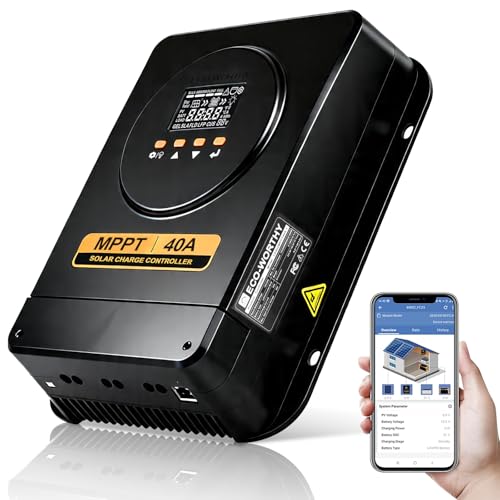
ECO-WORTHY 40A MPPT Charge Controller with Bluetooth · Our score 80/100
Price on Amazon: $111.99
A 40A MPPT controller that detects 12V or 24V batteries, with Bluetooth and a screen, a LiFePO4 charging mode and a lithium wake-up for a battery whose BMS has shut it off, per ECO-WORTHY’s listing.
Skip it if: You plan to wire several panels in series. We don’t list its maximum solar input voltage, so read the manual before you string panels.
For 24V, 36V and 48V banks

Renogy Rover 60A MPPT Charge Controller (12V to 48V) · Our score 79/100
Price on Amazon: $276.99
A 60A MPPT controller for 12V, 24V, 36V or 48V batteries with a 150V solar input. That covers a 36V trolling-motor battery, which needs a panel string well above its roughly 43.8V charge voltage, and larger RV or cabin banks.
Skip it if: You only have one small panel on a 12V battery; it is far more controller than you need, and Bluetooth needs an add-on module.
Panels for a 12V Battery
Rigid glass panels with MC4 connectors are the standard pairing with a charge controller on a roof, rack, trailer tongue or boat rail.
One 100W panel

Renogy 100W N-Type 16BB Rigid Solar Panel · Our score 77/100
Price on Amazon: $76.49
A 100W N-type glass panel, 34.1 × 22.8 in and about 13 lb, with MC4 leads. Its 22.79V open-circuit voltage suits both PWM and MPPT controllers on a 12V battery, and Renogy publishes 2,400 Pa wind and 5,400 Pa snow ratings and a 25-year, 80% output warranty.
Skip it if: You only need to maintain a parked car; a 5–15W maintainer panel is enough for that, per Battery Tender.
400W pair for an RV or boat bank

Callsun 400W N-Type Bifacial Solar Panel (2 x 200W) · Our score 77/100
Price on Amazon: $345.99
Two 200W N-type bifacial glass panels with MC4 leads and an open-circuit voltage of 27.31V each. Wired in series on an MPPT controller, the pair also clears the voltage a 24V battery needs.
Skip it if: Weight or space is tight: each panel is 51.3 × 30.3 in and 23.8 lb.
Panel + Controller Kits
A kit bundles matched panels, a controller, cables and mounts. None of these includes the battery or the battery fuse.
400W RV roof kit (MPPT)

ECO-WORTHY 400W Premium Solar Kit (40A MPPT) · Our score 83/100
Price on Amazon: $459.99
Four 100W panels, a 40A MPPT controller, a Bluetooth module, 16 ft cables with Y-branch connectors and Z-brackets. Four hundred watts refills a 200Ah LiFePO4 house bank from 20% in about ~1.4 days of good sun by our math.
Skip it if: You only need to keep a boat or trailer battery topped up; 100–200W is plenty for that.
200W starter kit (PWM)

Renogy 200W Solar Starter Kit (30A PWM) · Our score 76/100
Price on Amazon: $194.64
Two 100W rigid panels, a Wanderer 30A PWM controller, cables and Z-brackets. Two hundred watts puts back a half-used 100Ah AGM battery in about ~0.8 days of good sun, plus the slow absorption stage at the end.
Skip it if: You want app monitoring or the extra harvest of MPPT in cold weather; PWM pulls the panels down to battery voltage, per Victron.
100W starter kit (PWM)

Renogy 100W Solar Starter Kit (30A PWM)
Price on Amazon: $130.89
One 100W rigid panel, the same Wanderer 30A PWM controller, cables and Z-brackets. It is the simplest way to keep a boat, trailer or tractor battery charged, and the controller has headroom to grow the array later, per Renogy.
Skip it if: You need to refill a big lithium bank quickly; 100W makes about 375 Wh on a good day by our math.
No Sun? A Plug-In Maintainer
If the vehicle sits next to an outlet, a smart plug-in charger does the same job in any weather.
Car, truck and boat batteries

NOCO GENIUS5 5A Smart Battery Charger · Our score 75/100
Price on Amazon: $69.95
NOCO rates the GENIUS5 to charge 6V and 12V batteries up to 120Ah and maintain any size, with 12V (14.5V), AGM (14.8V) and 12V lithium (14.6V) modes, a thermal sensor and an IP65 case, per its user guide. It has a 3-year warranty.
Skip it if: The battery is far from any outlet, which is exactly where a solar panel and controller earn their place.
Going Bigger: A Complete Off-Grid System
For a cabin or shed, a complete system includes the battery and an inverter, not just a way to charge one.
48V cabin starter system

ECO-WORTHY 1170W 48V Complete Solar Kit (2.56kWh + 3500W Inverter) · Our score 82/100
Price on Amazon: $1,994.99
Six 195W N-type bifacial panels (1,170W), a 48V, 3,500W off-grid inverter with a built-in 80A MPPT charger and WiFi monitoring, and one 2.56 kWh 48V LiFePO4 battery.
Skip it if: You are charging a car, boat or RV battery. This is a permanent install, and fuses, breakers and any permit are on you.
Side by side
| Type | Product | Key spec | Price | Link |
|---|---|---|---|---|
| Charge Controllers | Renogy Rover 2 20A MPPT Charge Controller with Bluetooth | 20A MPPT, 12V/24V, 100V PV max | $75.99 | View on Amazon → |
| Charge Controllers | ECO-WORTHY 40A MPPT Charge Controller with Bluetooth | 40A MPPT, 12V/24V | $111.99 | View on Amazon → |
| Charge Controllers | Renogy Rover 60A MPPT Charge Controller (12V to 48V) | 60A MPPT, 12V/24V/36V/48V, 150V PV max | $276.99 | View on Amazon → |
| Panels for a 12V Battery | Renogy 100W N-Type 16BB Rigid Solar Panel | 100W, 22.79V Voc, MC4 | $76.49 | View on Amazon → |
| Panels for a 12V Battery | Callsun 400W N-Type Bifacial Solar Panel (2 x 200W) | 400W, 27.31V Voc each, MC4 | $345.99 | View on Amazon → |
| Panel + Controller Kits | ECO-WORTHY 400W Premium Solar Kit (40A MPPT) | 400W (4 panels), 40A MPPT | $459.99 | View on Amazon → |
| Panel + Controller Kits | Renogy 200W Solar Starter Kit (30A PWM) | 200W (2 panels), 30A PWM | $194.64 | View on Amazon → |
| Panel + Controller Kits | Renogy 100W Solar Starter Kit (30A PWM) | 100W (1 panel), 30A PWM | $130.89 | View on Amazon → |
| No Sun? A Plug-In Maintainer | NOCO GENIUS5 5A Smart Battery Charger | 5A, 6V/12V, lead-acid + lithium, plug-in | $69.95 | View on Amazon → |
| Going Bigger: A Complete Off-Grid System | ECO-WORTHY 1170W 48V Complete Solar Kit (2.56kWh + 3500W Inverter) | 1170W (6 panels), 80A MPPT, 2,560 Wh battery | $1,994.99 | View on Amazon → |
Verdict: Panel, Controller, Fuse, Battery First
For almost any 12V battery, the recipe is the same: a panel sized to the job, a charge controller set to the battery’s chemistry, a fuse on the battery cable, and the battery connected before the panels. To maintain a parked car, a small maintainer panel is enough. To refill a boat or RV battery, a 100W panel and a 20A MPPT controller such as the Renogy Rover 2 20A MPPT Charge Controller with Bluetooth (our score 82/100) is a sound start with room for two more panels. Currently $75.99 on Amazon, it pairs with the Renogy 100W N-Type 16BB Rigid Solar Panel (77/100). If you’d rather buy matched parts in one box, the Renogy 200W Solar Starter Kit (30A PWM) (76/100) includes two panels, a PWM controller and the cables.
Solar Battery Charging FAQ
Can you charge a battery directly with a solar panel?
Only with a small maintainer panel whose maker says it needs no controller, such as Samlex's 5 W SC-05, which Samlex sells for direct charging. Battery Tender says a controller is needed for anything but the smallest trickle panels, because an unregulated panel can push a battery past its safe voltage. A 100 W "12V" panel such as Renogy's has an open-circuit voltage of about 23 V, so it needs a charge controller.
Should I connect the battery or the solar panel to the charge controller first?
The battery. Victron says to connect the battery first and let the controller recognize the system voltage, and Renogy says to connect the battery first and then the solar panel or the controller may be damaged. Cover the panels while you wire, set the battery type, then connect the panels. To disconnect, reverse the order.
What size solar panel do I need to charge a 12V battery?
To maintain a parked car or motorcycle battery, 5–15 W is enough, per Battery Tender. To refill a battery, size to the energy you need to put back: a 100 W panel makes about 375 Wh on a 5-sun-hour day by our math (100 W × 5 h × 0.75), enough to put back a half-flat car battery in about a day. Deep-cycle boat and RV batteries usually get 100–400 W.
How long does a 100W solar panel take to charge a 100Ah battery?
About 2.7 days of good sun for a 12V 100Ah LiFePO4 battery from 20% (80 Ah × 12.8 V = 1,024 Wh, at about 375 Wh a day), and about 1.6 days for a 100Ah AGM battery from 50%, plus a slow absorption stage at the end. NREL puts most of the continental U.S. at 3 to 6 peak sun hours a day, so at 3 sun hours, as on a poor winter day, it takes about two-thirds longer.
Can I charge a car battery with solar through the cigarette lighter?
Only if that socket stays powered with the ignition off, which depends on the vehicle. Ford's F-650 manual describes its 12V power point as working with the ignition on, while the 2009 Dodge Challenger's front outlet works only with the ignition on and its console outlet is powered from the battery at all times. Test the socket with the key off or check the owner's manual; clamps or ring terminals on the battery always work.
PWM or MPPT: which charge controller should I buy?
PWM is fine and cheaper for one or two 12V-class panels on a 12V battery. Choose MPPT for a few hundred watts or more, for higher-voltage panels, for panels in series, or for 24V and 36V batteries. Victron says MPPT typically harvests about 10–40% more, with the biggest gains in cold weather, very hot panels or weak light.
How do I charge a marine or trolling motor battery with solar?
Mount a 100–200 W panel where it won't be shaded, run it to a charge controller kept dry in a console or locker, and fuse the controller's battery cable. The controller must match the battery voltage: many handle only 12V and 24V, so a 36V lithium trolling battery needs a 36V-capable MPPT controller and panels wired in series to stay at least 5 V above the battery's charge voltage, per Victron.
Can I charge a lithium (LiFePO4) battery with a solar panel?
Yes, through a controller with a lithium setting: 14.2–14.6 V for a 12V battery (Battle Born recommends 14.4 V), no equalization, and float not needed. Renogy says its Rover Li needs at least 16 V from the panels to charge a 12V lithium battery. Don't charge below freezing unless the battery is self-heating: Battle Born gives about 25 °F as the limit, and some batteries stop charging at 32 °F.
Is it safe to charge a lead-acid battery with solar in a closed space?
Not without ventilation. CCOHS says lead-acid batteries generate hydrogen while recharging, which is explosive at 4.1 to 72 percent in air, and that batteries shouldn't be charged near heat, flames or sparks. OSHA's construction rule requires ventilation that prevents an explosive mixture. Keep flooded batteries in a vented box or compartment, and fuse the battery cable.
Sources
Wiring order, fusing and controller limits come from Victron’s and Renogy’s controller manuals; charge voltages from the battery makers; solar resource figures from NREL; safety guidance from CCOHS and OSHA; vehicle socket behavior from owner’s manuals, as cited. Panel sizes, days to refill and controller amps are our arithmetic on those figures, using our own 0.75 planning allowance. Product specs come from our product database, recorded from the makers’ listings. Nothing here was measured by us. Last reviewed November 18, 2026.
- Victron Energy, SmartSolar MPPT 100/30 & 100/50 manual, installation: connect the battery first and let the controller detect system voltage; the battery supply must be fused (35–40 A for the 100/30); PV open-circuit voltage must not exceed 100 V and should be at least 5 V above battery voltage; Voc rises below 25 °C
- Renogy, Rover Li 20A/30A/40A MPPT solar charge controller user manual (version B3, January 30, 2026): connect the battery first and then the solar panel; fuses at both input and output; batteries may produce explosive gases when charged; lithium battery type set manually, 14.4 V default lithium boost; at least 16 V solar input for 12 V lithium
- Victron Energy, Which solar charge controller: PWM or MPPT? (PWM pulls the array down to near battery voltage; MPPT typically harvests about 10–40% more, most in cold, very hot or low light)
- NREL, Technology Tips for Solar + Storage REAP Application Reviews (NREL/PR-7A40-90582, July 2024): global horizontal irradiance of 3.0–6.0 kWh/m²/day over most of the continental U.S.; one kWh/m² is sometimes called a sun-hour
- NREL, PVWatts calculator (month-by-month solar estimates for any U.S. address)
- Samlex America, SC-05 5 Watt Battery Maintainer: “Direct charging – no need for additional Charge Controller”; prevents back flow of current from the battery to the panel; 12V plug or ring terminals
- Battery Tender, Solar battery maintainer: how it works (a controller for anything but the smallest trickle panels; 5–15 W maintains a healthy 12V starting battery; 20–100 W plus a controller for house or deep-cycle banks)
- Trojan Battery, Flooded battery quick start guide (charging voltages at 77 °F; equalize flooded only; never AGM or gel)
- Lifeline Batteries, FAQs (AGM charge and float voltages, temperature compensation, self-discharge about 2–3% a month at 77 °F)
- Battle Born Batteries, Charging Battle Born LiFePO4 batteries (14.4 V recommended; 14.2–14.6 V range; float not needed, under 13.6 V is fine)
- Victron Energy, Blue Smart IP65 charger manual (Li-ion mode: 14.2 V absorption, 13.5 V float)
- Battle Born Batteries, Understanding temperature limits of LiFePO4 batteries (do not charge below about 25 °F without internal heating; discharge to about -4 °F)
- Power Queen, 36V 50Ah smart LiFePO4 trolling battery (stops charging below 32 °F, resumes above 41 °F; 43.8 V charger recommended)
- Canadian Centre for Occupational Health and Safety, Battery charging (lead-acid batteries generate hydrogen when recharged; explosive at 4.1–72% in air; ventilation; keep heat, flames and sparks away)
- 29 CFR 1926.441, Batteries and battery charging: ventilation shall ensure diffusion of the gases and prevent an explosive mixture (Cornell LII copy of the eCFR)
- Ford F-650/F-750 owner’s manual, 12 volt DC power point: works with the ignition on (ManualsLib copy)
- 2009 Dodge Challenger SRT8 owner’s manual, power outlets: front outlet powered only with the ignition on; center console outlet powered directly from the battery at all times (ManualsOnline copy)
- Intrepid Control Systems, OBD-II / J1962 connector pinout: pin 16 VBATT, unswitched vehicle battery positive; pins 4 and 5 ground
- Copperhill Technologies, OBD2 J1962 16-pin cable pinout: pin 16 battery power, pin 4 chassis ground
Starting with one panel on a boat or trailer? The Renogy 100W N-Type panel is currently $76.49 on Amazon.
Check Price on Amazon →Save to cart