
Buying Guide · Updated November 2026
Best 100 Watt Solar Panel 2026: Portable, Rigid and Kit Picks
The best 100W portable solar panel for most people is the Anker SOLIX PS100 Bifacial. It weighs about 7 lb with its stand, is rated IP68 and has a 25.9V open-circuit voltage that suits small power stations. For a roof or rack, the Renogy 100W N-type rigid panel costs far less per watt. For a 12V battery, the Renogy 100 watt solar panel kit adds a controller, cables and brackets. A 100W panel makes roughly 225–450 Wh on a clear day, enough to refill a 300Wh station or keep phones, lights and a CPAP going.
As an Amazon Associate, SolarGenAdvisor earns from qualifying purchases made through links on this page, at no additional cost to you.
 By
Quick Verdict: Which 100W Solar Panel Should You Buy?
Camping with a small power station: the Anker SOLIX PS100 Bifacial. It folds, stands on its own and is IP68. Lightest: the 4.52 lb Jackery SolarSaga 100W Light. Roof, rack or shed: the Renogy 100W N-type rigid panel. 12V battery system from scratch: the Renogy 100W starter kit. Jackery Explorer (not the 300 series): the SolarSaga 100W Air.
| Panel | Type | Weight | Voc | Our Score | Price |
|---|---|---|---|---|---|
| Anker SOLIX PS100 Bifacial Solar Panel Best 100W Portable Solar Panel |
Folding, bifacial | 6.2 lb | 25.9V | 78/100 | Check price at Amazon → |
| Jackery SolarSaga 100W Light Lightest 100W Panel |
Flat, bendable, bifacial | 4.52 lb | 24.8V | 77/100 | Check price at Amazon → |
| Renogy 100W N-Type 16BB Rigid Solar Panel Best Rigid 100 Watt Solar Panel |
Rigid glass | 13 lb | 22.79V | 77/100 | Check price at Amazon → |
| Renogy 100W Solar Starter Kit (30A PWM) Best 100 Watt Solar Panel Kit |
Rigid panel + 30A PWM controller | Not listed | Not published | 72/100 | $151.99 |
| Jackery SolarSaga 100W Air Best Folding Panel for Jackery Owners |
Folding, bifacial | 7.05 lb | 29.7V | 69/100 | Check price at Amazon → |
The Renogy kit’s panel Voc and weight aren’t published in the sources we checked. Folding panels, rigid panels and kits are scored on separate rubrics (see below), so compare scores within a type. Scores are editorial ratings synthesized from published specs and Amazon prices. We did not test these panels. Prices update from Amazon; a “Check price” link means no live price was available.
What a 100 Watt Solar Panel Really Delivers
The 100W rating is measured at standard test conditions: strong direct sun, a 25°C cell and the panel square to the light. Outdoors, plan on about 75% of nameplate, roughly 75W at midday in good sun. Daily energy is 100W × peak sun hours × 0.75. NREL’s solar resource maps put most of the continental US at roughly 3 to 6 peak sun hours a day on an annual average (NREL solar resource maps). For your own address, NREL’s free PVWatts calculator gives month-by-month estimates.
| Peak Sun Hours | Typical Situation | 100W × Hours × 0.75 |
|---|---|---|
| 2 | Northern winter, overcast stretches | ~150 Wh |
| 3 | Northern states in spring and fall | ~225 Wh |
| 4 | Much of the Midwest and Northeast | ~300 Wh |
| 5 | Southeast, Texas, much of the Mountain West | ~375 Wh |
| 6 | Desert Southwest in summer | ~450 Wh |
Renogy says its 100W starter kit averages 500 Wh a day. That would take five full-rated sun hours with no losses, so treat it as a best case and size around our lower figures. Angle matters more than most buyers expect: a portable panel propped toward the sun and turned two or three times a day will out-produce the same panel lying flat.
How We Score 100W Panels and Kits
Our scores are AI-synthesized from manufacturer spec sheets, Amazon listing details and the Amazon prices we checked. We did not install, measure or test these panels, and a spec the maker doesn’t publish earns no credit. Each product type has its own rubric:
- Folding and flat portable panels use our Panel Evaluation Framework: output, published cell efficiency and watts per pound (20% each), IP rating and connector compatibility (15% each), and watts per dollar (10%). It’s explained on our portable solar panel awards page.
- Rigid panels use the same rubric as our 400 watt solar panel guide: cell type and efficiency, value per watt and published build and warranty (22.2% each), plus weight and voltage compatibility (16.7% each).
- Kits use our RV kit rubric: controller and harvest, value, completeness, panel build, expandability, and documentation.
Power stations are rated on a different six-factor matrix, explained on our methodology page.
The 5 Best 100 Watt Solar Panels and Kits
1. Best 100W Portable Solar Panel

Anker SOLIX PS100 Bifacial Solar Panel
Folding, bifacial · Monocrystalline (N-type) · 6.2 lb · 25.9V Voc · IP68 · Score 78/100
Anker’s PS100 Bifacial is the most complete folding 100W panel in stock right now. Anker’s Amazon listing gives N-type bifacial cells at 25%+ efficiency, IP68, “just 7 lb including the stand” and a 5-year warranty, and the box includes two 8.2 ft solar cables plus an XT60i adapter cable. Anker’s bifacial datasheet lists a 25.9V open-circuit voltage and 4.86A short-circuit current, low enough for small 12–28V station inputs. Anker recommends its 60W or 100W panels for the SOLIX C300, which tops out at 100W of solar input.
Pros
- IP68 and a published 5-year warranty
- Built-in stand and XT60i cable in the box
- 25.9V Voc fits small 12–28V station inputs
Cons
- Costs more per watt than a rigid 100W panel
- Anker’s “up to 10%” bifacial gain needs reflective ground like snow or concrete
- Non-Anker stations may need a different adapter cable
Buy it if: Anker SOLIX owners and anyone with a 250–300Wh station who wants a panel that sets up in seconds.
Skip it if: The panel will live on a roof. A rigid glass panel is cheaper and lasts longer there.
2. Lightest 100W Panel

Jackery SolarSaga 100W Light
Flat, bendable, bifacial · Monocrystalline (IBC) · 4.52 lb · 24.8V Voc · IP68 · Score 77/100
At 4.52 lb, Jackery’s SolarSaga 100W Light is the lightest of our five picks. It doesn’t fold. It’s a thin, flat bifacial panel about 41.7 × 22 in that Jackery says bends up to 221°, so it suits balcony rails, van roofs and backpacks that can carry a long flat item. Jackery lists 25% IBC cells, IP68, and Anderson-to-DC8020 and Anderson-to-DC7909 adapters in the box. Jackery publishes 24.8V Voc and 5.15A Isc, but we found no independent spec table to confirm them.
Pros
- 4.52 lb, the lightest of the five picks
- IP68 and 25% IBC bifacial cells per Jackery
- Adapters for Jackery and DC7909 stations included
Cons
- Doesn’t fold; packs flat at about 42 × 22 in
- A 42-inch flat panel is awkward to carry without a sleeve
- Voc and Isc are Jackery-published only
Buy it if: Van and balcony setups, and Jackery owners who want the lightest 100W option.
Skip it if: You need a panel that folds into a car trunk bag. Pick the PS100 or SolarSaga 100W Air.
3. Best Rigid 100 Watt Solar Panel

Renogy 100W N-Type 16BB Rigid Solar Panel
Rigid glass · Monocrystalline (N-type) · 13 lb · 22.79V Voc · IP65 junction box · Score 77/100
For a roof, rack or ground mount, a rigid glass panel gives the most watts for the money, and Renogy’s N-type 16BB 100W is the one we would buy. Renogy’s Amazon listing gives 25% cell efficiency, low-iron tempered glass, 2,400 Pa wind and 5,400 Pa snow ratings, and a 10-year material warranty plus a 25-year, 80% output guarantee. Renogy and Off Grid Stores both list 22.79V open-circuit voltage, so two panels in series stay well under a 60V station limit. Retailer spec tables give 34.1 × 22.8 × 1.2 in and about 13 lb. The listing title says IP67, while retailers list an IP65 junction box with IP67 connectors, so we use the lower figure.
Pros
- Lowest cost per watt of the five picks
- Glass front with published wind and snow load ratings
- 22.79V Voc suits 12V controllers and 60V station inputs
Cons
- About 13 lb and 34 in long, so it isn’t for backpacking
- Needs brackets plus an MC4 adapter cable for most power stations
- Isc is Renogy-published only
Buy it if: RV, van, shed and trailer roofs, and anyone building a 12V battery system one panel at a time.
Skip it if: You set up and pack away at camp every day. Pick a folding panel.
4. Best 100 Watt Solar Panel Kit

Renogy 100W Solar Starter Kit (30A PWM)
Rigid panel + 30A PWM controller · Monocrystalline · Not listed · Score 72/100
Price: $151.99
The cheapest way to put 100W of solar on a 12V battery. Renogy’s starter kit pairs one rigid mono panel (22.5% cell efficiency, UL 61730, 2,400 Pa wind and 5,400 Pa snow loads, IP65 junction box) with a Wanderer 30A PWM controller, cables and Z-brackets. Renogy says the same controller takes up to 400W of panels, so you can add three more panels later without replacing it. Renogy lists 10 years of panel material coverage, 2 years on the controller and 25 years on panel output. You supply the battery.
Pros
- Panel, controller, cables and mounting brackets in one box
- Controller has room for 400W of panels
- Works with AGM, gel, flooded and lithium batteries
Cons
- PWM harvests less than an MPPT controller
- No app without Renogy’s add-on BT-1 module
- Kit weight isn’t published
Buy it if: First-time 12V systems on a trailer, shed or boat where a battery is already in place.
Skip it if: You use a portable power station. It has a charge controller built in, so buy just the panel.
5. Best Folding Panel for Jackery Owners
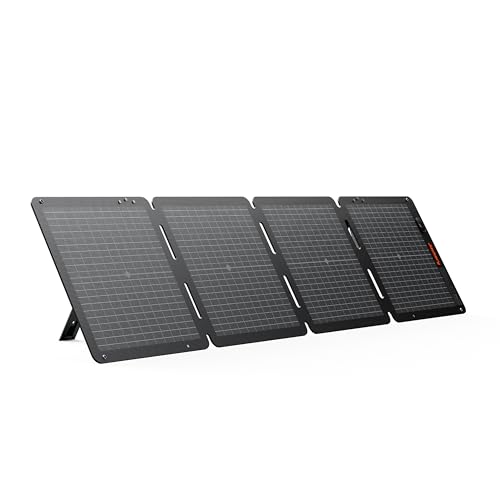
Jackery SolarSaga 100W Air
Folding, bifacial · Monocrystalline (PERC) · 7.05 lb · 29.7V Voc · IP65 · Score 69/100
The SolarSaga 100W Air folds in a W shape, has an integrated aluminium stand and weighs about 7 lb. It uses Jackery’s DC8020 lead with a DC7909 adapter, and there are USB ports on the cable for charging a phone straight from the panel. Two cautions. CSE Solar lists a 29.7V open-circuit voltage, and Jackery’s listing says the panel is not compatible with the Explorer 300 series. The Amazon title says IP65 while the bullets say IP68, so we score it at IP65.
Pros
- Built-in stand and W-fold design
- Native Jackery DC8020 lead plus a DC7909 adapter
- USB ports on the cable for direct phone charging
Cons
- Not compatible with the Explorer 300 series, per Jackery
- 29.7V Voc is above some small stations’ input range
- Conflicting IP rating on the listing
Buy it if: Jackery Explorer owners outside the 300 series who want a folding 100W panel with a stand. Check Jackery’s compatibility list for your model.
Skip it if: You own an Explorer 300 or 300 Plus, or a station with a 28V solar input limit.
Also rated, but unavailable when we checked: the EcoFlow 110W Portable Solar Panel (72/100) and the FlexSolar 100W Foldable (50/100) both showed as currently unavailable on Amazon on November 12, 2026. Our solar panels under $200 guide tracks the value-brand folding panels, and Anker’s and Jackery’s full ranges are compared in our Anker SOLIX solar panels and Jackery solar panels guides. For a curved roof, see our flexible solar panel picks, which include several 100W models.
Portable vs Rigid 100W Panels
Both types produce the same 100W at standard test conditions. Where the panel will live decides which one you want.
| Folding / flat portable | Rigid glass | |
|---|---|---|
| Weight (our picks) | 4.52–7.05 lb | About 13 lb (Renogy N-type) |
| Front surface | Polymer film over the cells | Tempered glass in an aluminium frame |
| Load ratings | Rarely published | 2,400 Pa wind / 5,400 Pa snow (Renogy) |
| Connector | Brand lead plus XT60, DC8020 or DC7909 adapters | MC4; needs an adapter cable for most power stations |
| Cost per watt | Higher | Lowest |
| Best for | Camping, tailgating, balconies, emergency kits | RV and van roofs, sheds, trailers, ground racks |
If you camp with the panel, the extra cost of a folding panel buys you the stand, the carry case and a setup that takes seconds. If the panel stays bolted down, a rigid panel is the better buy every time. Our best solar panels for camping guide ranks portable panels by weight for campsite use.
Will a 100W Panel Charge Your Power Station?
A single 100W panel is the right size for 250–300Wh stations, many of which accept only about 100W of solar. The “sun hours to full” column is our estimate: battery capacity ÷ (100W × 0.75). Divide by your local peak sun hours to get days.
| Power Station | Capacity | Max Solar Input | Peak Sun Hours to Full (one 100W panel) | Note |
|---|---|---|---|---|
| Anker SOLIX C300 DC | 288 Wh | 100W | ~3.8 hrs | Anker recommends its 60W or 100W panels; 100W is the solar ceiling |
| Bluetti Elite 30 Mini | 288 Wh | 100W | ~3.8 hrs | BLUETTI lists 12–28V; the 100W Air’s 29.7V Voc is over that |
| EcoFlow River 3 | 245 Wh | 110W | ~3.3 hrs | One 100W panel uses almost all of the 110W solar input |
| EcoFlow River 3 Plus | 286 Wh | 220W | ~3.8 hrs | Room for two 100W panels on the 220W input |
| Anker SOLIX C1000 Gen 2 | 1,024 Wh | 600W | ~13.7 hrs | A single 100W panel is a slow top-up here; use 400W or more |
Check voltage as well as watts. Small stations often accept a narrow voltage range. BLUETTI lists 12–28V for the Elite 30 Mini’s DC input. The PS100 (25.9V), SolarSaga 100W Light (24.8V) and Renogy N-type (22.79V) sit inside that on paper, while the SolarSaga 100W Air’s 29.7V does not. Jackery’s own listing says the Air isn’t compatible with the Explorer 300 series. Connector type matters too: MC4 panels need an MC4-to-XT60, MC4-to-Anderson or MC4-to-8mm cable depending on the station. Our solar panel setup guide explains how to read an input spec.
100 Watt Solar Panel Kit: Panel, Controller and Battery
A “100 watt solar panel kit” means a panel plus a charge controller, cables and mounting brackets for a 12V battery. It doesn’t include the battery. If you already own a portable power station, skip the kit. The station has a controller built in and you only need the panel and a connector cable.
- Controller size: 100W ÷ 12V is about 8.3A, so 10A is the minimum. The Renogy kit’s 30A Wanderer leaves room to grow to 400W of panels, per Renogy.
- PWM vs MPPT: a PWM controller holds the panel at roughly battery voltage, so part of a 12V-class panel’s output goes unused, especially in cold weather. An MPPT controller converts the extra voltage into charging current. At 100W the difference is a few watts; at 300–400W it’s worth paying for MPPT. Renogy’s 100W kit with a 20A MPPT controller showed as currently unavailable on Amazon on November 12, 2026.
- Battery: a 12V 100Ah lithium battery stores about 1,280 Wh, roughly three and a half good days of 100W harvest. A 50Ah battery is a better match for a single panel.
- Fusing and wiring: follow the controller manual for fuse sizes and cable gauge, and use a qualified electrician for anything connected to home wiring.
Want MPPT from the start? The ECO-WORTHY 200W Solar Kit (20A Bluetooth MPPT) (76/100 on our kit rubric) pairs two 100W N-type panels with a 20A MPPT controller with built-in Bluetooth. Currently $271.99 on Amazon, it leaves little controller room to add panels on a 12V system. For bigger roof kits, see our 400 watt solar panel kit guide, which compares complete kits from 100W to 1,000W, and our best RV solar kit picks.
What Can You Run With a 100 Watt Solar Panel?
Panels charge a battery; the battery runs your loads. Take a 5-sun-hour day (about 375 Wh stored) and allow for conversion losses with Wh × 0.85 ÷ load watts:
| Load | Average Draw | Runtime from 375 Wh |
|---|---|---|
| LED camp lights | ~10W | ~32 hrs |
| CPAP, no humidifier | ~40W | ~8 hrs |
| 12V compressor fridge | ~50W averaged over its cycle | ~6.4 hrs |
| Laptop | ~60W | ~5.3 hrs |
| TV | ~100W | ~3.2 hrs |
One 100W panel covers phones, lights, a CPAP and a laptop on a weekend trip. It doesn’t keep a 12V fridge running around the clock, which needs roughly 1,200 Wh a day at 50W. That job needs 300–400W of panels. For a full sizing walk-through, use our solar size calculator.
100W vs 200W: When to Size Up
If your station accepts 200W or more, a single 200W folding panel usually beats two 100W panels: one cable, one stand, and less weight per watt. Here is our top 100W pick next to two 200W folding panels already rated on the site:
| Panel | Watts | Weight | IP | Our Score | Price |
|---|---|---|---|---|---|
| Anker SOLIX PS100 Bifacial Solar Panel | 100W | 6.2 lb | IP68 | 78/100 | Check price at Amazon → |
| Anker SOLIX PS200 Bifacial Portable Solar Panel | 200W | 10.6 lb | IP68 | 83/100 | Check price at Amazon → |
| Renogy 200W Portable Solar Panel (N-Type) | 200W | 13.9 lb | IP65 | 84/100 | Check price at Amazon → |
Stay at 100W if your station caps solar near 100W, if you hike or pack light, or if you only top up phones and lights. Size up if you run a fridge, a CPAP every night or a 500Wh-plus station. Our best 200W portable solar panel guide covers that size, and for permanent roof arrays our best 400 watt solar panel guide compares single panels with 2×200W and 4×100W sets. The full field of folding panels is in our best portable solar panels guide.
Connecting Two or More 100W Panels
Panels in series add their open-circuit voltages; panels in parallel add their currents. Most 1 kWh-class power stations top out at 60V. Two-panel series totals from the published Voc figures:
| Two Panels in Series | Voc Total | Under a 60V Input? |
|---|---|---|
| 2 × Renogy 100W N-Type 16BB Rigid Solar Panel | 45.6V | Yes, with good cold-weather margin |
| 2 × Jackery SolarSaga 100W Light | 49.6V | Yes |
| 2 × Anker SOLIX PS100 Bifacial Solar Panel | 51.8V | Yes, but little margin in freezing weather |
| 2 × Jackery SolarSaga 100W Air | 59.4V | Too close; wire in parallel |
Cold weather raises voltage. A panel’s Voc climbs as cell temperature drops. For fixed installations, the National Electrical Code (NFPA 70, Section 690.7) requires calculating maximum PV voltage at the lowest expected temperature. Our rule of thumb for portable setups is to keep a string’s rated Voc at least 10–15% under the input limit, about 51–54V on a 60V station. Portable panels with brand-specific leads may need the maker’s parallel or series adapter, so check the manual before wiring. We don’t publish wiring diagrams.
Who Should Buy a 100W Solar Panel
Buy one if you…
- Own a 250–300Wh station that accepts about 100W of solar
- Camp for a weekend and charge phones, lights, a laptop or a CPAP
- Want a starter 12V system you can grow one panel at a time
- Need a light panel for an emergency kit or balcony
Skip it if you…
- Run a 12V fridge around the clock (plan on 300–400W)
- Own a 1 kWh-plus station that accepts 400W or more
- Want solar to back up household appliances during outages
- Live somewhere with short winter days and need daily charging
100 Watt Solar Panel FAQ
What can a 100 watt solar panel run?
A 100W panel charges a battery or power station, and the battery runs your devices. On a 5-sun-hour day it stores roughly 375 Wh. After about 15% conversion loss that runs a 12V compressor fridge averaging 50W for about 6 hours, a CPAP without humidifier at 40W for about 8 hours, a 60W laptop for about 5 hours, or 10W of LED lights for about 32 hours. It will not run a microwave, space heater or air conditioner.
How much power does a 100W solar panel produce per day?
Roughly 225 to 450 Wh on a clear day. Multiply 100W by your peak sun hours, then by about 0.75 to allow for heat, angle and wiring losses. NREL solar resource data puts most of the continental US at about 3 to 6 peak sun hours a day, so 100W x 5 hours x 0.75 is about 375 Wh. Winter and cloud can cut that in half or more.
How long does a 100 watt solar panel take to charge a 12V battery?
A 12V 100Ah lithium battery stores about 1,280 Wh, so a 100W panel making about 375 Wh a day needs roughly three and a half sunny days to fill it from empty. A half-charged battery takes under two days. A small 300 Wh power station refills in about one good day. For daily use of a 12V fridge, plan on 200W or more.
Do I need a charge controller with a 100W solar panel?
If you connect the panel to a 12V battery, yes. A panel rated about 18 to 20V at maximum power will overcharge a battery without a controller. A 10A controller is the minimum for 100W at 12V (100W divided by 12V is about 8.3A). Portable power stations have a controller built in, so you only need the right connector cable.
Is a portable or rigid 100W solar panel better?
It depends on where the panel lives. A rigid glass panel costs less per watt, handles wind and snow loads and lasts longer, but it weighs about 13 lb and needs brackets. A folding or flexible 100W panel weighs 4.5 to 7 lb, sets up in seconds and packs into a car, but costs more per watt. Buy rigid for a roof or rack and portable for camping.
Can I connect two 100W solar panels together?
Yes. In series the voltages add, and in parallel the currents add. Two panels with about 23V open-circuit voltage reach about 46V in series, which fits a 60V power-station input. Three in series would exceed 60V. Panels near 30V open-circuit voltage are close to the limit even in pairs, and cold weather raises voltage further, so check your station or controller manual before wiring.
The Bottom Line
Match the panel to where it will live. For camping with a small station, buy a folding 100W panel with a stand and check its voltage against your station’s input range. For a roof or a 12V battery, buy a rigid panel or a starter kit, and expect about 300–375 Wh on a good day.