
Product Review · Updated November 2026
EcoFlow DELTA Pro Review: Is the Original 3.6kWh Still Worth It in 2026?
Verdict
The EcoFlow DELTA Pro is still a solid buy in 2026 if you want a large 120V home-backup battery for less than a Delta Pro 3. It pairs 3,600Wh of LiFePO4 with 3,600W of output (7,200W surge), takes 1,600W of solar and expands to 10.8kWh. Its age shows in three places: it weighs 99 lb, it takes less solar than the Delta Pro 3, and 240V needs a second unit plus EcoFlow’s Double Voltage Hub. It was $1,799.00 on Amazon when this page loaded.
As an Amazon Associate, SolarGenAdvisor earns from qualifying purchases made through links on this page, at no additional cost to you.
 By Morgan Chen
Reviewed & approved by Juhi Sahni
|
Published: October 31, 2026
|
Updated:
|
How we score
EcoFlow DELTA Pro at a Glance
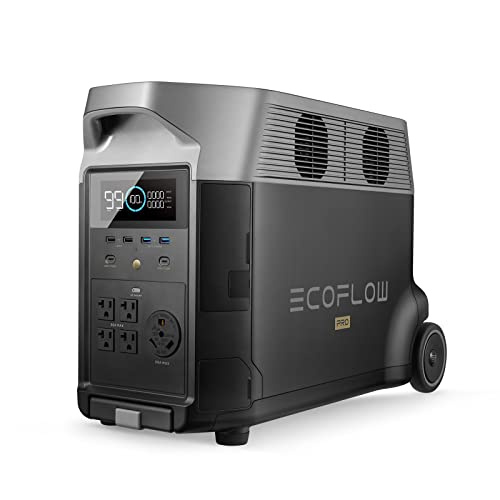
Capacity
3,600
Wh LiFePO4 (to 10.8kWh)
AC Output
3,600
Watts, 120V (7,200W surge)
Solar Input
1,600
Watts (11–150V, 15A)
Weight
99
lb, on two wheels
Our editorial rating: 87/100 · Amazon price: $1,799.00
When we checked on November 1, 2026, this listing was sold by Amazon.com, in stock, and carried Amazon’s “Limited time deal” badge. Deal badges come and go without notice, so the price shown above is the one that counts.
Who Should Buy the EcoFlow DELTA Pro (and Who Should Skip It)
Buy it if you…
- ✓ Want 3–4 kWh of LiFePO4 backup for a fridge, furnace fan, sump pump, lights and Wi-Fi, all on 120V
- ✓ Want the 3,600W output and 7,200W surge rating for a window AC, microwave or well-pump start on 120V
- ✓ May add an extra battery later (up to 10.8kWh per unit)
- ✓ Will keep it in one place, like a garage or utility room, and roll it out when the power goes
- ✓ Want EcoFlow’s app and ecosystem for less than the Delta Pro 3
Skip it if you…
- ✗ Need 240V (well pump, dryer or central-air circuits) from one battery: get the Delta Pro 3
- ✗ Have a big solar array: 1,600W on one input is modest for 3.6kWh in 2026
- ✗ Need to lift it into a vehicle often: it weighs 99 lb
- ✗ Run a desktop PC or network rack that needs a true UPS: EcoFlow’s spec sheet lists no switchover time
- ✗ Count on buying an extra battery right now: the Amazon listing was unavailable on November 1, 2026
EcoFlow DELTA Pro Specs
Figures come from EcoFlow’s DELTA Pro specification sheet (the US version, distributed through retailers such as WebstaurantStore). We cross-checked each one against EcoFlow’s Amazon listing and Camping World’s spec table.
| Battery capacity | 3,600 Wh |
| Chemistry / cycle life | LFP (LiFePO4); 3,500 cycles to 80%+ capacity (EcoFlow). Camping World also lists 6,500 cycles to 50%. |
| AC output | 3,600 W total across 5 outlets, 120V; X-Boost supports devices up to 4,500W (EcoFlow) |
| Surge | 7,200 W |
| Other outputs | 2 × USB-A (12W), 2 × USB-A fast charge (18W), 2 × USB-C (100W), car socket (126W), 2 × DC5521, Anderson port (12.6V, 30A) |
| Solar input | 1,600 W max, 11–150V DC, 15A (one input); EcoFlow quotes 2.8–5.6 hours to full |
| AC charging | 1,800W on 100–120V (about 2.7 hours); 3,000W on 220–240V (about 1.8 hours) |
| Other charging | 12/24V car charging; EV stations via EcoFlow’s EV X-Stream Adapter (Camping World: about 1.7 hours at 3,400W); up to 6,500W “MultiCharge” with an extra battery connected |
| Expansion | Up to 2 Smart Extra Batteries (3,600Wh each) or a Smart Generator per unit = 10.8kWh |
| Ecosystem | Smart Home Panel (US/EU), Double Voltage Hub (US), Smart Generator, 400W panels, remote control, EcoFlow app |
| Connectivity | Wi-Fi, Bluetooth, wired |
| Weight / size | 99 lb (45 kg); 25 × 11.2 × 16.4 in |
| Amazon price | $1,799.00 |
What we could not confirm: Warranty: EcoFlow’s spec sheet doesn’t list it. Retailer listings we checked describe a 5-year EcoFlow warranty, and one splits that into 2 years plus 3 with registration, so confirm the terms with your seller. Backup switchover: some retailer listings say it switches to battery within 30 ms in EPS mode, but EcoFlow’s sheet lists no figure. Treat it as basic backup, not a UPS. Expansion: EcoFlow markets the system as expandable to 25kWh, but we found no EcoFlow breakdown of that setup.
Is the 2021 EcoFlow DELTA Pro Still Worth Buying in 2026?
EcoFlow launched the DELTA Pro on Kickstarter in July 2021 as a “portable home battery” (EcoFlow press release). Five years on, the core hardware still holds up. Here is how it compares with newer models.
Battery chemistry: still current
The DELTA Pro already used LFP (LiFePO4), the chemistry most home-backup stations use today. EcoFlow rates it for 3,500 cycles to 80% capacity, the same figure it publishes for the DELTA Pro Ultra’s battery modules. That works out to almost ten years of daily cycling. “Older” here means an older platform, not a weaker battery type.
Solar input: the clearest sign of age
It takes 1,600W on a single 11–150V, 15A input. The Delta Pro 3 takes 2,600W across two inputs. Because current is capped at 15A, you only reach 1,600W with a high-voltage string: about 107V or more at the maximum power point, with open-circuit voltage still under 150V in the cold. In practice that means several 400W-class panels wired in series. EcoFlow’s Amazon listing cites four 400W panels for its 2.8-hour solar figure. Panels wired in parallel at lower voltage will charge more slowly.
120V only, unless you buy two
One DELTA Pro outputs 120V. That covers fridges, furnace blowers, sump pumps, window AC units and most kitchen appliances. It won’t power 240V well pumps, dryers or central-air condensers. For 240V, EcoFlow’s Double Voltage Hub links two DELTA Pros, which doubles the cost and weight. The Delta Pro 3 and DELTA Pro Ultra both put out 120/240V from a single unit.
Charging is still fast
EcoFlow quotes about 2.7 hours to full on a standard 120V outlet at 1,800W, and about 1.8 hours on 240V at 3,000W. It can also charge from a public EV station through EcoFlow’s EV X-Stream Adapter. For an outage battery that you top up between storms, that is still fast.
Accessories are thinner on Amazon
The station itself was sold and shipped by Amazon.com on November 1, 2026, but the DELTA Pro Extra Battery listing showed as “Currently unavailable” the same day. If expansion is the main reason you’re choosing it, check that the extra battery is available from EcoFlow or another seller before you commit.
Bottom line: if you want a 120V battery to ride out outages, the DELTA Pro still delivers, often for well under the Delta Pro 3’s price. The Delta Pro 3 was $2,799.00 on Amazon when this page loaded, so compare the two live prices before you decide. If you need 240V, more solar or a newer platform, pay for the Delta Pro 3.
EcoFlow DELTA Pro vs DELTA Pro 3 vs DELTA Pro Ultra
These are three generations of EcoFlow’s home-backup line, and the names cause a lot of confusion. The specs below come from our product database and EcoFlow’s published figures.
| Spec | DELTA Pro (original) | DELTA Pro 3 | DELTA Pro Ultra |
|---|---|---|---|
| Base capacity | 3,600 Wh | 4,096 Wh | 6,144 Wh per module |
| Continuous output | 3,600W, 120V | 4,000W, 120/240V | 7,200W, 120/240V |
| Surge | 7,200W | 8,000W | 10,800W |
| Solar input | 1,600W | 2,600W | 5,600W |
| 240V | Two units + Double Voltage Hub | Built in | Built in |
| Max expansion | 10.8kWh per unit (2 extra batteries) | 48kWh (EcoFlow’s Amazon title) | 90kWh (3 inverters × 5 batteries) |
| Home panel | Smart Home Panel (1st gen); SHP2 only with 2 units + hub | Smart Home Panel 2 | Smart Home Panel 2 |
| Weight | 99 lb, one unit | 113.5 lb, one unit | ~182 lb, two pieces |
| Our rating | 87/100 | 95/100 | 90/100 |
| Full review | This page | Delta Pro 3 review | DELTA Pro Ultra review |
| Price now | $1,799.00 | $2,799.00 | Check price at Amazon → |
The DELTA Pro Ultra price is for a Smart Home Panel 2 bundle listing, which had no live Amazon price when we checked.
Choose the DELTA Pro
You want 3.6kWh of 120V backup for less per watt-hour than the Delta Pro 3, and you are fine without 240V.
Choose the DELTA Pro 3
You need 240V from one box, more solar, or Smart Home Panel 2 with a single unit. It is the best all-round EcoFlow for whole-home backup.
Choose the DELTA Pro Ultra
You are planning a permanent, electrician-installed system above 7kW, or room to grow past 20kWh.
Still deciding between smaller Deltas too? Our which EcoFlow Delta should I buy chooser lines up every Delta we rate, from 1 kWh up.
How Long Will the EcoFlow DELTA Pro Run Your Home?
These estimates take rated capacity × 0.85 for inverter losses and divide by the load, which gives about 3,060Wh usable from the DELTA Pro alone. The whole-home row uses the U.S. average household draw of about 1,230W, based on the EIA’s figure of roughly 899 kWh a month (EIA FAQ). Fridges and furnaces cycle on and off, so real runtimes are often longer.
| Load | Typical draw | DELTA Pro (3.6kWh) | +1 extra battery (7.2kWh) | +2 extra batteries (10.8kWh) |
|---|---|---|---|---|
| CPAP without humidifier | ~40W | ~3.2 days | ~6.4 days | ~9.6 days |
| Refrigerator (average while cycling) | ~150W | ~20.4 hrs | ~40.8 hrs | ~2.6 days |
| Essentials: fridge, furnace fan, lights, router | ~500W | ~6.1 hrs | ~12.2 hrs | ~18.4 hrs |
| Window AC unit (running) | ~800W | ~3.8 hrs | ~7.7 hrs | ~11.5 hrs |
| Average U.S. home (all loads) | ~1,230W | ~2.5 hrs | ~5.0 hrs | ~7.5 hrs |
A single DELTA Pro carries an essentials-only load through most of a workday. With two extra batteries, or a sunny day on 1,600W of panels, it can stretch to several days. For appliance-by-appliance sizing, see can a solar generator power a house.
DELTA Pro Expansion: Extra Batteries, Smart Home Panel and 240V
Extra batteries
According to EcoFlow’s spec sheet, each DELTA Pro takes up to two DELTA Pro Smart Extra Batteries. Each one stores 3,600Wh and weighs 84 lb, for 10.8kWh per unit. The same sheet says EcoFlow’s Smart Generator (a gas generator) can connect in place of an extra battery. Retailer listings for EcoFlow’s first-generation Smart Home Panel describe two DELTA Pros with four extra batteries, which comes to 21.6kWh.
Smart Home Panel compatibility
The DELTA Pro was built for EcoFlow’s first-generation Smart Home Panel. EcoFlow’s spec sheet lists it (US/EU), and retailer listings such as Shop Solar Kits describe a 10-circuit panel that links up to two DELTA Pro units. Smart Home Panel 2 is built around the Delta Pro 3 and DELTA Pro Ultra. Outbound Power says a single DELTA Pro only charges through SHP2 and does not discharge into it. Two DELTA Pros on a Double Voltage Hub are the supported route. Our smart home panel guide covers SHP2’s compatibility in detail.
240V with the Double Voltage Hub
EcoFlow’s Double Voltage Hub (US only) joins two DELTA Pros into a 240V supply. Retailer listings from Outbound Power and Norwall rate the output at 7,200W and 30A. That is the only way to run 240V loads from the original DELTA Pro, and it needs two full units. At the prices we logged on November 1, 2026, two DELTA Pros alone cost more than one Delta Pro 3, so this route mainly makes sense if you already own a DELTA Pro.
Home wiring is not a DIY job. Any connection to your home’s circuits, whether a Smart Home Panel or a transfer switch, should be installed by a licensed electrician, and most areas require a permit. Never backfeed a home through a dryer or wall outlet: the CPSC warns that backfeeding can electrocute utility workers and neighbors. Our transfer switch guide explains the options.
EcoFlow DELTA Pro Alternatives on Amazon
Three priced stations from our database that compete with the DELTA Pro. The prices below are live from Amazon, and the ratings are our editorial scores. For the full field, see our best 3000-watt solar generators.

The successor: built-in 240V
EcoFlow Delta Pro 3
4,096Wh · 4,000W · 2,600W solar · 113.5 lb · Rating 95/100
More of everything in one wheeled unit: 4,096Wh, 4,000W at 120/240V and 2,600W of solar input. It works with Smart Home Panel 2 on its own, with no second unit or hub needed for 240V. It costs more and weighs 113.5 lb. Read our review →

Lighter 3 kWh, same 3,600W
Jackery HomePower 3000
3,072Wh · 3,600W · 1,000W solar · 59.5 lb · Rating 87/100
The same 3,600W output and 7,200W surge as the DELTA Pro on a 3,072Wh battery that weighs about 40 lb less. It has a TT-30 outlet and transfer-switch support. The trade-offs: it cannot be expanded and takes only 1,000W of solar. Read our review →

Compact 3 kWh value pick
Bluetti Elite 300
3,014Wh · 2,400W · 1,200W solar · 58 lb · Rating 89/100
3,014Wh and 2,400W in a compact, roughly 58 lb box with a TT-30 RV outlet and 1,200W of solar. Lower output than the DELTA Pro and no expansion, but a strong value if 2,400W covers your loads. Read our review →
DELTA Pro vs Delta Pro 3, Jackery HomePower 3000 and Bluetti Elite 300
| Model | Capacity | AC output | Solar in | 240V | Expandable | Weight | Rating | Price | Amazon |
|---|---|---|---|---|---|---|---|---|---|
| EcoFlow DELTA Pro | 3,600 Wh | 3,600W | 1,600W | 2 units + hub | Yes, to 10.8kWh | 99 lb | 87 | $1,799.00 | View → |
| EcoFlow Delta Pro 3 | 4,096 Wh | 4,000W | 2,600W | Yes (120/240V) | Yes (Amazon title: to 48kWh) | 113.5 lb | 95 | $2,799.00 | View → |
| Jackery HomePower 3000 | 3,072 Wh | 3,600W | 1,000W | No | No | 59.5 lb | 87 | $1,499.00 | View → |
| Bluetti Elite 300 | 3,014 Wh | 2,400W | 1,200W | No | No | 58 lb | 89 | Check price at Amazon → | View → |
Expansion and 240V details for the alternatives come from our individual reviews and the manufacturers’ Amazon listings.
EcoFlow DELTA Pro Pros & Cons
What We Like
- • 3,600Wh of LFP rated 3,500 cycles to 80%
- • 3,600W output, 7,200W surge, with X-Boost support for devices up to 4,500W
- • Fast recharge: about 2.7 hours on 120V, 1.8 hours on 240V
- • Expands to 10.8kWh with two extra batteries
- • Sold and shipped by Amazon.com when we checked
- • Broad ports: 5 AC outlets, 100W USB-C and a 30A Anderson port
What Could Be Better
- • 120V only per unit; 240V needs two units and a hub
- • 1,600W solar on one input, versus 2,600W on the Delta Pro 3
- • 99 lb: it rolls, but lifting it is a two-person job
- • No published UPS switchover time from EcoFlow
- • Extra battery unavailable on Amazon when we checked
EcoFlow DELTA Pro Black Friday Price: What to Expect
EcoFlow has historically run some of its largest Amazon promotions around Prime Day in October and the Black Friday–Cyber Monday window. On November 1, 2026, Amazon showed a “Limited time deal” badge on this listing. We don’t predict discount sizes or end dates: the live price on this page is the one to trust. Our EcoFlow Black Friday deals tracker follows the DELTA Pro alongside the rest of the lineup, and our EcoFlow power station guide covers every current model.
How We Score the EcoFlow DELTA Pro
We do not physically test products. Our 87/100 rating applies our 6-dimension scoring matrix to EcoFlow’s published specs, the live Amazon price and published third-party listings. The matrix weights Capacity & Power 25%, Value 20%, Solar Charging 15%, Portability 15%, Expandability & Features 15% and Battery Chemistry 10%. We compare the DELTA Pro with other 3–4 kWh stations in our database.
- Strong: value (cost per watt-hour at the price we logged on November 1, 2026), expandability, LFP chemistry and capacity/output.
- Middling: solar charging, with 1,600W on one input.
- Weak: portability, at 99 lb for 3.6kWh.
For context, the Jackery HomePower 3000 scores 87/100 and the Delta Pro 3 scores 95/100 in the same matrix. If the DELTA Pro’s price changes a lot, we will re-score it.
EcoFlow DELTA Pro FAQ
Is the EcoFlow DELTA Pro still worth buying in 2026?
Yes, for the right buyer. It still offers 3,600Wh of LiFePO4 storage, 3,600W of 120V output (7,200W surge), 1,600W of solar input and expansion to 10.8kWh, and it costs less than the Delta Pro 3. It is a worse fit if you need 240V from one unit, more solar input or a lighter battery. For 240V it needs a second DELTA Pro plus EcoFlow's Double Voltage Hub, and the DELTA Pro Extra Battery was listed as currently unavailable on Amazon when we checked on November 1, 2026.
What is the difference between the EcoFlow DELTA Pro, DELTA Pro 3 and DELTA Pro Ultra?
The DELTA Pro (2021) is a single 3,600Wh, 3,600W, 120V unit that takes 1,600W of solar. The DELTA Pro 3 is its single-unit successor: 4,096Wh, 4,000W at 120/240V and 2,600W of solar. The DELTA Pro Ultra is a two-piece modular system: a 7,200W 120/240V inverter on 6,144Wh battery modules with 5,600W of solar, scalable to 90kWh. Only the DELTA Pro needs a second unit and a hub to make 240V.
Is the EcoFlow DELTA Pro discontinued?
We could not find a discontinuation notice from EcoFlow. On November 1, 2026, Amazon.com was selling the DELTA Pro new and in stock. EcoFlow now sells the newer DELTA Pro 3 above it, and accessory availability is patchier: the DELTA Pro Extra Battery listing showed as currently unavailable on Amazon the same day.
What is the EcoFlow DELTA Pro maximum solar input?
1,600W through one solar input rated 11-150V DC and 15A, per EcoFlow's DELTA Pro specification sheet; Camping World's listing gives the same figures. Because current is capped at 15A, you only reach 1,600W with a high-voltage string (about 107V or more at the maximum power point) whose open-circuit voltage stays under 150V. EcoFlow quotes 2.8-5.6 hours for a full solar recharge.
Can the EcoFlow DELTA Pro output 240V?
Not from a single unit. One DELTA Pro outputs 120V. EcoFlow's Double Voltage Hub (US only) links two DELTA Pro units to provide 240V at up to 7,200W, according to EcoFlow's spec sheet and retailer listings. Any connection to home wiring needs a transfer switch or smart panel installed by a licensed electrician.
How many extra batteries can the EcoFlow DELTA Pro use?
Two. EcoFlow's spec sheet lists support for up to two DELTA Pro Smart Extra Batteries (3,600Wh each) or a Smart Generator per unit, for 10.8kWh per DELTA Pro. EcoFlow markets the system as expandable to 25kWh; we could not find EcoFlow documentation that breaks that configuration down, so we use the 10.8kWh-per-unit figure.
How long will the EcoFlow DELTA Pro run a refrigerator?
About 3,060Wh is usable after inverter losses (3,600Wh x 0.85). A full-size fridge averaging about 150W while cycling would run for roughly 20 hours, and a 500W essentials load (fridge, furnace fan, lights, router) for about 6.1 hours. Each extra battery adds the same again.
Sources: EcoFlow DELTA Pro / Smart Extra Battery specification sheet, US version (PDF via WebstaurantStore), for capacity, outputs, surge, X-Boost, AC/solar/car input, cycle life, weight, dimensions, expansion and ecosystem; EcoFlow’s Amazon listing B0C1Z4GLKS (title and feature bullets, checked November 1, 2026); Camping World DELTA Pro listing (solar, charge times, EV charging, cycle life, weight); Outbound Power and Norwall Double Voltage Hub listings (240V, 7,200W, 30A); Shop Solar Kits Smart Home Panel listing (10 circuits, two units); EcoFlow 2021 Kickstarter press release; EIA residential consumption FAQ; CPSC portable generator safety guide. Delta Pro 3 and DELTA Pro Ultra figures come from our product database and their reviews. SolarGenAdvisor does not physically test products. This rating is AI-assisted and editor-reviewed.