
Product Review · Updated October 2026
FOSSiBOT F3600 Pro Review: Big Capacity for the Money, With Trade-offs
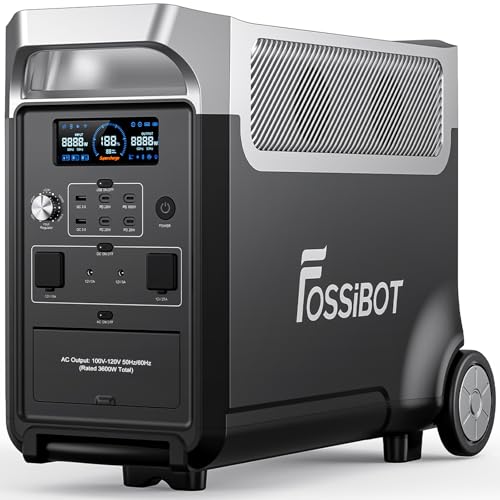
The FOSSiBOT F3600 Pro is a 3,840Wh LiFePO4 power station with 3,600W of 120V output (7,200W surge), a 30A TT-30 RV outlet, 2,000W of solar input and expansion to 11,520Wh with two FB3840 batteries. It is a value play: more stored energy than the Anker SOLIX F3000 in a similar 92.6 lb wheeled case. The catches are 120V-only output, a 1,500W wall-charging ceiling, no listed UL certification and a short US track record. Currently $1,139.00 on Amazon, it scores 86/100 in our scoring, a score synthesized from FOSSiBOT's published specs, third-party coverage and Amazon listing data.
As an Amazon Associate, SolarGenAdvisor earns from qualifying purchases made through links on this page, at no additional cost to you.
 By
Capacity
3,840
Watt-hours (LiFePO4)
AC Output
3,600
Watts (120V only)
Solar Input
2,000
Watts max (12–160V)
Price
$1,139.00
Current price on Amazon
What Is the FOSSiBOT F3600 Pro?
The F3600 Pro is an expandable version of FOSSiBOT's original F3600, built for home backup and RV use. FOSSiBOT's US spec page lists a 3,840Wh (48V, 80Ah) LiFePO4 battery built from EVE Energy cells, a 3,600W pure sine wave inverter with a 7,200W surge rating, 2,000W of solar input, and expansion to 7,680Wh with one FB3840 battery or 11,520Wh with two. It weighs 92.59 lb (42 kg), measures about 24.0 × 12.6 × 18.7 in, and has built-in wheels and an extendable handle (FOSSiBOT US). Notebookcheck's 2024 launch coverage reports the same capacity, output, surge, solar and expansion figures (Notebookcheck).
Which version you are buying matters. The F3600 Pro is sold in Europe as a 230V unit, and much of the English-language coverage describes that version, including a 2,200W AC charging rate. The US version has 120V outlets, a 30A TT-30 RV outlet and a 1,500W AC charging ceiling. The Amazon listing we link to (ASIN B0FP9RTPXL) is the US version: its title lists “5x120V AC Output” and the product photo shows a 100–120V AC label. At the time of writing that listing is sold by a third-party seller (HK Hongli Tech) rather than by Amazon.
Amazon listings don't agree with each other. A second US listing for the F3600 Pro quotes 2,200W AC charging, 4,000+ cycles and a 5-year warranty, while FOSSiBOT's own US page says 1,500W, 6,500+ cycles and “2+3 Years”. On this page we use FOSSiBOT's US spec page and flag the conflicts. Confirm warranty terms and the charging rate on the listing before you buy.
Key Features and Specs That Matter
3,600W at 120V, Plus a TT-30 RV Outlet
FOSSiBOT lists five AC outlets sharing 3,600W: four three-prong household outlets and one 30A NEMA TT-30 for an RV. That covers a 30 amp RV service, which tops out at 3,600W, and most 120V home essentials at once. The 7,200W surge rating gives headroom for compressor and pump startups. There is no 240V output, and FOSSiBOT's FAQ says two units can't be linked for more power, so 240V well pumps, dryers and central AC are out. DC ports are generous: one 100W and three 20W USB-C, two 18W USB-A, a 12V/10A car socket, a 12V/25A XT60 for compressor fridges or RV 12V systems, and two 5.5mm barrel outlets.
2,000W Solar, but Only 1,500W From the Wall
The single XT90 solar input takes up to 2,000W across 12–160V. FOSSiBOT quotes about 2.5 hours to full in ideal sun. AC charging is the weak spot on the US model: 1,500W maximum (adjustable in five steps from 300W), about 3 hours to full. Combine AC and solar and it reaches 3,500W, about 1 hour 50 minutes. For comparison, the Anker SOLIX F3000 accepts 3,600W from AC alone, according to our F3000 review. If you plan to refill between rolling blackouts from the grid, the F3600 Pro is noticeably slower. A generator input is rated at 1,100W, and a 12V/24V car input at about 120W.
Expandable to 11.5kWh, With Limits
One FB3840 battery doubles capacity to 7,680Wh, and two take it to 11,520Wh. That is the ceiling. FOSSiBOT's FAQ says third-party batteries are not supported and the built-in battery is not user-replaceable. Rivals in the same class go further: Anker lists the F3000 at up to 24kWh. For a 120V essentials backup, though, 11.5kWh covers several days of fridge, lights and internet.
LiFePO4 Cycle Rating: Read the Fine Print
FOSSiBOT advertises 6,500+ cycles, but its spec table defines that as cycles to 50% of original capacity. Most rivals quote cycles to 80%. Our F3000 review lists 3,500+ cycles to 80% for Anker, and our Delta Pro 3 review lists 4,000+ to 80% for EcoFlow. The numbers use different end points and can't be compared directly. The cells are LiFePO4 either way, the chemistry we score highest for longevity and thermal stability.
10ms UPS, App Control, No UL Listing
FOSSiBOT rates UPS switchover at 10ms and supports pass-through charging. The BrightEMS app connects over Bluetooth or Wi-Fi. The certifications on its spec sheet are FCC, CE, PSE, RoHS, UN38.3 and MSDS. No UL listing appears there, which may matter if an inspector, landlord or insurer asks about a semi-permanent hookup. Rated operating temperature is 14–104°F. FOSSiBOT says the unit is not waterproof and should be kept upright, including in storage.
How Long Will the F3600 Pro Run Your Appliances?
Runtime = usable Wh ÷ load in watts. We assume about 85% of the rated 3,840Wh is usable after inverter losses (about 3,264Wh). These are steady-load estimates; appliances that cycle (fridges, furnaces, RV air conditioners) run longer than the average suggests.
| Load scenario | Average draw | F3600 Pro alone | With 2 × FB3840 |
|---|---|---|---|
| CPAP (no humidifier) | 40W | ~3.4 days | ~10.2 days |
| Refrigerator only | 150W | ~21.8 hrs | ~2.7 days |
| Fridge + internet + LED lights + phones | 300W | ~10.9 hrs | ~32.6 hrs |
| Essentials + furnace blower | 700W | ~4.7 hrs | ~14.0 hrs |
| RV rooftop AC (13,500 BTU, typical running draw) | 1,300W | ~2.5 hrs | ~7.5 hrs |
| Space heater on high | 1,500W | ~2.2 hrs | ~6.5 hrs |
The RV air-conditioner row is the running draw only; starting surge is higher, and the 7,200W surge rating is there to absorb it. Solar stretches every row: FOSSiBOT quotes about 2.5 hours to refill the base battery from 2,000W of panels in ideal sun, and real-world arrays usually take longer. To size your own loads, use the solar generator size calculator.
Pros & Cons
What We Like
- • 3,840Wh at 92.6 lb: about 25% more capacity than the F3000 at similar weight
- • 7,200W surge: strong headroom for motor startups at 120V
- • TT-30 RV outlet built in, plus a 12V/25A XT60 port
- • 2,000W solar input over a wide 12–160V range
- • Expands to 11,520Wh with two FB3840 batteries
- • LiFePO4 (EVE cells), 10ms UPS and app control
What Could Be Better
- • 120V only, and two units can't be linked for 240V
- • 1,500W AC charging: about 3 hours from the wall
- • No UL certification listed on the spec sheet
- • Warranty terms vary by listing (2+3 vs 5 years)
- • Cycle rating is to 50% capacity, not the usual 80%
- • Short US track record, and Amazon sales go through a third-party seller
FOSSiBOT F3600 Pro vs Anker, Bluetti, EcoFlow and Pecron
These are the large stations already rated on SolarGenAdvisor that F3600 Pro shoppers are most likely to cross-shop. Specs and scores come from our product database. Prices and cost per watt-hour are live from Amazon.
| Model | Capacity | Output | Solar In | Weight | Our Score | Price | Cost / Wh | Amazon |
|---|---|---|---|---|---|---|---|---|
| FOSSiBOT F3600 Pro | 3,840 Wh | 3,600W | 2,000W | 92.6 lb | 86/100 | $1,139.00 | $0.30/Wh | Check Price → |
| Anker SOLIX F3000 | 3,072 Wh | 3,600W | 2,400W | 91.5 lb | 93/100 | $1,399.99 | $0.46/Wh | Check Price → |
| Bluetti Apex 300 | 2,765 Wh | 3,840W | 2,400W | 83.8 lb | 90/100 | Check price at Amazon → | — | Check Price → |
| EcoFlow Delta Pro 3 | 4,096 Wh | 4,000W | 2,600W | 113.5 lb | 95/100 | $2,799.00 | $0.68/Wh | Check Price → |
| Pecron F5000LFP Power Station | 5,120 Wh | 7,200W | 6,400W | 123.9 lb | 90/100 | Check price at Amazon → | — | Check Price → |
At today's Amazon prices, the FOSSiBOT F3600 Pro has the lowest cost per watt-hour of the models above with a live price. Prices change often, so treat this as a snapshot, not a forecast.
F3600 Pro vs Anker SOLIX F3000: This is the closest match. Both have 3,600W of 120V output and weigh about 92 lb. The FOSSiBOT stores more energy (3,840Wh vs 3,072Wh) and has a higher surge rating (7,200W vs 4,860W). The Anker SOLIX F3000 recharges more than twice as fast from the wall (3,600W vs 1,500W), takes more solar (2,400W vs 2,000W), expands to 24kWh instead of 11.5kWh, and can reach 240V by pairing two units. It also has Anker's larger support network behind it. Choose the FOSSiBOT if it costs less per watt-hour at today's prices (see the table); choose the F3000 for recharge speed, a 240V upgrade path and brand support.
F3600 Pro vs Bluetti Apex 300: The Bluetti Apex 300 has less capacity (2,764.8Wh) but delivers 120V and 240V from a single unit, takes 2,400W of solar and expands far further. It is lighter at about 84 lb but has no wheels. If you need 240V at all, the Apex 300 is the better fit. For 120V-only backup or RV use, the FOSSiBOT gives you more watt-hours per box.
FOSSiBOT vs EcoFlow (Delta Pro 3): The EcoFlow Delta Pro 3 has slightly more capacity (4,096Wh), 120V/240V from one unit, 2,600W of solar input and EcoFlow's home-integration accessories. It weighs 113.5 lb and sits in a higher price tier. The F3600 Pro is the budget alternative for buyers who don't need 240V.
F3600 Pro vs Pecron F5000LFP: The Pecron F5000LFP is the other challenger-brand value pick, one size up: 5,120Wh, 7,200W dual-voltage output and 6,400W of solar input, at about 124 lb and a higher price tier. If you want challenger-brand value with 240V included, look at the Pecron. If 3.8kWh at 120V is enough, the FOSSiBOT is the smaller box in a lower price tier.
FOSSiBOT F3600 Pro Full Specifications (US Version)
| Battery capacity | 3,840 Wh (LiFePO4, 48V 80Ah, EVE Energy cells) |
| AC output (continuous) | 3,600W, 120V pure sine wave |
| Surge | 7,200W |
| AC outlets | 5 total: 4 × three-prong 120V + 1 × NEMA TT-30 (30A RV) |
| USB outputs | 1 × USB-C 100W, 3 × USB-C 20W, 2 × USB-A QC3.0 18W |
| DC outputs | 12V/10A car socket, 12V/25A XT60, 2 × 5.5mm 12V/3A |
| Solar input | 2,000W max, 12–160V (XT90 to MC4), about 2.5 hrs in ideal sun |
| AC charging | 1,500W max (300/600/900/1,200/1,500W steps), about 3 hrs |
| AC + solar | 3,500W max, about 1 hr 50 min |
| Generator / car input | 1,100W / about 120W (12/24V) |
| Expansion | Up to 2 × FB3840: 7,680Wh or 11,520Wh total |
| 240V / parallel | No (FOSSiBOT says two units cannot be linked) |
| UPS switchover | 10ms |
| Cycle life | 6,500+ cycles to 50% of original capacity |
| Certifications listed | FCC, CE, PSE, RoHS, UN38.3, MSDS (no UL listed) |
| Warranty | “2+3 Years” on FOSSiBOT’s spec table; 5 years marketed for us.fossibot.com purchases; varies by Amazon listing |
| Operating temperature | 14°F to 104°F |
| Weight | 92.6 lb (42 kg) |
| Dimensions | About 24.0 × 12.6 × 18.7 in (609 × 321 × 475.5 mm), wheels + extendable handle |
Sources: FOSSiBOT F3600 Pro US product page and spec table (checked October 31, 2026); Notebookcheck launch coverage (Aug 2024, EU version); Nerdsheaven (Mar 2026, EU version; 42 kg, 6,500+ cycles); Amazon listing B0FP9RTPXL (title, bullets, seller). European sources list 230V outlets and 2,200W AC charging; the US figures above come from FOSSiBOT's US page.
Who Should Buy the FOSSiBOT F3600 Pro?
Buy if you…
- ✓ Want the most watt-hours your budget can buy and only need 120V
- ✓ Run a travel trailer or RV on a 30A service and want a built-in TT-30
- ✓ Back up a fridge, freezer, sump pump, network and lights through a long outage
- ✓ Mostly recharge from solar, where the 2,000W input is competitive
- ✓ Are comfortable confirming warranty terms with a third-party seller
Skip if you…
- ✗ Prioritize established-brand support; the Anker SOLIX F3000 is the closest alternative
- ✗ Need 240V for a well pump, dryer or transfer switch; see the Delta Pro 3
- ✗ Recharge mainly from the grid between rolling outages (1,500W is slow)
- ✗ Need a UL listing for an inspector, landlord or insurer
- ✗ Want something you can lift into a car; look at our 2000Wh picks
Verdict: Strong Value, If You Accept the Trade-offs
The F3600 Pro earns 86/100 in our scoring (the Anker SOLIX F3000 scores 93 and the Delta Pro 3 scores 95). It scores high on capacity, surge and value, and solidly on solar input and LiFePO4 chemistry. It loses points for 120V-only output, a firm 11.5kWh expansion ceiling, slow wall charging, a cycle rating measured to 50% rather than 80%, no listed UL certification and warranty terms that differ between listings. Its case rests on capacity per dollar, so check the live cost-per-watt-hour column above to see whether today's Amazon price delivers it. What you give up is a 240V path, recharge speed and the support depth of a larger brand. If you are still comparing sizes, start with our best 3000 watt solar generators guide or the Best Budget 2026 award. For sale timing, the Black Friday tracker and the always-current solar generator deals page show live prices.
How we rate: our scores are synthesized from published specifications, manufacturer figures, logged Amazon prices and public reviews, weighted using our awards methodology. Runtime figures are calculated, not measured.
FOSSiBOT F3600 Pro FAQ
Is FOSSiBOT a good brand?
FOSSiBOT is a smaller brand than Anker, EcoFlow or Jackery, and it has far less US review history. What we can confirm: its US store ships from US warehouses, it says the F3600 Pro uses EVE Energy LiFePO4 cells, and its spec sheet lists FCC, CE, PSE, RoHS and UN38.3 certifications but no UL listing. When we checked in October 2026, its Trustpilot profile for us.fossibot.com had only 7 reviews (TrustScore 3.7), listed a Hong Kong business address, and the company said it runs repair centers in the US, Germany and Japan. The F3600 Pro itself has been covered by outlets such as Notebookcheck since its 2024 launch. If established-brand support matters most to you, Anker or EcoFlow is the safer choice.
Is the FOSSiBOT F3600 Pro 120V or 240V?
The US version is 120V only. FOSSiBOT lists five AC outlets rated 3,600W in total: four standard three-prong outlets plus a 30A NEMA TT-30 RV outlet. Its FAQ says two F3600 Pro units cannot be connected for more power, so there is no path to 240V. European listings of the same model are 230V, so check that the Amazon listing says 120V before you buy.
How long will the FOSSiBOT F3600 Pro run a refrigerator?
Assuming about 85% usable energy after inverter losses, the 3,840Wh battery gives roughly 3,264Wh. A full-size refrigerator averaging 150W would run about 22 hours. With two FB3840 expansion batteries (11,520Wh total) that rises to about 2.7 days. These are calculated estimates, not measurements.
How fast does the FOSSiBOT F3600 Pro recharge?
From a 120V wall outlet it accepts up to 1,500W, which FOSSiBOT puts at about 3 hours to full. You can step the rate down to 300W, 600W, 900W or 1,200W. Solar input is up to 2,000W (12-160V), about 2.5 hours in ideal sun, and AC plus solar together reach 3,500W, about 1 hour 50 minutes. Some Amazon listings quote a 2,200W AC rate, which matches European 230V versions rather than FOSSiBOT's US spec page.
What warranty does the FOSSiBOT F3600 Pro have?
It depends on where you buy. FOSSiBOT's US product page markets a 5-year warranty "only at us.fossibot.com", while its own spec table lists "2+3 Years". The Amazon listing we link to also says "2+3 Year Warranty", and another US Amazon listing for the F3600 Pro claims 5 years. Warranty terms vary by listing, so confirm them with the seller before buying.
FOSSiBOT F3600 Pro vs EcoFlow Delta Pro 3: which should I buy?
The EcoFlow Delta Pro 3 has slightly more capacity (4,096Wh vs 3,840Wh), outputs 120V and 240V from a single unit, accepts more solar (2,600W vs 2,000W) and comes from a much larger brand, but it weighs about 21 lb more and sits in a higher price tier. The F3600 Pro makes sense if you only need 120V and want the most capacity for the money. If you need 240V for a well pump or dryer, choose the Delta Pro 3.