
Cold-Weather Camping Guide · Updated November 2026
Best Tent Heater for Camping: Battery, Propane and Diesel Options, and the Safety Rules for Each
The best tent heater for camping is usually not a heater: a 12V heated blanket on a power station burns nothing, and a 1 kWh station runs a 50W blanket all night. For heat while you are awake, Mr. Heater rates its Buddy propane heaters for tents with a window or roof vent, never while sleeping. A diesel heater works only with its exhaust outside. Run a battery CO alarm with any fuel heater.
Below: runtime math for electric heat, what each propane manual actually allows in a tent, how diesel heaters are set up outside, and the CDC and CPSC rules that apply to all of them.
As an Amazon Associate, SolarGenAdvisor earns from qualifying purchases made through links on this page, at no additional cost to you.
 By
Camping Space Heater Types Compared
Every camp heater makes heat one of three ways: electricity, propane burned inside the tent, or diesel burned outside it. Heat output is converted to one unit (1 watt = 3.412 BTU/h, EIA) so you can compare them.
| Option | Heat | How long | In the tent? | Price |
|---|---|---|---|---|
| 12V heated blanket + Anker SOLIX C300 DC | 50W (~170 BTU/h), on your body | ~4.9 h | Yes; nothing burns, so no CO | $269.99 |
| 1,500W space heater + Anker SOLIX C1000 Gen 2 | 1,500W (~5,100 BTU/h) | ~35 min | No fumes, but a fire risk near fabric | $469.99 |
| Mr. Heater Portable Buddy MH9BX (4,000-9,000 BTU) | 4,000–9,000 BTU/h | ~5.4 h low / ~2.4 h high per 1 lb cylinder | Maker allows tents with a window or roof vent; awake only; CDC advises against | $79.99 |
| VEVOR XMZ-TB20 8kW All-in-One Diesel Heater with CO Alarm | 8 kW (~27,300 BTU/h) | ~28 h per tank at minimum burn (our math) | Heater outside, warm-air hose in; exhaust always outdoors | $137.52 |
Battery rows use Wh × 0.85 ÷ watts. Propane runtimes are Mr. Heater's published figures; its manuals warn that runtime drops when the heater runs continuously below 20°F. Diesel runtime is tank volume ÷ VEVOR's minimum burn rate.
Scores on this page come from separate scales: power stations from our awards methodology, propane heaters from our indoor propane heater rubric and diesel heaters from our diesel heater rubric. Each is synthesized from published specs, logged Amazon prices and Amazon customer reviews, and a score only compares products of the same type.
Electric Tent Heater: Battery Picks and Runtime
An electric heater turns every watt into heat, so it draws its full rating the whole time it runs. A typical 1,500W space heater uses 1,500 watt-hours every hour, which is more than most camping batteries hold. Runtime = battery Wh × 0.85 ÷ watts, the loss factor Bluetti and Anker publish for heaters. Anker also says the station's continuous AC output must exceed the heater's wattage, ideally with 20–30% headroom.
| Load | Anker SOLIX C300 DC 288 Wh / no AC, 120W 12V socket |
Anker SOLIX C1000 Gen 2 1,024 Wh / 2,000W AC |
Bluetti Elite 200 V2 2,074 Wh / 2,600W AC |
|---|---|---|---|
| Space heater, high (1,500W) | Over 12V socket limit | ~35 min | ~1.2 h |
| Space heater, low (750W) | Over 12V socket limit | ~1.2 h | ~2.4 h |
| Heated over-blanket (100W) | ~2.4 h | ~8.7 h | ~18 h |
| 12V heated blanket (50W) | ~4.9 h | ~17 h | ~35 h |
| USB heated throw (10W) | ~24 h | ~87 h | ~176 h |
Continuous-draw estimates. Blankets cycle once warm, so real runtimes are often longer. The C300 DC has no AC outlet, so only 12V and USB loads apply. Capacities come from our product database; check your own heater's or blanket's label.
The takeaway: the station that gives you about half an hour of space heater gives you a full night or more of heated-blanket warmth. Heat the person in the sleeping bag, not the air in the tent. Use the station's 12V socket or USB ports for the blanket where you can: Sunbeam's heated-bedding manual says not to use its blankets with generator power or an inverter, and a station's AC outlets come from an inverter (Sunbeam manual). Our battery powered heater guide runs the same math for larger stations and home outages.
Best Fume-Free Tent Setup (Carry-In Size)

Anker SOLIX C300 DC · Power station score: 86/100
288 Wh · no AC outlet; 120W 12V car socket (Anker listing) · 6.17 lb
Current Price on Amazon: $269.99
Pair it with a 12V heated blanket and nothing in the tent burns. The 50W Stalwart blanket below runs ~4.9 h on it, and a roughly 10W USB throw ~24 h. It has no AC outlet, so it can't run a space heater even by mistake, and DC loads skip the inverter, so real runtimes tend to beat our 0.85-factor estimate.
Best for Two Sleepers or Long Weekends
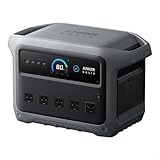
Anker SOLIX C1000 Gen 2 · Power station score: 92/100
1,024 Wh · 2,000W AC · 24.9 lb
Current Price on Amazon: $469.99
It runs a 50W blanket for ~17 h, or two blankets for ~8.7 h, enough for a couple through a typical night if nothing else draws from it. Its inverter can start a 1,500W heater, but that empties it in ~35 min. It is a car-camping box at 24.9 lb, not a backpacking item.
Low-watt blankets to plug into it
Both publish a draw you can do math with. More USB, 12V and cordless models are compared in our battery heated blanket guide.
12V Blanket for a Power Station or Car

Stalwart 12V Heated Car Blanket (Navy)
12V socket plug · 50W rated (Stalwart manual) · 59 x 43 in
Current Price on Amazon: $32.99
A published 50W rating makes the math easy: ~4.9 h on the C300 DC, ~17 h on the C1000 Gen 2. One heat level and no published auto-off, so unplug it once you're warm.
USB Throw for the Lightest Setup

Keltne USB Heated Throw 58 x 38 in (Battery Not Included)
USB, 5V 2A supply (about 10W) · 58 x 38 in · machine washable (listing)
Runs from a power bank or a station's USB port. At about 10W it's gentle warmth, not heat, but it lasts: ~24 h on the C300 DC. The battery is not included and the listing doesn't mention an auto shut-off.
Electric space heater at a campsite with power
At a site with an electric hookup, the battery limit goes away but the fire rules don't. CPSC says to keep space heaters at least three feet from anything that can burn, never to leave them on while sleeping, and to plug electric space heaters "directly into a wall outlet and never into an extension cord or power strip" (CPSC). Most tent pads are too far from the pedestal for that. Pick a heater with a tip-over switch, "an automatic device that turns the heater off if it tips over" (CPSC), and keep it on a hard, level surface. Recharging the station from the hookup and running a blanket overnight avoids the cord problem entirely. Station picks for car camping are in our best solar generators for camping guide.
Propane Tent Heater: What the Manuals Allow
Most propane "camp heaters" are outdoor-only. We list only Mr. Heater Buddy models because their manuals address tents directly. The Portable Buddy, Little Buddy and Big Buddy manuals each say the heater "is safe for indoor use in small recreational enclosures, having means for providing combustion air and ventilation, such as enclosed porches, cabins, fishing huts, trailers, tent trailers, tents, truck caps and vans" (MH9BX manual; MH4B manual; MH18B manual). The same manuals add conditions that rule out many tents:
- A window or roof vent is required. "If the recreational enclosure does not have a window or roof vent, DO NOT USE THIS HEATER INSIDE."
- A specific fresh-air opening: 4 sq in for the Little Buddy, 9 sq in for the Portable Buddy and 18 sq in for the Big Buddy. The Buddy and Big Buddy manuals specify it at the ceiling and at floor level.
- Clearances to anything that can burn: 30 in above, 24 in in front and 6 in at the sides for all three. In a dome tent under about 5 ft tall, 30 in of clear space above a heater sitting on the floor is hard to guarantee once the walls sag or flap.
- "NEVER OPERATE THE HEATER WHILE SLEEPING!" and never leave it unattended while burning.
- One fuel appliance at a time: "Do not use other fuel burning appliances inside." No stove or lantern running alongside it.
- Cold and altitude limits: runtime drops when the heater runs continuously below 20°F, and above 7,000 ft the heater may shut off.
Public-health guidance is stricter than the manuals. The CDC says fuel-burning equipment, including camping stoves, camping heaters, lanterns and charcoal grills, should never be used inside a tent, camper or other enclosed shelter, and that "Opening tent flaps, doors, or windows is insufficient to prevent build-up of CO concentrations from these devices" (CDC MMWR). CPSC says never to use fuel-burning portable heaters or lanterns while sleeping in tents, campers and vehicles, and that this "is especially important at high altitudes" (CPSC). We won't call any propane heater safe in a tent. If you use one, use it only as its manual says, while you are awake, with a battery CO alarm, then turn it off for the night.
Best Indoor-Rated Propane Heater for Most Tents
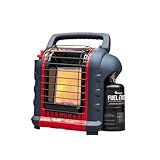
Mr. Heater Portable Buddy MH9BX (4,000-9,000 BTU) · Propane heater score: 75/100
4,000–9,000 BTU/h · ~225 sq ft · 9 sq in vent · ODS + tip-over shut-off
Current Price on Amazon: $79.99
The heater most people mean by "Buddy heater." Two settings (4,000 and 9,000 BTU), about 225 sq ft per Mr. Heater, and about 5.4 hours on low or 2.4 on high from a 1 lb cylinder (Amazon listing; the manual gives 3–6 hours). Its manual requires a 9 sq in fresh-air opening at the ceiling and at floor level, and clearances of 30 in above, 24 in in front and 6 in at the sides. Source: owner's manual.
Smallest Indoor-Rated Option (Small Tents, Blinds)

Mr. Heater Little Buddy MH4B (3,800 BTU)
3,800 BTU/h · ~95 sq ft · 4 sq in vent · ODS + tip-over shut-off
A single 3,800 BTU setting for about 95 sq ft, screwed straight onto one 1 lb cylinder. Mr. Heater's catalog sheet gives 5.6 hours and the manual says about 5 hours. It needs the smallest vent of the three (4 sq in) but has the same 30 in top and 24 in front clearances, which most small tents can't provide. Source: owner's manual.
Large Wall Tents and Cabin Tents
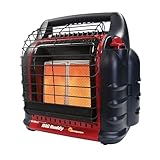
Mr. Heater Big Buddy MH18B, No Fan (4,000-18,000 BTU) · Propane heater score: 80/100
4,000–18,000 BTU/h · ~450 sq ft · 18 sq in vent · ODS + tip-over shut-off
Three settings from 4,000 to 18,000 BTU for up to 450 sq ft, with two 1 lb cylinder ports. That is more heat than a typical family tent needs, and it needs the biggest vent: 18 sq in at the ceiling and at floor level. This listing is the no-fan version. Source: owner's manual.
Use only disposable 1 lb cylinders inside: the Portable Buddy manual says it "may be used for emergency indoor heating when connected to a disposable 1 lb. propane cylinder," and says to attach or detach the cylinder outdoors. A 20 lb tank on a hose stays outside. For the Buddy FLEX, Hunting Buddy, runtime per cylinder and room-by-room limits, see our best indoor propane heater guide.
Diesel Heater for a Tent: Heater Outside, Warm Air In
An all-in-one diesel air heater burns fuel in a sealed chamber and blows clean air across it, so it can heat a large tent or a hot tent for hours on a small tank. The catch is the exhaust, which carries carbon monoxide. VEVOR says "The exhaust pipe needs to extend outdoors" (VEVOR), Hcalory says the exhaust must be fully discharged outside (Hcalory). CPSC says never use portable fuel-burning camping equipment inside a tent unless it is specifically designed for enclosed spaces and comes with instructions for safe use there (CPSC). The setup campers use: heater outside on level ground, warm-air hose through a vent or stove-jack opening, exhaust pointed downwind and away from the fabric.
Power: once running, a diesel heater needs little electricity. BougeRV, for example, publishes 10 to 60W operating power for its 5 kW unit but 150W at start, and says a 12V/10A (120W) cigarette-lighter port isn't enough to start it (BougeRV). Check the start draw against your power station's 12V output before you rely on it.
Best Diesel Heater With a Built-In CO Alarm

VEVOR XMZ-TB20 8kW All-in-One Diesel Heater with CO Alarm · Diesel heater score: 79/100
8 kW · 5 L tank · 12V/24V DC (Amazon listing adds an adapter option) · CO alarm: Built in: alert at 300 ppm, auto shut-off at 500 ppm (VEVOR)
Current Price on Amazon: $137.52
The only heater on this page with its own CO sensor: VEVOR lists an alert at 300 ppm and automatic shut-off at 500 ppm. It is 8 kW (about 27,300 BTU/h) on 12/24V DC with 0.18–0.4 L/h of diesel. VEVOR says "The exhaust pipe needs to extend outdoors," and it is rated up to 75 dB. You still need a separate CO alarm inside the tent. Source: maker's product page.
Longest Runtime Between Fills

Hcalory TB MAX2 8kW All-in-One Diesel Heater (7.9L) · Diesel heater score: 82/100
8 kW · 7.9 L tank · 12V/24V DC, 110-120V AC · CO alarm: Not listed for the MAX2
Current Price on Amazon: $279.99
A 7.9 L tank and up to 65 hours at its lowest burn rate per Hcalory, 12/24V DC or 110V AC power, and a published 54.6 dBA. Its glow plug draws up to 12A for the 3–5 minute start, so Hcalory says the power source must supply at least 15A. No CO alarm is listed for this model, and the exhaust must vent outdoors. Source: maker's product page.
Fuel use, startup current and the other two models we compared are in our best diesel heater guide. The same exhaust logic applies to a gas generator at camp: it belongs well away from the tent, and a generator tent is a rain cover for the generator, not a place to run it near where people sleep.
Tent Heater Safety Checklist
Before you heat any tent
- Carbon monoxide. Any flame inside a tent makes CO, which you can't see or smell. CPSC lists early symptoms as headache, fatigue, shortness of breath, nausea and dizziness, and says CO "can kill a sleeping person in less than two hours" (CPSC; CPSC). If anyone feels this way, get everyone out into fresh air and call 911.
- Battery CO alarm in the tent. CPSC recommends alarms that meet UL 2034 and says CO alarms "are available for boats and recreational vehicles and should be used" (CPSC). Our best portable carbon monoxide detector picks run on batteries, so they work in a tent with no outlet.
- An oxygen depletion sensor is not a CO alarm. The Buddy's low-oxygen shut-off responds to falling oxygen. It doesn't measure CO and doesn't replace the vent opening its manual requires.
- Tip-over shut-off. All three Buddy heaters have one; the MH9BX manual still says "DO NOT LEAVE HEATER UNATTENDED OR WHERE CHILDREN MAY CAUSE THE HEATER TO TIP OVER." Set any heater on a flat, hard base, never on a sleeping pad or loose ground.
- Ventilation. Open the vent the manual specifies before you light it. The CDC says opening tent flaps alone is not enough to stop CO building up.
- Clearance from fabric and bedding. Mr. Heater's manuals: 30 in above, 24 in in front. CPSC: at least three feet from anything that can burn. Sleeping bags, clothing and tent walls all count.
- Off before sleep. Every Buddy manual and CPSC say so. Switch to a heated blanket for the night.
Which Tent Heater Fits Your Trip
Buy the battery + blanket setup if you
- Want warmth while you sleep (the fuel heaters here must be off by then)
- Car-camp with kids or pets in the tent
- Already carry a power station for lights and phones
- Camp where open flames or fuel heaters are restricted
Consider propane or diesel if you
- Need the air warm for cooking, dressing or sitting up in the evening (propane, awake only, tent with a roof vent)
- Run a large canvas or hot tent with a stove-jack opening (diesel, heater and exhaust outside)
- Will carry a battery CO alarm and follow the manual's vent and clearance rules
Skip fuel heaters in small backpacking or dome tents where you can't keep 24–30 in of clear space around the heater.
A warmer sleeping bag and an insulated pad do most of the work on a cold night; any heater on this page adds comfort on top of them.
Tent Heater FAQ
What is the safest tent heater for camping?
One that burns nothing. A 12V or USB heated blanket powered by a portable power station makes no carbon monoxide and has no open flame. A 50W 12V blanket runs ~4.9 h on a 288 Wh station and ~17 h on a 1,024 Wh station. The CDC says fuel-burning equipment such as camping stoves, camping heaters and lanterns should never be used inside a tent, camper or other enclosed shelter.
Can you use a Mr. Heater Buddy in a tent?
Mr. Heater's manuals for the Portable Buddy (MH9BX), Little Buddy (MH4B) and Big Buddy (MH18B) list tents among the "small recreational enclosures" where the heater is safe for indoor use, but only if the enclosure has a window or roof vent ("If the recreational enclosure does not have a window or roof vent, DO NOT USE THIS HEATER INSIDE"), with a fresh-air opening of 4 to 18 sq in depending on the model, required clearances of 30 in above and 24 in in front, and never while sleeping. The CDC's guidance is stricter: it says camping heaters should never be used inside a tent. If you use one, use it only while awake, follow the manual exactly, and run a battery CO alarm.
Can I sleep with a heater on in a tent?
Not a fuel-burning one. Every Mr. Heater Buddy manual says "NEVER OPERATE THE HEATER WHILE SLEEPING!" and CPSC says never to use fuel-burning portable heaters or lanterns while sleeping in enclosed areas such as tents, campers and vehicles. CPSC also warns that carbon monoxide can kill a sleeping person in less than two hours. Warm the tent while you are awake, turn the heater off, and sleep with a heated blanket on a power station.
How long will a power station run a heater in a tent?
Multiply the station's watt-hours by about 0.85 and divide by the heater's watts. A 1,500W space heater empties a 1,024 Wh station in ~35 min and a 2,074 Wh station in ~1.2 h. A 50W heated blanket on the same 1,024 Wh station runs ~17 h. That is why heated blankets, not space heaters, are the battery option for tents.
Can you put a diesel heater in a tent?
Only the warm-air outlet, never the exhaust. Hcalory and VEVOR both say the exhaust must vent outdoors. Campers usually keep the heater outside and feed the warm-air hose in. CPSC says never use portable fuel-burning camping equipment inside a tent unless it is designed for enclosed spaces and comes with instructions for safe use there. Keep a battery CO alarm in the tent even with the exhaust outside.
Do I need a carbon monoxide detector in a tent?
Yes, whenever any fuel-burning heater runs in or near the tent. A heater's low-oxygen (ODS) shut-off responds to oxygen, not carbon monoxide, so it is not a CO alarm. CPSC recommends CO alarms that meet the UL 2034 standard and says CO alarms are available for boats and recreational vehicles and should be used. A small battery-powered alarm works in a tent with no outlet; see our portable carbon monoxide detector picks.
What size heater do I need for my tent?
Mr. Heater rates its heaters by enclosure area: about 95 sq ft for the 3,800 BTU Little Buddy, 225 sq ft for the 9,000 BTU Portable Buddy and 450 sq ft for the 18,000 BTU Big Buddy. Compare that with your tent's floor area (a 10 x 10 ft tent is 100 sq ft). We found no manufacturer sizing rule written for fabric tents, so treat those ratings as a guide, and check that the tent is tall and wide enough for the manual's clearances before you pick a heater.
Is an electric space heater safe in a tent?
It makes no fumes, but it is still a fire risk near fabric. CPSC says to keep space heaters at least three feet from anything that can burn, never to leave them on while sleeping, and to plug electric heaters directly into a wall outlet, never an extension cord or power strip, which rules out most tent sites without a pedestal close by. Look for a tip-over switch, which CPSC describes as a device that turns the heater off if it tips over. On a battery, a 1,500W heater lasts minutes, not hours.