
Buying Guide · Updated November 2026
Best Generator for Food Truck 2026: 7 Picks Sized to Your Fridge, Steam Table, AC and Espresso
Short answer
The best generator for food truck kitchens running a fridge, a freezer, a steam table and lights is a 3,500W-class inverter. Our in-stock pick is the Champion 4500 Dual Fuel Inverter, with 3,500 running and 4,500 starting watts and CO Shield shutoff. A rooftop AC or 240V espresso machine pushes you to the Westinghouse WGen9500DFc (9,500W, 120/240V). Coffee carts and booths can run silently on a power station.
As an Amazon Associate, SolarGenAdvisor earns from qualifying purchases made through links on this page, at no additional cost to you. Ratings are AI-synthesized from manufacturer specs, published figures and logged Amazon prices; we did not test these generators.
 By
Food Truck Generator Comparison: Watts, Voltage and Noise
Most people shopping for an electric generator for food truck service need three numbers: running watts for the whole kitchen, starting watts for the compressors, and whether the generator has the 240V outlet some commercial gear needs. All figures below are manufacturer-published or from the Amazon listing, on gasoline unless noted. "Fits" is our reading of each generator against the load worksheet in the next section. Prices are live from Amazon.
| Generator | Running / starting W | Voltage / outlets | Fits | Noise | Weight | CO shutoff | Price |
|---|---|---|---|---|---|---|---|
| Champion 4500-Watt Electric Start Dual Fuel Inverter Generator (65/100) | 3,500 / 4,500 LP: 3,150 running |
120V only (TT-30R, 5-20R) | Lunch truck without AC; coffee truck if you stagger the brewer | 61 dBA | 99.2 lb | CO Shield automatic shutoff | $999.00 Check Price → |
| Westinghouse iGen5000DFc Dual Fuel Inverter Generator (73/100) | 3,900 / 5,000 LP: 3,500 running |
120V only (TT-30R, 5-20R) | Coffee truck; lunch truck without AC | 52 dBA | 106 lb* | CO sensor with automatic shutdown | $999.00 Check Price → |
| Champion 2500-Watt Dual Fuel Inverter Generator with CO Shield (66/100) | 1,850 / 2,500 LP: 1,665 running |
120V only (5-20R; 30A RV outlet via the parallel kit) | Espresso cart or tent; two in parallel for a small truck | 53 dBA | 43.2 lb | CO Shield automatic shutoff | $575.00 Check Price → |
| Honda EU2200i Inverter Generator (57/100) | 1,800 / 2,200 | 120V only (duplex; 30A via the Companion) | Espresso cart, vendor booth; paired for a small truck | 53 dBA | 46.5 lb | CO-MINDER automatic shutdown | Check price at Amazon → |
| WEN 56380i 3800-Watt Inverter Generator (55/100) | 3,400 / 3,800 | 120V only (TT-30R, two 120V) | Lunch truck without AC, on a budget | 57 dBA | 99.2 lb | None listed (fuel shutoff only) | $699.99 Check Price → |
| Westinghouse WGen9500DFc Dual Fuel Generator with CO Sensor (70/100) | 9,500 / 12,500 LP: 8,500 running |
120/240V (L14-30R, 14-50R, GFCI duplexes) | Lunch truck with AC; 208-240V espresso or cooking gear | 74 dBA | 212.1 lb | CO sensor with automatic shutdown | $1,049.00 Check Price → |
| DuroMax XP12000EH Dual Fuel Generator (51/100) | 9,500 / 12,000 LP: 9,025 running |
120/240V (14-50R, L14-30R, L5-30R, GFCI) | Full kitchen or 240V gear in California | Not published | 238 lb | None listed on the Amazon listing | Check price at Amazon → |
Noise conditions: Champion measures at 23 ft. Honda's 53 dB and WEN's 57 dBA are at 1/4 load with no stated distance, and Westinghouse's 52 dBA is an "as low as" figure. DuroMax publishes no noise rating. *Westinghouse doesn't list the iGen5000DFc's weight on the spec page we could load, so the figure is a retailer's. Sources: Champion 201319, Champion 201323, iGen5000DFc via Norwall, WGen9500DFc via Norwall, XP12000EH via Norwall, Honda EU2200i specifications, WEN 56380i spec summary, plus each product's Amazon listing.
What Size Generator for a Food Truck? A Load Worksheet
Food truck generator sizing comes down to one method: total the running watts of everything on at the same time, then add the single biggest start-up surge, which comes from a compressor (fridge, freezer, AC). Heating loads such as steam tables, espresso boilers and coffee brewers draw a lot, but they have no surge. We built the worksheet from real commercial models' nameplates so you can see where the watts go. Your own equipment will differ, so copy the method and use your nameplates.
| Appliance (example model) | Running W | Starting W | Source |
|---|---|---|---|
| Reach-in refrigerator, 1 door (True T-23-HC: 115V, 2.2A) | 253 | 760 (est. 3×) | WebstaurantStore listing |
| Reach-in freezer, 1 door (True T-23F-HC: 115V, 5.5A) | 633 | 1,900 (est. 3×) | Prima Coffee listing |
| 3-well electric steam table (Vollrath 38003: 480W per well) | 1,440 | heating element, no surge | Vollrath spec sheet |
| 13,500 BTU rooftop air conditioner | 1,500 | 2,800 (Micro-Air: up to 2,800) | Micro-Air |
| 1-group espresso machine, 120V (Nuova Simonelli Appia Life: 1,500W, 13A) | 1,500 | heating element, no surge | WebstaurantStore listing |
| Pourover coffee brewer, 3 warmers (Bunn VP17-3: 1,670W, 13.9A) | 1,670 | heating element, no surge | WebstaurantStore listing |
| LED lighting (our allowance: four 15W fixtures) | 60 | — | Our assumption |
| POS tablet, card reader, phone charging (our allowance) | 50 | — | Our assumption |
Running watts are volts × amps from the listing where only amps are given (115V × 2.2A = 253W). Compressor starting watts marked "est. 3×" are our estimate: the Virginia Cooperative Extension fact sheet notes a motor draws about three times its running current when it starts. The AC figures are Micro-Air's for a 13,500 BTU RV rooftop unit; Micro-Air's own amp-based calculation gives 1,800 running watts, so treat 1,500 as a low estimate. Lights and POS are our allowances.
Four Food Truck Setups, Totaled
| Setup | What runs | Running W | Peak W (running + largest surge) | What covers it |
|---|---|---|---|---|
| Lunch truck with AC | Reach-in refrigerator, 1 door + Reach-in freezer, 1 door + 3-well electric steam table + 13,500 BTU rooftop air conditioner + LED lighting + POS tablet, card reader, phone charging | 3,936 | 5,236 | Two Champion 4500s in parallel (7,000W), or the WGen9500DFc / DuroMax XP12000EH |
| Lunch truck, no AC | Reach-in refrigerator, 1 door + Reach-in freezer, 1 door + 3-well electric steam table + LED lighting + POS tablet, card reader, phone charging | 2,436 | 3,703 | Champion 4500, iGen5000DFc or WEN 56380i |
| Coffee truck | 1-group espresso machine, 120V + Pourover coffee brewer, 3 warmers + Reach-in refrigerator, 1 door + LED lighting + POS tablet, card reader, phone charging | 3,533 | 4,040 | iGen5000DFc on gasoline (tight); otherwise two Champion 2500s, two 4500s or a 9,500W unit |
| Espresso cart or market tent | 1-group espresso machine, 120V + LED lighting + POS tablet, card reader, phone charging | 1,610 | 1,610 | One Champion 2500 or Honda EU2200i; Anker SOLIX F3000 on battery |
Three things stand out. First, the rooftop AC is what breaks a single 30A-class inverter: the same lunch truck goes from 2,436 to 3,936 running watts, past the Champion 4500's 3,500 and just over the iGen5000DFc's 3,900. Second, coffee trucks are heating-element trucks. An espresso machine and a brewer heating together make 3,533 running watts with almost no surge, so staggering them (brew, then pull shots) is the cheapest way to fit a smaller generator. Third, these totals assume everything is on at once, which is the right way to size for a lunch rush. Leave yourself headroom: generators run hotter, louder and thirstier near their limit.
240V espresso machines and cooking gear
Check the voltage before the wattage. A 120V one-group espresso machine such as the Nuova Simonelli Appia Life is listed at 1,500 watts and 13 amps on a regular 5-15P plug (WebstaurantStore). The two-group version is listed at 220V, 17 amps and 3,400 watts (Prima Coffee). Every inverter on this page has 120V outlets only. If your truck has 208–240V equipment, you need a generator with a 120/240V outlet (L14-30R or 14-50R), such as the Westinghouse WGen9500DFc or DuroMax XP12000EH, and an electrician who can confirm how your truck's inlet and panel are wired.
Keep cold holding at 41°F through the whole shift
The FDA Food Code, a model code that state and local health departments adopt, requires refrigerated time/temperature control for safety (TCS) food to be held at 5°C (41°F) or less (FDA Food Code 2022, §3-501.16). Your local health department enforces the edition your state adopted, so check with them. For generator planning, that means the fridge and freezer can't be the loads you shed when the generator is overloaded or runs out of fuel mid-service. Size so the cold side always runs, keep a thermometer in each unit, and refuel on schedule, not when the engine stalls.
Sizing a different load? Our appliance wattage chart lists running and starting watts for more than 50 appliances, and our portable generator for construction sites guide covers saws and compressors.
The 7 Best Generators for Food Trucks in 2026
Picks 1–5 are inverter generators (120V) for trucks without a rooftop AC, coffee trucks and carts. Picks 6–7 are open-frame 120/240V generators for full kitchens with AC or 240V gear. Each score uses the same gas-generator rubric as our best inverter generator and best propane generator guides, which weighs running output, value per running watt, runtime and fuel options, CO safety, noise and portability. The rubric is separate from our power-station matrix, so don't compare a generator's score with a battery station's. The list leads with the in-stock pick for each job, not strictly by score.
#1 · Best for Most Food Trucks (in stock) · 65/100

Champion 4500-Watt Electric Start Dual Fuel Inverter Generator
3,500W running / 4,500W starting · Dual fuel · 61 dBA · 99.2 lb
Best fit: Lunch truck without AC; coffee truck if you stagger the brewer · 120V only (TT-30R, 5-20R)
Current price on Amazon: $999.00
Champion rates the 4500 at 3,500 running and 4,500 starting watts on gasoline and 3,150 running on propane, with a covered TT-30R 30A outlet, a 5-20R duplex, electric start and CO Shield, which shuts the engine off if carbon monoxide builds up. In our worksheet that covers a no-AC lunch truck (2,436W running) with about 1,000 watts to spare, and its 4,500 starting watts clear a freezer compressor's start-up. Champion publishes 14 hours on gasoline and 21 hours on a 20-lb propane tank at 1/4 load, which is a full service day at light load. It is not enough on its own for a truck with a 13,500 BTU AC and a steam table (3,936W running), but Champion's 50A ParaLINK kit (model 100319) pairs two of them for 7,000 running watts. The costs: a published 61 dBA from 23 feet, the loudest inverter here, and 99.2 lb.
- 3,500 running / 4,500 starting watts
- Dual fuel with CO Shield shutoff
- 21 hr on a 20-lb propane tank at 1/4 load
- 50A parallel kit for two units
- 61 dBA from 23 ft, loudest inverter here
- 99.2 lb: wheels, not carrying
- 120V only
Specs: Champion 201319 page, Amazon listing.
#2 · Most Inverter Output (Highest-Rated) · 73/100

Westinghouse iGen5000DFc Dual Fuel Inverter Generator
3,900W running / 5,000W starting · Dual fuel · 52 dBA · 106 lb*
Best fit: Coffee truck; lunch truck without AC · 120V only (TT-30R, 5-20R)
Current price on Amazon: $999.00
The most running watts of any inverter here: 3,900 running and 5,000 peak on gasoline (3,500/4,500 on propane), a CO sensor with automatic shutdown, an "as low as" 52 dBA rating and the longest published runtime in this group, 18 hours at 25% load on 3.4 gallons. That is enough for our coffee-truck worksheet (3,533W running) on gasoline, though with the brewer and espresso machine heating at once there is under 400 watts of margin, and on propane (3,500W) you would need to stagger them. It weighs over 100 lb by retailer figures, it is marked not for sale in California, and when we checked on November 9, 2026 the Amazon listing said it usually ships in 8 to 13 days, which is why the in-stock Champion 4500 leads this list.
- 3,900 running / 5,000 peak watts
- CO sensor with automatic shutdown
- 18 hr at 25% load (published)
- As low as 52 dBA
- About 106 lb by retailer figures
- Not sold in California
- Ships in 8-13 days (Amazon, Nov 9)
Specs: Westinghouse spec via Norwall, Amazon listing.
#3 · Best for Coffee Carts (Pair Two for a Truck) · 66/100

Champion 2500-Watt Dual Fuel Inverter Generator with CO Shield
1,850W running / 2,500W starting · Dual fuel · 53 dBA · 43.2 lb
Best fit: Espresso cart or tent; two in parallel for a small truck · 120V only (5-20R; 30A RV outlet via the parallel kit)
Current price on Amazon: $575.00
One Champion 2500 is rated 1,850 running watts on gasoline (1,665 on propane), which covers a 120V one-group espresso machine (1,500W), the POS and lights for a cart or market tent. It is the lightest dual fuel pick here, it has CO Shield shutoff, and Champion publishes 53 dBA from 23 feet with 11.5 hours on gasoline or 25 hours on a 20-lb propane tank at 1/4 load. Two of them on Champion's 30A ParaLINK kit (model 100740, which adds a 30A RV-style outlet) give 3,700 running watts in two pieces you can lift, and on slow afternoons you run one. Stock was limited on Amazon when we checked on November 9.
- Lightest pick here, easy to lift
- 53 dBA from 23 ft
- Gas or propane, CO Shield shutoff
- 30A parallel kit for two units
- 1,850 running W: one espresso machine, not a kitchen
- Single duplex outlet on the unit
Specs: Champion 201323 page, Amazon listing.
#4 · Premium Quiet Pick · 57/100

Honda EU2200i Inverter Generator
1,800W running / 2,200W starting · Gasoline · 53 dBA · 46.5 lb
Best fit: Espresso cart, vendor booth; paired for a small truck · 120V only (duplex; 30A via the Companion)
Honda rates the EU2200i at 2,200W max and 1,800W rated, 46.5 lb dry, 53 dB at 1/4 load and 62 dB at rated load, with 8.1 hours at 1/4 load on 0.95 gallons. The Amazon listing adds CO-MINDER automatic shutdown and Bluetooth app control. For a cart with a one-group espresso machine it has 300 watts of headroom. For more, Honda says the EU2200i Companion paired with a regular EU2200i delivers up to 4,400 watts, and the Companion has a 30A receptacle. In our scoring it loses most of its points on price per running watt, and it runs on gasoline only, so it can't share a propane supply.
- 46.5 lb, compact
- CO-MINDER shutdown + Bluetooth app
- Pairs with the Companion for up to 4,400W
- Highest price per running watt here
- Gasoline only
- Amazon listing shows it as unavailable to California buyers
Specs: Honda technical specifications, Honda EU2200i Companion page, Amazon listing.
#5 · Lowest Price per Running Watt (Inverter) · 55/100
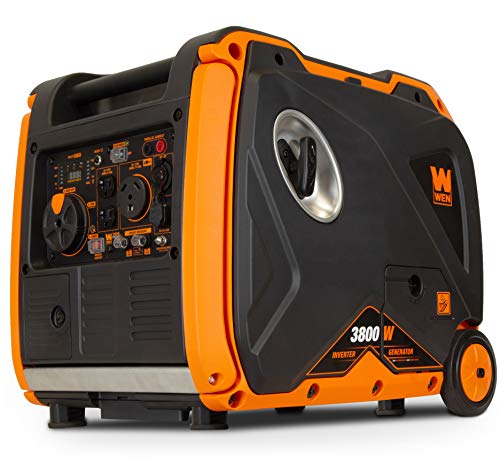
WEN 56380i 3800-Watt Inverter Generator
3,400W running / 3,800W starting · Gasoline · 57 dBA · 99.2 lb
Best fit: Lunch truck without AC, on a budget · 120V only (TT-30R, two 120V)
Current price on Amazon: $699.99
3,400 running and 3,800 surge watts with electric start and a TT-30R outlet, at the lowest price per running watt of the inverters here. WEN lists 57 dBA at 1/4 load and 8.5 hours at half load. That covers the running watts of our no-AC lunch truck worksheet (2,436W), but its 3,800 surge watts leave only about 100 watts of margin over the 3,703W peak when the freezer compressor starts, so stagger anything else that starts at the same time. It is the only inverter pick whose Amazon listing names no CO shutoff sensor (only a fuel shutoff), and it has no propane option or listed parallel capability, which is why it scores lowest on safety and fuel in our rubric. If you buy it, give placement and the CO alarm in the truck extra attention.
- Lowest cost per running watt (inverters)
- Electric start, TT-30R outlet
- EPA III compliant (listing)
- No CO shutoff sensor listed
- Gasoline only, no parallel listed
- Half-load runtime only
Specs: spec summary citing wenproducts.com, Amazon listing.
#6 · Best for Full Kitchens and 240V Gear · 70/100

Westinghouse WGen9500DFc Dual Fuel Generator with CO Sensor
9,500W running / 12,500W starting · Dual fuel · 74 dBA · 212.1 lb
Best fit: Lunch truck with AC; 208-240V espresso or cooking gear · 120/240V (L14-30R, 14-50R, GFCI duplexes)
Current price on Amazon: $1,049.00
This is the pick when the worksheet outgrows a 30A inverter. It is rated 9,500 running and 12,500 peak watts on gasoline (8,500/11,200 on propane), more than double our lunch-truck-with-AC total of 3,936 running watts. It also has 120/240V outlets (L14-30R and 14-50R), which a two-group espresso machine rated at 220V needs and a 120V-only inverter can't supply. It has a CO sensor with automatic shutdown and remote start. The costs are real for a food truck: it is an open-frame unit at a published 74 dBA, about 212 lb, and not sold in California. Check your event's noise rules before you bring one, and plan where it will sit (see the placement checklist below).
- 9,500 running W (8,500 on propane)
- 120/240V L14-30R and 14-50R outlets
- CO sensor with automatic shutdown
- Remote key-fob + electric start
- 74 dBA, open frame
- About 212 lb
- Not sold in California
Specs: Westinghouse spec via Norwall, Amazon listing.
#7 · 240V Pick Sold in California · 51/100

DuroMax XP12000EH Dual Fuel Generator
9,500W running / 12,000W starting · Dual fuel · no published dBA · 238 lb
Best fit: Full kitchen or 240V gear in California · 120/240V (14-50R, L14-30R, L5-30R, GFCI)
The two Westinghouse units are marked not for sale in California. Norwall lists the DuroMax XP12000EH as EPA and CARB compliant and "for sale in all 50 states." It is rated 9,500 running watts on gasoline and 9,025 on propane, the smallest propane derate here, which matters if you run it on propane all day. It has 120/240V 14-50R and L14-30R outlets plus an L5-30R twist-lock. It scores lowest in our rubric because the Amazon listing names no CO shutoff sensor and DuroMax publishes no noise rating, so you can't check it against a market's decibel limit before you buy.
- CARB compliant per Norwall
- 9,025 running W on propane
- 120/240V outlets
- No CO shutoff sensor listed
- No published noise rating
- Open frame, heavy
Specs: DuroMax spec via Norwall, Amazon listing.
Running an RV-style rooftop AC is the same sizing problem in a food truck as in a camper. Our best generator for RV guide covers soft starters, which Micro-Air says can cut an AC's start-up surge by as much as 70% (Micro-Air), and the 30A vs 50A outlet question in more detail.
Quiet Generator for Food Truck Events and Markets
At street fairs and farmers markets, a quiet generator for food truck service can decide whether you're invited back. There is no single national rule, but markets do set and enforce their own. Two examples:
- Chattanooga Market (Tennessee): its generator noise policy says the customer experience must be lower than 92 dB, measured 4 feet from accessible areas from any angle, and that trucks that can't maintain a pleasant customer experience will be declined from future market events. It doesn't require a particular brand (Chattanooga Market vendor policy).
- FRESHFARM markets (Washington, D.C. area): the 2025 vendor agreement says complaints of excessively loud generators will be addressed with a calibrated reading by market staff, and vendors may be required to reconfigure their setup or use generators that do not emit noise above a reasonable decibel level (FRESHFARM 2025 vendor agreement).
Many cities also have noise ordinances, and event organizers often add their own rules, so ask before you book. On published figures, the quietest picks here are the iGen5000DFc ("as low as" 52 dBA), the Champion 2500 (53 dBA at 23 ft) and the Honda EU2200i (53 dB at 1/4 load). Each gets louder with load: Honda lists 62 dB at rated load (Honda). The open-frame 9,500W units are rated at 74 dBA. Two practical ways to cut noise at the window are running two small inverters in parallel, so each works at a lighter load, and using a battery for the quiet hours. Our quietest generator guide compares these decibel figures with battery stations, whose only sound is a cooling fan.
Power Station for a Food Truck, Coffee Cart or Vendor Booth
We mostly cover battery power stations ("solar generators"), so here is the trade-off as evenly as we can put it. A power station makes no noise and no exhaust, so it can sit right beside the cart and never trips a decibel limit. It recharges from solar panels or a wall outlet. It runs out, though: a steam table, a rooftop AC or a coffee brewer will drain even a 3 kWh battery in a couple of hours, and you can't refuel it from a gas can. That makes batteries a good fit for vendor booths, display coolers, lights and POS, and for an espresso cart if the station's output covers the machine. Most full trucks run on a generator. Some use a hybrid: the battery covers quiet setup and evening hours, and the generator handles the lunch rush and recharges the battery.
How Long a Battery Runs Cart and Booth Loads
Runtime = watt-hours × 0.85 ÷ load in watts. The 0.85 is our assumption for inverter losses. An espresso machine's element cycles off once the boiler is hot, so the real average is lower than the worst case below. A plug-in watt meter on your machine during a service gives you the real number.
| Load | Jackery Explorer 1000 V2 (1,024 Wh, 1,500W) | Anker SOLIX F3000 (3,072 Wh, 3,600W) |
|---|---|---|
| Vendor booth: LED lights + POS (~110W) | 7.9 hr | 23.7 hr |
| Cart: reach-in fridge + lights + POS (~363W) | 2.4 hr | 7.2 hr |
| Espresso cart, element heating nonstop (worst case) (~1,610W) | Over the 1,500W output | 1.6 hr |
Loads come from the worksheet above: the True T-23-HC reach-in at 253W running (a compressor that cycles, so this is a conservative figure), the 1,500W Appia Life one-group, plus our 60W lighting and 50W POS allowances.
Silent pick for vendor booths · 93/100 (power-station score)

1,024 Wh · 1,500W (3,000W peak) · 23.3 lb
Current price on Amazon: $559.00
1,024 Wh with 1,500W continuous output and 23.3 lb. By our math it runs lights and a POS silently for about 8 hours, but adding a reach-in fridge cuts that to about 2.4 hours, and 1,500W is not enough for a 1,500W espresso machine plus anything else, so it is a booth and display-cooler station, not an espresso station. It was in stock when we checked on November 9.
Runs a 1-group espresso machine · 93/100 (power-station score)

3,072 Wh · 3,600W (4,860W peak) · 91.5 lb
Current price on Amazon: $1,699.99
3,072 Wh with 3,600W continuous and 4,860W surge, expandable with extra batteries, and up to 2,400W of solar input. It runs a 120V one-group espresso machine with the POS and lights and has room for the fridge too. By our math a full charge covers under two hours if the espresso element were heating nonstop. When we checked on November 9, the Amazon listing showed a future availability date, not in-stock.
The full fuel-vs-battery comparison, including running costs, is in solar generator vs gas generator. If the cart's main load is a fridge, our guide to running a refrigerator on a solar generator has the duty-cycle math.
Propane, Gas or Dual Fuel for All-Day Service
Five of the seven picks are dual fuel. What each fuel means on a service day:
- Propane costs about 10% of the output on most dual fuel picks here: the Champion 4500 goes from 3,500 to 3,150 running watts, the iGen5000DFc from 3,900 to 3,500 and the WGen9500DFc from 9,500 to 8,500. The DuroMax XP12000EH loses the least (9,500 to 9,025). If your worksheet is close to the limit on gasoline, it will be over on propane.
- Published runtimes on a 20-lb tank are long at light load: Champion lists 21 hours for the 4500 and 25 hours for the 2500 at 1/4 load (Champion 4500, Champion 2500). A food truck at lunch is not at 1/4 load, so expect much less and carry a spare cylinder.
- Fuel handling is a fire-code item. NFPA's food truck fact sheet says to refuel only during non-operating hours, to shut down any engine-driven power source before refueling from a portable container and to check that its surfaces are cool to the touch (NFPA Food Truck Safety fact sheet). It also says portable gas containers must be upright and secured against tipping. DeLand, Florida requires propane cylinders other than those on personal grills to be 10 feet from the cooking appliance (DeLand Fire).
- Plan the generator's fuel separately from the cooking line. Whether a generator may share a truck's installed LP system is a question for your fire marshal and the generator's manual. We don't recommend tapping into it on your own.
The best propane generator guide compares propane runtimes and derates across all our gas picks.
Generator Placement, CO Safety and the Fire-Marshal Checklist
Every generator here makes carbon monoxide. CPSC says an average of nearly 100 people die in the U.S. each year from CO poisoning caused by portable generators, and that a portable generator must never run inside an enclosed space (CPSC). CDC says to keep a generator outside, at least 20 feet from any doors, windows or vents (CDC). A food truck adds a service window, a line of customers and other vendors, so placement matters more than at a campsite.
Fire-code rules are local. Check yours with the fire marshal before your first event. These are examples from published checklists, not rules for your city:
- Lenexa, Kansas (Mobile Food Vendor Fire Inspection Checklist, with the Heart of America Fire Marshal's Group, citing NFPA 96, 2024 edition). A generator not mounted on the vehicle must be at least 12 ft from the cooking operation and isolated by guards, fencing or an enclosure. Its exhaust must be at least 12 ft from openings, air intakes and exits, and pointed away from buildings and other cooking operations. The checklist also requires a 2-A:20-B:C extinguisher, or two 2-A:10-B:C, where internal-combustion power sources are used, and a Class K extinguisher with a deep fryer. Trucks need 10 ft of clearance from buildings, combustibles, vehicles and other cooking operations. Power strips are for POS-type devices only, and a CO detector is required where open flames are used (Lenexa checklist).
- DeLand, Florida (Mobile/Temporary Cooking Operations, Florida Fire Prevention Code, 8th edition). Generators must be at least 20 ft from tents and membrane structures and protected by fencing or an enclosure, with exhaust directed away from openings, air intakes and buildings. Using a generator requires at least one 3A:40BC extinguisher. Refueling is allowed only when the generator is not in use (DeLand Fire).
- NFPA's Food Truck Safety fact sheet (2018 edition). Separate any engine-driven power source from the public with barriers. Keep its exhaust at least 10 ft from openings, air intakes and exits, and refuel only during non-operating hours (NFPA fact sheet). The fact sheet cites the older Annex B of NFPA 96, while Lenexa cites Chapter 17 of the 2024 edition. Distances differ between editions and jurisdictions, which is why your locally adopted code is the one that counts.
- Point the exhaust away from the service window, the line and neighboring trucks.
- CPSC recommends a generator with a CO shut-off safety feature. Five of our seven picks list one; the WEN 56380i and DuroMax XP12000EH listings don't. A shutoff is a backup: Champion says its CO Shield is not a substitute for an indoor CO alarm (Champion). Our portable CO detector guide covers alarms for the truck.
- Generators built into the vehicle are a different category. Lenexa's checklist requires vehicle-mounted generators to comply with NFPA 70 (the National Electrical Code), Article 551, Part III. This page covers portable generators that sit outside the truck.
Who Should Buy Which Food Truck Generator
Buy a gas or dual fuel generator if…
- You run a steam table, a rooftop AC or a coffee brewer through a full shift.
- You work events with no shore power and can place the generator 12+ feet from the cooking line, fenced or caged.
- You already carry propane and want a dual fuel option for long days.
- You have 208–240V equipment (pick a 120/240V unit).
Skip it (or go battery) if…
- You run a booth or cart with lights, a POS and a display cooler.
- Your markets restrict generator noise or ban generators near the stalls.
- You mostly park where shore power is provided.
- You only need power for quiet setup and closing hours.
If you also run a commissary kitchen, a storefront or an office, our backup power for small business guide covers the POS, router, cameras and refrigerated stock there.
Food Truck Generator FAQ
What size generator do I need for a food truck?
Add the running watts of everything that runs at once, then add the single biggest start-up surge. In our worksheet, built from appliance nameplates, a lunch truck with a reach-in fridge, a reach-in freezer, a 3-well steam table, lights and a POS comes to about 2,400 running watts, so a 3,500W inverter such as the Champion 4500 covers it. Add a 13,500 BTU rooftop AC and it is about 3,900 running and 5,200 peak watts. That calls for two inverters in parallel or a 9,500W open-frame generator. Use the nameplates on your own equipment, because models vary widely.
What is the quietest generator for a food truck?
Among our picks, the lowest published figures are Westinghouse's "as low as" 52 dBA for the iGen5000DFc, 53 dBA from 23 feet for the Champion 2500 Dual Fuel, and 53 dB at 1/4 load for the Honda EU2200i. Makers measure at different loads and distances, so the numbers are not strictly comparable, and all of them get louder as you add load. Honda lists 62 dB at rated load. Open-frame 9,500W generators are rated at 74 dBA, and some markets measure noise on site: Chattanooga Market's policy, for example, requires under 92 dB measured 4 feet from accessible areas.
Can a power station run a food truck or coffee cart?
A vendor booth or a cart, yes. A full truck kitchen, usually not for a whole day. By our math (watt-hours x 0.85 / load), the 1,024 Wh Jackery Explorer 1000 V2 runs 110 watts of lights and POS for about 8 hours. The 3,072 Wh Anker SOLIX F3000 runs a reach-in fridge, lights and POS (about 360 watts) for about 7 hours. Its 3,600W output also handles a 120V one-group espresso machine, though the battery would last under two hours if the element heated nonstop. Steam tables, ACs and coffee brewers drain a battery fast, which is why trucks with those loads use a generator.
Can I run an espresso machine on a generator?
Yes, if the generator matches its voltage and wattage. A 120V one-group machine such as the Nuova Simonelli Appia Life is listed at 1,500 watts and 13 amps on a standard 5-15P plug, which a 2,000W-class inverter can run by itself. Two-group commercial machines are commonly 220V: Prima Coffee lists the Appia Life 2-group at 220V, 17 amps and 3,400 watts. That needs a generator with a 120/240V outlet, such as the Westinghouse WGen9500DFc or DuroMax XP12000EH, because the inverters on this page have 120V outlets only.
How far does a generator have to be from a food truck?
It depends on your local fire code, so ask your fire marshal. As examples, the Lenexa, Kansas mobile food vendor checklist (citing NFPA 96, 2024 edition) requires a generator not mounted on the vehicle to be at least 12 feet from the cooking operation, guarded by fencing or an enclosure, with its exhaust at least 12 feet from openings, air intakes and exits. DeLand, Florida requires generators to be at least 20 feet from tents and fenced off. For carbon monoxide, CDC says to keep a generator at least 20 feet from doors, windows and vents.
Is propane or gasoline better for a food truck generator?
Propane stores well, and you may already carry it for cooking. It costs some power: about 10% fewer running watts on the dual fuel picks here, for example 3,500W vs 3,150W on the Champion 4500. Gasoline gives full output. A dual fuel generator lets you choose by the day. Either way, fire codes treat fuel seriously. NFPA's food truck fact sheet says to refuel only during non-operating hours, with the engine off and cool. DeLand requires propane cylinders to be 10 feet from the cooking appliance and secured.
No AC? A 3,500W dual fuel inverter. Rooftop AC or 240V gear? A 9,500W 120/240V generator or two inverters in parallel. Cart or booth? A power station.
Check live prices, or compare more inverters in our best inverter generator guide first.