
Business Guide · Updated November 2026
Backup Generator for Business: Small Business Backup Power by Business Type
Choosing a backup generator for business use starts with what has to keep running, and for how long. For most shops and offices, backup power for small business means three tiers: a UPS for the POS, router and cameras; a battery power station for a fridge of stock or hours of uptime; and an inverter generator for a food truck, a kitchen or a whole shop. Find your business type below.
As an Amazon Associate, SolarGenAdvisor earns from qualifying purchases made through links on this page, at no additional cost to you.
 By Morgan Chen
Reviewed & approved by Juhi Sahni
|
Published: November 9, 2026
|
Updated:
|
Battery backup vs generator
Which Backup Power Does Your Business Need?
Start from the loads that cost you money when they stop, not from the biggest generator you can afford. The runtime goals below are our planning starting points, not code requirements; set your own from how long your outages last and what an hour of downtime costs you.
| Business type | Typical critical loads | Minimum runtime goal | Right equipment |
|---|---|---|---|
| Retail shop, salon, café counter | POS terminal, card reader, modem, router | Long enough to finish sales and close out; hours if you trade through outages | 1500VA UPS; power station with UPS mode for hours (POS guide) |
| Office or professional practice | Modem or fiber ONT, router, PCs, phones | PCs: time to save and shut down. Internet: hours | Desktop UPS per workstation; mini DC UPS on the router (router guide) |
| Any site with cameras | NVR, PoE switch, cameras, router | Through the outage, so recording continues | Sine-wave 1500VA UPS; power station for hours (camera guide) |
| Network closet or server rack | Switch, firewall, NAS or small server | Minutes: a clean, automatic shutdown | Rack UPS with shutdown software (rack UPS picks) |
| Restaurant, deli, florist, convenience store | Reach-in fridges and freezers, lights, POS | Longer than the 4 hours an unopened fridge holds (FDA) | 2 kWh+ power station per fridge, or an inverter generator for several |
| Food truck, coffee cart, vendor booth | Fridge, steam table, espresso machine, POS, lights | A full service shift | Inverter generator (trucks); power station (carts, booths) (food truck guide) |
| Contractor or jobsite | Corded tools, battery chargers, work lights | A work day | Large power station or generator (job site guide) |
| Remote office or Starlink site | Starlink dish and router, laptop | Overnight, refilled by solar each day | Power station plus panels (Starlink guide) |
| Whole small building | Selected circuits: lights, outlets, fridges | Hours to days | Generator + transfer switch by an electrician, or installed battery or standby (compare) |
| Clinic or pharmacy storing vaccines | Vaccine storage units and data loggers | Set by your emergency plan and state program | No product pick: see CDC guidance below |
| Hospital or larger facility | Life-safety and critical branches | Set by code | Engineered standby system; outside this guide |
What to Put on Backup Power First
Walk the building with a notepad and list what stops when the lights go out. Then back it up in roughly this order, because the first items are small, cheap to cover and needed by almost everything after them.
- The internet path. Modem or fiber ONT, router and any network switch. Card payments, VoIP phones, cloud POS and camera alerts all depend on it. A mini DC UPS or small AC UPS covers it for little money; our UPS for router and modem section compares both.
- Payments. The POS terminal, tablet stand and card-reader dock. Offline card modes exist but shift risk to you; our POS UPS section quotes what Square and Clover say about them.
- Security. The NVR, PoE switch and alarm communicator, so recording and alerts continue (camera backup sizing).
- Computers and the server. Enough runtime to save work and shut down cleanly. In a rack, use a UPS whose software triggers the shutdown for you.
- Refrigerated stock. Fridges and freezers holding food or inventory. Keep an appliance thermometer in each one so you know what is still safe afterwards.
- Enough light to work or close safely. A few LED fixtures or battery work lights, not the whole ceiling.
- Last: big comfort and cooking loads. HVAC, space heaters, ovens, fryers and coffee urns draw the most power. Covering them usually takes a generator, an installed battery system or a standby generator.
Leave life-safety systems alone. Fire alarm panels, exit signs and emergency lighting are code-regulated systems with their own backup arrangements. Don’t rewire them onto portable gear; ask the contractor who services them how they behave in an outage.
To add up the watts, use the labels on each adapter and appliance, our appliance wattage chart, or the solar size calculator for a battery recommendation.
UPS, Power Station or Generator: The Three Tiers
1. UPS
Switches over in milliseconds, so nothing reboots. Gives minutes of runtime on lead-acid: CyberPower lists 12 min (CyberPower) at half load for the CP1500AVRLCD3. Use it for the network, POS, cameras and PCs. See our power station vs UPS comparison.
2. Power station
A LiFePO4 battery with AC outlets. Silent, no exhaust, safe indoors, and many models have a UPS mode. Gives hours, not minutes: about 12 hours of a 150W fridge from the Bluetti Elite 200 V2 by our math. Refills from the wall or solar.
3. Inverter generator
Runs as long as you refuel it, and handles kitchens and several fridges: 3,500 running watts for the Champion 4500. It takes time to start, runs outdoors only, and needs a transfer switch to feed circuits. Compare more in our best inverter generator guide.
Many small businesses end up with two tiers: a UPS on the network and register so nothing drops when the power blinks, and a power station or generator behind it for longer outages. If you chain a UPS to a generator or power station, keep the total load within the smaller unit’s continuous rating and test the setup before you rely on it.
How Long Battery Backup Runs a Small Business
Battery Wh × 0.85 ÷ average load in watts = hours. The 0.85 allows for inverter losses. The loads are examples; find your own by adding adapter labels, or for a fridge, divide its yearly kWh (on the ENERGY STAR or nameplate label) by 8.76 to get average watts.
| Power station | Counter: modem, router, POS dock (~50W) | Cameras + NVR + router (~100W) | One fridge averaging (~150W) | Price |
|---|---|---|---|---|
| Anker SOLIX C1000 Gen 2 (1,024 Wh) | ~17.4 hrs | ~8.7 hrs | ~5.8 hrs | $529.99 |
| Jackery Explorer 1000 V2 (1,024 Wh) | ~17.4 hrs | ~8.7 hrs | ~5.8 hrs | $559.00 |
| Bluetti Elite 200 V2 (2,073.6 Wh) | ~35.3 hrs | ~17.6 hrs | ~11.8 hrs | $898.99 |
Our estimates from rated capacity, before solar recharge. Cold rooms, the station’s own idle draw and compressor starts reduce real hours. UPS runtimes are the makers’ published figures (see the picks below), because lead-acid runtime is not linear with load.
Refrigerated stock. The FDA says a refrigerator keeps food cold for about 4 hours if it is unopened, and a full freezer holds its temperature for about 48 hours (24 if half full); it advises discarding refrigerated perishables that have been above 40°F for 4 hours or more (FDA; FoodSafety.gov has the same chart). That is consumer guidance. Licensed food businesses work to their local health code, which in most places is based on the FDA Food Code’s cold-holding limit of 5°C (41°F) or less (FDA Food Code 2022, §3-501.16); ask your health department what it expects after an outage. Our guides on whether a solar generator can run a refrigerator and a solar generator for a freezer go deeper on compressor surge and runtime.
Backup Power Picks for Small Businesses
These are the picks from our dedicated guides, chosen by job, all checked for stock on Nov 9, 2026. UPS units, power stations and gas generators are scored on separate rubrics in our scoring, so compare ratings within each type. Each card links to the guide or review with the full sourcing.

1. Counter UPS: POS, Card Reader and Router
CyberPower CP1500AVRLCD3 Intelligent LCD UPS (1500VA/900W)
1,500VA / 900W · Line-interactive · Simulated sine on battery · Our rating 78/100 (UPS rubric)
For a register, card-reader dock, modem and router on one counter, a 1500VA line-interactive UPS is the low-cost fix for short outages. CyberPower rates this one at 1500VA/900W with AVR, six battery-backed and six surge-only outlets, and about 12 minutes at half load. Its battery output is a simulated sine, so CyberPower points PCs with active-PFC power supplies to its sine-wave models; a tablet POS or a router does not care.

2. Sine-Wave UPS: Cameras, NVR and Office PCs
APC Back-UPS Pro BR1500MS2 Sine Wave UPS (1500VA/900W)
1,500VA / 900W · Line-interactive · Pure sine on battery · Our rating 80/100 (UPS rubric)
APC rates the BR1500MS2 at up to 73 minutes at 100W, which covers a small PoE camera system, its NVR and the router through a typical short outage. Its battery output is a sine wave, so you don’t need to check whether an NVR or office PC has an active-PFC power supply. APC’s warranty covers the battery for one year, against three years for the UPS itself.

3. Rack UPS: Network Closet or Small Server
CyberPower CP1500PFCRM2U PFC Sinewave Rack UPS (1500VA/1000W, 2U)
1,500VA / 1,000W · Line-interactive · Pure sine on battery · Our rating 79/100 (rack UPS rubric)
Current price on Amazon: $359.95
If the switch, firewall and NAS live in a wall rack, this 2U unit is only 10.5 inches deep and runs on an ordinary NEMA 5-15 outlet. CyberPower rates it 1500VA/1000W with sine-wave output listed as Active PFC compatible, eight battery-backed outlets and a hot-swappable battery, and lists 10.2 minutes at half load. That is time for a clean shutdown, not for trading through a long outage.
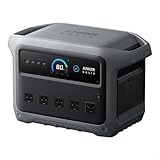
4. Power Station with UPS Mode: Hours, Not Minutes
Anker SOLIX C1000 Gen 2
1,024 Wh · 2,000W output · LiFePO4 · 24.9 lb · Our rating 92/100 (power-station matrix)
Current price on Amazon: $529.99
When the counter or the office has to stay up for hours, swap minutes of lead-acid for LiFePO4. The C1000 Gen 2 stores 1,024 Wh, puts out 2,000W, and Anker publishes a 10 ms UPS switchover. By our math it runs a 50W counter (router, modem, POS dock) for about 17 hours. It is also light enough, at 24.9 lb, to carry to a market stall.

5. Refrigerated Stock: One Reach-In or Chest Freezer
Bluetti Elite 200 V2
2,073.6 Wh · 2,600W output · LiFePO4 · 53.4 lb · Our rating 91/100 (power-station matrix)
Current price on Amazon: $898.99
About 2 kWh (2,073.6 Wh) with 2,600W of output and 3,900W surge for compressor starts, and up to 1,000W of solar input. By our math it carries a fridge averaging 150W for about 12 hours, well past the 4-hour window the FDA gives an unopened fridge. It weighs 53.4 lb, so it stays in the back room. Check your fridge’s average draw first (see the runtime table below).

6. Silent Vendor Booth or Pop-Up
Jackery Explorer 1000 V2
1,024 Wh · 1,500W output · LiFePO4 · 23.3 lb · Our rating 93/100 (power-station matrix)
Current price on Amazon: $559.00
For a farmers-market tent, a craft fair or a pop-up with lights, a POS and a phone charger, a 1 kWh station makes no noise and no exhaust. The Explorer 1000 V2 stores 1,024 Wh with 1,500W continuous output and weighs 23.3 lb. It cannot run a 1,500W espresso machine alongside anything else; for that, see the food truck guide.

7. Inverter Generator: Food Truck or Whole Small Shop
Champion 4500-Watt Electric Start Dual Fuel Inverter Generator
3,500 running / 4,500 starting W (gasoline) · 99.2 lb · Our rating 65/100 (gas-generator rubric)
Current price on Amazon: $999.00
When the load is a kitchen, several fridges or a set of shop circuits for a full day, fuel beats batteries. Champion rates the 4500 at 3,500 running and 4,500 starting watts on gasoline (3,150 running on propane), with electric start, CO Shield shutoff and 14 hours at 1/4 load. Its 30A outlet is a TT-30R, which is 120V only, so it feeds 120V circuits through a 120V inlet and transfer switch fitted by an electrician. It runs outdoors only.

8. Light Dual Fuel Generator: Carts and Essentials
Champion 2500-Watt Dual Fuel Inverter Generator with CO Shield
1,850 running / 2,500 starting W (gasoline) · 43.2 lb · Our rating 66/100 (gas-generator rubric)
Current price on Amazon: $575.00
Amazon showed “Only 14 left in stock” when we checked on Nov 9, 2026.
At 43.2 lb, this is the one to lift into a van. Champion rates it 1,850 running and 2,500 starting watts on gasoline, with CO Shield shutoff, 53 dBA at 23 feet and 11.5 hours at 25% load. It has a single duplex outlet, so it suits a coffee cart, a market booth or a few essentials, not a whole shop.
For a router or ONT alone, a mini DC UPS such as the Marsriva KP5 MAX runs for hours at router loads; it has no AC outlets, so it sits in our router UPS comparison rather than here.
Backup Power by Business Type
Food trucks, coffee carts and vendors
A truck with a fridge, freezer, steam table and lights usually needs a 3,500W-class inverter generator, and a rooftop AC or 240V equipment pushes you higher. A coffee cart or market booth can often run on a large power station, which is silent and has no exhaust near customers. Fire marshals set placement and fueling rules for mobile kitchens. Our best generator for food trucks guide has a load worksheet, the NFPA fact-sheet rules and picks for each size.
Retail, salons, cafés and offices: POS, router and cameras
Here the job is keeping the payment path, the network and the cameras up, which is a UPS job. Our best UPS battery backup guide has sections on a UPS for the router and modem, a UPS for a POS system, and battery backup for security cameras. Salons should note that hair dryers, flat irons and color processors are high-wattage heating loads, so they are poor candidates for battery backup.
Network closets and server racks
A rack UPS gives the switch, firewall and NAS minutes to shut down cleanly, and its management software can trigger that shutdown automatically. Our best rack mount UPS guide covers VA vs watts, 1U vs 2U depth, sine wave for active-PFC servers and network management cards.
Restaurants and shops with refrigerated inventory
One reach-in fridge or chest freezer is a power station job; a kitchen full of them is a generator or installed-system job. Size from the fridge’s average draw and its startup surge, both covered in our refrigerator backup guide and our freezer backup guide.
Contractors and jobsites
Battery stations handle drills, saws and chargers quietly near occupied homes; big compressors and long days still favor a generator. Our power station for job site guide lists what common tools draw.
Remote offices and Starlink
Where Starlink is the office internet, the dish and router become an all-day load. Our power station for Starlink guide has runtime by station and the snow-melt setting that changes the math.
Whole-building backup vs standby generators
To keep the lights, outlets and fridges on across a whole small building, you are choosing between a portable generator wired in through a transfer switch or interlock, an installed battery system, and a standby generator on natural gas or propane. Our battery backup vs generator comparison has dated installed-cost ranges, switchover times and maintenance, and the transfer switch guide covers the connection. Note that the inverter generators we track in the 3,500–5,000W class are 120V only, so 240V equipment needs a bigger generator or an installed system.
Clinics and Pharmacies Storing Vaccines
Vaccine storage has its own federal guidance, and portable backup gear comes after it, not instead of it. The storage unit comes first: CDC lists acceptable units in order of preference (units that conform to NSF/ANSI Standard 456, then purpose-built, then pharmaceutical-grade units, with household-grade units only for refrigerated vaccines) and says never to use dormitory- or bar-style combined refrigerator/freezer units (CDC, Vaccine Storage Units (July 14, 2026)). The practice’s written emergency plan comes next. CDC says providers should plan for storage or transport during emergencies. A practice with an on-site generator should keep enough fuel to run it continuously for at least 72 hours, test it quarterly and have it serviced annually. CDC says a backup battery power source can be used in lieu of a generator, tested and serviced on the same schedule. It also recommends a working agreement with at least one alternative storage facility with 24-hour access (CDC, Emergency Vaccine Storage and Transport (July 14, 2026); part of the CDC Vaccine Storage and Handling Toolkit, updated July 14, 2026). State immunization programs repeat these steps; North Carolina’s, for example, asks providers to verify at least 72 hours of generator fuel and says back-up units must meet the same requirements as primary units (NC Division of Public Health).
We don’t recommend any product for vaccine storage backup. Plan it with your state immunization program, your storage-unit maker and an electrician, and follow the toolkit. The UPS and router picks above can still keep a clinic’s front desk, phones and records online.
Hospitals and facilities with installed standby generators
Hospitals and larger facilities run professionally engineered and installed emergency power systems under codes such as NFPA 110 (Standard for Emergency and Standby Power Systems), and, for hospitals that take part in Medicare, CMS rules that point to NFPA 99, NFPA 101 and NFPA 110 (42 CFR 482.15(e)). That work is outside the scope of portable gear and of this guide.
Carbon Monoxide Safety for Gas Generators
Every gas, propane or dual fuel generator makes carbon monoxide. CPSC says an average of nearly 100 people die in the US each year from CO poisoning caused by portable generators. It says to run them outside only, at least 20 feet from the building, and never inside a home, garage, basement, crawlspace, shed or other enclosed space, and to look for models with a CO shut-off (CPSC (Mar. 16, 2026)). CDC says to keep a generator more than 20 feet from windows, doors and vents, never to use it indoors even with doors and windows open, and to use a battery-powered or battery-backup CO detector inside (CDC).
For a business that means no generator in the stockroom, the back hallway, a loading dock with the roll-up door open, or an alcove next to the customer entrance or an air intake. Both Champion picks above have CO Shield shutoff, but that is a backstop, not permission to run indoors. A battery power station burns nothing, which is why it is the only option on this page you can use inside. See our carbon monoxide detector picks.
Insurance, Leases and Local Code
We can help you size equipment, but some questions have to go to the people who answer for them:
- •Your insurer: whether spoiled stock, lost income or outage damage is covered, and whether the policy says anything about backup power or fuel stored on site.
- •A licensed electrician: any connection to the building’s wiring, including a transfer switch, interlock or inlet box, and whether it needs a permit. This also prevents backfeeding the utility lines.
- •Your landlord and fire marshal: where a generator may sit, how much fuel you can store, and, for mobile kitchens, the event or market rules.
- •Your health department: what it expects after an outage if you hold refrigerated food.
Nothing on this page is insurance, legal or code advice.
Verdict: Start Small, Then Add Runtime
For most small businesses the first dollar of backup power belongs on the router and the register, and a 1500VA UPS like the CyberPower CP1500AVRLCD3 Intelligent LCD UPS (1500VA/900W) (78/100 on our UPS rubric) does that job. If you hold refrigerated stock or want hours of uptime indoors, add a 2 kWh power station such as the Bluetti Elite 200 V2 (91/100 in our scoring). If you run a kitchen, a truck or a whole shop for a full day, an inverter generator and a transfer switch fitted by an electrician is the practical route; for anything code-driven, hire an engineer.
Small Business Backup Power FAQ
What is the best backup generator for a small business?
It depends on what has to keep running. For a POS, card reader and router through short outages, a 1500VA UPS such as the CyberPower CP1500AVRLCD3 is the low-cost answer. For hours of runtime or refrigerated stock, a LiFePO4 power station such as the Bluetti Elite 200 V2 (about 2 kWh) runs silently indoors. For a food truck, a kitchen or a whole small shop for a full day, a dual fuel inverter generator such as the Champion 4500 (3,500 running watts) connected through a transfer switch is the usual choice. It must run outdoors.
Is a UPS or a generator better for a small business?
They do different jobs, and many businesses use both. A UPS switches over in milliseconds, so registers, routers and computers never drop, but a desktop or rack UPS gives minutes of runtime: APC rates the BR1500MS2 at up to 73 minutes at 100W. A generator runs for hours on a tank but takes time to start and must sit outdoors. A common setup is a UPS on the network and POS to bridge the gap, with a generator or large power station for longer outages.
Can a solar generator run a small business during an outage?
It can run the essentials. A portable power station (often sold as a solar generator) has no engine, makes no carbon monoxide and can sit indoors. By our math (Wh x 0.85 / watts), a 1,024 Wh station runs a 50W counter of router, modem and POS for about 17 hours, and a 2,073.6 Wh station runs a fridge averaging 150W for about 12 hours. Solar panels can refill it during the day. Heavy loads such as kitchen equipment, HVAC or several freezers need a large home-battery system or a generator.
How long will a UPS keep my POS and router running?
Use the maker's published runtime at your load. APC rates the BE600M1 at 23 minutes and the BR1500MS2 at up to 73 minutes at 100W, and CyberPower lists about 12 minutes at half load (450W) for the CP1500AVRLCD3. A router, modem and tablet POS usually draw much less than 100W, so add up the adapter labels and check the chart. For several hours, use a power station with UPS mode, or a mini DC UPS for the router alone.
Do I need an electrician to connect a backup generator to my business?
Yes, if it will feed the building's wiring. Running extension cords from a generator to individual appliances needs no wiring work, but powering circuits needs a transfer switch or interlock installed by a licensed electrician, usually with a permit, so the generator cannot backfeed the utility lines. Ask your electrician which option fits your panel, and ask your landlord, insurer and local fire marshal about generator placement and fuel storage before you buy.
Can I run a generator inside my shop, stockroom or loading dock?
No. CPSC says to never run a portable generator inside a home, garage, basement, crawlspace, shed or other enclosed space, and to run it outside only, at least 20 feet from the building. CDC says to keep it more than 20 feet from windows, doors and vents, and warns that open doors and windows do not make indoor use safe. Use a battery-powered or battery-backup CO alarm inside. A battery power station burns no fuel, so it can be used indoors.