SolarGenAdvisor SolarGenAdvisor

Brand Panel Guide · Updated November 2026

Jackery Solar Panels Compared: The SolarSaga Lineup, and Which Panel Fits Your Explorer

Jackery sells three SolarSaga panels new on Amazon right now: the 200W bifacial, the folding 100W Air and the flat, bendable 100W Light. For most owners the best buy is the SolarSaga 200W. One per input fills the 400W ceiling on the Explorer 1000 v2, 1500 v2 and 2000 v2. The key catch: Jackery’s Amazon listing for the 1000 v2 says it solar-charges only from Jackery panels. The 100W Air is listed as incompatible with the Explorer 300 series.

As an Amazon Associate, SolarGenAdvisor earns from qualifying purchases made through links on this page, at no additional cost to you.

The SolarSaga Lineup: Specs Side by Side

Two numbers decide which station a panel can plug into: its open-circuit voltage (Voc), which must stay under the station’s input voltage ceiling, and its short-circuit current (Isc), which the station will cap at its amp limit. Jackery’s published figures for the same panel do not always agree with retailer spec sheets, so where they differ we show the range and use the less forgiving number in the pairing math.

Panel Voc / Isc Weight Folded size IP Connector Score Amazon
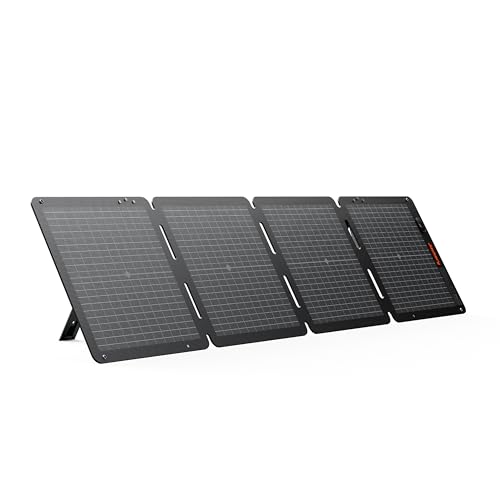
SolarSaga 100W Air (bifacial) About 29.7–30V / not published† 7.05 lb About 17.0 × 16.6 × 1.8 in IP65 or IP68 (listing conflicts) DC8020 + DC7909 adapter; USB-A/USB-C on the cable 69/100 Check price at Amazon →
SolarSaga 100W Light (bifacial) 24.8V / 5.15A (27.1V / 5.91A bifacial)‡ 4.52 lb Does not fold: 41.7 × 22 × 0.6 in flat IP68 Anderson lead + DC8020 and DC7909 adapters 77/100 Check price at Amazon →
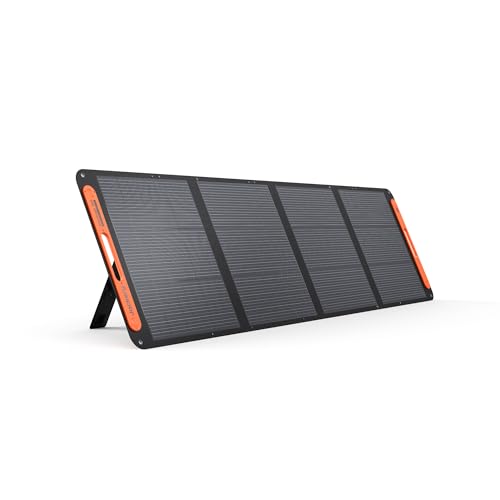
SolarSaga 200W (bifacial) 22–24.8V / 11.2–12.5A (sources differ)§ 14.3 lb§ 23.6 × 23.5 × 1.6 in IP68 DC8020 + DC7909 adapter; USB-A/USB-C on the cable 74/100 Check price at Amazon →
SolarSaga 100 Prime (rigid DIY) Not verified Not verified Rigid; does not fold IP68 (listing) Anderson + Anderson-to-DC8020 adapter (listing) Not rated Unavailable on Nov 7

† 100W Air: 29.7V Voc per the CSE Solar USA spec table and Jackery’s 100 Air buying guide; Jackery’s JS-100H FAQ gives 30V ±5%. Neither publishes a short-circuit current. The rated (operating) current is 3.95–4.28A depending on the source, so the pairing math below treats it as a low-current panel. Weight 3.2 kg (about 7.05 lb) per Jackery’s FAQ and CSE; the Amazon listing says “just 7lbs.” The Amazon title says IP65 while its bullets, CSE and Jackery’s own site say IP68. Our framework uses the lower rating when listings conflict.

‡ 100W Light: Voc and Isc are Jackery’s published figures (its 100 Light guide), at standard test conditions and, in brackets, with bifacial rear-side gain. We did not find an independent retailer table to cross-check them. Weight, flat size and 25% efficiency agree across the Amazon listing, Jackery’s Canadian product page and Jackery’s 100 Light / Air / Prime comparison.

§ 200W bifacial: Jackery’s US product page gives 22V / 12.5A; Mr. Solar’s spec sheet (model JS-200E) gives 23.2V / 11.76A; a JS-200D manual gives 24.8V / 11.2A. The pairing math uses 24.8V and 12.5A, the less forgiving pair. Weight is 14.3 lb in our data, matching Jackery’s 6.5 kg ±0.3 kg; Mr. Solar lists 8.0 kg (about 17.6 lb), so allow for either. Folded size agrees across Mr. Solar and retailer listings.

Not sold new on Amazon US when we checked: the original SolarSaga 100W and 100X (renewed listings only), the SolarSaga 40W Mini, 60W and 80W, the 200W Prime and the 500W / 500X. Jackery’s 40W panel is currently sold on Amazon only in a bundle with the Explorer 300. Connector details for the Air, Light and 100 Prime come from their Amazon listings and the retailer tables above.

The Jackery Panels You Can Buy New on Amazon Right Now

These three had a new-condition offer in Amazon’s buy box when we checked on November 7, 2026. Scores come from our panel scoring framework (output, efficiency, weight, durability, connector and value) and are the same numbers used everywhere else on the site.

Jackery SolarSaga 200W
Best all-round Jackery panel

Jackery SolarSaga 200W

74/100
200W panel IP68 14.3 lb

The panel most Explorer owners should start with. It is bifacial, IP68-rated and folds to about 23.6 × 23.5 in, and its DC8020 lead plugs straight into every current Explorer and HomePower input (a DC7909 adapter covers older units). One per input fills the 400W ceiling of the 1000 v2, 1500 v2 and 2000 v2 exactly; on the 1,000W HomePower models, two in series per input is the cleanest layout (see the pairing table).

See today’s price on Amazon
Check Price on Amazon →
Jackery SolarSaga 100W Light
Lightest per watt

Jackery SolarSaga 100W Light

77/100
100W panel IP68 4.52 lb

At 4.52 lb, the 100W Light is the lightest Jackery panel per watt in our data. It is a flat, bendable panel rather than a folding one (it flexes up to 221° to sit on a van roof or a curved balcony rail), so it packs at roughly 42 × 22 in. Jackery lists 25% IBC cells and an IP68 rating, and ships Anderson-to-DC8020 and Anderson-to-DC7909 adapters in the box.

See today’s price on Amazon
Check Price on Amazon →
Jackery SolarSaga 100W Air
Best compact folding 100W

Jackery SolarSaga 100W Air

69/100
100W panel IP65 7.05 lb

The 100W Air folds to about 17 × 17 in and weighs about 7 lb, with a built-in aluminium stand and USB-A and USB-C ports on its cable. It runs at about 30V open-circuit, which is why Jackery’s own listing says it is not compatible with the Explorer 300 / 300 v2 series (an F7 input-voltage error). On a 60V Explorer or HomePower input it is fine. Its listing calls it IP65 in the title and IP68 in the bullets; we score the lower figure.

See today’s price on Amazon
Check Price on Amazon →

Nameplate wattage is measured under standard test conditions. Plan on roughly 75–80% of it in good sun.

Do Jackery Stations Only Charge From Jackery Panels?

This is the question most Jackery buyers ask first, and Jackery’s answer depends on where you read it. Here is what each source says:

  • Explorer 1000 v2: the Amazon listing sold by Jackery Inc says, word for word, “The Explorer 1000 V2 is compatible only with Jackery solar panels for solar charging.” 9to5Toys quotes the same line. This is the only listing we checked that states the restriction outright.
  • Jackery’s US FAQ (faq.jackery.com, “Can third-party solar panels be used with Jackery Power Stations?”) takes a softer line. A non-Jackery panel can be connected if its open-circuit voltage and current fall within the station’s input range and the connector matches, but Jackery does not guarantee compatibility or operation with third-party products.
  • Jackery’s buying-advice blog (“Can I Use Any Solar Panel with Jackery Power Stations?”) is stricter than the FAQ. It says third-party panels can’t be connected to Jackery portable power stations, and it names the Explorer 5000 Plus as the exception for third-party rooftop arrays. The 5000 Plus listing agrees, calling it “compatible with both high- and low-voltage solar panels.”

We checked the feature text on each station’s current Amazon listing on November 7, 2026. Here is what each one says about panels:

Station What the Amazon listing says about panels
Explorer 300 PlusNo current Amazon US listing found (Mr. Solar lists it as discontinued). No Jackery-only statement found. Separately, the 100W Air listing says that panel is not compatible with the Explorer 300 / 300 v2 series.
Explorer 1000 v2“Compatible only with Jackery solar panels for solar charging.”
Explorer 1500 v2No restriction stated. The listing is a bundle that includes a SolarSaga 200W.
Explorer 2000 v2No restriction stated. It quotes charge times “with 400W panels.”
Explorer 2000 PlusNo restriction stated. It quotes charge times with six SolarSaga 200W panels. Currently unavailable.
HomePower 1000 Plus v2No restriction stated.
HomePower 3000No restriction stated. It quotes charge times with two SolarSaga 200W panels.
HomePower 3600 PlusNo restriction stated. The listing is a bundle with two 200W panels and is currently unavailable.
Explorer 5000 Plus“Compatible with both high- and low-voltage solar panels.”

What we would do: on an Explorer 1000 v2, buy Jackery panels, because that is the only setup Jackery’s listing says it supports. On the other stations, a third-party panel can work under Jackery’s FAQ conditions: open-circuit voltage inside the input window (with the cold margin below), current within the amp limit, and an MC4-to-DC8020 adapter. You give up Jackery’s compatibility guarantee when you do. We have not found a published Jackery warranty term that addresses third-party panels either way, so we don’t make claims about warranty.

Which Jackery Panel for Which Jackery Station

Each row takes a station’s published solar input (voltage window, amp limit and watt cap) and works out the largest SolarSaga setup that stays inside it. The method is the same one we use on our EcoFlow solar panels guide. We take the highest published Voc for each panel (200W: 24.8V; Air: 30V; Light: 27.1V with bifacial gain), add about 10% for a cold morning, and keep the result under the station’s ceiling. Where spec sheets disagree, we use the lower ceiling.

Station Solar input Best SolarSaga setup The math
Explorer 300 Plus 12–27V, 100W max None of the three panels sold new on Amazon has cold margin. Use a lower-voltage Jackery panel such as the 40W Mini, which Jackery bundles with it in some markets 200W: 24.8V × 1.1 ≈ 27.3V, over 27V on a cold morning. Light: 27.1V bifacial Voc is already at the ceiling. Air: about 30V is over the limit, and Jackery lists it as incompatible with the 300 series.
Explorer 1000 v2 2 × DC8020, each 12–16V / 8A or 16–60V / 10.5A; 400W combined 2 × 200W, one per input (400W). Or 4 × 100W Air, two in parallel per input 200W: 24.8V (about 27.3V cold) < 60V. Isc of up to 12.5A is above the 10.5A port limit, so the station trims a little current in strong sun (about 10.5A × 18V ≈ 190W per port). Two Air in parallel: 30V (33V cold), roughly 8–9A operating current. Two Air in series would be 60V before the cold margin, so don’t.
Explorer 1500 v2 2 × DC8020, each 16–60V / 12A; 21A and 400W combined 2 × 200W, one per input (400W) 24.8V (27.3V cold) < 60V; 12.5A sits at the 12A limit. Adding more panels can’t beat the 400W cap.
Explorer 2000 v2 2 × 8mm DC, each 11–16V / 8A or 16–60V / 12A; 400W max 2 × 200W, one per input (400W) Same limits and same answer as the 1500 v2. A 2,042Wh battery behind a 400W ceiling makes solar a top-up rather than a daily refill (see charge times below).
Explorer 2000 Plus 2 × DC8020, each 11–17.5V / 8A or 17.5–60V / 12A; 24A and 1,400W combined 4 × 200W: two in series on each input (800W of nameplate) 2 × 24.8V = 49.6V (about 54.6V cold) < 60V, at 12A. Three in series = 74.4V, over the limit. Jackery’s listing quotes six 200W panels; with the published 60V / 12A per-port limits, we could not make six panels add usable watts beyond the four-panel layout, so we don’t recommend it. The 1,400W cap needs higher-voltage strings than SolarSaga folding panels give.
HomePower 1000 Plus v2 2 × DC8020, each 16–60V / 12A; 21A and 400W combined 2 × 200W, one per input (400W) Same window as the 1500 v2. We list it for completeness; it is not ranked here while our rating is pending.
HomePower 3000 2 × 8mm DC, each 12–16V / 8A or 16–60V / 12A; 24A and 1,000W total 4 × 200W: two in series on each input (800W) 49.6V (54.6V cold) < 60V per input, 12A each. One 200W per input (Jackery’s own two-panel example) is limited to about 400W.
HomePower 3600 Plus 2 × DC8020, each 16–60V / 12A; 1,000W combined 4 × 200W: two in series on each input (800W) Same math as the HomePower 3000.
Explorer 5000 Plus Low-voltage: 2 × 16–60V / 10.5A, 1,200W combined. High-voltage: 135–450V / 15A, 4,000W Low-voltage: 4 × 200W, two in series per input (800W). The high-voltage input is meant for rooftop or 500W-class arrays Low-voltage: 49.6V (54.6V cold) < 60V; 12.5A is trimmed to 10.5A. High-voltage: a 200W panel works at about 18V, so it takes eight in series (about 144V) to clear the 135V minimum. Sixteen in series = 396.8V, about 437V cold, under 450V. That is a lot of folding panels to string together.

Station input sources: Explorer 300 Plus 12–27V / 100W per Mr. Solar (which lists it as discontinued) and a Best Buy Q&A answer (12–27V DC input); sources disagree on whether solar goes through a USB-C or an 8mm input. Explorer 1000 v2 per Mr. Solar and Jackery’s EU help centre (12–60V, DC8020). Explorer 1500 v2 per the Roofnest spec sheet cited in our 1500 v2 review and Jackery’s retailer listings (16–60V, 12A, 21A / 400W). Explorer 2000 v2 per Mr. Solar and the Amazon listing (400W). Explorer 2000 Plus per Mr. Solar and a retailer spec sheet giving the same 17.5–60V / 12A, 24A / 1,400W figures. HomePower 1000 Plus v2 per CleanTechnica and GearJunkie, as cited in our review. HomePower 3000 per Jackery’s spec sheet (12–16V / 8A, 16–60V / 12A, 1,000W, dual input to 24A) and Off Grid Source. HomePower 3600 Plus per Mr. Solar (16–60V, 12A each, 1,000W combined) and The Solar Lab (1,000W via two DC inputs). Explorer 5000 Plus high-voltage figures per Jackery’s “Explorer 5000 Plus Basic Information” FAQ and the Amazon listing (up to 4,000W); low-voltage figures per Mr. Solar. Series wiring of SolarSaga panels uses Jackery’s Solar Series Connector. Check its switch setting and your station’s manual before you string panels.

We left the Explorer 300 (the 292Wh model now sold on Amazon) out of this table while we reconcile its listing against our product data.

How Long to Charge a Jackery With Solar Panels

Our estimate is battery Wh ÷ (panel nameplate × 0.75 real-world output) ÷ 0.9 charging efficiency, counted in hours of strong sun. These are our calculations, not Jackery’s figures, and a winter day or a hazy sky can double them.

Station Battery Panels One 200W Full setup
Explorer 1000 v2 1,024Wh 2 × 200W About 7.6 h About 3.8 h
Explorer 1500 v2 1,536Wh 2 × 200W About 11.4 h About 5.7 h
Explorer 2000 v2 2,042Wh 2 × 200W About 15.1 h About 7.6 h
Explorer 2000 Plus 2,042Wh 4 × 200W About 15.1 h About 3.8 h
HomePower 1000 Plus v2 1,024Wh 2 × 200W About 7.6 h About 3.8 h
HomePower 3000 3,072Wh 4 × 200W About 22.8 h About 5.7 h
HomePower 3600 Plus 3,584Wh 4 × 200W About 26.5 h About 6.6 h
Explorer 5000 Plus 5,040Wh 4 × 200W (low-voltage inputs) About 37.3 h About 9.3 h

Jackery’s own listings set realistic expectations. The 2000 v2 listing says “as few as 6 hours with 400W panels,” and the HomePower 3000 listing gives about 80% in 9 hours with two SolarSaga 200W panels. That matches our math: a big battery behind a few panels is a multi-day refill. For a 100W panel on a small station, the same formula gives roughly 4.3 hours for a 288Wh battery.

Series or Parallel? How the Math Works on Jackery Inputs

Wire panels in series and the voltages add while the current stays the same. Wire them in parallel and the currents add while the voltage stays the same. Jackery’s inputs mostly share a 60V ceiling with a 10.5–12A limit per input, and SolarSaga panels run around 22–30V, so two panels is the practical limit per input either way.

Step 1: Voltage check, with cold-weather headroom

Multiply the panel’s Voc by the number in series, then add about 10%. Panel voltage rises as cells get colder: published coefficients for crystalline panels run about −0.25% to −0.30% per °C, so a sunny morning at about −10°C (14°F) pushes Voc up roughly 10%. Two 200W panels: 49.6V × 1.1 ≈ 54.6V, safe under 60V. Two 100W Air: 60V before the adjustment, so not in series. Going over the voltage limit is the mistake that can damage a station’s charge controller.

Step 2: Current check

Add the Isc of panels in parallel. Two 200W panels in parallel reach about 25A, well past a 12A input, so the station draws only what it can and the second panel adds little in full sun. Exceeding the amp limit usually just means clipped charging rather than damage. The 100W panels are the better match for parallel: two Lights come to about 11.8A with bifacial gain, and two Airs come to roughly 8–9A operating current.

Step 3: Watt cap

On the 400W stations (1000 v2, 1500 v2, 2000 v2, HomePower 1000 Plus v2), two 200W panels already meet the cap, so a bigger array only helps on cloudy days. On the 1,000W HomePower models, four 200W panels leave a modest gap under the cap, which real-world output will fill with headroom to spare.

Two catches

Jackery sells a Solar Series Connector with a series/parallel switch. Confirm its setting against the manual before you plug in, because the wrong position changes the voltage your station sees. And shade on one panel in a series string drags down the whole string, so keep series panels side by side in the same light. Jackery’s 2000 v2 guidance also says to use the same panel model, and the same number of panels, on both inputs.

For connectors, MPPT and wiring diagrams in more depth, see our solar panel setup guide.

Real-World Output: What to Expect From a SolarSaga Panel

Every wattage on this page is a nameplate figure measured under standard test conditions: strong light, a 25°C cell temperature and a panel square to the sun. Outdoors, plan on roughly 75–80% of nameplate on a clear summer day, and less in these cases:

  • Angle. The 200W and 100W Air have kickstands and the Air has a sun indicator, so re-aim them a few times a day. The 100W Light has no stand. Laid flat on a roof in winter, it can lose more than half its potential.
  • Bifacial gain depends on the ground. All three current SolarSaga panels are bifacial. Rear-side gain is a best case over snow, sand, concrete or a pale tarp. Over grass or dark soil, expect a small gain. Jackery’s own figures for the 100W Light show the rear face raising Isc from 5.15A to 5.91A, about 15%.
  • Heat. Hot cells produce less, so a panel baking at noon can trail the same panel on a cool, bright morning.
  • Partial shade. In a series string, a shadow across one panel cuts the output of both.
  • Cables. The cables bundled with the 200W include USB outputs and are not weatherproof, per the listing, so keep the junction out of the rain. Long, thin extension leads also waste power.

A useful rule of thumb: daily solar energy ≈ nameplate × 0.75 × peak sun hours. One SolarSaga 200W in a 5-sun-hour location gives about 750Wh on a good day. That is about two-thirds of an Explorer 1000 v2 once charging losses are counted (about 675Wh into a 1,024Wh battery), or most of a day’s running for a 12V fridge averaging 40W (40W ÷ 0.85 × 24h ≈ 1,130Wh of battery per day).

SolarSaga vs Other Brands’ Panels

If your station is not the Explorer 1000 v2, other panels are an option under the conditions above. Here is how the SolarSaga 200W compares with the 200–220W panels we already rate. Note that each of the others needs an MC4- or XT60-to-DC8020 adapter on a Jackery.

Panel Watts Weight IP Connector Score Price
Jackery SolarSaga 200W 200W 14.3 lb IP68 DC8020 + DC7909 adapter 74/100 Check price at Amazon →
Renogy 200W Portable Solar Panel (N-Type) 200W 13.9 lb IP65 MC4 (plus USB-A and USB-C ports) 84/100 Check price at Amazon →
EcoFlow NextGen 220W Portable Solar Panel 220W 15.9 lb IP68 EcoFlow solar connector + XT60i cable 82/100 Check price at Amazon →
Bluetti PV200 200W Solar Panel 200W 16.1 lb IP65 MC4 79/100 $399.00

The Renogy 200W N-type scores higher in our framework because it is lighter and lower-priced per watt, with a plain MC4 lead. The SolarSaga’s advantage is the native DC8020 plug, plus being the only option Jackery supports on the 1000 v2. For the full cross-brand field, see our best portable solar panels guide and the best 200W portable solar panel comparison.

Who Should Buy Jackery Panels, and Who Should Skip Them

Buy SolarSaga panels if…

  • You own an Explorer 1000 v2. Its listing says it solar-charges only from Jackery panels.
  • You want the DC8020 plug in the box and no adapter shopping.
  • You own a 400W-input Explorer and want the simplest full setup: two 200W panels, one per input.
  • You need a light panel for a van roof or balcony: the 100W Light weighs 4.52 lb and bends.

Skip them if…

  • You are buying on price per watt for a station that accepts third-party panels. See our solar panels under $200.
  • You own an Explorer 300-series station and are eyeing the 100W Air. Jackery lists it as incompatible.
  • The panels will stay on a roof or in a yard. Rigid panels cost less per watt and outlast folding ones.
  • You own an EcoFlow or Anker station. Their own panels avoid the adapter; see EcoFlow solar panels.

Still choosing a station? Our Jackery solar generator guide compares the full Explorer and HomePower lineup.

Frequently Asked Questions

Do Jackery power stations only work with Jackery solar panels?

It depends on the model. Jackery’s Amazon listing for the Explorer 1000 v2 says it is compatible only with Jackery solar panels for solar charging. Jackery’s US FAQ says a third-party panel can be connected if its open-circuit voltage and current fall within the station’s input range and the connector matches, but Jackery does not guarantee compatibility. None of the other current listings we checked state a Jackery-only rule, and the Explorer 5000 Plus is described as compatible with both high- and low-voltage panels.

Which Jackery solar panel is best for the Explorer 1000 v2?

Two SolarSaga 200W panels, one on each DC8020 input. Each stays well under the 60V ceiling (about 24.8V, or 27.3V on a cold morning), and together they reach the station’s 400W solar limit. Four 100W Air panels, two in parallel per input, are the lighter-per-panel alternative. Expect a full recharge in roughly 4 hours of strong sun.

How long does it take to charge a Jackery with a solar panel?

By our calculation (battery Wh divided by 75% of panel nameplate, then by 90% charging efficiency), one SolarSaga 200W refills an Explorer 1000 v2 in about 7.9 hours of strong sun, and two panels in about 4 hours. A 2,042Wh Explorer 2000 v2 takes about 7.6 hours on its 400W maximum. Winter sun, haze or a flat-lying panel can double those times.

Can I use the SolarSaga 100W Air with an Explorer 300?

No. Jackery’s Amazon listing for the 100W Air says it is not compatible with the Explorer 300 / 300 v2 series and may trigger an F7 input-voltage error. Its open-circuit voltage is about 30V, which is above the roughly 27V ceiling published for the Explorer 300 Plus. On the 60V inputs of the 1000 v2 and larger stations it works normally.

Can I connect Jackery solar panels in series?

Yes, with Jackery’s Solar Series Connector, as long as the total stays under the input’s voltage limit with cold-weather headroom. Two SolarSaga 200W panels in series reach about 49.6V, or 54.6V on a cold morning, which fits a 60V input. Three would reach 74.4V, which is over. Two 100W Air panels in series would already be at 60V, so connect those in parallel instead.

What connector do Jackery solar panels use?

The SolarSaga 200W and 100W Air use Jackery’s DC8020 (8mm) plug, which fits the current Explorer v2, Plus and HomePower inputs, and they include a DC7909 adapter for older Explorers. The 100W Light and 100 Prime have Anderson leads with adapters to DC8020 (the Light also includes DC7909). Third-party panels with MC4 leads need an MC4-to-DC8020 adapter.

Jackery SolarSaga 200W ★
Check Price →

What to read next

Jackery buying guide → The Jackery lineup compared, and who each model suits. What size do you need? → Add your appliances and get a capacity recommendation in a minute. Black Friday deal tracker → Today's Amazon prices on the models we track, through the Black Friday season.

Get our weekly power station research email

One product worth knowing about, one practical guide to sizing, solar setup, battery care or safety, and answers to reader questions, with sources cited. About two minutes a week; unsubscribe anytime.

Subscribe free on Substack → Opens Substack in a new tab. You sign up on Substack, which stores your address and sends the emails; we use the subscriber list only to send this newsletter. See our privacy policy.