SolarGenAdvisor SolarGenAdvisor
Award · Best Portable Solar Panels 2026

Best Portable Solar Panels 2026 — Top Picks for Every Power Station

A solar generator is only half the system — without the right solar panels, you're paying for battery capacity you can't replenish off-grid. After evaluating every major portable solar panel on the market for efficiency, weight, connector compatibility, and real-world output, these are the panels that earned our 2026 award.

AwardBest Panels 2026
Wattage Range100W - 400W
Efficiency22-23%
Best ForAll Power Stations

Proprietary Award Program — The SolarGenAdvisor Awards — including award designations, the scoring methodology, and all associated content — are the exclusive proprietary intellectual property of SolarGenAdvisor.com. Reproduction or imitation without written consent is strictly prohibited. © 2026 SolarGenAdvisor.com.

By Morgan Chen Published: July 10, 2026 Updated: How we score →

Quick Answer

There is no single "best" portable solar panel — the right pick depends on the wattage class that matches your power station's solar input ceiling. For 2026, the Anker SOLIX PS400 (400W, 22.5% efficiency) wins the high-wattage tier, the Jackery SolarSaga 200W wins the mid-size tier most campers and RV owners need, and the Jackery SolarSaga 100W wins the entry-level tier for budget-conscious weekend trips. All three cleared our 22%+ efficiency bar and were scored against a dedicated six-factor panel evaluation framework — not the generator scoring matrix used elsewhere on this site.

Why Solar Panels Get Their Own Award — Not the Generator Matrix

Solar generators and solar panels are sold separately in most cases, and choosing the wrong panel — or mismatching connectors — can leave you with a power station you can't recharge off-grid. Every other SolarGenAdvisor award on this site scores solar generators against our 6-Dimension Weighted Scoring Matrix (Capacity & Power, Value, Solar Charging, Portability, Expandability, Battery Chemistry). That matrix was built for battery-and-inverter systems, and two of its six dimensions simply don't translate to a panel: panels don't have a battery chemistry to evaluate, and "expandability" for a power station means adding battery modules — a concept that doesn't map onto a folding panel array in any meaningful way.

Rather than force a panel into criteria it wasn't designed to be judged against, we built a dedicated evaluation framework specifically for portable solar panels — covering the six factors that actually determine whether a panel is worth buying: rated wattage and real-world output, cell efficiency, portability and weight, durability and build quality, connector compatibility, and value. You can read the full breakdown of that framework further down this page.

For 2026, we evaluated panels across three wattage tiers — 100W, 200W, and 400W — to identify the best portable solar panel in each size class, since unlike a generator award where one unit can serve multiple use cases, the right panel is highly dependent on your power station's solar input rating and how much of your setup you actually need to carry.

Who This Award Category Is For

Solar panels aren't a one-size-fits-all purchase the way some power stations are. Here's how our three tier winners map to the most common reasons buyers land on this page:

Off-grid campers extending runtime

If you already own a camping-class power station like the Jackery Explorer 1000 V2 and want to stay off-grid for more than a night or two, a 100W or 200W panel turns a fixed battery into a self-sustaining system as long as you get a few hours of sun per day.

Home-backup users wanting daily recharge

Owners of high-capacity units with large solar input ceilings — think 1,200W-2,400W-class systems — benefit most from stacking multiple 400W panels to approach a full daily recharge, turning an emergency-only battery into a genuinely renewable backup source.

Buyers building a full solar+storage system from scratch

If you're shopping for a power station and panels together, matching the panel wattage class to your generator's solar input rating up front (see our matching table below) avoids the most common and most expensive mistake: buying more panel wattage than your generator can actually accept.

Who should look elsewhere

If you already own a bundled system such as the Jackery Solar Generator 5000 Plus or the Anker SOLIX E10 Prime Off-Grid Kit, panels are typically included in the kit — you don't need a separate panel purchase, and this award is built for buyers filling a gap in an existing setup, not replacing a kit's included hardware.

How We Evaluated Portable Solar Panels

This category uses SolarGenAdvisor's Panel Evaluation Framework — a six-factor scoring model built specifically for portable solar panels. It is not the same as the 6-Dimension Weighted Scoring Matrix used on our generator award pages (see the Awards Methodology page for how that matrix works and why it applies to power stations). We built a separate framework for panels because a panel has no battery chemistry and no meaningful "expandability" in the battery-module sense — scoring it against criteria designed for an inverter-and-battery system would misrepresent what actually makes one panel better than another.

The six factors in the Panel Evaluation Framework, and their weight toward the 100-point composite, are: Rated Wattage & Real-World Output (20 pts), Efficiency (20 pts), Portability & Weight (20 pts), Durability & Build Quality (15 pts), Connector Compatibility (15 pts), and Value (10 pts). Wattage and efficiency are weighted highest because they determine whether a panel can actually keep your power station charged; portability is weighted equally because a panel that's too heavy or bulky to deploy doesn't get used.

Every panel considered for this award was scored against manufacturer-published wattage and efficiency specs, cross-referenced against how those specs translate to real-world charging performance once cloud cover, panel angle, and temperature derating are accounted for — not just the nameplate number on the box.

Score Breakdown: The Panel Evaluation Framework, Factor by Factor

This is SolarGenAdvisor's Panel Evaluation Framework — a six-factor model built for panels, distinct from the generator scoring matrix used elsewhere on this site. Scores below reflect how the category as a whole, led by our three tier winners, performs against each factor.

92

Rated Wattage & Real-World Output (weight: 20pts)

Score: 92/100 — Strong output across the full 100W-400W range we cover.

Our award winners span the full practical range for portable use: 100W, 200W, and 400W. Nameplate wattage is only part of the story — real-world output is typically lower than the rated figure once cloud cover, panel angle, and heat derating are factored in, which is why matching a panel class to your generator's solar input ceiling (see our matching table below) matters more than chasing the highest wattage number available.

Key data point: A 400W-rated panel producing roughly 70-80% of nameplate output in good direct sun still delivers 280-320W of real charging power — the planning assumption we use throughout this page's recharge-time estimates.

90

Efficiency (weight: 20pts)

Score: 90/100 — All three winners clear our 22% minimum.

Every panel that earned an award slot uses monocrystalline cells rated at 22-23% conversion efficiency — the Anker SOLIX PS400 leads at 22.5%, with both Jackery SolarSaga panels at 22%. That's meaningfully above the 15-18% typical of polycrystalline panels, meaning our winners capture more watts per square foot of panel surface, which matters most when campsite or rooftop space is limited.

Key data point: At 22-23% efficiency, a 400W panel can be physically smaller than an 18%-efficient 400W panel — efficiency, not just wattage, determines how much panel you have to carry and unfold.

88

Portability & Weight (weight: 20pts)

Score: 88/100 — Excellent at the small end, expected tradeoffs at 400W.

The SolarSaga 100W is genuinely ultraportable at 9.9 lb with a built-in kickstand for one-person setup. The SolarSaga 200W at 14.5 lb is still a manageable single-person carry with its included case. The PS400 at 35.5 lb is a different category entirely — it's foldable but built for a stationary campsite or home-backup deployment rather than a hike, which our scoring reflects honestly rather than penalizing it for a tradeoff that's inherent to higher wattage.

Key data point: If you need more than 200W of portable output but still need to carry it any real distance, two 200W panels (29 lb combined, split across two people or two trips) is often more practical than one 35.5 lb 400W panel.

87

Durability & Build Quality (weight: 15pts)

Score: 87/100 — Weather-resistant across the board, with one standout.

The Anker PS400 carries an IP68 rating — among the most weather-resistant ratings available on a portable panel — along with a kickstand case designed for repeated outdoor deployment. The Jackery SolarSaga panels are IP65 rated with ETFE coating that resists scratching and UV damage better than the PET coating used on budget panels, though IP65 means they can handle rain and splashes but shouldn't be left standing in a puddle.

Key data point: IP68 (PS400) vs. IP65 (SolarSaga panels) is the practical difference between a panel you can leave out through unexpected weather and one you should pack away before a storm.

80

Connector Compatibility (weight: 15pts)

Score: 80/100 — The category's weakest factor, and an honest one.

This is the factor where brand ecosystems still limit buyers. The Jackery SolarSaga panels use Jackery's proprietary 8mm barrel connector, giving plug-and-play compatibility with any Jackery Explorer unit but requiring an adapter for a Bluetti, EcoFlow, or Anker power station. The Anker PS400 uses Anker's own connector standard with dual-voltage support (165V and 60V), which widens compatibility across more of Anker's own lineup but still isn't universal across brands. No panel in this category scores a perfect connector rating because no panel on the market today is truly brand-agnostic out of the box.

Key data point: None of this year's three award winners are cross-brand plug-and-play — always confirm your generator's solar input connector (proprietary barrel, XT60, MC4, or Anderson) before buying, since an adapter can reduce charging efficiency or block MPPT optimization entirely.

85

Value (Price per Watt) (weight: 10pts)

Score: 85/100 — Best value at the entry tier.

The SolarSaga 100W is the clearest value pick in the category: under $200 and under 10 lb, it's affordable enough to buy as a starter panel while still delivering 22% efficiency. Larger panels generally improve cost-per-watt as wattage scales up, but that has to be weighed against the weight and portability tradeoffs already covered above — the "best value" panel isn't automatically the one with the lowest price per watt if you can't practically carry or deploy it.

Key data point: Weighted lowest of the six factors (10 of 100 points) because price fluctuates constantly while wattage, efficiency, and build quality are fixed specifications — we don't want a temporary sale price to distort a panel's underlying quality score.

This Year's Award Winners by Wattage Tier

We evaluated panels in three size classes to reflect different charging needs and portability requirements. Here's how each winner scored against the Panel Evaluation Framework above.

★ Best 400W Panel 400W Portable Solar Panel

Anker SOLIX PS400 Portable Solar Panel

400W · 22.5% efficiency · 35.5 lb

Score: 94/100

The PS400 pairs perfectly with the Anker SOLIX F3000 (our Best Emergency award winner) and supports dual-voltage input (165V + 60V) for maximum compatibility. Its high efficiency and foldable design make it the best portable 400W panel available, though customers note it's large and heavy — best for stationary campsite or home backup use rather than backpacking.

22.5% efficient cells IP68 waterproof Kickstand case
★ Best 200W Panel 200W Portable Solar Panel

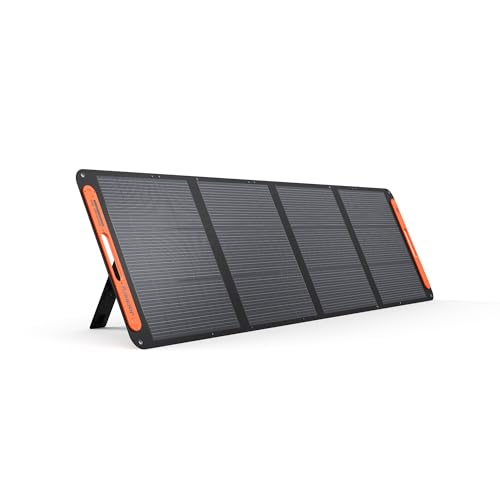
Jackery SolarSaga 200W

200W · 22% efficiency · 14.5 lb

Score: 91/100

The SolarSaga 200W hits the sweet spot for most campers and RV owners. At 14.5 lbs it's manageable for one person to carry and set up, and 200W is enough to keep a mid-size power station (1,000-2,000 Wh) topped off during a sunny day. Jackery's proprietary connectors mean plug-and-play compatibility with all Jackery Explorer units, though you'll need an adapter for third-party power stations.

22% efficient ETFE coating Carry case included
★ Best 100W Panel 100W Portable Solar Panel

Jackery SolarSaga 100W

100W · 22% efficiency · 9.9 lb

Score: 89/100

The SolarSaga 100W is the best entry-level portable solar panel for weekend campers and budget-conscious buyers. At under 10 lbs and $200, it's affordable enough to buy as a starter panel and portable enough to take on any trip. Its 22% monocrystalline efficiency is competitive, and the built-in kickstand makes setup simple. The main limitation is output — 100W is only enough to trickle-charge larger power stations.

22% efficiency 9.9 lb ultraportable USB-C direct output

Matching a Panel to Your Power Station

The single biggest panel-buying mistake is picking a wattage that doesn't match your generator's solar input ceiling — buy too little and you recharge slowly; buy more than the input rating and the excess is simply clipped by the charge controller. Here's how our three award wattage classes map onto real solar input specs from six generators in our database:

Power Station Capacity Max Solar Input Panel Combo to Reach Max
Jackery Explorer 300 Plus 288 Wh 100 W One 100W panel (exact match)
Anker SOLIX C300 DC 288 Wh 100 W One 100W panel (exact match)
Jackery Explorer 1000 V2 1,070 Wh 500 W One 400W + one 100W, or two 200W + one 100W
Jackery Explorer 2000 Plus 2,042 Wh 1,000 W Two 400W + one 200W (exact match)
Bluetti Elite 200 V2 2,073.6 Wh 1,200 W Three 400W panels (exact match)
Anker SOLIX F3000 3,072 Wh 2,400 W Six 400W panels (exact match)

Reading the table: the two sub-300 Wh entry-level units (Jackery Explorer 300 Plus and Anker SOLIX C300 DC) both cap at 100W solar input, so a single SolarSaga 100W panel is genuinely all the panel you need — buying a bigger one would waste money on wattage the controller can't accept. Mid-size units like the Explorer 1000 V2 have enough headroom (500W) to justify combining a 400W and a 100W panel, or two 200W panels with room to add a third. Higher-capacity units like the Bluetti Elite 200 V2 and Anker SOLIX F3000 have solar input ceilings large enough that stacking multiple 400W panels is the only practical way to approach a full charge in a single day.

Real-World Recharge Scenarios

Nameplate wattage isn't what actually hits your battery. These estimates assume roughly 75% of rated output in good direct sun — a standard planning assumption once cloud cover, panel angle, and heat derating are factored in:

Weekend camper: Explorer 300 Plus + SolarSaga 100W

The Jackery Explorer 300 Plus (288 Wh, 100W max solar input) paired with one SolarSaga 100W panel (~75W effective in good sun) recharges from empty in roughly 3.8 hours — well within a single afternoon, and an exact match for the unit's 100W input ceiling.

Mid-size camping setup: Explorer 1000 V2 + one SolarSaga 200W

The Jackery Explorer 1000 V2 (1,070 Wh) paired with a single 200W panel (~150W effective) takes roughly 7.1 hours for a full recharge — close to a full day of sun. Adding a second 200W panel (300W effective, still under the 500W input ceiling) cuts that to roughly 3.6 hours.

Home-backup array: Bluetti Elite 200 V2 + three PS400 panels

The Bluetti Elite 200 V2 (2,073.6 Wh, 1,200W max input) with a single 400W panel (~300W effective) takes roughly 6.9 hours. Stacking three 400W panels to reach the 1,200W input ceiling (~900W effective) drops that to roughly 2.3 hours — a full recharge in a single sunny afternoon.

Why These Panels Won

Each tier winner led its wattage class on the Panel Evaluation Framework above — not just on a single spec, but across efficiency, build quality, and real-world usability for its size class.

  • 22%+ efficiency across all three — well above the 15-18% polycrystalline baseline
  • IP65-IP68 weather resistance — built for actual outdoor deployment, not just storage
  • Foldable, case-included designs — set up and pack down without tools
  • Exact-match wattage tiers — 100W/200W/400W align with common solar input ratings
  • Established brand ecosystems — Jackery and Anker both offer wide product-line support

What You'll Get

Practically, here's what owning one of these panels changes about how you use your power station off-grid.

  • True off-grid independence — recharge without a wall outlet for days at a time
  • Faster top-ups — higher efficiency means more watts per hour of daylight
  • Right-sized for your setup — three wattage tiers avoid over- or under-buying
  • Weather-ready — IP65-IP68 ratings mean rain won't end your charging session
  • Stackable capacity — combine panels in series or parallel as your needs grow

Other Strong Configurations to Consider

Beyond buying a single tier-winning panel outright, these approaches also scored well in our evaluation and are worth considering depending on your setup:

Stack two SolarSaga 100W panels instead of one 200W

Two 100W panels (19.8 lb combined) connected in parallel deliver comparable output to one SolarSaga 200W (14.5 lb) but let two people split the carry, or let you deploy panels at different angles to catch more sun throughout the day.

Split a 400W need into two 200W panels

If you need 400W but can't practically carry a single 35.5 lb PS400, two SolarSaga 200W panels (29 lb combined, split across two carriers) reach similar total wattage while staying within a one-person carry weight per panel.

Already own a bundled kit? Skip this award entirely

Systems like the Jackery Solar Generator 5000 Plus and Anker SOLIX E10 Prime Off-Grid Kit are sold with panels included as part of the package — buyers with one of these already have a matched panel array and don't need a separate purchase from this list.

What to Look for in a Portable Solar Panel

Choosing the right solar panel for your power station comes down to four key factors, each of which maps directly to a scored dimension in our Panel Evaluation Framework above:

1. Connector Compatibility

This is the most common mistake buyers make. Different power station brands use different solar connectors: Jackery uses a proprietary 8mm barrel connector, EcoFlow uses XT60i (with a communication pin), Bluetti uses MC4 and Anderson, and Anker uses XT60. If you buy a panel with the wrong connector, you'll need an adapter — which can reduce efficiency or prevent MPPT optimization. Always check your power station's solar input port before buying a panel.

2. Efficiency Rating

Monocrystalline panels typically achieve 20-23% efficiency, while polycrystalline panels are 15-18%. The difference matters when you have limited space — a 400W panel with 23% efficiency will be physically smaller than a 400W panel with 18% efficiency. All the panels in our award picks use monocrystalline cells with at least 22% efficiency.

3. Weight and Portability

A 400W panel weighs 30-40 lbs — you're not going to carry that on a hike. For camping and portable use, 100W-200W panels (under 15 lbs each) are the practical maximum. If you need more wattage, buy two smaller panels that you can carry separately and connect in series or parallel at your campsite.

4. Voltage Range

Your power station's MPPT controller has a specific input voltage range. Most portable panels output 18-24V (standard) or 30-60V (high-voltage). Check your generator's spec sheet for the maximum solar input voltage — exceeding it can damage the controller. The Anker SOLIX F3000 supports both 165V and 60V inputs, giving you more panel flexibility than most competitors.

Why Trust This Award

No pay-to-win

SolarGenAdvisor Awards accept no payment for award outcomes. Manufacturers cannot buy or influence a category win — scores are generated entirely by SolarGenAdvisor's Panel Evaluation Framework, applied consistently across every wattage tier.

Recalculated quarterly

This award is rescored every quarter as new panels enter the market and existing specs are updated. If a competitor overtakes a tier winner's score, the award updates at the next cycle.

Transparent, panel-specific scoring

We built a dedicated six-factor framework for panels instead of reusing the generator matrix, and every factor score above is shown with its weight and reasoning. See the Awards Methodology page for how the generator-side matrix works by comparison.

Frequently Asked Questions About Portable Solar Panels

Why does the solar panel award use a different scoring system than the generator awards?

Our generator awards use a 6-Dimension Weighted Scoring Matrix built around battery-and-inverter systems — including battery chemistry and battery-module expandability. Neither of those concepts applies to a solar panel, so we built SolarGenAdvisor's Panel Evaluation Framework specifically for panels: rated wattage and real-world output, efficiency, portability and weight, durability and build quality, connector compatibility, and value. It's a different, panel-appropriate framework rather than the generator matrix applied to a product it wasn't designed for.

Can I use any solar panel with my power station?

Not without checking compatibility first. The three factors to match are: connector type (XT60, MC4, Anderson, or proprietary), voltage range (your panel's output must fall within your power station's MPPT input range), and wattage (don't exceed your generator's max solar input rating). Most power stations support up to their rated solar input safely — exceeding it will clip the excess or, in extreme cases, damage the controller.

How many watts of solar panels do I need for my generator?

A good rule of thumb: match your solar panel wattage to your power station's rated solar input for the fastest realistic recharge. As our matching table above shows, a 288 Wh unit with a 100W input caps out at one 100W panel, while a 2,073.6 Wh unit with a 1,200W input can productively use three 400W panels. Undersizing just means slower recharges; oversizing wastes money on wattage the controller will clip.

Are portable solar panels weatherproof?

Most portable panels have an IP65 to IP68 rating, meaning they can handle rain and splashes but shouldn't be submerged. The Anker PS400 is IP68 rated, making it one of the most weather-resistant portable panels available. SolarSaga panels from Jackery are IP65 rated — fine for rain but don't leave them in a puddle. Always disconnect panels from your generator during thunderstorms, and store them dry when not in use.

Can I connect multiple portable panels together?

Yes — most portable panels support series or parallel connection to increase voltage or current. Series connection adds voltage (used for high-voltage MPPT inputs like the Anker F3000's 165V port), while parallel connection adds current (used for standard 12-24V charge controllers). Check your power station's manual for the recommended configuration and never exceed the maximum input voltage.

How long do portable solar panels last?

Quality portable solar panels with monocrystalline cells typically last 20-25 years with gradual efficiency degradation (about 0.5% per year). The ETFE coating on premium panels (Jackery SolarSaga, Anker PS400) resists scratching and UV damage better than PET-coated budget panels. Most manufacturers offer 5-year warranties on portable panels — shorter than the panel's actual lifespan, but reasonable given the portable form factor's higher wear and tear.

Should I buy one large panel or several smaller panels?

It depends on how far you need to carry it. A single 400W panel like the Anker PS400 is more convenient to set up (one unit, one connection) but weighs 35.5 lb and is best left near a vehicle or fixed campsite. Splitting the same wattage across two 200W SolarSaga panels (29 lb combined) lets two people share the carry, or lets you angle each panel independently toward the sun at different times of day — a real advantage during long charging sessions.

Do I need a separate panel if my power station came as a "solar generator" kit?

No. Bundled systems such as the Jackery Solar Generator 5000 Plus or the Anker SOLIX E10 Prime Off-Grid Kit already ship with matched panels sized to the unit's solar input rating. This award is aimed at buyers who purchased a power station on its own and need to add panels separately, not at replacing hardware that already came in the box.

The Bottom Line

There is no single "Best Portable Solar Panel of 2026" because the right choice depends entirely on your power station's solar input ceiling and how far you need to carry the panel. The Anker SOLIX PS400 (400W, 94/100) wins for high-capacity home-backup arrays that stay near a fixed location. The Jackery SolarSaga 200W (91/100) is the best all-around pick for camping and RV owners with mid-size power stations. The Jackery SolarSaga 100W (89/100) is the smartest entry point for budget-conscious weekend campers and anyone whose generator caps at 100W of solar input. Whichever tier fits your setup, match the panel's wattage to your generator's rated solar input first — that single decision matters more than any spec sheet comparison between individual panels.

Written by Morgan Chen · Updated · Power & Energy Editor
Best Portable Solar Panels
View Guide →