
Buying Guide · Updated November 2026
Sump Pump Battery Backup: The Best Backup Systems (and When a Power Station Wins)
A sump pump battery backup is a second, 12V pump in the pit that runs from its own battery when the power fails or the main pump can't keep up. Our top pick is the Basement Watchdog Special CONNECT (BWSP), which its maker rates at 1,850 GPH at 10 ft of lift with battery alarms and a Wi-Fi option. Replacing an old main pump too? The Basement Watchdog CITS-50 combo includes both pumps. A power station can run your main pump through long outages as well.
As an Amazon Associate, SolarGenAdvisor earns from qualifying purchases made through links on this page, at no additional cost to you. Ratings are AI-synthesized from manufacturer specs and logged Amazon prices; we did not test these pumps. No backup system guarantees a dry basement.
 By
Quick Verdict
If your primary pump is healthy, add the Basement Watchdog BWSP: it has the strongest maker-rated flow at 10 ft here, a 1.6 A charger, battery alarms and room for a second battery. If your primary pump is old, the CITS-50 replaces both pumps with one preassembled unit. Prefer Wayne? The ESP25n has the most flow at zero lift and a steel and cast-iron build, but Wayne publishes less about its charger and alarms. If your outages last days, read the power station option below: a large power station can run your main pump far longer than a single 12V battery.
When we checked on November 1, 2026, the BWSP and CITS-50 buy boxes were held by third-party sellers, while the Wayne ESP25n was sold and shipped by Amazon. If the BWSP shows low stock or a long ship date, the Wayne is the in-stock fallback. Wayne ESP25n on Amazon →
Installation and safety note
Install any backup pump exactly as its manual describes, including the check valve and discharge piping, or hire a licensed plumber. Follow the manual's requirements for the outlet the charger plugs into, and have a licensed electrician add an outlet near the pit if you need one. We don't publish installation or wiring steps. A backup pump lowers the risk of a flooded basement but can't eliminate it, so test it regularly as the maker recommends.
How We Score Sump Pump Battery Backups
Our power-station matrix doesn't fit backup pumps, so these scores use a sump-backup rubric. Each score is AI-synthesized from manufacturer spec pages and Amazon prices checked on November 1, 2026. We did not test any pump, and we don't use Amazon star ratings because we have no reliable review data for these listings. A spec the maker doesn't publish earns no credit, and where Amazon and the maker disagree we score the maker's figure. Weights total 100:
- Pumping at 10 ft of lift (25): the maker's backup-pump GPH at 10 ft, scaled to the best in this group (1,850 GPH)
- Value (20): the lowest price per gallon-per-hour of backup flow at 10 ft here, divided by this system's (batteries excluded for all)
- Monitoring and alarms (20): credit for an audible alarm, Wi-Fi or app alerts (even if the module is extra) and maker-documented battery-condition alerts
- Battery and charging (20): charger amps (scaled to 1.6 A) averaged with credit for a published runtime claim and a documented two-battery option
- System (15): a preassembled primary-plus-backup combo scores higher than a backup-only kit
Power stations on this page keep their scores from our standard 6-dimension power-station matrix. The two rubrics measure different things, so don't compare a pump score with a power-station score directly.
The Best Battery Backup Sump Pumps
All four are 12V DC backup systems with their own float switch, controller and charger; none includes the battery. We cross-checked specs against each maker's product page (linked) and the Amazon listing. Runtimes are manufacturers' claims at their stated duty cycle; our own math is in the runtime section.
1. Best Overall Battery Backup (Add to Your Existing Pump)

Basement Watchdog Special CONNECT (BWSP) Battery Backup Sump Pump
Backup 1,850 GPH at 10 ft (maker) · Backup only · Score 86/100 (sump-backup rubric)
Price: $279.00
The Special CONNECT is a backup-only kit: it sits in the pit beside the pump you already have and runs from a 12V battery when the power goes out or the primary pump can't keep up. Basement Watchdog rates it at 2,600 GPH at 0 ft and 1,850 GPH at 10 ft of lift, the highest 10-ft figure in this group (tied with the CITS-50's backup pump). It has a 1.6 A multi-stage charger, dual reed float switches and a controller that alarms for a discharged or worn battery, a loose cable and power or fuse problems. A USB port takes the BW-WiFi2 module (sold separately) for text, email or app alerts. Basement Watchdog claims 48 hours on one BW-27AGM battery and 96 hours on two at a 10% duty cycle. The battery is sold separately. Manufacturer specs.
Pros
- ✓ Highest maker-rated flow at 10 ft here (1,850 GPH)
- ✓ 1.6 A smart charger and battery-condition alarms
- ✓ Wi-Fi capable and supports two batteries in parallel
- ✓ Keeps your existing primary pump
Cons
- ✗ Battery and Wi-Fi module cost extra
- ✗ Amazon's title and bullets quote different flow numbers than the maker (see table below)
- ✗ Linked listing was sold by a third-party seller with low stock when we checked
2. Best Combo (Replace an Old Primary Pump Too)
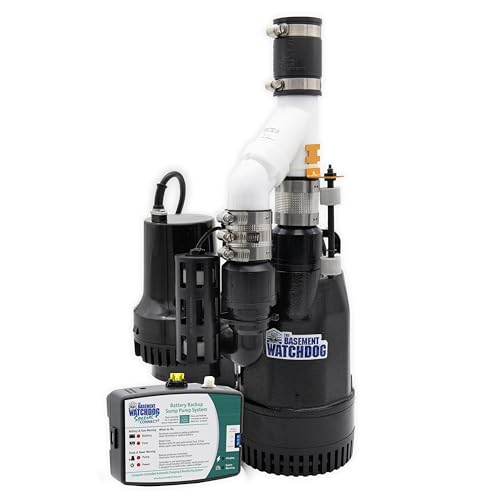
Basement Watchdog Big Combo CONNECT (CITS-50) Primary + Battery Backup Sump Pump
Backup 1,850 GPH at 10 ft (maker) · 1/2 HP primary included · Score 83/100 (sump-backup rubric)
Price: $449.99
If your primary pump is old, the CITS-50 replaces both pumps at once with a preassembled, pre-plumbed unit. Basement Watchdog lists a 1/2 HP primary pump at 3,540 GPH at 10 ft and a 12V backup pump at 1,850 GPH at 10 ft, the same backup figure as the BWSP. It shares the BWSP's 1.6 A charger, battery alarms, Wi-Fi module port and two-battery option, and the maker claims the same 48 hours on one BW-27AGM (96 on two) at a 10% duty cycle. It scores a little lower than the BWSP only because it costs more per gallon of backup flow, but that price also buys a new primary pump. Manufacturer specs.
Pros
- ✓ New 1/2 HP primary pump plus battery backup in one preassembled unit
- ✓ Backup rated 1,850 GPH at 10 ft (maker)
- ✓ Wi-Fi capable; two-battery option
- ✓ Glentronics (the maker) also sells it on Amazon
Cons
- ✗ Highest price here; battery still sold separately
- ✗ Amazon bullets list a higher backup flow than the maker (2,150 vs 1,850 GPH at 10 ft)
- ✗ Needs a pit large enough for both pumps (check the manual)
3. Best Wayne Battery Backup Sump Pump

Wayne ESP25n 12V Battery Backup Sump Pump
Backup 1,500 GPH at 10 ft (maker) · Backup only · Score 57/100 (sump-backup rubric)
Price: $279.99
Wayne's ESP25n is the toughest-built pump here on paper: Amazon's listing describes coated-steel and cast-iron construction, a reed float switch and a top-suction intake meant to resist clogs and air lock. Wayne rates it at 2,700 GPH at 0 ft, the highest zero-lift figure here, falling to 1,500 GPH at 10 ft on Wayne's own chart (Amazon lists 1,680). Wayne says it removes up to 10,000 gallons on a single battery charge; the Amazon listing pairs that claim with Wayne's WSB1275 75Ah battery, sold separately. It scores lower mainly because Wayne doesn't publish a charger rating, a Wi-Fi option or a two-battery setup, and our rubric gives no credit for specs a maker doesn't publish. Manufacturer specs.
Pros
- ✓ Highest maker-rated flow at 0 ft here (2,700 GPH)
- ✓ Coated steel and cast iron; top-suction intake
- ✓ Sold and shipped by Amazon.com when we checked
- ✓ LED display and audible alarm on the battery case
Cons
- ✗ Wayne publishes no charger rating, Wi-Fi option or two-battery setup
- ✗ Lower 10-ft flow than the Basement Watchdog backups (maker figures)
- ✗ Battery extra (Wayne recommends the WSB1275)
4. Most Compact Combo (Small Pits)

Basement Watchdog Combo (CITE-33) Primary + Battery Backup Sump Pump
Backup 1,000 GPH at 10 ft (maker) · 1/3 HP primary included · Score 53/100 (sump-backup rubric)
Price: $379.00
The CITE-33 is the smaller Basement Watchdog combo: a 1/3 HP primary pump (3,100 GPH at 10 ft, per the maker) and a 12V backup in a preassembled unit that Amazon's listing says fits pits as small as 12 inches across. Its weak spot is the backup side. Basement Watchdog rates the backup at only 1,000 GPH at 10 ft and pairs it with a 0.4 A charger, so a drained battery takes much longer to recover than on the 1.6 A models. There's no Wi-Fi port, and the maker lists two batteries as "not recommended." Its 80-hour runtime claim (one BW-27AGM, 10% duty) is the longest here because the smaller backup pump draws less current. Manufacturer specs.
Pros
- ✓ Preassembled primary + backup; fits 12 in pits (Amazon listing)
- ✓ Longest maker runtime claim here (80 h at 10% duty)
- ✓ Battery-condition alarms
- ✓ Sold by Glentronics, the maker
Cons
- ✗ Backup rated just 1,000 GPH at 10 ft (maker)
- ✗ Slow 0.4 A charger; no Wi-Fi port
- ✗ Amazon bullets list a higher backup flow (1,500 GPH at 10 ft) than the maker
Backup Pump GPH at 10 ft: Maker Figures vs Amazon Listings
A pump's flow drops as it lifts water higher, so the 0-ft number on the box is the least useful one. Ten feet is a common real-world lift from the pit to where the discharge pipe leaves the house, which is why we score the 10-ft figure. When we checked, several Amazon listings quoted different flow numbers than the manufacturers' own spec pages. The Basement Watchdog BWSP is the clearest case: its Amazon title says 2,890 GPH, its Amazon bullets say 2,500 GPH at 0 ft and 1,730 at 10 ft, and Basement Watchdog's own page says 2,600 and 1,850 (Basement Watchdog). Abt's retail listing matches the maker (Abt). Listings may describe a different production version, so check the label on the unit you receive.
| Backup pump | Maker: GPH at 0 ft | Maker: GPH at 10 ft | Amazon listing says | Maker source |
|---|---|---|---|---|
| Basement Watchdog Special CONNECT (BWSP) Battery Backup Sump Pump | 2,600 | 1,850 | Amazon title 2,890 GPH; Amazon bullets 2,500 GPH at 0 ft / 1,730 at 10 ft | Spec page |
| Basement Watchdog Big Combo CONNECT (CITS-50) Primary + Battery Backup Sump Pump | 2,600 | 1,850 | Amazon bullets list the backup at 2,890 GPH at 0 ft / 2,150 at 10 ft | Spec page |
| Wayne ESP25n 12V Battery Backup Sump Pump | 2,700 | 1,500 | Amazon bullets list 1,680 GPH at 10 ft | Spec page |
| Basement Watchdog Combo (CITE-33) Primary + Battery Backup Sump Pump | 2,000 | 1,000 | Amazon bullets list the backup at 2,500 GPH at 0 ft / 1,500 at 10 ft | Spec page |
Maker figures from each manufacturer's product page, checked November 1, 2026. Wayne's chart also lists 2,100 GPH at 5 ft and 660 GPH at 15 ft for the ESP25n (Wayne). Combo primary pumps: CITS-50 3,540 GPH and CITE-33 3,100 GPH at 10 ft (maker).
How Much GPH Do You Need?
Size the backup against how fast water actually enters your pit in a storm. During heavy rain, time how many inches the water rises in one minute while the pump is off between cycles (don't reach into the pit). Then convert: a round pit's volume per inch is π × radius² cubic inches, and a gallon is 231 cubic inches. In an 18-inch pit, each inch of rise is about 1.1 gallons, so a 6-inch rise per minute is about 6.6 gallons a minute, or roughly 400 GPH. Any backup here covers that at 10 ft on paper; the question is how long its battery lasts at that pace.
How Long Will a Battery Backup Sump Pump Run?
Makers quote runtimes at a duty cycle, the share of each hour the pump is actually running. Basement Watchdog's figures assume 10%, or about 6 minutes per hour:
- BWSP and CITS-50: 48 hours on one BW-27AGM battery, 96 hours on two (Basement Watchdog)
- CITE-33: 80 hours on one BW-27AGM; the smaller backup pump draws less current (Basement Watchdog)
- Wayne ESP25n: "up to 10,000 gallons on a single battery charge" (Wayne); the Amazon listing ties that figure to the WSB1275 75Ah battery
Our math (best case): Basement Watchdog lists the BWSP drawing 18 amps at 10 ft. A 75Ah battery (the size of Wayne's WSB1275) divided by 18 A gives about 4.2 hours of continuous pumping, or roughly 7,700 gallons at the BWSP's rated 10-ft flow. Battery amp-hour ratings are normally quoted at a slow discharge rate, and lead-acid batteries deliver less than their rating at a pump's high current, so real numbers will be lower:
| Storm intensity (duty cycle) | One 75Ah battery, 18 A pump | Two batteries in parallel |
|---|---|---|
| Light: pump runs 6 min per hour (10%) | ~42 h | ~83 h |
| Moderate: 15 min per hour (25%) | ~17 h | ~33 h |
| Heavy: 30 min per hour (50%) | ~8.3 h | ~17 h |
| Nonstop (100%) | ~4.2 h | ~8.3 h |
Our calculated upper bounds, not measurements and not manufacturer claims. Two batteries only where the maker documents it (BWSP and CITS-50 with Basement Watchdog's parallel jumper cable). After an outage, recharge time depends on the charger: a 1.6 A charger restores a deeply drained battery far faster than a 0.4 A one.
Sump Pump Backup Battery: AGM, Wet-Cell or Lithium?
Every system on this page ships without a battery, so budget for one. Use the type the pump maker specifies, because the controller's charger is built for it:
- AGM (sealed lead-acid): what Basement Watchdog recommends (its BW-27AGM). There's no water to top up, and buying it with a Basement Watchdog system adds a year to the pump warranty, per the maker. Wayne's WSB1275 for the ESP25n is a sealed, maintenance-free 12V 75Ah lead-acid battery (Wayne's Amazon listing).
- Wet-cell (flooded): Basement Watchdog says its systems also work with wet-cell batteries, and the BWSP's controller has a fluid-level sensor for them. You'll need to check and top up the fluid.
- Lithium (LiFePO4): lighter and longer-lived in other uses, but none of the four makers lists lithium as compatible on the product pages we checked. A lead-acid charger profile isn't designed for lithium cells, so only use one if your pump or charger manual explicitly supports it.
Alarms and Wi-Fi Alerts
A backup that fails silently is worse than none, because you think you're covered. Basement Watchdog's controllers sound an alarm and light a warning when the pump runs, the battery is discharged or needs replacing, a battery cable is loose, or there's a power, fuse or breaker problem. Its spec tables also say they don't alert if the backup pump itself fails and don't self-test the pump, so test it by hand as the manual describes (Basement Watchdog CITS-50 spec table). The BWSP and CITS-50 add a USB port for the BW-WiFi2 module (sold separately), which sends text, email or app alerts; the CITE-33 has no Wi-Fi port. Wayne lists an LED display and audible alarm on the ESP25n's battery case but no Wi-Fi option (Wayne).
Battery Backup vs Water-Powered vs Power Station
There are three ways to keep a pit pumping when the power goes out. They protect against different failures, and many homes combine two.
| Approach | How it works | Covers a failed primary pump? | Long outages | Main catch |
|---|---|---|---|---|
| 12V battery backup pump | Second pump with its own float, charger and battery | Yes, automatically | Limited by one or two batteries | Battery upkeep and replacement; lower flow than most primary pumps |
| Water-powered backup | City water pressure creates suction; no battery | Yes, automatically | As long as city pressure holds | Municipal water only; uses city water; backflow rules |
| Power station (or inverter + battery) | Runs your existing AC primary pump during an outage | No | Hours to days; rechargeable by solar | Surge rating must start your pump; costs more |
Water-Powered Backup Sump Pumps
Water-powered backups use the pressure in your city water line to pull water out of the pit, so there's no battery to run down. The trade-offs are written into their spec sheets. Zoeller's Home Guard Max, for example, is rated to perform at 40 to 80 psi of municipal water pressure, and the same sheet notes that some districts require a reduced-pressure backflow preventer under ASSE standard 1013 and tells buyers to check local codes (Zoeller FM2805 data sheet). They use city water while they run, and they won't work in an outage if your house is on a well, because the well pump needs electricity too. (Well owners can see can a solar generator run a well pump?) Installation ties into your potable water supply, so this is a job for a licensed plumber.
Sump Pump Power Station: Running Your Main Pump Through an Outage
A large portable power station can run the AC primary pump you already own, which usually moves more water than any 12V backup. Plug the pump directly into the station; for automatic takeover, keep the station plugged into the wall in its UPS or pass-through mode so it carries the pump the moment the grid drops. The make-or-break spec is surge: a pump motor draws several times its running current for a moment at start-up, and if the station can't supply it the pump won't start. Our can a solar generator run a sump pump? guide covers running and starting watts by horsepower, and the appliance wattage chart shows how to add the pump to the rest of your outage load. Read your pump's nameplate (volts × amps ≈ running watts) rather than relying on typical figures.
A power station does not protect you if the primary pump's float sticks or its motor fails, which is the other job a battery backup pump does. A 12V inverter wired to a deep-cycle battery is the do-it-yourself version of the same idea; it needs a pure sine wave model with enough surge and proper cabling (see our best power inverter guide). Never connect any battery system to your home's wiring without a transfer switch or interlock installed by a licensed electrician: power fed back into home wiring can energize utility lines and electrocute lineworkers making repairs (New Jersey DCA generator safety advisory). Our transfer switch guide explains the options. For how UPS-mode switching compares with a true UPS, see power station vs UPS.
| Pump running watts (your nameplate) × storm duty | Anker SOLIX F3000 (3,072 Wh) | EcoFlow Delta Pro 3 (4,096 Wh) |
|---|---|---|
| 600 W pump, running 10% of the time | ~44 h | ~58 h |
| 600 W pump, running 50% of the time | ~8.7 h | ~12 h |
| 900 W pump, running 10% of the time | ~29 h | ~39 h |
| 900 W pump, running 50% of the time | ~5.8 h | ~7.7 h |
Our estimates: rated Wh × 0.85 ÷ (running watts × duty cycle). 600 W and 900 W are example loads, not specs for any pump; use your own nameplate figure. Excludes anything else plugged into the station and the station's own standby draw.
Battery Backup Sump Pumps vs Power Stations: Side by Side
The four dedicated systems next to two power stations we already rate for sump-pump duty. Specs come from our product database and the maker pages cited above.
| Option | Type | Backup flow / output | Battery | Remote alerts | Our score | Price |
|---|---|---|---|---|---|---|
| Basement Watchdog Special CONNECT (BWSP) Battery Backup Sump Pump | 12V backup only | 1,850 GPH at 10 ft (maker) | Sold separately (1.6 A charger) | Capable with BW-WiFi2 module (sold separately) | 86/100 (sump-backup rubric) | $279.00 |
| Basement Watchdog Big Combo CONNECT (CITS-50) Primary + Battery Backup Sump Pump | 1/2 HP primary + 12V backup | 1,850 GPH at 10 ft (maker) | Sold separately (1.6 A charger) | Capable with BW-WiFi2 module (sold separately) | 83/100 (sump-backup rubric) | $449.99 |
| Wayne ESP25n 12V Battery Backup Sump Pump | 12V backup only | 1,500 GPH at 10 ft (maker) | Sold separately (charger rating unpublished) | Not published | 57/100 (sump-backup rubric) | $279.99 |
| Basement Watchdog Combo (CITE-33) Primary + Battery Backup Sump Pump | 1/3 HP primary + 12V backup | 1,000 GPH at 10 ft (maker) | Sold separately (0.4 A charger) | No (no Wi-Fi module port per maker) | 53/100 (sump-backup rubric) | $379.00 |
| Anker SOLIX F3000 | Power station (runs your AC pump) | 3,600 W continuous / 4,860 W surge | 3,072 Wh LiFePO4, built in | App | 93/100 (power-station matrix) | $1,399.99 |
| EcoFlow Delta Pro 3 | Power station (runs your AC pump) | 4,000 W continuous / 8,000 W surge | 4,096 Wh LiFePO4, built in | App | 95/100 (power-station matrix) | $2,799.00 |
The Delta Pro 3's built-in UPS mode switches in about 10 ms, per our EcoFlow Delta Pro 3 review. Check each power station's manual for motor loads in UPS mode.
Building a broader outage kit around the pump? See our best solar generators for power outages and our home battery backup guide for whole-home systems.
Who Should Buy a Battery Backup Sump Pump (and Who Should Skip It)
Good fit
- ✓ Finished basements where one failed pump means expensive damage
- ✓ Homes that lose power in spring storms or snowmelt
- ✓ Anyone away from home often who wants Wi-Fi alerts (BWSP, CITS-50)
- ✓ Owners of an aging primary pump who'd rather replace both at once (CITS-50, CITE-33)
Skip it, or add something else, if
- ✗ Your outages regularly last several days (pair it with a power station)
- ✗ Your pit has no room for a second pump (ask a plumber about a combo or a water-powered unit)
- ✗ You won't check or replace the battery; an unmaintained backup gives false confidence
- ✗ You expect it to guarantee a dry basement; no backup can
Prices on this page load live from Amazon. Several of these listings were low-stock third-party offers when we checked, so availability may change.
Sump Pump Battery Backup FAQ
What is the best sump pump battery backup?
In our scoring, the Basement Watchdog Special CONNECT (BWSP) ranks first among the systems we compared. Basement Watchdog rates it at 1,850 gallons per hour at 10 feet of lift, it has a 1.6 amp smart charger and battery alarms, and it can take a Wi-Fi alert module and a second battery. If your primary pump is also due for replacement, the Basement Watchdog CITS-50 combo adds a new 1/2 HP primary pump with the same backup pump. Scores are AI-synthesized from maker specs and Amazon prices; we did not test these pumps.
How long will a battery backup sump pump run?
It depends on battery size and how often the pump has to run. Makers quote runtimes at a stated duty cycle: Basement Watchdog claims 48 hours on one BW-27AGM battery for the BWSP at a 10% duty cycle (the pump running 6 minutes per hour), and Wayne says the ESP25n removes up to 10,000 gallons on one battery charge. By our math, a 75Ah battery feeding a pump that draws 18 amps gives about 4 hours of continuous pumping at best, so if the pump has to run nonstop in a heavy storm, expect hours, not days.
What battery is best for a backup sump pump: AGM, wet-cell or lithium?
Use the battery type your pump maker specifies. Basement Watchdog recommends its maintenance-free AGM battery (BW-27AGM) and says its systems also work with wet-cell batteries; Wayne recommends its WSB1275 sealed lead-acid battery for the ESP25n. AGM needs no water top-ups, while wet-cell batteries need their fluid checked. None of the four makers we checked lists lithium batteries as compatible on the product pages we reviewed, so only use lithium if your pump or charger manual explicitly supports it.
Is a water-powered backup sump pump better than a battery backup?
A water-powered backup uses city water pressure instead of a battery, so it never runs out of charge, but it only works on municipal water with enough pressure (Zoeller lists 40 to 80 psi for its Home Guard Max), it uses city water while it runs, and some districts require a reduced-pressure backflow preventer under ASSE 1013. It will not work during an outage if your home is on a well, because the well pump needs electricity. Check local plumbing codes before choosing one.
Can a portable power station be a sump pump backup?
Yes, if its surge rating can start your pump and you set it up so it takes over automatically. Plug the pump straight into the power station, keep the station plugged into the wall in its UPS or pass-through mode, and confirm the station's surge rating covers the pump's starting current. A dedicated battery backup still covers a different failure: a stuck float or a burned-out primary pump. Many homes use both. Never connect a power station to home wiring without a transfer switch installed by a licensed electrician.
How many GPH do I need in a backup sump pump?
Compare each pump's rated gallons per hour at your actual lift (often 8 to 10 feet from the pit to where the pipe exits) with how fast water enters your pit in a storm. To estimate inflow, time how many inches the water rises in one minute. In an 18-inch-diameter pit, each inch of rise is about 1.1 gallons, so a 6-inch rise per minute is roughly 400 gallons per hour. Pick a backup with comfortable headroom over that figure at your lift.
Can I install a battery backup sump pump myself?
Some homeowners do, but follow the manufacturer's installation manual exactly, including its check-valve and discharge-pipe requirements, and hire a licensed plumber if you are unsure. Follow the manual's requirements for the outlet the charger plugs into, and have a licensed electrician add one if there is none near the pit. We do not publish installation steps. No backup system guarantees a dry basement, so test it regularly as the manual describes.
Sources checked November 1, 2026: Basement Watchdog product pages for the Special CONNECT (BWSP), Big Combo CONNECT (CITS-50) and Combo (CITE-33); Wayne ESP25n; Abt BWSP listing; Fleet Farm ESP25n listing (2-year limited warranty; Wayne's page doesn't state the term); Zoeller Home Guard Max data sheet; Amazon listings for each product. Basement Watchdog lists a 2-year limited warranty on its systems, extended by one year with its AGM battery and one more with online registration.