
Maker Ratings + EIA Prices · Updated November 2026
Do Electric Blankets Use a Lot of Electricity? Watts and Cost per Night
The short answers
- Do they use a lot?
- No. A double blanket is about 100 W [3], one-fifteenth of a 1,500 W space heater [19]. Eight hours costs about 15¢ at the U.S. average of 18.16¢/kWh [15].
- Watts by size
- About 10 W (USB) and 50 W (12 V car blanket) up to Biddeford’s maximum ratings of 180 W for a twin and 130 or 180 W per side on a queen or king [8][7][1].
- Worst case
- A king with both sides on maximum all night: 360 W, about 52¢ a night (our arithmetic).
Jump to watts by type and size, blanket vs space heater vs furnace or running a blanket in a power outage.
As an Amazon Associate, SolarGenAdvisor earns from qualifying purchases made through links on this page, at no additional cost to you. Figures come from manufacturer ratings, manuals and public data; we did not test these blankets.
 By
Electric Blanket Watts by Type and Size
Few blanket makers print a wattage on the box; the figure is on the label on the cord or controller. The ones that do publish it are below. A maximum rating is what the blanket can draw on its highest setting; on lower settings it draws less. Cost uses the August 2026 U.S. residential average, 18.16¢/kWh [15], for an 8-hour night at the published figure, so it is a ceiling, not a typical night.
| Type and size | Published watts | kWh per 8-h night | Cost per night | Cost per 30 nights |
|---|---|---|---|---|
| USB heated throw (Keltne, 58 x 38 in)5 V × 2 A supply the maker specifies | About 10 W max [8] | 0.08 | 1.5¢ | 44¢ |
| Cordless throw with its own pack (comfheat)5,000 mAh (voltage/Wh not published) | Not published [9] | — | — | — |
| 18V tool-battery blanket (Makita DCB200A)Up to 35 h on low from a 108 Wh pack: about 3 W average on low (our arithmetic) | Not published [10] | — | — | — |
| 12V car blanket (Stalwart, 59 x 43 in)Under 4.5 A at 12 V | 50 W rated [7] | 0.40 | 7.3¢ | $2.18 |
| Corded 120 V throw (Sunbeam Royal Ultra Fleece, 50 x 60 in)Check the label on the cord or controller | Not on the listing [6] | — | — | — |
| Single (twin) blanket, planning figureExtension-service estimate | 60 W [3] | 0.48 | 8.7¢ | $2.62 |
| Double (full) blanket, planning figureExtension-service estimate | 100 W [3] | 0.80 | 15¢ | $4.36 |
| Twin blanket, maximum rating (Biddeford)One controller | 180 W [1] | 1.44 | 26¢ | $7.85 |
| Full blanket, maximum rating (Biddeford)One controller | 180 W [1] | 1.44 | 26¢ | $7.85 |
| Queen dual-control blanket (Biddeford)260 W with both sides on | 130 W per side [1] | 2.08 | 38¢ | $11.33 |
| King dual-control blanket (Biddeford)360 W with both sides on | 180 W per side [1] | 2.88 | 52¢ | $15.69 |
| Heated mattress pad, twin / full (Biddeford)Cost columns use the full size | 85 W / 130 W [2] | 1.04 | 19¢ | $5.67 |
| Heated mattress pad, queen (Biddeford)160 W with both sides on | 80 W per side [2] | 1.28 | 23¢ | $6.97 |
| Heated mattress pad, king (Biddeford)200 W with both sides on | 100 W per side [2] | 1.60 | 29¢ | $8.72 |
Our arithmetic: watts ÷ 1,000 × hours = kWh, and kWh × price = cost [17]. Dual-control rows assume both sides on at once. The Biddeford figures are the brand’s own per-size ratings on its Amazon listings; other brands differ, so use the label on yours. The 60 and 100 W rows are an extension-service planning estimate, not a rating [3]. Sunbeam’s heated-bedding manual does not print a wattage, and the Sunbeam throw’s listing does not state one [4][6].
Mattress pad or top blanket?
In Biddeford’s line, the heated mattress pad is rated lower than the blanket of the same size: 80 W per side against 130 on a queen, and 100 against 180 on a king [1][2]. That is one brand, not a rule. Both have two controllers on queen and king sizes, so one sleeper can leave a side off, which halves the draw.
Does the setting change the draw?
Yes, but the makers we checked don’t publish how much each setting draws, so we can’t give a sourced duty cycle. The one published low-setting figure we found is Makita’s: up to 35 hours on low from an 18 V 6.0Ah battery [10], which works out to an average of about 3 W from a 108 Wh pack. To get your own blanket’s real number, plug it into a plug-in watt meter for a night and read the kWh; our watts to kWh calculator converts either way. UL also notes that older blankets put out higher wattages than current models [11].
How Much Does an Electric Blanket Cost to Run?
At the August 2026 U.S. residential average of 18.16¢/kWh [15], a 100 W double blanket left on for 8 hours uses 0.8 kWh, about 15¢ a night or $4.36 for 30 nights. That is 24 kWh a month, about 2.8% of the 863 kWh an average U.S. home uses [16]. Even a queen with both sides at Biddeford’s maximum rating all night would be about $11.33 a month (our arithmetic).
Two things bring the real figure down. The blanket draws its full rating only on the top setting, and UL’s advice is to switch it on about half an hour before bed and turn it off before you get in [11]. Used that way, even a 260 W queen costs about 2.4¢ a night. Your own rate may be well above or below the national average; swap it into the formula.
Is a heated blanket energy efficient?
Every electric resistance heater, a blanket included, turns all the electricity it uses into heat at the point of use [18][17]. What makes a blanket cheap is where that heat goes: into the bed with you, instead of into the air of a whole room. That is why it can do with about a fifteenth of a space heater’s watts.
Electric Blanket vs Space Heater vs Furnace
They do different jobs, so compare what each one warms as well as the watts. The space heater and furnace figures are the same ones we use in our space heater wattage guide and power station for a furnace guide.
| Load | Warms | Watts | Electricity per hour | Per 8 hours | Runtime on 1,024 Wh |
|---|---|---|---|---|---|
| 12V heated blanket | One person | 50 W [7] | 0.9¢ | 7.3¢ | ~17 h |
| Double electric blanket | One or two people in bed | 100 W [3] | 1.8¢ | 15¢ | ~8.7 h |
| Queen blanket, both sides at maximum | Two people in bed | 260 W [1] | 4.7¢ | 38¢ | ~3.3 h |
| Gas furnace blower, ECM motor at low speed | Whole house (gas makes the heat) | 80 W [21] | 1.5¢ | 12¢ | ~11 h |
| Gas furnace blower, older PSC motor | Whole house (gas makes the heat) | 500 W [21][22] | 9.1¢ | 73¢ | ~1.7 h |
| Space heater on low | One room | 750 W [19][3] | 14¢ | $1.09 | ~1.2 h |
| Space heater on high | One room | 1,500 W [19][20][3] | 27¢ | $2.18 | ~35 min |
Our arithmetic at 18.16¢/kWh [15], load running the whole time. Runtime = battery Wh × 0.85 ÷ watts. A furnace blower cycles with the thermostat, and its electricity is only part of the bill: the gas that makes the heat is not priced here. An extension-service table lists a furnace at 750 W [3]; check the nameplate on yours. Estimates, not test results.
What the numbers mean
- Blanket vs space heater: a 1,500 W heater on high for 8 hours costs about $2.18, against 15¢ for a double blanket. CPSC also tells people to turn space heaters off when they go to sleep [14], so for a bed, the blanket is the one designed for the job.
- Blanket vs furnace: the furnace heats the whole house and the blanket heats one bed, so the cheaper choice depends on your gas and electric rates and how far you turn the thermostat down. We can’t give a general answer without those numbers.
- In an outage: a gas furnace still needs electricity for its blower and controls, and powering it is covered in our furnace backup guide. Without that, a blanket is the lowest-watt way to stay warm on a battery, as our battery powered heater guide shows.
Running a Blanket on a Power Station in an Outage
A blanket is a small load, so a power station runs one for a long time. The catch is the kind of blanket. A power station’s AC outlets come from an inverter, and Sunbeam’s heated-bedding manuals say not to use its blankets, pads and throws with generators, power converters or inverters [4][5]. Biddeford’s listings don’t address it, so read the manual that came with yours before plugging a 120 V blanket into a station or generator.
A 12 V blanket avoids the question: it plugs into the station’s car socket, which is DC. On the Anker SOLIX C1000 Gen 2 that socket is rated 12 V, 10 A (120 W) [23], well above the 50 W Stalwart’s manual lists [7]. A USB blanket runs from a USB port the same way.
| Blanket | Port | Anker SOLIX C1000 Gen 2 (1,024 Wh) |
|---|---|---|
| USB heated throw, ~10 W [8] | USB (DC) | ~87 h |
| 12V car blanket, 50 W [7] | 12 V car socket (DC) | ~17 h |
| 120 V double blanket, 100 W (only if its manual allows inverter power) [3] | AC outlet (inverter) | ~8.7 h |
| 120 V queen, both sides at maximum, 260 W (same caveat) [1] | AC outlet (inverter) | ~3.3 h |
Our arithmetic, blanket at its full figure the whole time; we use the same 0.85 allowance on DC ports, which usually lose less than the inverter. Blankets on lower settings draw less, so real runtimes are often longer. Station capacity from our product database, cross-checked against Anker and B&H [23][24].
With the station’s capacity, that 12 V blanket covers two nights. Pre-warming the bed and switching off, as UL suggests [11], stretches it much further. For the whole plan, including the fridge, lights and the furnace blower, see our winter storm power backup guide. For a cold night in a tent, our best tent heaters for camping guide covers what is safe to use, and the battery heated blanket guide compares the USB, 12 V and rechargeable blankets in more detail.
12 V blanket in a car
Stalwart’s manual says to start the vehicle’s engine before plugging the blanket in, and to unplug it when it is not in use or the vehicle is unattended [7]. A 50 W blanket can run a parked car’s starter battery down; a power station has no such problem.
Blankets and a Station, by Type
One in-stock pick per type (Amazon stock checked November 16, 2026). They do different jobs, so they are grouped, not ranked. Specs come from our product database, which is sourced from the makers’ manuals and listings; where a figure isn’t published, we say so.
12V blanket: for a power station or car

Stalwart 12V Heated Car Blanket (Navy)
12V DC accessory socket (96 in cord) · 50W rated, under 4.5A (Stalwart manual) · 59 x 43 in · Single automatic temperature (manual) · Auto-off: None published · Spot clean only [7]
Price on Amazon: $32.99
The easy blanket to run in an outage. It plugs into a 12 V car-style socket, so on a power station it skips the inverter, and Stalwart’s manual rates it at 50 W, which makes runtime simple: ~17 h on the 1,024 Wh station below, by our math.
Skip it if: You want several heat levels or a timer: it has one automatic temperature and Stalwart publishes no auto shut-off. It is spot-clean only.
Cordless throw: battery included

comfheat Cordless Heated Throw (5,000 mAh battery)
Included 5,000 mAh rechargeable pack · Not published · 30 x 55 in · 104 / 118 / 135 F (listing) · Auto-off: 45 minutes · Not stated on listing [9]
Price on Amazon: $44.99
No cord and no power station needed: the throw ships with its own 5,000 mAh pack, three heat levels and a 45-minute auto shut-off with overheat protection. Good for a cold desk or the stands.
Skip it if: You want to know how long it runs. comfheat publishes neither the pack’s watt-hours nor the blanket’s watts, and at 30 x 55 in it covers one lap, not a bed.
Corded 120 V throw: for grid power
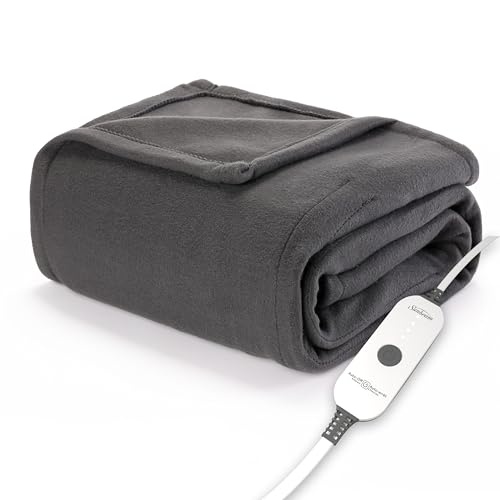
Sunbeam Royal Ultra Fleece Heated Throw 50 x 60 in
120V AC wall outlet · Not published on the listing · 50 x 60 in · Warm / low / medium / high · Auto-off: 4 hours · Machine washable, controller detached [6][4]
For the couch on normal house power: a 50 x 60 in fleece throw with four heat settings, a 4-hour auto shut-off, ETL certification and a 5-year limited warranty, per the listing.
Skip it if: You plan to run it from a power station or generator. Sunbeam’s heated-bedding manual says not to use its products with generators, power converters or inverters, and the wattage is not on the listing.
Power station: runs a 12V blanket two nights

Anker SOLIX C1000 Gen 2 · Our score 92/100
1,024 Wh · 2,000 W continuous · 3,000 W surge · 12 V 10 A car socket · 24.9 lb · LiFePO4 [23][24]
Price on Amazon: $469.99
Its 120 W car socket takes a 12 V blanket with no inverter in between, and by our math it runs a 50 W blanket for ~17 h, or a 10 W USB throw for ~87 h. The 2,000 W inverter also covers a fridge or a short burst of a space heater, and it accepts up to 600 W of solar to refill during a multi-day outage.
Skip it if: you only need an evening of warmth at a desk or in the stands; a USB throw on a power bank or a cordless throw is lighter than this 24.9 lb station.
Side by side
| Blanket | Power | Published watts | Auto-off | Size (in) | Price | Link |
|---|---|---|---|---|---|---|
| Stalwart 12V Heated Car Blanket (Navy) | 12V car / power-station socket | 50W rated, under 4.5A (Stalwart manual) | None published | 59 x 43 | $32.99 | View on Amazon → |
| comfheat Cordless Heated Throw (5,000 mAh battery) | Cordless (battery pack included) | Not published | 45 minutes | 30 x 55 | $44.99 | View on Amazon → |
| Sunbeam Royal Ultra Fleece Heated Throw 50 x 60 in | 120V wall outlet (corded) | Not published on the listing | 4 hours | 50 x 60 | Check price at Amazon → | View on Amazon → |
More USB, 12 V and rechargeable models, with runtime tables and how we score blankets, are in our battery heated blanket guide.
Electric Blanket Safety Basics
Low watts doesn’t mean no risk. In July 2026 CPSC announced a recall of about 178,000 heated sherpa throws and blankets sold on Amazon after 555 reports of overheating, including 27 fires [12]. The basics from UL, CPSC and the makers’ manuals:
- Buy one with a safety-lab listing such as UL or ETL, and don’t buy secondhand [11]. Biddeford says its blankets are tested by UL or Intertek (ETL), and the Sunbeam throw’s listing says ETL [1][6].
- Check for recalls in the CPSC database before you buy or use an older blanket [13][11].
- Use the auto shut-off. Sunbeam’s blankets and pads turn off after 10 hours and its throws after 3, with some controls selectable at 2, 6 or 10 hours [4]; the Sunbeam throw above lists 4 hours and the comfheat throw 45 minutes [6][9]. UL’s advice is to warm the bed and switch the blanket off before you get in [11].
- Never fold, tuck or bunch it while it is on, and throw it out if you see worn spots, a loose plug or damaged wiring [11][4].
- Plug it straight into the wall. Sunbeam’s manual and Biddeford’s listing both say not to use an extension cord; Biddeford adds no power strips [4][1].
- Not for everyone. UL says electric blankets are not recommended for infants and young children [11], and Sunbeam’s manual adds incapacitated or immobile people, diabetics and anyone insensitive to heat or unable to work the controls [4].
- Mind the power source. Sunbeam’s manuals say not to use its heated bedding with generators, power converters or inverters [4][5]; use a 12 V or USB blanket on a power station instead.
Verdict: Pennies a Night, Not a Big Load
An electric blanket is one of the smallest heating loads in the house: about 60–100 W on planning figures, and 130–180 W per side at the maximum ratings Biddeford publishes. A double costs about 15¢ for an 8-hour night at the U.S. average price, against $2.18 for a 1,500 W space heater. Pre-warm the bed and switch off, and it costs less still. For outages, use a 12 V blanket such as the Stalwart 12V Heated Car Blanket (Navy) on a station’s car socket rather than a 120 V blanket on the inverter. The Anker SOLIX C1000 Gen 2 (our score 92/100) runs that blanket for ~17 h by our math. Currently $469.99 on Amazon, it also has the inverter for a fridge and lights.
Electric Blanket Electricity FAQ
Do electric blankets use a lot of electricity?
No. A double electric blanket is about 100 W, so an 8-hour night uses 0.8 kWh, about 15¢ at the August 2026 U.S. average of 18.16 cents per kWh. Thirty nights is about 24 kWh, roughly 2.8% of what an average U.S. home uses in a month. A 1,500 W space heater uses fifteen times as much.
How many watts does an electric blanket use?
Planning figures put a single blanket at about 60 W and a double at 100 W. Maximum ratings are higher: Biddeford lists 180 W for its twin and full blankets, 130 W per side for a queen and 180 W per side for a king. A USB throw is limited to about 10 W by its 5 V 2 A supply, and Stalwart rates its 12 V car blanket at 50 W. The label on your blanket's cord or controller gives its exact rating.
How much does it cost to run an electric blanket all night?
At 18.16 cents per kWh, about 15¢ for a 100 W double over 8 hours, about 38¢ for a queen with both sides at Biddeford's 130 W-per-side maximum, and about 52¢ for a king at 180 W per side. Lower settings draw less. Multiply watts by hours, divide by 1,000 and multiply by your own price per kWh.
Is an electric blanket cheaper than a space heater?
Yes, by a wide margin. A plug-in space heater draws 1,500 W on high and 750 W on low, so 8 hours on high costs about $2.18 at the U.S. average price, against about 15¢ for a 100 W double blanket. Both turn all their electricity into heat; the blanket just puts it next to you instead of into the room. CPSC also says to turn space heaters off when you sleep.
Is it cheaper to use an electric blanket than to turn up the furnace?
It depends on your gas and electricity prices, so there is no single answer. A gas furnace heats the whole house; its electricity goes to the blower, which DOE's Building America program puts at 500 to 550 W for older PSC motors and as little as 80 W for ECM motors at low speed, but most of its running cost is the gas. A blanket heats one bed for about 100 W.
Are heated blankets energy efficient?
Like every electric resistance heater, a heated blanket turns all the electricity it uses into heat at the point of use. It is cheap to run because it needs so few watts: it warms you directly instead of heating the air in a room. Switching it on about half an hour before bed and off when you get in, as UL suggests, cuts the cost further.
Does a heated mattress pad use less electricity than a blanket?
In Biddeford's line it does: its heated mattress pads are rated 80 W per side for a queen and 100 W per side for a king, against 130 and 180 W per side for its blankets. That is one brand's ratings, not a rule, so check the label. On any dual-control queen or king, leaving one side off halves the draw.
Can I run an electric blanket on a power station or generator?
Check the manual first. Sunbeam's heated-bedding manuals say not to use its blankets, pads and throws with generators, power converters or inverters, and a power station's AC outlets come from an inverter. A 12 V blanket in the station's car socket or a USB blanket in a USB port avoids the inverter: the Anker SOLIX C1000 Gen 2's car socket is rated 12 V 10 A (120 W), well above a 50 W 12 V blanket.
How long will a power station run an electric blanket?
Runtime is battery Wh x 0.85 divided by the blanket's watts. A 1,024 Wh station runs a 50 W 12 V blanket for about 17 hours by that math, a 10 W USB throw for about 87 hours, and a 100 W blanket for about 8.7 hours if its manual allows inverter power. Lower settings stretch those times.
Is it safe to leave an electric blanket on all night?
UL's advice is to use it to warm the bed and switch it off before you get in. Many blankets have an auto shut-off: Sunbeam's blankets and mattress pads turn off after 10 hours and its throws after 3. Never fold or bunch a blanket while it is on, plug it straight into the wall, check cpsc.gov for recalls, and don't use one for an infant, a young child or anyone who can't feel heat or work the controls.
Sources
Wattage figures come from manufacturers’ listings and manuals and a university extension table, as cited; electricity prices from the U.S. EIA. Costs, runtimes and percentages are our arithmetic on those figures. Product specs come from our product database, cross-checked against the sources listed. Nothing here was measured by us. Last reviewed November 18, 2026.
- Biddeford Blankets MicroPlush electric heated blanket, brand listing on Amazon (ASINs B00DN6SRJO and B076BCC77D, same text): Twin 180 W, Full 180 W, Queen 130 W per side, King 180 W per side (120 V); Queen and King have 2 controllers; 10 heat settings with auto shut-off; tested by UL or Intertek (ETL); do not use an extension cord or power strip
- Biddeford Blankets quilted electric heated mattress pad, brand listing on Amazon (ASIN B000JI1OS0): Twin 85 W, Full 130 W, Queen 80 W per side, King 100 W per side (120 V); dual heat zone on Queen and King; 10 heat settings with auto shut-off
- Virginia Cooperative Extension, Estimating appliance and home electronic energy use: electric blanket single/double 60/100 W; portable heater 750–1,500 W; furnace 750 W
- Sunbeam heated bedding user manual P.N. 174822 (Home Depot copy): use only on a 110–120 V, 60 Hz AC circuit; do not use with an extension cord; do not use with generators, power converters or inverters; Auto-Off after 10 hours (3 hours for throws); some controls selectable at 2, 6 or 10 hours; do not use with an infant, a child, an incapacitated person, a diabetic or anyone insensitive to heat
- Sunbeam heated bedding manual: do not use with generator power or inverter (ManualsLib copy)
- Sunbeam Royal Ultra Fleece heated throw, Amazon listing (ASIN B008BF2MFM): 50 x 60 in, 4 heat settings, 4-hour auto shut-off, ETL certified, 5-year limited warranty; no wattage stated
- Stalwart 12V Heated Blanket manual (Home Depot copy): 12 V DC input, 50 W rated power, max. current under 4.5 A, 8 A fuse; start the vehicle’s engine before plugging in; unplug when not in use or when the vehicle is unattended
- Keltne USB heated throw, Amazon listing (ASIN B0CFJGNQ2G): 58 x 38 in, 3 heat levels, USB powered, maker suggests a 5 V 2 A supply or above, battery not included
- comfheat cordless heated throw, Amazon listing (ASIN B0H82SSQ8N): 30 x 55 in, 5,000 mAh pack included, 3 levels, 45-minute auto shut-off, overheat protection; pack Wh and blanket watts not stated
- Makita, DCB200A 18V LXT cordless heated blanket: up to 35 hours on low with an 18V LXT 6.0Ah battery; 3 heat settings; washer and dryer safe
- UL Solutions, Electric blankets are cozy, but are they safe? (use blankets approved by a nationally recognized testing agency such as UL; turn it on about half an hour before bed and switch it off before you get in; never fold one in use; discard a damaged blanket; older models put out higher wattages; check for recalls)
- U.S. CPSC, Heated sherpa throws and blankets recalled due to fire and burn hazards; sold on Amazon by OCTROT (July 30, 2026: about 178,000 units, 555 overheating reports, 27 fires)
- U.S. CPSC, Recalls database
- U.S. CPSC, Keep warm and safe this winter (news release, January 23, 2026): plug space heaters directly into a wall outlet, turn them off when sleeping; portable heaters involved in about 1,600 fires a year
- U.S. EIA, Electric Power Monthly, Table 5.6.A: average price of electricity by state and sector; U.S. residential 18.16 cents/kWh in August 2026 (17.57 in August 2025); released October 23, 2026, preliminary
- U.S. EIA, Electric Sales, Revenue, and Average Price, 2024, Table 5.a: average U.S. residential use 863 kWh a month
- Missouri Department of Natural Resources, Electric space heaters (PUB2849): all electric resistance heaters are considered 100% efficient; kilowatts × rate × time = cost
- U.S. DOE Energy Saver, Electric resistance heating: 100% efficient at the point of use (Wayback Machine copy of May 5, 2026)
- Vornado, Heater FAQs: most Vornado heaters use a maximum 1,500 W on high and 750 W on low
- Lasko CS12200 ceramic space heater product catalog listing: 1,500 W high, 900 W low, 120 V
- PNNL Building America Solution Center, ECM air handler fans: older PSC blower motors typically draw 500–550 W; ECM motors can run on as little as 80 W at low speed
- Anker SOLIX, Backup generator for a gas furnace: typical gas furnace about 400–800 W in normal operation
- Anker SOLIX, C1000 Gen 2 product page: 1,024 Wh, 2,000 W AC (3,000 W peak), car socket 12 V 10 A (120 W), USB-C up to 140 W
- B&H Photo spec listing, Anker SOLIX C1000 Gen 2 (1,024 Wh, 2,000 W continuous, 3,000 W surge)
Planning for winter outages? The Stalwart 12V blanket is currently $32.99 on Amazon.
Check Price on Amazon →Save to cart