
Product Review · Updated October 2026
Pecron F3000LFP Review: A Budget 3kWh Power Station With Real Trade-offs
Quick verdict
The Pecron F3000LFP is a 3,072Wh LiFePO4 power station with 3,600W of 120V output, a 30A outlet, 1,800W wall charging and 1,600W of solar input, at about 63 lb. It is one of the lowest-cost ways to get 3kWh of storage, and it scores 86/100 in our scoring. Skip it if you need 240V, strong surge headroom for big motors, or fast solar recharging.
Currently $899.00 on Amazon, the F3000LFP competes with the Anker SOLIX F3000 and the FOSSiBOT F3600 Pro. It gives up some recharge speed, expansion range and surge headroom to those rivals, and in return it is about 28 lb lighter than either. Our score is synthesized from Pecron's published specs, third-party reviews and Amazon listing data.
As an Amazon Associate, SolarGenAdvisor earns from qualifying purchases made through links on this page, at no additional cost to you.
 By

Capacity
3,072
Watt-hours (LiFePO4)
AC Output
3,600
Watts (120V only)
Weight
63.3
lb (no built-in wheels)
Price
$899.00
Current price on Amazon
What Is the Pecron F3000LFP?
The F3000LFP is Pecron's 3kWh-class portable power station, a smaller sibling to the 5kWh Pecron F5000LFP. Pecron's product page lists a 3,072Wh LiFePO4 battery rated for 3,500+ cycles to 80%, a 3,600W bidirectional pure sine wave inverter with a surge of “4500W in 5s”, a 30A AC output, 1,800W AC charging in about 2 hours, 1,600W of solar input (XT60, 25–120V, 25A max), 3,200W combined AC plus solar input, 13 outputs including a 100W USB-C port, UPS mode and Wi-Fi/Bluetooth app control (Pecron). The Amazon listing we link to (ASIN B0F6YCRKTJ) repeats the 3,072Wh, 3,600W, 1,800W AC and 1,600W solar figures.
Independent coverage matches the core figures. The Solar Lab lists 3,072Wh, a 3,600W 120V inverter, five 120V outlets plus a 30A RV-style plug, 1,800W AC charging, 1,600W solar and about 63 lb. Solar Power Picks, working from Pecron's US manual, lists 63.3 lb, 19.3 × 11.6 × 11.1 in and no 240V output on a single unit. An authorized retailer's spec block gives the same 63.3 lb and dimensions (Outbound Power). Note that The Solar Lab's Pecron links carry affiliate tracking, so it is not fully independent of Pecron sales. The same is true of this page for Amazon.
Two figures are disputed, so we flag them rather than pick one. Surge: Pecron says 4,500W for 5 seconds, while one retailer lists 7,000W. Warranty: Pecron advertises “2+3 Years”, one retailer states 24 months and another says 5 years. Details are in the surge section and FAQ below.
Pecron F3000LFP Specs That Matter
3,600W at 120V, With a 30A Outlet
Six AC outlets share 3,600W: five standard household outlets and one 30A RV-style outlet, which Pecron lists as “AC 30A Output”. That is enough for a travel trailer on 30A service or for a fridge, freezer, sump pump, router and lights in an outage. DC outputs are two USB-C (one 100W PD), two 18W USB-A, a car socket and two 5.5mm DC barrel ports (Amazon listing). There is no 240V output, and we found no Pecron documentation of a two-unit 240V kit for this model. If you need 240V, see the F5000LFP or the Anker SOLIX F3000, which pairs two units for 240V.
Pecron F3000LFP Surge Rating: 4,500W for 5 Seconds
This is the spec to read carefully. Pecron's page rates surge at 4,500W for 5 seconds, which is 1.25× the continuous rating. The FOSSiBOT F3600 Pro lists 7,200W and the Anker F3000 4,860W. Some retailer listings quote 7,000W or more for the F3000LFP, which does not match Pecron's own figure (Shop Solar). In The Solar Lab's review, the unit ran its full 3,600W load continuously without tripping. A 4,500W load lasted about 10 seconds before the unit tripped and had to be restarted. In practice, plan around 3,600W and check the starting watts of any well pump, air compressor or large AC unit before relying on the surge.
1,800W Wall Charging, 1,600W Solar
Pecron lists 1,800W AC charging (15A max) and about 2 hours to full, with an adjustable rate. The Solar Lab reported just over 2 hours. That beats the FOSSiBOT F3600 Pro's 1,500W but trails the Anker F3000's 3,600W. Solar input is a single XT60 port taking up to 1,600W at 25–120V and 25A. Solar Power Picks notes that the array's open-circuit voltage must stay under 120V, which limits how many panels you can wire in series. AC and solar together reach 3,200W, about 1.3 hours to full by Pecron's figure.
Expandable to 9.2kWh or 10.75kWh
The F3000LFP takes up to two Pecron 48V expansion batteries. Pecron's page lists two EP3000-48V packs for 9,216Wh, and it sells bundles with one or two EP3800-48V packs (3,840Wh each) for up to 10,752Wh, the figure in the Amazon title. The Amazon listing warns that an EP3800-48V needs a separate F3000LFP XT120-M cascade cable. For comparison, Anker lists the F3000 at up to 24kWh, and the FOSSiBOT F3600 Pro tops out at 11,520Wh.
UPS, Idle Draw and Efficiency
The Amazon listing gives an 8–20ms UPS switchover, and Solar Power Picks, citing the manual, says UPS loads must stay under 1,800W at 120V. That is fine for a router or desktop PC, but not a true zero-millisecond online UPS like the F5000LFP's. The Solar Lab measured 83% average efficiency at a sustained 3,600W load. It also measured a 37W idle draw with the inverter on and nothing plugged in, against 20.5W for the Anker F3000. That idle draw matters most for small loads left running overnight, as the runtime table below shows. Pecron's product page does not list safety certifications, and we could not confirm a UL listing.
How Long Will the Pecron F3000LFP Run Your Appliances?
Runtime = usable Wh ÷ load in watts. We assume about 85% of the rated 3,072Wh is usable after inverter losses (about 2,611Wh). The expanded column assumes two EP3800-48V batteries (10,752Wh, about 9,139Wh usable). These are steady-load estimates. Appliances that cycle, like fridges, furnaces and RV air conditioners, run longer than their average draw suggests.
| Load scenario | Average draw | F3000LFP alone | With 2 × EP3800 |
|---|---|---|---|
| CPAP (no humidifier) | 40W | ~2.7 days | ~9.5 days |
| Refrigerator only | 150W | ~17.4 hrs | ~2.5 days |
| Fridge + internet + LED lights + phones | 300W | ~8.7 hrs | ~30.5 hrs |
| Essentials + furnace blower | 700W | ~3.7 hrs | ~13.1 hrs |
| RV rooftop AC (13,500 BTU, typical running draw) | 1,300W | ~2.0 hrs | ~7.0 hrs |
| Space heater on high | 1,500W | ~1.7 hrs | ~6.1 hrs |
The idle-draw caveat: with a reported 37W inverter overhead, small AC loads drain the battery faster than the table implies. A 40W CPAP on an AC outlet could see closer to 34 hours than 65. Run CPAPs and 12V fridges from the DC car socket where you can, and switch the AC inverter off when nothing needs it. The RV air-conditioner row is running draw only; starting surge is higher and may exceed the 4,500W short-burst rating on some units. To size your own loads, use the solar generator size calculator.
Pros & Cons
What We Like
- • Low cost per watt-hour for a 3kWh LiFePO4 station (see the live table below)
- • About 63 lb, roughly 28 lb lighter than the Anker F3000 or FOSSiBOT F3600 Pro
- • 3,600W continuous plus a 30A RV-style outlet
- • 1,800W wall charging, about 2 hours to full
- • Expands to 10,752Wh with two EP3800-48V batteries
- • LiFePO4 rated 3,500+ cycles to 80%, app control and UPS mode
What Could Be Better
- • 120V only, with no documented 240V pairing
- • Modest surge: 4,500W for 5 seconds by Pecron's own spec
- • 1,600W solar on one XT60 port with a 120V ceiling
- • No built-in wheels (Pecron sells a cart option)
- • 37W idle draw reported by The Solar Lab
- • Warranty terms differ between Pecron and retailers
Pecron F3000LFP vs Anker F3000, Jackery HomePower 3000, FOSSiBOT F3600 Pro and Pecron F5000LFP
These are the stations already rated on SolarGenAdvisor that F3000LFP shoppers are most likely to compare. Specs and scores come from our product database. Prices and cost per watt-hour are live from Amazon.
| Model | Capacity | Output | Surge | Solar In | Weight | Our Score | Price | Cost / Wh | Amazon |
|---|---|---|---|---|---|---|---|---|---|
| Pecron F3000LFP | 3,072 Wh | 3,600W | 4,500W | 1,600W | 63.3 lb | 86/100 | $899.00 | $0.29/Wh | Check Price → |
| Jackery HomePower 3000 | 3,072 Wh | 3,600W | 7,200W | 1,000W | 59.5 lb | 87/100 | $1,499.00 | $0.49/Wh | Check Price → |
| FOSSiBOT F3600 Pro | 3,840 Wh | 3,600W | 7,200W | 2,000W | 92.6 lb | 86/100 | $1,139.00 | $0.30/Wh | Check Price → |
| Anker SOLIX F3000 | 3,072 Wh | 3,600W | 4,860W | 2,400W | 91.5 lb | 93/100 | $1,399.99 | $0.46/Wh | Check Price → |
| Pecron F5000LFP Power Station | 5,120 Wh | 7,200W | 7,200W | 6,400W | 123.9 lb | 90/100 | Check price at Amazon → | — | Check Price → |
At today's Amazon prices, the Pecron F3000LFP has the lowest cost per watt-hour of the models above with a live price. Prices change often, so treat this as a snapshot, not a forecast.
Pecron F3000 vs Anker F3000
This is the matchup most shoppers search for. Both have 3,072Wh and 3,600W of 120V output. The Anker SOLIX F3000 recharges far faster (3,600W from AC, 6,000W with AC plus solar), takes 2,400W of solar across two inputs, rolls on built-in wheels, expands to 24kWh and can pair two units for 240V. It also has a higher surge rating (4,860W) and a lower reported idle draw. The Pecron weighs about 28 lb less (63.3 vs 91.5 lb) and cost less per watt-hour when we checked on October 31, 2026; compare the live column above, since prices change. Choose the Anker (93/100) for recharge speed, expansion and a 240V path. Choose the Pecron (86/100) if you want 3kWh for less and will mostly charge from the wall.
Pecron F3000LFP vs FOSSiBOT F3600 Pro
These two are the budget picks in this class. The FOSSiBOT F3600 Pro stores more (3,840Wh), lists a much higher 7,200W surge, takes 2,000W of solar over a wider 12–160V range and has wheels. The Pecron charges faster from the wall (1,800W vs 1,500W), rates its cycles to 80% capacity rather than 50%, and is about 29 lb lighter. If you run motor loads, lean FOSSiBOT. If you will lift the unit into a vehicle, lean Pecron.
Pecron F3000LFP vs Jackery HomePower 3000
The Jackery HomePower 3000 has the same 3,072Wh and 3,600W of 120V output, and it is the lighter of the two at about 59.5 lb. Jackery lists a 7,200W surge, a TT-30 outlet, a 20ms-or-faster UPS and support for a six-circuit manual transfer switch. The Pecron has more room to grow: it takes 1,600W of solar against the Jackery’s 1,000W, and it accepts two expansion batteries, while the HomePower 3000 can’t be expanded. It also sits in a lower price tier; compare the live cost-per-watt-hour column above. Choose the Jackery (87/100) for surge headroom, a lighter case and a larger brand’s support. Choose the Pecron for solar capacity, expansion and price.
Pecron F3000LFP vs Pecron F5000LFP
The F5000LFP is the step up: 5,120Wh, 7,200W of 120/240V output, 6,400W of solar input and expansion to 35.8kWh, at about 124 lb and a much higher price tier. Buy the F5000LFP for 240V circuits through a transfer switch. Buy the F3000LFP for 120V essentials, RV use or a unit one or two people can still carry.
Pecron F3000LFP Alternatives
If one of the F3000LFP's trade-offs is a deal-breaker, these are the closest alternatives we have rated.

Anker SOLIX F3000
93/100 in our scoring · 3,072Wh · 92 lb
Faster recharging, 24kWh expansion and a two-unit 240V path.
Price: $1,399.99
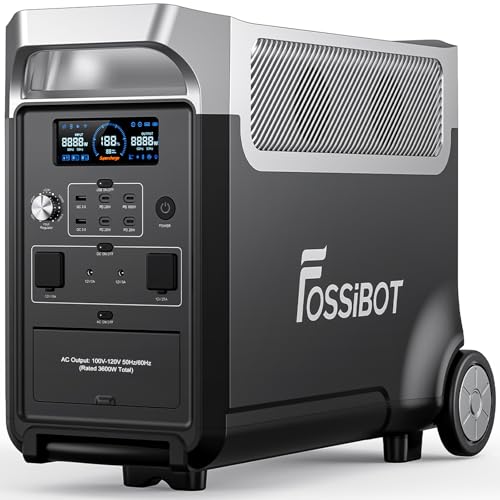
FOSSiBOT F3600 Pro
86/100 in our scoring · 3,840Wh · 93 lb
More capacity and a 7,200W surge rating for motor loads, on wheels.
Price: $1,139.00

Pecron F5000LFP Power Station
90/100 in our scoring · 5,120Wh · 124 lb
5,120Wh with 120/240V output from a single unit for whole-home circuits.
Pecron F3000LFP Full Specifications
| Battery capacity | 3,072 Wh (LiFePO4) |
| AC output (continuous) | 3,600W, 120V pure sine wave (bidirectional inverter) |
| Surge | 4,500W for 5 seconds (Pecron); some retailers list 7,000W+; sources conflict |
| AC outlets | 6 total: 5 × standard 120V + 1 × 30A RV-style |
| USB / DC outputs | 2 × USB-C (one 100W PD), 2 × USB-A 18W, 1 × car socket, 2 × DC5525 |
| Total outputs | 13 |
| AC charging | 1,800W max (15A), adjustable, about 2 hrs |
| Solar input | 1,600W max, XT60, 25–120V, 25A max |
| AC + solar | 3,200W max, about 1.3 hrs (Pecron) |
| Expansion | Up to 2 batteries: 2 × EP3000-48V = 9,216Wh; 2 × EP3800-48V = 10,752Wh (EP3800 needs XT120-M cascade cable) |
| 240V / parallel | No 240V on a single unit; no pairing kit documented |
| UPS switchover | 8–20ms (Amazon listing); UPS loads under 1,800W |
| Cycle life | 3,500+ cycles to 80% (Pecron) |
| App | Wi-Fi + Bluetooth |
| Certifications | Not listed on Pecron's product page |
| Warranty | “2+3 Years” on pecron.com; 24 months per one retailer, 5 years per another; confirm with seller |
| Weight | 63.3 lb (about 28.7 kg) |
| Dimensions | 19.3 × 11.6 × 11.1 in (489 × 295 × 282 mm); no built-in wheels |
Sources: Pecron F3000LFP product page (checked October 31, 2026); Amazon listing B0F6YCRKTJ (title and feature bullets); The Solar Lab review; Solar Power Picks (US manual figures); Outbound Power spec block and warranty note; Shop Solar listing (7,000W surge and 5-year warranty claims).
Who Should Buy the Pecron F3000LFP?
Buy if you…
- ✓ Want about 3kWh of LiFePO4 storage for the least money and only need 120V
- ✓ Back up a fridge, freezer, router, lights and phones through a 1–2 day outage
- ✓ Run a travel trailer on a 30A service
- ✓ Mostly recharge from the wall, where 1,800W is competitive
- ✓ Need to lift it into a car or truck; it is about 28 lb lighter than the Anker F3000 or FOSSiBOT F3600 Pro
Skip if you…
- ✗ Need 240V for a well pump, dryer or transfer switch; see the F5000LFP
- ✗ Start big motors; the F3600 Pro lists 7,200W surge
- ✗ Want fast solar refills or plan to grow past 10.75kWh; see the Anker F3000
- ✗ Leave tiny loads on the AC inverter for days (37W reported idle draw)
- ✗ Need a UL listing for an inspector, landlord or insurer
Verdict: Is the Pecron F3000LFP Worth It?
The F3000LFP earns 86/100 in our scoring. For comparison, the Anker SOLIX F3000 scores 93, the FOSSiBOT F3600 Pro 86 and the Pecron F5000LFP 90. It scores high on value and portability for its capacity, and solidly on LiFePO4 longevity and wall charging. It loses points for 120V-only output, a 4,500W short-burst surge rating, a single 1,600W solar input, a two-battery expansion ceiling, a high reported idle draw and warranty terms that vary by seller. If its live cost per watt-hour stays below its rivals', it is a sensible way to get 3kWh of backup for 120V essentials. If you are still comparing sizes, start with our best 3000 watt solar generators guide or the Best Budget 2026 award. For holiday sales, the Black Friday tracker and the always-current solar generator deals page show live prices.
How we rate: our scores are synthesized from published specifications, manufacturer figures, logged Amazon prices and public reviews, weighted using our awards methodology. Runtime figures are calculated, not measured. Figures attributed to The Solar Lab are that outlet's published results.
Pecron F3000LFP FAQ
Is the Pecron F3000LFP worth it?
For buyers who want about 3kWh of LiFePO4 storage at 120V for the lowest cost, it is one of the strongest options we cover. It pairs Pecron's published 3,072Wh and 3,600W with 1,800W wall charging, a 30A outlet and a weight of about 63 lb. The trade-offs are 120V-only output, a modest 4,500W surge rating, 1,600W of solar input, no built-in wheels, a high reported idle draw and warranty terms that differ between sellers. It scores 86/100 in our scoring.
Is the Pecron F3000LFP 120V or 240V?
It is 120V only. Its six AC outlets are five standard household outlets plus one 30A RV-style outlet, all sharing 3,600W. We found no Pecron documentation of a kit that pairs two F3000LFP units for 240V, so it is not a fit for 240V well pumps, dryers or central air. Pecron's larger F5000LFP outputs 120V and 240V from one unit.
What is the Pecron F3000LFP surge rating?
Pecron's own product page lists a surge of 4,500W for 5 seconds. Some retailer listings quote 7,000W or more, and those figures do not match Pecron's. In The Solar Lab's review, a 4,500W load ran for about 10 seconds before the unit tripped and had to be restarted. Treat 4,500W as a short starting burst, not extra running capacity, and check the locked-rotor or starting watts of any motor you plan to run.
How long will the Pecron F3000LFP run a refrigerator?
Assuming about 85% usable energy after inverter losses, the 3,072Wh battery gives roughly 2,611Wh. A full-size refrigerator averaging 150W would run about 17 hours. With two EP3800-48V expansion batteries (10,752Wh total) that rises to about 2.5 days. These are calculated estimates, not measurements.
How fast does the Pecron F3000LFP charge?
Pecron lists 1,800W AC charging and about 2 hours to full from a wall outlet, with an adjustable charging rate. Solar input is up to 1,600W through one XT60 port (25-120V, 25A max). AC and solar together reach 3,200W, which Pecron puts at about 1.3 hours. The Solar Lab reported a full AC charge in just over 2 hours.
Pecron F3000LFP vs Anker SOLIX F3000: which should I buy?
Both have 3,072Wh and 3,600W of 120V output. The Anker SOLIX F3000 recharges much faster (3,600W AC, 6,000W AC plus solar), takes more solar (2,400W), has wheels, expands to 24kWh and can pair two units for 240V, but it weighs about 91.5 lb and sits in a higher price tier. The Pecron is about 28 lb lighter and cost less per watt-hour when we checked, though prices change often. Choose the Anker for recharge speed, expansion and a 240V upgrade path; choose the Pecron to get 3kWh for less.
What warranty does the Pecron F3000LFP have?
Sources conflict. Pecron's product page advertises a "2+3 Years Warranty", one authorized retailer states that Pecron power stations carry a 24-month warranty, and another retailer lists 5 years. Warranty terms can depend on where you buy and whether you register the product, so confirm the terms with the seller before you buy.
Can you expand the Pecron F3000LFP?
Yes, with up to two Pecron 48V expansion batteries. Two EP3000-48V packs bring the total to 9,216Wh, and two EP3800-48V packs bring it to 10,752Wh. The Amazon listing notes that connecting an EP3800-48V requires a separate XT120-M cascade cable for the F3000LFP, so check that one is included.
Ready to Compare Prices?
Pecron F3000LFP on Amazon: $899.00
Need 240V instead? Read our transfer switch guide before choosing a station.