
Winter Outage Guide · Updated November 2026
Battery Backup for a Pellet Stove: What It Draws and What Runs It
The short answer
A pellet stove is one of the easiest heat sources to back up with a battery. Once lit, the manuals we checked list about 90–184W. The igniter pulls roughly 300–600W for the first several minutes. A 1 kWh pure sine wave power station with a fast (about 10 ms) UPS switchover keeps a typical stove running for about 5–9 hours, and a 2 kWh unit for about 10–17. Read your stove’s manual first. Some makers, Harman included, treat battery backup as a way to shut down safely, not to keep heating.
As an Amazon Associate, SolarGenAdvisor earns from qualifying purchases made through links on this page, at no additional cost to you.
 By Morgan Chen
Reviewed & approved by Juhi Sahni
|
Published: November 7, 2026
|
Updated:
|
Winter storm backup plan
How Much Power Does a Pellet Stove Use?
A pellet stove makes its heat from wood pellets, but it can’t run without electricity. An auger feeds pellets into the burn pot, a combustion blower pulls air through the fire and pushes exhaust out the vent, a convection fan moves heat into the room, and a control board runs the lot. At start-up, a hot-air or cartridge igniter lights the pellets. The igniter is the biggest load, but it only runs for the first few minutes.
Here is what manufacturers actually publish. These are examples, not a spec for your stove:
| Stove (manual) | Start-up / igniter | Running | Source |
|---|---|---|---|
| Lennox Bella | 360W max, igniter on for the first 8 minutes | 90–115W in burn mode | Owner’s manual, p. 4 |
| US Stove / Ashley AP5613 | 310W with igniter running | 125W operational | Owner’s manual (PDF) |
| Enviro Mini | 600W peak (4.1A) | 184W maximum (2.0A average) | Owner’s manual (PDF) |
General guides land in the same range. Angi puts ignition at 400–500W and normal operation at about 100W. Anker’s pellet-stove guide gives around 300–500W at ignition and 60–150W running, depending on fan speed and heat setting. An appliance-repair guide is more conservative, at 600–840W for the igniter cycle and up to 240–480W maximum load, which is a reminder that bigger stoves and inserts can draw more.
Use your own stove’s number. Look on the rating plate (often on the back or under the hopper lid) or in the electrical specifications section of the manual. Amps × 120V gives a rough watts figure. A plug-in power meter between the stove and the wall will show the real draw at ignition and on your usual heat setting. Our appliance wattage chart covers the other loads you might add to the same battery.
Does a Pellet Stove Need a Pure Sine Wave Battery Backup?
Plan on it. Comfortbilt says its stoves “require a Pure Sine Wave output with at least a 1000W peak wattage.” Anker’s guide adds that modified sine wave power can cause problems in some models. A pellet stove is a control board plus several small motors, and those are the loads most likely to misbehave on a stepped or modified waveform.
- Every unit on this page lists a pure sine (or sine wave) output. The cheap risk is a bargain car inverter or an unbranded “inverter generator” that doesn’t state its waveform.
- Size the inverter for the igniter, not the running load. A 300–600W igniter plus the fans is well within a 1,500–2,400W inverter. Comfortbilt’s 1,000W peak is a sensible floor.
- Check what your manual names. Some manufacturers approve specific backup units. Harman’s P43 manual names two small UPS models (see the shutdown section below).
UPS Switchover Time: Why It Matters for a Running Stove
With the station in line between the wall and the stove, the stove runs on grid power while the battery stays full (that’s UPS or pass-through mode). When the grid drops, the station switches the stove to its battery. How long that switch takes is the spec that decides whether the stove keeps running or reboots.
Comfortbilt describes what happens when the gap is too long: with an inverter that has a switchover delay, the stove’s control panel reboots, the stove goes into a safety shutdown, and someone has to restart it by hand. A stove that shuts itself down at 2 a.m. with nobody watching is exactly what a backup is supposed to prevent. Comfortbilt’s recommendation is a pure sine UPS with an instant switchover.
| Unit | Published switchover | Source |
|---|---|---|
| CyberPower CP1500PFCLCD (UPS) | 4 ms typical | CyberPower spec sheet (see our UPS guide) |
| EcoFlow Delta 3 Plus | Under 10 ms | EcoFlow, via StorageReview, which reports measuring just over 8 ms |
| Anker SOLIX C1000 Gen 2 | 10 ms, all AC outlets | Anker |
| Anker SOLIX C2000 Gen 2 | 10 ms | Anker |
| Jackery Explorer 1000 v2 | Within 20 ms | Jackery |
What we could not find: any pellet-stove maker that publishes the longest power gap its control board will tolerate. So faster is safer, but no millisecond figure is a guarantee for your stove. Do a supervised test on a mild day before you rely on it. With the stove running on low and the station fully charged, switch off the wall outlet or breaker that feeds the station. Stay by the stove, and be ready to restore power and open a window if it shuts down or smokes. If it rides through, you have your answer. If it reboots, plan on the safe-shutdown approach below, or run the stove straight off the station’s battery during storm season. For the bigger picture, see our power station vs UPS comparison.
Keep the Stove Running, or Let It Shut Down Safely?
Start with why backup matters at all. It’s smoke, not comfort. The combustion blower is what pushes exhaust out of the vent, and the manuals are blunt about what happens when it stops:
What the manuals say about power loss and smoke
- • Harman P43: “A power failure will cause the combustion blower to stop,” exhaust can seep into the room, and a tall vent may give only partial draft. Harman “strongly recommends installing battery back-up to minimize entry of smoke into the room in the event of power loss.” It also says to keep doors and the hopper lid closed and latched during power failures (Harman P43 manual, “Loss of Power”).
- • US Stove / Ashley AP5613: the heater will not operate during a power outage. If one occurs, check the heater for smoke spillage and open a window if smoke spills into the room (AP5613 manual).
- • Enviro Mini: “DO NOT unplug unit while Combustion fan is operating. This may lead to smoke escaping from the stove” (Enviro manual).
Pellet-stove manuals also require working smoke detectors. Put battery-powered or battery-backup CO alarms on every level and outside sleeping areas too (CPSC).
Option 1: Safe shutdown
The battery only has to power the stove long enough to burn out cleanly with the blower running. Harman describes exactly this: a fully charged UPS powers a combustion-blower-only shutdown, pulsing the blower every few seconds until the fire is out. The same manual says the UPS “provides safe shut-down only. It is not intended for continued operation.” It names the APC BE750G and Tripp Lite INTERNET750U as approved. If your manual reads like this, follow it. A small UPS or any power station will do the job.
Option 2: Keep heating
A 1–2 kWh power station gives hours of stove runtime instead of minutes (see the runtime table below). Comfortbilt’s backup advice is aimed at this: keeping the stove running without interruption. It is the better plan for multi-hour outages, as long as your manufacturer allows continued operation on battery and your switchover test passes. Harman also lists a 12V deep-cycle battery kit (Surefire 512) that it says runs the stove “for up to eight (8) hours,” so Harman does support running on battery with its own accessory.
Either way, plan for the battery running out. Harman warns that if the outage outlasts the battery, smoke leakage may still occur unless the stove has been safely shut down. When the station gets to about 15–20%, turn the stove off yourself and let it run its normal shutdown on battery. Don’t let the battery hit zero with the fire still burning.
What about a gas generator for a pellet stove? It works if its output is clean enough for the control board (an inverter generator), but it has to run outdoors, at least 20 feet from the house, never in a garage (CDC). It can’t take over in milliseconds either. You still need a battery or UPS to bridge the gap, or you will be restarting the stove every time. A battery station sits indoors next to the stove with no exhaust. For non-electric backup heat, see our indoor propane heater guide and the ventilation rules that come with it.
How Long Will a Battery Run a Pellet Stove?
Runtime = battery Wh × 0.85 ÷ running watts. The 0.85 covers inverter and conversion losses, and it’s the same method our solar size calculator uses. We run two running loads that bracket the manuals above, 100W and 175W, and a version that also subtracts one ignition cycle in case the stove relights on battery.
The assumptions: one ignition cycle is counted as 500W for 10 minutes, about 83 Wh. That rounds up the manual figures (310–360W for about 8 minutes), so it’s a conservative allowance. Running loads are constant: a stove that cycles down or idles on a mild day will run longer. Capacities come from our product database.
| Unit | Capacity | 100W running | 100W + 1 ignition | 175W running | 175W + 1 ignition |
|---|---|---|---|---|---|
| Anker SOLIX C1000 Gen 2 | 1,024 Wh | ~8.7 h | ~7.9 h | ~5.0 h | ~4.5 h |
| EcoFlow Delta 3 Plus | 1,024 Wh | ~8.7 h | ~7.9 h | ~5.0 h | ~4.5 h |
| Anker SOLIX C2000 Gen 2 | 2,048 Wh | ~17.4 h | ~16.6 h | ~9.9 h | ~9.5 h |
| Jackery Explorer 1000 V2 | 1,024 Wh | ~8.7 h | ~7.9 h | ~5.0 h | ~4.5 h |
| CyberPower CP1500PFCLCD PFC Sinewave UPS (1500VA/1000W) | Not published as Wh | Minutes (see note) | Minutes (see note) | Minutes (see note) | Minutes (see note) |
UPS note: CyberPower doesn’t publish a watt-hour figure for this model. It lists about 10 minutes at half load (500W) and 2.5 minutes at full load. Runtime at a stove’s 100–200W is longer, but check CyberPower’s runtime chart for your load. Plan on it as a shutdown bridge, not overnight heat.
What the table says: a 1 kWh station covers an evening or most of a night for a stove on a moderate setting. A 2 kWh station covers a full night with margin. If the stove is the only load, that’s already a better deal than electric heat. The same 1 kWh runs a 1,500W space heater for about 35 minutes (see our battery powered heater math). If you also have a gas furnace, its blower is a bigger load. Our furnace power station guide sizes that one.
Best Battery Backup for a Pellet Stove
Picked for this job: pure sine output, enough surge for the igniter, and the fastest published switchover in the roughly $240–1,100 range. Scores come from our awards methodology, built from published specs, logged Amazon prices and Amazon customer reviews.
Best Overall for Pellet Stoves
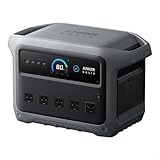
Anker SOLIX C1000 Gen 2 · Our score: 92/100
1,024 Wh · 2,000W output (3,000W surge) · switchover 10 ms (Anker) · 24.9 lb · LiFePO4
Current Price on Amazon: $529.99
The closest match to what pellet-stove owners ask for. Anker lists a 10 ms UPS switchover on its AC outlets, the 2,000W pure sine inverter has plenty of room for a 300–600W igniter, and 1,024 Wh runs a stove drawing 100W for roughly 8–9 hours. Leave it plugged in beside the stove all winter and it takes over on its own when the grid drops. It is not expandable, so for multi-day outages look at the C2000 Gen 2 below.
Best for Winter Solar Recharge

EcoFlow Delta 3 Plus · Our score: 89/100
1,024 Wh · 1,800W output (3,600W surge) · switchover Under 10 ms (EcoFlow) · 27.6 lb · LiFePO4
Current Price on Amazon: $719.00
Same 1 kWh class as the Anker, with EcoFlow’s sub-10 ms UPS and a 1,800W pure sine inverter. What sets it apart for a long outage is the 1,000W solar input in our database, the highest of the 1 kWh picks, which helps on short winter days. It also accepts an extra battery to reach about 5 kWh, so you can start at 1 kWh and grow.
Best for Overnight-Plus Outages
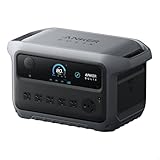
Anker SOLIX C2000 Gen 2 · Our score: 90/100
2,048 Wh · 2,400W output (4,000W surge) · switchover 10 ms (Anker) · 41.7 lb · LiFePO4
Current Price on Amazon: $1,499.00
Double the battery: 2,048 Wh keeps a 100W stove going for about 17 hours, enough to carry most stoves through a night and the next morning. Anker’s spec page lists the same 10 ms UPS switchover and a 2,400W pure sine inverter, and it can add a BP2000 Gen 2 battery for about 4 kWh. At 41.7 lb it is still movable, and it sits near the top of the price range here.
Highest-Rated 1 kWh (Slower Switchover)

Jackery Explorer 1000 V2 · Our score: 93/100
1,024 Wh · 1,500W output (3,000W surge) · switchover Within 20 ms (Jackery) · 23.3 lb · LiFePO4
Current Price on Amazon: $559.00
The highest-scored station on this page, with 1,024 Wh and a 1,500W pure sine inverter. The catch for this job: Jackery publishes a UPS switchover of within 20 ms, twice the Anker and EcoFlow figures. That may be fine for your stove or it may not; no pellet-stove maker we found publishes a tolerance. It is a strong pick if you plan to switch the stove over by hand, or if a supervised test shows your control board rides through.
Lowest-Cost Safe-Shutdown Backup

CyberPower CP1500PFCLCD PFC Sinewave UPS (1500VA/1000W) · Our score: 89/100
1,000W output · switchover 4 ms typical (CyberPower) · 24.9 lb · Sealed lead-acid
A desktop UPS, not a power station, and it is here for one job: a fast, clean handover so the stove can finish a proper shutdown and clear its smoke. That matches how Harman’s manual describes a UPS (“safe shut-down only”). CyberPower rates its battery output as sine wave, with a 1,000W limit that covers an igniter. But CyberPower lists only about 10 minutes at half load and 2.5 minutes at full load, so it buys you minutes, not a night of heat. Two caveats. CyberPower designs it for computers and network gear and doesn’t list pellet stoves as a supported load; its manuals warn against putting large devices such as space heaters and sump pumps on the battery outlets. And if your stove manual names a specific UPS (Harman names APC and Tripp Lite models), use that one instead. Its score comes from our UPS scoring rubric, not the power-station one.
Compare the five at a glance
| Model | Capacity | AC output | Switchover | Solar input | Score | Price |
|---|---|---|---|---|---|---|
| Anker SOLIX C1000 Gen 2 | 1,024 Wh | 2,000W | 10 ms (Anker) | 600W | 92/100 | $529.99 |
| EcoFlow Delta 3 Plus | 1,024 Wh | 1,800W | Under 10 ms (EcoFlow) | 1,000W | 89/100 | $719.00 |
| Anker SOLIX C2000 Gen 2 | 2,048 Wh | 2,400W | 10 ms (Anker) | 800W | 90/100 | $1,499.00 |
| Jackery Explorer 1000 V2 | 1,024 Wh | 1,500W | Within 20 ms (Jackery) | 400W | 93/100 | $559.00 |
| CyberPower CP1500PFCLCD PFC Sinewave UPS (1500VA/1000W) | Minutes (UPS) | 1,000W | 4 ms typical (CyberPower) | None | 89/100 | Check price at Amazon → |
Brands have historically discounted these lines around Black Friday. See what we’re tracking on the Black Friday deals hub.
Who should buy a pellet stove battery backup
- Anyone heating with a pellet stove where winter outages happen. The smoke risk alone justifies a shutdown backup.
- Homes where the pellet stove is the main heat, and a few hours without it means cold rooms or freezing pipes
- Owners whose manual approves running on battery (or a specific backup unit) and who want heat through an evening or a night
Who should skip a big power station
- Owners whose manual says backup is for safe shutdown only: a small approved UPS does that job for far less
- Anyone expecting multi-day heat from one 1 kWh battery. A stove drawing 100W around the clock uses about 2.4 kWh a day.
- Homes that rely on a stove plus a well pump or sump pump. Size for all of those loads together with our home backup picks.
Recharging With Solar in Winter
Solar can stretch a long outage, but winter is the weakest season. The NREL solar maps show much of the U.S. averaging 4 hours or less of full sun per day in December (NREL insolation maps). Use NREL’s PVWatts for your own ZIP code. A rough planning formula: panel watts × winter sun hours × about 0.75 for angle, heat and charging losses.
- Worked example (illustrative): 400W of panels × 3 sun hours × 0.75 ≈ 900 Wh on a clear winter day. That’s about 9 hours of a 100W stove, but a stove running all day uses about 2.4 kWh. Solar slows the drain. It won’t keep up on its own.
- Input limits: the Delta 3 Plus accepts the most solar of the 1 kWh picks (1,000W in our database), versus 600W for the C1000 Gen 2, 800W for the C2000 Gen 2 and 400W for the Explorer 1000 v2. On short days, more panel wattage is the only way to collect more energy.
- Keep the battery warm: these LiFePO4 stations won’t charge below freezing. Anker lists 32–104°F for charging the C1000 Gen 2 and C2000 Gen 2, and Jackery lists 0–45°C for the Explorer 1000 v2. Leave the station indoors by the stove and run the panel cable in.
- Clear snow, angle steeply. Snow-covered panels make almost nothing. A steeper tilt sheds snow and catches the low winter sun better. Our portable solar panel guide covers folding panels that match these inputs.
For the full outage plan (which loads to keep, how to stretch a battery across several days, and CO safety), see the winter storm power backup guide.
Pellet Stove Battery Backup FAQ
Will a pellet stove work in a power outage?
Not on its own. A pellet stove needs electricity for its auger, combustion blower, convection fan and controls, so it stops feeding pellets and stops pulling exhaust when the power goes out. US Stove’s AP5613 manual says plainly that the heater will not operate during a power outage. With a battery backup or power station plugged in, it can keep running, or at least finish a safe shutdown, depending on what your stove’s manual allows.
How many watts does a pellet stove use?
Typically about 300–600W for the first several minutes while the igniter heats, then roughly 100–200W once the fire is established. Manufacturer figures we found: Lennox Bella, 360W for the first 8 minutes and 90–115W in burn mode; US Stove AP5613, 310W with the igniter on and 125W operating; Enviro Mini, 184W maximum and 600W peak. Angi gives 400–500W at ignition and about 100W running. Your stove’s rating plate or manual is the number to use.
What size battery backup do I need for a pellet stove?
Use runtime = battery Wh × 0.85 ÷ running watts. A 1 kWh power station runs a 100W stove for about 8–9 hours, or about 5 hours at 175W. A 2 kWh unit roughly doubles that. Pick a unit with at least 1,000W of pure sine output so it can handle the igniter. Comfortbilt asks for at least 1,000W peak. For a whole night with margin, aim for 2 kWh or a 1 kWh unit you can recharge.
Does a pellet stove need a pure sine wave inverter?
Many do. Comfortbilt says its stoves require pure sine wave output with at least 1,000W peak, and Anker’s pellet-stove guide notes that modified sine wave power can cause problems in some models. Pellet stoves run on electronic control boards and motors, so pure sine is the safe default. Every power station and UPS on this page lists a sine wave output.
Can I use a regular computer UPS for a pellet stove?
For a safe shutdown, often yes. Harman’s P43 manual names two small UPS models it approves and says a fully charged UPS will power a safe, combustion-blower-only shutdown, but that it is not intended for continued operation. A desktop UPS holds minutes of energy, not hours. To keep the stove heating through an outage you need a power station with UPS mode, and you should confirm with your stove’s maker that continued operation on battery is allowed.
Why does my pellet stove smoke when the power goes out?
The combustion blower is what pulls exhaust out of the stove. Harman’s manual says a power failure stops that blower, so exhaust can seep into the room, and a tall vent may provide only partial natural draft. Enviro’s manual warns not to unplug the stove while the combustion fan is running for the same reason. Keep the doors and hopper lid closed, open a window if smoke appears, and keep working smoke and CO alarms. A battery backup that lets the stove finish its shutdown cycle removes most of this risk.
How do I restart a pellet stove after a power outage?
Follow your manual’s procedure, because stoves behave differently when power returns. Harman’s P43 manual says units in Automatic mode with automatic ignition respond to the set point, while in Idle mode the stove stays shut down if it has cooled, or may show a status error if the fire is out but the stove is still warm. If a stove does not light normally, US Stove’s manual says to turn it off, wait a few minutes and clear the burn pot before trying again.