
DOE + ENERGY STAR Data · Updated November 2026
How Many Watts Does an Air Conditioner Use? Window, Portable, Mini-Split and Central AC
The short answers
- Window AC
- About 350–1,100 W running for 5,000–12,000 BTU, and about 1,800–2,650 W for 24,000 BTU [1][4][6].
- Portable AC
- About 1,000–1,200 W for a typical 10,000–12,000 BTU unit [8][10].
- Mini-split and central
- About 960 W for a 12,000 BTU mini-split; about 3,000–5,000 W for a 3-ton central system [11][14].
- Starting watts
- A conventional compressor can need 2–3× its running watts for a moment; inverter units ramp up softly [14][15].
Jump to watts by BTU, kWh per day or which power station starts it.
As an Amazon Associate, SolarGenAdvisor earns from qualifying purchases made through links on this page, at no additional cost to you.
 By
Window AC Watts by BTU: 5,000 to 24,000
A window air conditioner’s running watts are its cooling capacity in BTU per hour divided by its efficiency rating. The table uses two published efficiency figures for each size. The first is the federal minimum CEER that applied from 2014 until May 26, 2026, which is close to what an older or basic conventional unit draws whenever its compressor runs [1]. The second is the median CEER of ENERGY STAR-certified window units in that size band. Every one of the 608 models on ENERGY STAR’s room AC list on November 12, 2026, including 540 window units, had a variable-speed (inverter) compressor [4], and for those units BTU ÷ CEER is a season average, not the peak.
| Size | Conventional unit, running watts | Starting watts, conventional (planning range) | ENERGY STAR inverter, season-average watts | kWh / year, ENERGY STAR (DOE 750-hour basis) |
|---|---|---|---|---|
| 5,000 BTU | ~455 WCEER 11.0 | 910–1,365 W | ~345 WMedian CEER 14.4 | 260 kWh |
| 6,000 BTU | ~545 WCEER 11.0 | 1,090–1,635 W | ~440 WMedian CEER 13.7 | 328 kWh |
| 8,000 BTU | ~735 WCEER 10.9 | 1,470–2,200 W | ~535 WMedian CEER 15.0 | 400 kWh |
| 10,000 BTU | ~915 WCEER 10.9 | 1,835–2,750 W | ~665 WMedian CEER 15.0 | 500 kWh |
| 12,000 BTU | ~1,100 WCEER 10.9 | 2,200–3,305 W | ~800 WMedian CEER 15.0 | 600 kWh |
| 14,000 BTU | ~1,310 WCEER 10.7 | 2,615–3,925 W | ~935 WMedian CEER 15.0 | 700 kWh |
| 18,000 BTUOften 208/230 V | ~1,680 WCEER 10.7 | 3,365–5,045 W | ~1,200 WMedian CEER 15.0 | 900 kWh |
| 24,000 BTUOften 208/230 V | ~2,555 WCEER 9.4 | 5,105–7,660 W | ~1,805 WMedian CEER 13.3 | 1,353 kWh |
Running watts = BTU ÷ CEER (our arithmetic). Minimum CEER from 10 CFR 430.32(b) for units with louvered sides and no heat [1]; ENERGY STAR medians are our arithmetic on the certified-model list, cooling-only window units [4]. The starting range is 2–3× running, the multiplier Generac gives for motor loads [14]; it is a planning range, not a measured figure for any unit. The annual column multiplies by 750 hours, the cooling season DOE’s test procedure assumes [3].
Why an inverter unit’s label watts are higher than the average
DOE tests variable-speed room ACs at four outdoor temperatures from 95 °F down to 82 °F and weights the results toward the milder conditions [3], so CEER reflects a typical day. On the hottest afternoon the compressor runs flat out. Frigidaire’s 24,000 BTU FHWW245WE2 shows the gap: its CEER of 13.3 works out to about 1,805 W on average, but the spec sheet lists 2,630 W [6][4]. For sizing a battery or a circuit, use the watts or amps on the label. Use the CEER figure only to estimate energy over a season.
The 2026 efficiency rules
Room ACs made or imported on or after May 26, 2026 must meet higher minimums: CEER 13.1 under 6,000 BTU, 13.7 at 6,000–7,900, and 16.0 from 8,000 to 19,900 BTU, up from 10.7–11.0 before [2][1]. Older stock can still be sold, and the units already in windows aren’t affected, so the conventional column above is still the right planning number for most existing ACs.
BTU to Watts: The EER and CEER Math
EER (energy efficiency ratio) is BTU per hour of cooling for each watt of electricity, at one test condition. CEER (combined EER) is the same idea averaged over a season, with standby power folded in. Central systems and mini-splits use EER2 and SEER2, measured under DOE’s 2023 test procedure. All of them turn into watts the same way:
Worked example: LG’s 8,000 BTU LW8016ER has an EER of 12.1, and 8,000 ÷ 12.1 = 661 W. Its spec sheet lists 660 W and 6.2 A at 115 V [5]. Volts × amps gives 713 VA, a little higher than the real watts because a compressor motor’s current and voltage aren’t perfectly in step, so amps-based estimates err on the safe side. To convert any of these figures between watts, kilowatts and kWh, use the watts to kWh calculator.
The old “BTU ÷ 10” shortcut assumes an EER of 10. That is close for older units, but it puts a modern ENERGY STAR window unit’s average draw about 50% too high (800 W instead of about 535 W at 8,000 BTU).
Real Models: Nameplate Watts vs the Math
Five current or recent models with published electrical specs. In each case the label figure is the one to size a power station or circuit around; the check column shows how it compares with the efficiency math.
| Model | Published watts | Volts / amps | Efficiency | Check |
|---|---|---|---|---|
| LG LW8016ER [5]8,000 BTU window · No inverter listed | 660 W | 115 V / 6.2 A | EER 12.1 / CEER 12.0 | 8,000 ÷ 12.1 = 661 W |
| Frigidaire FHPC102AB1 [7][8]Portable, 10,000 BTU ASHRAE / 6,500 BTU DOE · No inverter listed | 1,050 W | 115 V / 9.5 A | CEER 6.7 | 6,500 ÷ 6.7 = 970 W |
| Midea Duo MAP12S1TBL [9][10]Portable, 10,000 BTU DOE · Inverter | 1,200 W | 115 V / 11.8 A | Not used here (see note) | 115 V × 11.8 A = 1,357 VA |
| MRCOOL DIY-12-HP-C-115D25-O [11][12]12,000 BTU ductless mini-split (5th Gen DIY) · Inverter (continuously variable) | 960 W | 115 V / — | EER2 12.5 / SEER2 23.5 | 12,000 ÷ 12.5 = 960 W at the 95 °F rating point |
| Frigidaire FHWW245WE2 [6][4]24,000 BTU window · Inverter | 2,630 W | 208/230 V / 12.8 A | CEER 13.3 | 24,000 ÷ 13.3 = 1,805 W season-average |
Published watts are the manufacturer’s or a retailer’s spec listing as cited. The Midea Duo’s listings disagree on its ASHRAE rating (10,000 vs 12,000 BTU), so we don’t compute an efficiency for it. The MRCOOL figure is our arithmetic from its certified EER2, because the listings we found give the rating and circuit size but not the input watts. The Frigidaire FHPC102AB1 has been discontinued; it is shown as a typical single-hose portable.
Portable AC Wattage: Why It Is Higher
A typical portable AC uses about 1,000–1,200 W, more than a window unit with the same number on the box. Frigidaire’s FHPC102AB1 is sold as 10,000 BTU (ASHRAE), but its DOE rating is 6,500 BTU with a CEER of 6.7, and it draws 9.5 A, about 1,050 W [7][8]. The DOE figure is lower because the test counts the hot outdoor air a portable pulls into the room to replace the air it vents out the window. A window unit at the same 1,050 W would deliver roughly 11,000–16,000 BTU of cooling, depending on its efficiency (our arithmetic from the CEER figures above).
Inverter portables close part of the gap. Midea’s Duo MAP12S1TBL is rated 10,000 BTU by DOE’s method and lists 1,200 W and 11.8 A [9][10]; because it is variable-speed, it spends much of its time below that once the room is cool. Our air conditioner on a solar generator guide covers portable sizes from 8,000 to 14,000 BTU and what each needs from a battery.
Mini-Split and Central AC Watts
Mini-splits are the most efficient way to cool one room. MRCOOL’s 12,000 BTU DIY 5th Gen unit is certified at EER2 12.5 and SEER2 23.5 with a continuously variable compressor [11][12]: about 960 W at the 95 °F rating point and about 510 W averaged over a season (12,000 ÷ 23.5, our arithmetic). That is roughly half the average draw of a 12,000 BTU conventional window unit.
Central air is sized in tons; one ton is 12,000 BTU per hour. Since January 1, 2023, new split-system central ACs must reach SEER2 13.4 in the North and 14.3 in the Southeast and Southwest (13.8 at 45,000 BTU and up), and the Southwest also sets an EER2 floor of 11.7 for most systems under 45,000 BTU (11.2 above that) [1][13]. The table divides by that EER2 floor for the hot-afternoon draw and by the national SEER2 minimum for the season average:
| System size | BTU / hour | Hot-afternoon watts (EER2 floor) | Season-average watts (SEER2 13.4) | kWh / day at 8 h |
|---|---|---|---|---|
| 1.5 ton | 18,000 | ~1,540 WEER2 11.7 | ~1,345 W | 12.3–10.7 |
| 2 ton | 24,000 | ~2,050 WEER2 11.7 | ~1,790 W | 16.4–14.3 |
| 2.5 ton | 30,000 | ~2,565 WEER2 11.7 | ~2,240 W | 20.5–17.9 |
| 3 ton | 36,000 | ~3,075 WEER2 11.7 | ~2,685 W | 24.6–21.5 |
| 4 ton | 48,000 | ~4,285 WEER2 11.2 | ~3,580 W | 34.3–28.7 |
| 5 ton | 60,000 | ~5,355 WEER2 11.2 | ~4,480 W | 42.9–35.8 |
Our arithmetic on the federal minimums; more efficient systems draw less. Generac puts a 3-ton system at about 3.5–5 kW running and up to 15–18 kW at start-up [14], higher than the floor-based figures; use your own system’s nameplate or EER2 rating where you can. The kWh range runs from hot-afternoon to season-average draw.
Starting Watts vs Running Watts
A conventional compressor starts by being switched straight on, and for a fraction of a second it draws far more than its running current. Generac describes starting wattage as typically two to three times the running figure [14], and Danfoss, which makes compressors, puts a direct-on-line start at roughly 5–6 times nominal current [15]. Inverter compressors start differently: the drive ramps the motor up from low speed, which Danfoss describes as a soft start with near-zero inrush [15].
Few AC makers publish a starting-watts figure, so we use two planning allowances. They aren’t measurements:
- Conventional (fixed-speed) unit: 3× running watts, the top of Generac’s range. A 660 W window unit plans at about 1,980 W.
- Inverter unit: 1.5× its label watts, to leave room for the fan and a fast ramp. A 1,200 W inverter portable plans at 1,800 W.
- Continuous output: at least 1.25× running watts, so the station isn’t at its limit for hours on a hot day.
If the label doesn’t say inverter or variable speed, assume a conventional start. Soft-start kits can cut a conventional unit’s start; the RV air conditioner guide covers them for rooftop units. To total the AC with other appliances on the same station, use the appliance wattage chart.
kWh Per Day and Per Month
Energy depends on how many hours the compressor actually runs, not how long the AC is switched on. A conventional unit cycles off once the room reaches the set temperature; an inverter unit slows down instead. The table shows a conventional 10,000 BTU window unit (about 915 W at the pre-2026 minimum CEER) and an ENERGY STAR inverter unit of the same size at its season average (about 665 W).
| Compressor hours / day | Conventional, kWh / day | Conventional, kWh / month | ENERGY STAR inverter, kWh / day | ENERGY STAR inverter, kWh / month |
|---|---|---|---|---|
| 4 h | 3.7 | 110 | 2.7 | 80 |
| 8 h | 7.3 | 220 | 5.3 | 160 |
| 12 h | 11.0 | 330 | 8.0 | 240 |
| 24 hHeat-wave worst case | 22.0 | 661 | 16.0 | 480 |
Month = 30 days. Our arithmetic. For a whole season, DOE’s test procedure assumes 750 hours of cooling a year [3], which is how ENERGY STAR’s annual kWh figures are calculated; we checked that all 608 listed models match BTU ÷ CEER × 750 hours [4].
For scale: the average U.S. home uses about 28 kWh a day in total, and air conditioning is its largest single electricity use. Our household electricity guide breaks that down by state and month from EIA data. A 3-ton central system running 8 hours uses about 21–25 kWh, which is most of that daily average on its own.
Can a Power Station Run It? Start Check and Runtime
Once you know the watts, three checks decide it: the station’s surge rating must clear the planned start, its continuous output must exceed running watts by 25%, and it needs a 240 V outlet if the AC has a 208/230 V plug. Runtime is usable battery energy (Wh × 0.85, our allowance for inverter losses) ÷ running watts. The hours below assume the compressor never stops; if it runs half the time, double them. For the full grid of stations and BTU sizes, see can a solar generator run an air conditioner.
| Air conditioner | Running / planned start | EcoFlow Delta Pro 34,000 W / 8,000 W surge / 120–240 V | Bluetti Elite 200 V22,600 W / 3,900 W surge / 120 V | Anker SOLIX C1000 Gen 22,000 W / 3,000 W surge / 120 V |
|---|---|---|---|---|
| 5,000 BTU window, conventionalAt the pre-2026 federal minimum CEER of 11.0 | 455 W / 1,365 W | ✓ Starts ~7.7 h flat out |
✓ Starts ~3.9 h flat out |
✓ Starts ~1.9 h flat out |
| LG LW8016ER (8,000 BTU window)Published 660 W | 660 W / 1,980 W | ✓ Starts ~5.3 h flat out |
✓ Starts ~2.7 h flat out |
✓ Starts ~1.3 h flat out |
| 12,000 BTU window, conventionalAt the pre-2026 minimum CEER of 10.9 | 1,100 W / 3,305 W | ✓ Starts ~3.2 h flat out |
✓ Starts ~1.6 h flat out |
✗ No Start exceeds 3,000 W surge |
| Frigidaire FHPC102AB1 (portable)Published 1,050 W | 1,050 W / 3,150 W | ✓ Starts ~3.3 h flat out |
✓ Starts ~1.7 h flat out |
✗ No Start exceeds 3,000 W surge |
| Midea Duo MAP12S1TBL (inverter portable)Published 1,200 W | 1,200 W / 1,800 W | ✓ Starts ~2.9 h flat out |
✓ Starts ~1.5 h flat out |
✓ Starts ~44 min flat out |
| MRCOOL DIY 12K (inverter mini-split)Hardwired: needs a transfer switch or inlet fitted by an electrician | 960 W / 1,440 W | ✓ Starts ~3.6 h flat out |
✓ Starts ~1.8 h flat out |
✓ Starts ~54 min flat out |
| Frigidaire FHWW245WE2 (24,000 BTU inverter window)Published 2,630 W; 208/230 V plug | 2,630 W / 3,945 W | ✓ Starts ~1.3 h flat out |
✗ No 120 V only |
✗ No 120 V only |
| 3-ton central AC, conventionalAt the Southwest EER2 floor of 11.7; Generac cites up to 15–18 kW to start | 3,075 W / 15,000 W | ✗ No Start exceeds 8,000 W surge |
✗ No 120 V only |
✗ No 120 V only |
Planned start = 3× running for conventional units, 1.5× for inverter units (our allowances; see the section above), and 15 kW for central AC, the low end of Generac’s start-up figure. Station specs come from our product database and the sources listed below. These are estimates, not test results; a unit with an unusually hard start can still trip a station that passes here.
Up to 24,000 BTU, including 240 V units

EcoFlow Delta Pro 3 · Our score 95/100
4,096 Wh · 4,000 W continuous · 8,000 W surge · 120/240 V · 113.5 lb · LiFePO4 [16][17]
The only station here with 240 V output, so it is the one that can start a 208/230 V window unit like the 24,000 BTU Frigidaire, and its 8,000 W surge rating clears a conventional 12,000 BTU start more than twice over. It can also feed a hardwired mini-split through a transfer switch.
Skip it if: You want to run central AC. A 3-ton system can need 15–18 kW to start (Generac), about twice this station’s surge rating, and its running draw uses most of the 4,000 W.
120 V window and portable units up to 12,000 BTU

Bluetti Elite 200 V2 · Our score 91/100
2,073.6 Wh · 2,600 W continuous · 3,900 W surge · 120 V · 53.4 lb · LiFePO4 [18]
Price on Amazon: $898.99
Its 3,900 W surge rating clears our 3× start allowance for a conventional 12,000 BTU window unit (about 3,300 W) and for the 1,050 W Frigidaire portable (about 3,150 W), and 2,600 W continuous carries either with room to spare. About 1.76 kWh usable is roughly 2.7 hours of an 8,000 BTU unit with the compressor running nonstop.
Skip it if: Your AC has a 208/230 V plug. The Elite 200 V2’s outlets are 120 V only.
Small window units, 5,000–8,000 BTU
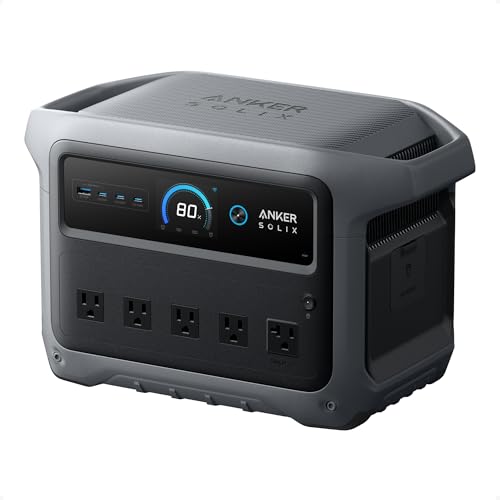
Anker SOLIX C1000 Gen 2 · Our score 92/100
1,024 Wh · 2,000 W continuous · 3,000 W surge · 120 V · 24.9 lb · LiFePO4 [19]
Price on Amazon: $529.99
With 2,000 W continuous and 3,000 W surge it clears a conventional 5,000 or 8,000 BTU start with our 3× allowance, and inverter portables up to about 1,200 W. One kilowatt-hour runs a 660 W window unit for a bit over an hour flat out, so treat it as a bedroom unit for part of a night.
Skip it if: Your unit is a conventional (non-inverter) 12,000 BTU or larger: its start can exceed 3,000 W on our allowance. A conventional 10,000 BTU unit is borderline at about 2,750 W.
Side by side
| Station | Usable energy | Continuous / surge | 8,000 BTU (660 W) flat out | Largest AC it starts here | Price | Link |
|---|---|---|---|---|---|---|
| EcoFlow Delta Pro 3 | ~3,482 Wh | 4,000 / 8,000 W | ~5.3 h | 24,000 BTU 240 V window | Check price at Amazon → | View on Amazon → |
| Bluetti Elite 200 V2 | ~1,763 Wh | 2,600 / 3,900 W | ~2.7 h | 12,000 BTU window or 1,200 W portable | $898.99 | View on Amazon → |
| Anker SOLIX C1000 Gen 2 | ~870 Wh | 2,000 / 3,000 W | ~1.3 h | 8,000 BTU window or 1,200 W inverter portable | $529.99 | View on Amazon → |
None of the three can start a conventional central AC, and we don’t recommend a portable station for it. For whole-home cooling see our whole-house solar generator cost guide. To size a station and solar panels around your own AC and other loads, use the solar size calculator.
Verdict: Size for the Label, Plan for the Start
Most window ACs draw about 350–1,100 W running, portables about 1,000–1,200 W, and a 12,000 BTU mini-split under 1,000 W. Read the watts or amps on your unit’s label, then check whether it has an inverter: that decides whether the start needs about 1.5× or about 3× the running watts. For any 120 V window or portable unit up to 12,000 BTU, the Bluetti Elite 200 V2 (our score 91/100) clears both checks. Currently $898.99 on Amazon, it runs an 8,000 BTU unit for close to three hours with the compressor flat out. For 240 V units, a mini-split on a transfer switch, or more hours per charge, step up to the EcoFlow Delta Pro 3 (95/100).
Air Conditioner Wattage FAQ
How many watts does a window AC unit use?
About 450 W for a conventional 5,000 BTU unit, 735 W for 8,000 BTU, 1,100 W for 12,000 BTU and 2,550 W for 24,000 BTU, using the federal minimum efficiency that applied until May 2026. ENERGY STAR inverter units average less: about 535 W at 8,000 BTU and 800 W at 12,000 BTU. The watts on your unit's label are the figure to size a battery or circuit around.
How many watts does a portable AC use?
Usually 1,000–1,200 W. Frigidaire's 10,000 BTU FHPC102AB1 draws about 1,050 W (9.5 A), and Midea's inverter Duo MAP12S1TBL lists 1,200 W. Portables use more watts per BTU of real cooling than window units because they pull warm outdoor air into the room, which is why their DOE rating is lower than the BTU number on the box.
How do you convert BTU to watts for an air conditioner?
Divide the BTU rating by the efficiency rating: watts ≈ BTU ÷ EER (or CEER, EER2). An 8,000 BTU unit with an EER of 12.1 draws about 661 W, which matches the 660 W on LG's LW8016ER spec sheet. The old BTU ÷ 10 shortcut assumes an EER of 10 and overstates modern units.
How many starting watts does an air conditioner need?
For a conventional compressor, plan on up to about 3× running watts; Generac puts starting wattage at typically two to three times the running figure. Inverter (variable-speed) units ramp up softly, so we plan on about 1.5× their label watts. Few AC makers publish a starting figure, so treat both as planning allowances, not measurements.
How many kWh does an air conditioner use per day?
Watts × compressor hours ÷ 1,000. A conventional 10,000 BTU window unit (about 917 W) uses about 7.3 kWh in 8 hours of compressor time, or about 220 kWh a month. An ENERGY STAR inverter unit of the same size averages about 5.3 kWh in 8 hours. DOE's ratings assume 750 cooling hours a year.
Can a portable power station run a window air conditioner?
Yes, if its surge rating clears the start and its continuous output covers the running watts with about 25% to spare. A 2,000 W / 3,000 W surge station starts a conventional 8,000 BTU unit; a 2,600 W / 3,900 W surge station starts a conventional 12,000 BTU unit. 208/230 V units need a station with 240 V output. Runtime is short: about 2.7 hours for an 8,000 BTU unit on a 2 kWh station with the compressor running nonstop.
Sources
Efficiency minimums come from federal regulations (10 CFR 430) and DOE’s 2023 room AC rule; certified efficiencies from ENERGY STAR’s public datasets; model figures from manufacturer spec sheets or retailer spec listings as cited. Watts, kWh, starting allowances and runtimes are our arithmetic on those figures. Station specs come from our product database, cross-checked against the listings below. Nothing here was measured by us. Last reviewed November 12, 2026.
- 10 CFR 430.32(b) and (c): federal minimum CEER for room air conditioners (2014 and May 26, 2026 tables) and SEER2/EER2 for central air conditioners (Cornell LII copy of the eCFR)
- U.S. DOE final rule, Energy Conservation Standards for Room Air Conditioners, 88 FR 34298 (May 26, 2023), Table I.1: amended CEER levels, compliance from May 26, 2026
- 10 CFR Part 430, Subpart B, Appendix F: room air conditioner test procedure (750 annual cooling hours; variable-speed units tested at 95, 92, 87 and 82 °F and weighted)
- ENERGY STAR Certified Room Air Conditioners dataset (608 models, downloaded Nov 12, 2026): CEER, annual kWh and compressor type by model
- LG LW8016ER spec sheet (8,000 BTU window AC): 660 W cooling, 6.2 A, EER 12.1, CEER 12.0
- Frigidaire FHWW245WE2 spec sheet (24,000 BTU inverter window AC): 2,630 W, 12.8 A, 208/230 V, CEER 13.3
- Frigidaire FHPC102AB1 product support page (10,000 BTU ASHRAE / 6,500 BTU DOE portable AC): 9.5 A, 115 V, CEER 6.7
- AJ Madison spec listing, Frigidaire FHPC102AB1: maximum cooling watts 1,050
- Midea Duo MAP12S1TBL product page (10,000 BTU DOE, variable-speed inverter portable AC)
- Alphachooser spec profile, Midea MAP12S1TBL: 1,200 W, 11.8 A (AHAM), 115 V, inverter compressor
- ENERGY STAR Certified Air-Source Heat Pumps dataset: MRCOOL DIY-12-HP-C-115D25-O, 12,000 Btu/h, SEER2 23.5, EER2 12.5, continuously variable compressor
- Sylvane listing, MRCOOL DIY 5th Gen 12,000 BTU 115 V mini-split
- Coleman (Johnson Controls), DOE 2023 regional efficiency requirements one-pager (North 13.4 SEER2; Southwest 14.3 SEER2 / 11.7 EER2 under 45,000 Btu/h)
- Generac, What size generator do I need? (starting watts typically 2–3× running; 3-ton central AC 3.5–5 kW running, up to 15–18 kW starting)
- Danfoss, Variable-speed (inverter) technology for AC: soft start with near-zero inrush; direct-on-line starts draw roughly 5–6× nominal current
- EcoFlow launch release, DELTA Pro 3 (4 kWh, 120/240 V, 4 kW output)
- B&H Photo spec listing, EcoFlow DELTA Pro 3 (4,000 W continuous, 8,000 W surge, 120/240 V)
- StorageReview, Bluetti Elite 200 V2 review (2,073.6 Wh, 2,600 W on the 120 V side, 3,900 W peak)
- B&H Photo spec listing, Anker SOLIX C1000 Gen 2 (1,024 Wh, 2,000 W continuous, 3,000 W surge)
Cooling with a 240 V unit or a mini-split?
Check Price on Amazon →