
Winter Outage Guide · Updated November 2026
Gas Fireplace Battery Backup: What Works in a Power Outage
The short answer
Most gas fireplaces can still make heat in an outage. Standing-pilot (millivolt) fireplaces need no electricity for the flame. Electronic-ignition (IPI) fireplaces usually have a battery backup pack, typically two D cells or four AA cells, that lights the pilot when the power is out. What stops is the 120V blower. A small pure sine power station runs a typical 35–185W blower for hours: about 8–9 hours at 100W from 1 kWh. Check your manual first, and keep a battery CO alarm in the room.
As an Amazon Associate, SolarGenAdvisor earns from qualifying purchases made through links on this page, at no additional cost to you.
 By Morgan Chen
Reviewed & approved by Juhi Sahni
|
Published: November 18, 2026
|
Updated:
|
Winter storm backup plan
Will a Gas Fireplace Work Without Power?
It depends on how the pilot is lit, and the answer is different for the flame and for the fan. The gas itself doesn’t need electricity. The question is what opens the gas valve and lights it.
| Part | Needs household power? | In an outage |
|---|---|---|
| Standing pilot / millivolt valve | No. The pilot flame heats a sensor that makes a small current to run the valve. | Flame works. Use the manual controls or set the control switch to ON. |
| Intermittent pilot ignition (IPI) | Yes, to spark the pilot: 120V or batteries. | Flame works on the battery backup pack, if your model has one. |
| Remote receiver | Often plugs into 120V, with a battery backup on many systems. | Runs on its batteries; the handheld remote has its own. |
| Blower / fan | Yes, 120V AC. | Stops, unless you power it from a power station or generator. |
| Lights, Wi-Fi, power vent | Yes. | Lights and app control stop. A power-vented unit should not run unless its manual allows it. |
Standing pilot (millivolt). The pilot burns all the time, and its flame heats a sensor that generates the small current the valve needs, so millivolt systems “run without external power” (HVACDirect). Majestic says products with standing pilots “do not require electricity to ignite, and therefore will work during a loss in power” (Majestic), and Heat & Glo says the same of its standing-pilot units (Heat & Glo).
Intermittent pilot ignition (IPI). Most newer fireplaces light the pilot only when you call for heat, which saves gas but needs electricity “whether in the form of 120VAC power or batteries” (HVACDirect). Manufacturers cover the gap with a battery pack. Napoleon says its electronic systems “still operate in power outage; as they include a battery backup system” (Napoleon), and Heatilator says its IntelliFire systems have battery backups “that can be used to light the pilot during a power outage” (Heatilator). Not every model has one. Regency notes its Hampton gas stoves don’t have a battery backup box (Regency), so confirm yours in the manual.
The blower is the part that stops. Mendota’s ML39 manual says that on battery backup the burner and flame height adjustment still work, but “the fan and accent light, which are dependent on 110VAC power, will not function” (Mendota ML39 manual). Napoleon puts it the same way: the blower “needs electricity to work,” and the fireplace heats a smaller area on radiant heat alone (Napoleon). Some fireplaces are built to heat without a fan at all. Valor says its gas fireplaces heat by natural convection and “do not require a main power source to provide heat,” though interior lighting and Wi-Fi controls may not work in an outage (Valor).
How to tell which you have. The owner’s manual or the rating plate (usually behind the lower louver or on the control panel) names the ignition system. A small flame that stays lit all the time behind the glass is a standing pilot. A control box with an ON / OFF / REMOTE switch, or the words IntelliFire, IPI or Proflame, points to electronic ignition. We don’t say any particular model will run without power unless its maker says so; your manual is the only answer that counts.
If Your Fireplace Needs a Battery Pack
For an IPI fireplace, the “battery backup” is usually a set of ordinary disposable cells in a holder, not a rechargeable battery. Getting it ready before the storm is the cheapest outage prep you can do.
- Find the right cells. Majestic, Heatilator and Heat & Glo say IntelliFire (IPI) systems generally take two D cells, and IntelliFire Plus and IntelliFire Touch take four AA cells (Majestic; Heatilator; Heat & Glo). These three are sister brands, so their systems overlap. Regency says the Proflame 2 receiver’s battery backup takes four AA (Regency). Other brands and older models differ, so check your manual.
- Find the battery holder. It is usually in the control compartment behind the lower louver. Regency says the backup box is mounted on an interior wall for its gas fireplaces, near the receiver on inserts and inside the door on freestanding stoves (Regency). Find it now, with the lights on.
- Install with the right polarity and set the switch. Match the + and − marks on the holder. Majestic and Heat & Glo say to slide the control box switch to ON (not OFF or REMOTE) for the fireplace to operate with the power off (Majestic; Heat & Glo).
- Take them out when power returns. Majestic says the batteries are “only to be used in the event of a power outage, not as your pilot’s standard power source,” and Heatilator and Heat & Glo say to remove them afterward because the appliance’s heat shortens battery life (Majestic; Heatilator). Keep a fresh set in your outage kit, and spares for the handheld remote, which has its own batteries.
What we could not find: any manufacturer figure for how long a set of D or AA cells lasts on an IPI system. Plan on carrying spares for a long outage rather than counting on one set.
Don’t improvise the battery pack. Use the cell type the manual names. Hearth & Home’s fan-kit instructions warn not to connect 110–120 VAC wiring to the gas control valve (GFK-160A instructions), and the GFK-160T instructions warn that incorrect wiring will damage the valve and override the IPI safety lockout (GFK-160T instructions). A power station doesn’t replace the battery pack. It runs the 120V parts that have a plug.
How Many Watts Does a Gas Fireplace Blower Use?
Much less than you might think. Fireplace makers’ own fan-kit instructions list the supply (120 VAC, 60 Hz) but, in the ones we read, not the watts (Heat & Glo GFK-160T; Hearth & Home GFK-160A). Replacement-blower listings do publish electrical ratings, and they bracket the range:
| Blower (fits) | Published rating | Source |
|---|---|---|
| FK24 kit (Majestic, Northern Flame, Vermont Castings) | 35W, 0.35A at 115V, 130 CFM | Parts listing |
| DA3610TA kit (many gas fireplaces) | 0.78A at 120V (about 94W) | Parts listing |
| 812-4900 replacement (Heatilator, Heat & Glo, Quadra-Fire) | 184W, 1.6A at 115V, 180 CFM | Parts listing |
So plan on roughly 35–185W, and most blowers have a variable speed control that draws less on low. That is a fraction of a furnace blower and in the same range as a pellet stove once it is lit. For your own number, read the label on the blower motor, or multiply its amps by 120. A plug-in power meter shows the real draw at each speed.
Start-up surge: we didn’t find a published start-up surge figure for any fireplace blower. Even the smallest pick below has a 600W continuous inverter, several times the largest blower rating we found, so starting a blower is not the constraint. Battery capacity is.
How Long Will a Power Station Run the Blower?
Runtime = battery Wh × 0.85 ÷ blower watts. The 0.85 covers inverter and conversion losses, and it’s the same method our solar size calculator uses. The three loads bracket the blower ratings above, at a constant draw. A thermostatic blower that cycles off as the room warms will run longer.
| Unit | Capacity | 35W blower | 100W blower | 185W blower |
|---|---|---|---|---|
| Anker SOLIX C1000 Gen 2 | 1,024 Wh | ~24.9 h | ~8.7 h | ~4.7 h |
| Bluetti Elite 100 V2 | 1,024 Wh | ~24.9 h | ~8.7 h | ~4.7 h |
| Bluetti Elite 30 V2 | 288 Wh | ~7.0 h | ~2.4 h | ~1.3 h |
What the table says: a 1 kWh station covers a long evening and a night with a mid-size blower, and close to a full day with a small one. A 288 Wh station covers an evening. Either way, the battery is spent moving heat the gas is already making, which is far more efficient than electric heat: 1 kWh runs a 1,500W space heater for only about 35 minutes (see our battery powered heater math).
Running the Blower or Receiver From a Power Station
How you connect depends on whether the part has a plug.
It has a cord and plug
Some fan kits and receivers plug into an ordinary receptacle. Heat & Glo’s GFK-160T fan plugs into a receptacle in the factory junction box in the control compartment (GFK-160T instructions), and Regency says the Proflame 2 receiver plugs into a standard 120V plug (Regency). A plug-in part can run from a power station’s AC outlet with a properly rated cord. Make the connection with the fireplace off and cool, and route the cord away from hot surfaces and the glass. If the cord can’t reach the station without being pinched by the louver or pulled over hot metal, use the option on the right.
It is hardwired
Many fireplaces are fed from a junction box on a house circuit. To run that circuit from a portable source you need an electrician-installed power inlet and transfer switch or interlock. Electric co-ops warn that plugging a generator into a wall outlet, known as backfeeding, can push power onto utility lines and endanger line workers (Lake Country Power; Poudre Valley REA). The same goes for a power station. Our transfer switch guide covers the 120V setups.
- Use pure sine output. Blower motors and electronic receivers are the loads most likely to hum, run hot or misbehave on a stepped “modified sine” waveform. All three power stations below are listed with pure sine output (C1000 Gen 2 review; TechRadar on the Elite 100 V2; Elite 30 V2 listing). Skip unbranded car inverters that don’t state a waveform.
- Leave it in UPS mode for storm season. Plug the blower or receiver into the station and the station into the wall. When the grid drops, it switches over on its own. Anker lists a 10 ms switchover for the C1000 Gen 2 (Anker). The Elite 100 V2 is listed at 10 ms (see our Elite 100 V2 review) and the Elite 30 V2 at 10 ms or less (Elite 30 V2 listing).
- Never back-feed household wiring. Don’t connect a power station to a wall outlet, the junction box or the gas valve wiring. Plug the appliance into the station, not the other way round.
- A gas generator works too, outdoors only. CPSC says to run it outside only, at least 20 feet from the house (CPSC). If you are already running one for the whole house, see the winter storm power backup guide for how to split the loads.
Direct-Vent vs Vent-Free: CO Safety in an Outage
An outage is when people lean hardest on fuel-burning heat, so it’s worth knowing how your fireplace vents.
- Direct-vent (sealed glass front): draws combustion air from outside and vents exhaust outside through a sealed pipe. Unless it is power-vented (below), that venting doesn’t depend on household power. The thing to watch in a storm is the outside vent cap. NFPA advises keeping vents for the furnace, dryer, stove and fireplace clear of snow during and after a storm (NFPA).
- Power-vented: uses an electric fan to push exhaust out, often where a chimney can’t run straight up. Don’t run one in an outage unless its manual says it can operate without the vent fan.
- Vent-free (ventless): releases its combustion products into the room. Procom’s vent-free manual says the heater “needs fresh air ventilation to run properly” and that its oxygen depletion sensor (ODS) “shuts down the heater if not enough fresh air is available.” The same manual notes that some state and local codes prohibit vent-free heaters altogether (Procom manual). Follow any run-time, room-size and window-opening limits in your own manual exactly, and if the ODS shuts the unit off, get fresh air in before you think about relighting.
CO alarms are not optional
CPSC says CO alarms should be installed on each level of the home and outside sleeping areas, tested monthly, with batteries replaced every year (CPSC). In an outage a plug-in alarm without a battery backup goes dark, so use battery-powered or battery-backup alarms. CPSCCPSC’s winter-storm guidance repeats the point (rsquo;s winter-storm guidance calls for battery-backed CO alarms on every level and outside sleeping areas (CPSC winter storm tips). If an alarm sounds, get everyone outside to fresh air and call 911 from there. Our portable carbon monoxide detector guide compares battery models.
Best Battery Backup for a Gas Fireplace Blower
Picked for this job: pure sine output, a fast UPS switchover, and enough capacity to run a 35–185W blower for an evening or a night, plus the battery CO alarm that belongs in the same room. Scores come from our awards methodology, built from published specs, logged Amazon prices and Amazon customer reviews. The CO alarm is scored on our separate CO-alarm rubric.
Best Overall for a Fireplace Blower
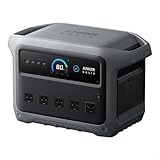
Anker SOLIX C1000 Gen 2 · Our score: 92/100
1,024 Wh · 2,000W output · 24.9 lb · LiFePO4
Current Price on Amazon: $469.99
A 1 kWh station that sits quietly beside the hearth. 1,024 Wh runs a 100W blower for roughly 8–9 hours by our formula, and a small 35W blower for most of a day. Anker lists a 10 ms UPS switchover, so a plug-in blower or receiver can stay connected through the station all winter and carry on when the grid drops. It also covers a phone, a lamp and a router on the same charge. It is not expandable; for multi-day outages pair it with solar or step up in capacity.
Best for Long Outages With Solar
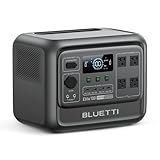
Bluetti Elite 100 V2 · Our score: 90/100
1,024 Wh · 1,800W output · 25 lb · LiFePO4
Same 1 kWh class as the Anker at about the same weight, with a 10 ms UPS and the highest solar input of the three picks (1,000W in our database). On a multi-day outage that matters: a few hours of winter sun can put back most of a day of blower use. Like the Anker, it is not expandable.
Smallest Budget Pick (Blower Only)
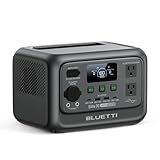
Bluetti Elite 30 V2 · Our score: 86/100
288 Wh · 600W output · 9.5 lb · LiFePO4
Current Price on Amazon: $329.99
If all you need is the blower for an evening, a 288 Wh station is enough. It runs a 35W blower for about 7 hours or a 100W blower for about 2.5 by our formula, and its 600W pure sine inverter has plenty of room for any blower rating we found. At 9.5 lb it is easy to store in a closet until the next storm. It will not carry a large blower through the night.
Battery CO Alarm for the Fireplace Room

Kidde COBD Battery CO Alarm with Digital Display · Our score: 87/100
Current Price on Amazon: $30.47
Not a power source, and arguably the more important purchase. A battery-only CO alarm keeps working when the power is out, which is when people lean hardest on fuel-burning heat. It is an ETL-listed UL 2034 alarm that runs on two AA batteries and has a backlit status display. Put one in the room with the fireplace and on each level, as CPSC recommends.
Compare the power stations
| Model | Capacity | AC output | 100W blower | Solar input | Score | Price |
|---|---|---|---|---|---|---|
| Anker SOLIX C1000 Gen 2 | 1,024 Wh | 2,000W | ~8.7 h | 600W | 92/100 | $469.99 |
| Bluetti Elite 100 V2 | 1,024 Wh | 1,800W | ~8.7 h | 1,000W | 90/100 | Check price at Amazon → |
| Bluetti Elite 30 V2 | 288 Wh | 600W | ~2.4 h | 200W | 86/100 | $329.99 |
Brands have historically discounted these lines around Black Friday. See what we’re tracking on the Black Friday deals hub.
Who should buy a power station for the fireplace
- Homes where the gas fireplace is the backup heat, and the blower makes the difference between one warm room and a warm floor
- Owners whose blower or receiver has a plug, so no wiring work is needed
- Anyone who will also use the station for phones, lights, a router or a CPAP in the same outage
Who can skip it
- Standing-pilot or IPI fireplaces with a battery pack and no blower: spare D or AA cells and a CO alarm are all you need
- Hardwired blowers with no inlet or transfer switch. Budget for the electrician first.
- Homes that need whole-house heat. A furnace blower is the bigger job; see our furnace power station guide.
Gas Fireplace Battery Backup FAQ
Will a gas fireplace work without electricity?
Many will, at least for the flame. A fireplace with a standing pilot (a millivolt valve) makes its own small current from the pilot flame and needs no household power to run the burner; Majestic and Heat & Glo both say standing-pilot units light during an outage. Most newer fireplaces use intermittent pilot ignition (IPI), which needs electricity to spark the pilot, and most of those have a battery backup pack for outages. What usually stops is the blower, which runs on 120V. Your owner’s manual tells you which type you have.
What batteries does a gas fireplace battery backup use?
It depends on the ignition system. Majestic, Heatilator and Heat & Glo say IntelliFire (IPI) systems generally take two D-cell batteries and IntelliFire Plus systems take four AA batteries. Regency says the receiver for its Proflame 2 remote system has a battery backup that takes four AA batteries. Check the manual for your model before you buy batteries, and install them with the polarity shown on the holder.
Will my gas fireplace blower work during a power outage?
Usually not on the fireplace’s own batteries. Mendota’s ML39 manual says the fan and accent light, which depend on 110VAC power, will not function on battery backup, and Napoleon says the blower needs electricity to work. The fireplace still heats by radiation and natural convection, just over a smaller area. To run the blower you need a 120V source such as a portable power station.
How long will a power station run a gas fireplace blower?
Use runtime = battery Wh × 0.85 ÷ blower watts. Blower ratings we found run from about 35W to about 185W. A 1,024 Wh station runs a 100W blower for about 8–9 hours and a 35W blower for about a day; a 288 Wh station runs a 100W blower for about 2.5 hours. Read the watts or amps (amps × 120 = watts) off your blower’s label for a real figure.
Is it safe to run a gas fireplace during a power outage?
A sealed direct-vent fireplace that is installed and maintained to its manual is designed to vent its exhaust outdoors whether or not the power is on, as long as the vent is not blocked by snow. A power-vented model, which uses an electric fan for exhaust, should not run unless its manual says it can operate without that fan. Vent-free units release combustion products into the room and rely on an oxygen depletion sensor, so follow any run-time and ventilation limits in their manual. In every case, keep battery-powered CO alarms on each level and outside sleeping areas, as CPSC and NFPA recommend.
Should I leave the batteries in my gas fireplace?
Majestic says the batteries are only to be used in a power outage, not as the pilot’s standard power source, and Heat & Glo and Heatilator advise removing them when power returns because heat from the appliance can shorten battery life. Keep a fresh set stored nearby with your outage kit so they are ready for the next storm.
Can I plug my gas fireplace into a power station?
Only the parts that plug in. If the blower or the remote receiver has a cord and plug, it can run from a power station’s AC outlet. Many fireplaces are wired to a junction box instead; those need an electrician-installed inlet and transfer switch to run from any portable source. Never connect a power station or generator to house wiring through a wall outlet, which backfeeds the grid and can endanger utility workers.