
Winter Outage Guide · Updated November 11, 2026
Battery Backup for Tankless Water Heater: What Works for Gas, and Why Electric Is Different
A gas tankless water heater stops in a power outage because its igniter, fan and controls need about 60–200W of electricity. A small battery backup can supply that. Our pick for a plug-in indoor unit is a 1 kWh power station with a UPS mode, such as the Anker SOLIX C1000 Gen 2. For outdoor or hardwired heaters, the purpose-built HUGO wall-mount backup is the better fit. An electric tankless heater is a different problem. Whole-house models are rated around 18,000W, which no portable battery can run.
As an Amazon Associate, SolarGenAdvisor earns from qualifying purchases made through links on this page, at no additional cost to you. Ratings are AI-synthesized from manufacturer specs and logged Amazon prices. We did not test these units. Runtimes are our own estimates.
 By
Quick Verdict
If your heater is gas or propane, indoors and plugs into an outlet, put it on a 1,024 Wh power station in UPS mode. The Anker SOLIX C1000 Gen 2 is our pick, and the EcoFlow Delta 3 Classic is the lower-cost alternative. Either gives you roughly 10 hours of burner time by our math. If the heater is mounted outdoors or hardwired, or you want a set-and-forget unit, the HUGO is built for that. It has an IP54 wall-mount enclosure and an optional flow sensor that only powers the heater when water runs. Hardwired installs need an electrician. If your heater is electric, skip to the electric math: a battery backup isn't realistic.
Safety note before you buy
A tankless heater burns gas and vents exhaust, and some are wired straight into your home's electrical system. Plug a battery only into a heater that already has its own cord, and never use an extension cord or adapter (Rinnai's manual forbids both). Hardwired and outdoor units need a licensed electrician. Keep working CO alarms on every level of the house. We don't publish wiring steps.
Gas vs Electric Tankless: What a Battery Can Actually Run
The word "tankless" covers two very different machines. A gas tankless heater gets its heat from the burner, and electricity only runs the electronic ignition, the combustion fan and the control board. That is why it goes cold in an outage. Rinnai's FAQ says its tankless heaters "will not operate" without power and need 120V and "less than three amps" (Rinnai FAQ). An electric tankless heater makes all its heat from electricity, so it draws about a hundred times more.
| Heater | Published electrical draw | Battery backup? | Source |
|---|---|---|---|
| Gas tankless (general) | About 60–100W while running | Yes | A.O. Smith |
| Rinnai 199,000 BTU condensing (RU199i / CU199i) | 84W normal (81W outdoor "e" models), 1.3W standby, about 150W with freeze protection running | Yes | RU199i manual, CU199i manual |
| Navien NPE-240 (condensing) | 200W max (2 A); 350W max (4 A) with an external pump | Yes; check the pump load | Navien |
| Electric tankless, whole house (Rheem RTEX-18) | 18,000W at 240V; two 40 A double-pole breakers | No | Rheem RTEX spec sheet, ABR listing |
Use the figure on your own heater's rating plate or manual. The Rinnai manual pages we read print the electrical values in columns, and we matched the freeze-protection figures (148W indoor, 152W outdoor) to their labels by column order.
The electric tankless math
An 18,000W heater on 240V pulls 18,000 ÷ 240 = 75 amps. Two problems follow. Output: the biggest station on this page, the EcoFlow Delta Pro 3, supplies 4,000W, about 22% of what the heater asks for. Energy: a 10-minute shower at full power uses 18,000W × 10/60 h = 3,000 Wh. That is most of the Delta Pro 3's roughly 3,480 Wh of usable energy, gone in one shower. Smaller point-of-use electric tankless units draw less, but they are still multi-kilowatt loads. For electric water heating in an outage, look at a standby generator or a permanently installed home battery; our appliance wattage chart shows how 240V loads compare with everything else in the house.
How Long a Battery Runs a Gas Tankless Water Heater
A tankless heater only draws its running wattage while the burner is firing, which is while a hot tap is open. So the useful number is burner-on hours: usable watt-hours ÷ the heater's watts. We use three loads: 84W (Rinnai's normal figure for its 199,000 BTU indoor model), 150W (Rinnai freeze protection) and 200W (Navien's NPE-240 maximum).
Our assumptions: power stations deliver their rated Wh × 0.85 after inverter losses. Safeguard publishes HUGO capacity in amp-hours, not watt-hours, so we use 12V × Ah × 0.80 (Safeguard's 80% depth of discharge) × 0.85. That works out to about 245 Wh usable for the L30 and 408 Wh for the L50. These are our estimates, not maker runtime claims.
| Backup | Battery | At 84W | At 150W (freeze protection) | At 200W | Price |
|---|---|---|---|---|---|
| HUGO L30 Battery Backup for Tankless Water Heaters (No Flow Kit) | 12V 30Ah LiFePO4 (no Wh published) | ~2.9 h | ~1.6 h | ~1.2 h | Check price at Amazon → |
| HUGO L50 Battery Backup for Tankless Water Heaters (No Flow Kit) | 12V 50Ah LiFePO4 (no Wh published) | ~4.9 h | ~2.7 h | ~2.0 h | Check price at Amazon → |
| EcoFlow Delta 3 Classic | 1,024 Wh LiFePO4 | ~10 h | ~5.8 h | ~4.4 h | $462.00 |
| Anker SOLIX C1000 Gen 2 | 1,024 Wh LiFePO4 | ~10 h | ~5.8 h | ~4.4 h | $529.99 |
| Bluetti Elite 200 V2 | 2,074 Wh LiFePO4 | ~21 h | ~12 h | ~8.8 h | $898.99 |
| EcoFlow Delta Pro 3 | 4,096 Wh LiFePO4 | ~41 h | ~23 h | ~17 h | Check price at Amazon → |
These are upper bounds from our arithmetic, not measurements. The HUGO L30 with Flow Kit has the same battery as the L30. Safeguard says the L50 gives "about 70% increased runtime" over the L30, which is close to the 67% our Ah-based math gives.
The drain nobody quotes: standby hours
The burner only fires while a hot tap is open, so burner time is rarely what empties the battery. The hours in between are. The heater itself idles at very little (Rinnai lists 1.3W standby). A power station in UPS or pass-through mode keeps its inverter running the whole time, though, and we didn't find published idle-draw figures for the stations here, so we can't put a number on it. This is the problem HUGO's flow sensor solves. Safeguard says it powers the heater only after it detects water flow, for at least five minutes, and otherwise idles to save battery. Its temperature sensor overrides that below 37°F so the heater's own anti-frost protection keeps working (Safeguard; the Amazon listing describes both sensors). With a power station, the practical equivalent is to switch the AC output off between uses. Only do that if freezing isn't a risk.
The Best Battery Backups for a Gas Tankless Water Heater
The power stations below keep the scores from our standard power-station matrix. We haven't given the HUGO units a score yet. The closest rubric we have, our desktop-UPS rubric, ignores battery capacity, so its number would mislead on a page about runtime.
Purpose-Built Pick: Outdoor, Hardwired or Set-and-Forget

HUGO Battery Backup (L30 and L50) by Safeguard Power Solutions
12V 30Ah or 50Ah LiFePO4 · 350W pure sine (Safeguard) · IP54 · Not yet scored
HUGO is the only product here designed for this one job. It is a wall-mountable LiFePO4 battery with a built-in inverter and an IP54/NEMA4 enclosure that Safeguard and the Amazon listing both say can go indoors or outdoors. Safeguard rates it at 500VA/350W pure sine wave, says it switches over "within 15ms" of an outage, and describes it as hardwire friendly (Safeguard product page). The Amazon listing doesn't repeat those three figures, and we found no independent spec sheet for this version, so treat them as the maker's claims. Rinnai's FAQ points owners to an earlier HUGO model when they ask about a battery backup (Rinnai FAQ).
Which version: the L30 with Flow Kit is the one to buy if you'll have the sensor plumbed in. The kit is a brass flow sensor with 3/4" NPT threads and push-fit adapters, per Safeguard, so it is a plumber's job. The L50 roughly doubles your margin for long outages or a recirculating heater. The plain L30 is the entry price if you only need a few hours.
Pros
- ✓ Built for gas tankless heaters; IP54 enclosure for outdoor units
- ✓ Flow sensor stops the standby drain; temperature sensor keeps freeze protection working
- ✓ Hardwire friendly (Safeguard), so an electrician can make it permanent
- ✓ Switches back to grid power on its own when power returns (Safeguard)
Cons
- ✗ About a third of the battery of a 1 kWh power station
- ✗ Safeguard publishes no Wh, surge or weight per model
- ✗ Safeguard's page gives conflicting battery warranty terms (we don't repeat them)
- ✗ 350W rating leaves no headroom over a Navien with an external pump
Best Power Station for a Gas Tankless Heater

Anker SOLIX C1000 Gen 2
1,024 Wh · 2,000W output (3,000W surge) · 24.9 lb · Score 92/100 (power-station matrix)
Price: $529.99
For a gas tankless heater that plugs into an outlet, this is the honest size. It has 1,024 Wh of LiFePO4, 2,000W of output and a UPS switchover of about 10 ms (Anker's figure, covered in our Anker SOLIX C1000 review). That is roughly three times the battery in a HUGO L30. It weighs 24.9 lb, so after the outage it can also run a fridge, router or CPAP. The catch: it has no flow sensor, so its inverter stays on the whole time the heater is plugged in, and we found no published idle-draw figure for it. As a portable station it belongs indoors next to the heater, so it suits indoor units that have a plug.
Est. burner-on time at 84W: ~10 h (our math).
Best for the Heater Plus the Rest of the House

Bluetti Elite 200 V2
2,074 Wh · 2,600W output (3,900W surge) · 53.4 lb · Score 91/100 (power-station matrix)
Price: $898.99
Choose this if the heater is one of several things you want running: hot water plus the furnace blower, the fridge and the router. It has 2,074 Wh and 2,600W of output, and Bluetti lists a UPS switchover of 15 ms (StorageReview spec table, Notebookcheck). That is the same figure Safeguard gives for HUGO. It is more battery than a tankless heater needs on its own. At 53.4 lb it is a station you set in one place, and it isn't expandable.
Est. burner-on time at 84W: ~21 h (our math).
Lowest-Cost 1 kWh Option
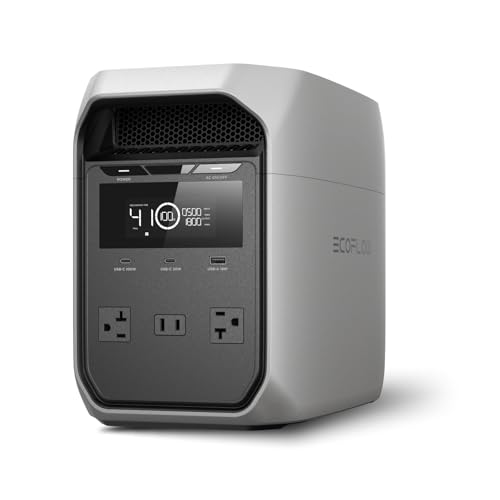
EcoFlow Delta 3 Classic
1,024 Wh · 1,800W output (3,600W surge) · 26.7 lb · Score 86/100 (power-station matrix)
Price: $462.00
The same 1,024 Wh class as the Anker, with 1,800W of output and a UPS EcoFlow rates at under 10 ms (Amazon title and our Delta 3 Classic review). It has only three AC outlets and no battery expansion. That doesn't matter for a single water heater, and it holds about three times the battery of a HUGO L30.
Est. burner-on time at 84W: ~10 h (our math).
Whole-Home Step-Up (Hardwired Heater on a Transfer Switch)

EcoFlow Delta Pro 3
4,096 Wh · 4,000W output (8,000W surge) · 113.5 lb · Score 95/100 (power-station matrix)
More battery than any water heater needs. It makes sense only if you are already planning an electrician-installed transfer switch or home panel that keeps several hardwired circuits running, with the tankless heater as one of them. It has 4,096 Wh and 4,000W of 120/240V output. The 240V output still doesn't make it an electric tankless backup (see the math above).
Est. burner-on time at 84W: ~41 h (our math).
HUGO vs a Power Station: Side by Side
The HUGO L30 with Flow Kit next to the two 1 kWh stations and the Bluetti. Specs come from our product database and the maker sources cited above.
| HUGO L30 + Flow Kit | Anker SOLIX C1000 Gen 2 | EcoFlow Delta 3 Classic | Bluetti Elite 200 V2 | |
|---|---|---|---|---|
| Battery | 12V 30Ah LiFePO4 (about 245 Wh usable, our estimate) | 1,024 Wh LiFePO4 | 1,024 Wh LiFePO4 | 2,074 Wh LiFePO4 |
| AC output | 350W pure sine (Safeguard) | 2,000W | 1,800W | 2,600W |
| Switchover (maker figure) | Within 15 ms | About 10 ms | Under 10 ms | 15 ms |
| Outdoor-rated enclosure | Yes, IP54 / NEMA4 | None listed (portable) | None listed (portable) | None listed (portable) |
| Flow / freeze sensors | Yes (flow kit + temperature sensor) | No | No | No |
| Hardwiring | "Hardwire friendly" (electrician) | Plug-in, or inlet / transfer switch (electrician) | Plug-in, or inlet / transfer switch (electrician) | Plug-in, or inlet / transfer switch (electrician) |
| Runs other things later | Small gas appliances (Safeguard) | Fridge, CPAP, router, tools | Fridge, CPAP, router, tools | Fridge, furnace blower, more |
| Our score | Not yet scored | 92/100 | 86/100 | 91/100 |
| Price | Check price at Amazon → | $529.99 | $462.00 | $898.99 |
Switchover sources: Safeguard (HUGO); our Anker C1000 Gen 2 and Delta 3 Classic reviews; StorageReview (Elite 200 V2). We found no published switchover tolerance from Rinnai, Navien or Rheem. If your heater shows an error or restarts after a transfer, check its manual. For how a station's UPS mode differs from a true online UPS, see power station vs UPS, and for desktop units see our best UPS battery backup guide.
Plug-In vs Hardwired: How the Backup Connects
How your heater is wired decides which backup you can use. Rinnai's installation manual is a clear example (Rinnai RU199i manual, power supply section):
- •Indoor models ship with a 5-foot power cord for a grounded three-prong 120V outlet. You can unplug that cord from the wall and plug it into a power station or a HUGO, as long as the battery sits within reach.
- •No extension cords or adapters. The manual says "Do not use an extension cord or adapter plug with this appliance." Put the battery next to the heater, not across the room.
- •Outdoor models are wired in, with a disconnect switch that must be provided for the incoming 120V power, under the National Electrical Code (NFPA 70) or local code. There is no plug to move, so any backup has to be wired in by a licensed electrician. That can be a HUGO, which Safeguard calls hardwire friendly, or a transfer switch fed by a power station.
Never connect any battery or generator to household wiring through a wall outlet. Power fed back into home wiring can energize utility lines and electrocute line workers (New Jersey DCA generator safety advisory). Our transfer switch guide explains the 120V setups that suit a single appliance circuit like this one.
Safety: Carbon Monoxide, Venting, Freezing and Your Warranty
Carbon monoxide and venting
- • A gas tankless heater burns fuel. Keep CO alarms "on each level of the home and outside separate sleeping areas" and test them monthly, as the CPSC advises (CPSC winter safety tips, 2026).
- • Snowstorms cause outages, so the CPSC's advice to clear snow from the outside vents of fuel-burning appliances applies directly. If your heater vents through a wall, keep that vent clear too.
- • A battery has no exhaust and can sit next to the heater. A gas generator can't. The CPSC says to run portable generators outside only, at least 20 feet from the house, never in a garage, basement or crawlspace, and not on a porch or in a carport (CPSC; CPSC CO report).
Freeze protection needs power too
Rinnai tells owners to "ensure continuous power supply" to the heater so its built-in freeze protection can work. It also says that if power is lost the unit "will not function", and it gives a draining procedure for prolonged outages (Rinnai freeze protection guide). Its FAQ adds that the heater is protected from freezing but the plumbing and valves leading to it are not, and it strongly recommends a drain-down system for outdoor units in cold climates (Rinnai FAQ). Freeze protection is also the heaviest load in the table above, at about 150W. So for an outdoor heater in a hard freeze, size the battery for the whole night, not just for showers. If it might run flat, follow the drain procedure.
What heater warranties say about power
We found no tankless maker that names battery backups in its warranty, either to approve or to forbid them. Navien's NPE-A warranty does exclude damage caused by "electrical surges" and performance problems caused by "electric service voltage, wiring, fusing or any other components." It also excludes units "installed by a non-licensed installer" (Navien NPE-A warranty). In practice, that means feeding the heater clean 120V power through a proper connection and having any hardwiring done by a licensed pro. Read the warranty for your own model before you change how it is powered.
Battery Backup for a Gas Water Heater With a Tank
Not every gas water heater needs one. Westlight Energy's outage guide says older tank heaters with a "continuously burning pilot light" keep working when the power is out. It adds that "many recent model, gas, tank-type water heaters have electronic ignition systems and will not work without electricity" (Westlight Energy). A.O. Smith says the same about newer gas tank models with electronic ignition (A.O. Smith).
- •Standing pilot, no power cord: it runs on gas alone, so you don't need a battery for it.
- •Electronic ignition or a power cord to an outlet: it needs backup power. Read the watts or amps on its rating plate, multiply volts × amps if only amps are listed, and size the battery the same way as the tankless math above. A 1 kWh power station is usually plenty, but use your heater's own figure.
- •Electric tank heater: its elements draw thousands of watts on 240V, so the electric tankless conclusion applies here too. See the 240V row in our appliance wattage chart.
If you are backing up the heater as part of a wider winter plan, the same small-load logic applies to a gas furnace's blower. Our power station for furnace guide works through it, and the winter storm power backup guide puts everything in priority order. If your water comes from a well, the well pump needs power before any heater can make hot water. See can a solar generator run a well pump? Basements that flood in the same storms should look at sump pump battery backup too.
Which Backup Fits Your Heater
Get a 1 kWh power station if
- ✓ Your gas tankless heater is indoors and has a plug
- ✓ You want the most battery for the money
- ✓ You'd use the same battery for a fridge, CPAP or router in an outage
- ✓ Your heater runs a recirculation pump (more output headroom than HUGO)
Get a HUGO if
- ✓ The heater is mounted outdoors or hardwired
- ✓ You want it permanently installed and automatic, with flow and freeze sensing
- ✓ You'll pay an electrician and a plumber for a clean install
Skip battery backup if
- ✗ Your tankless or tank heater is electric
- ✗ Your gas tank heater has a standing pilot and no cord
Tankless Water Heater Battery Backup FAQ
Can a battery backup run a tankless water heater?
A gas or propane tankless heater, yes. The gas makes the heat, and electricity only runs the controls, igniter and combustion fan. A.O. Smith puts that at about 60 to 100 watts while running. Rinnai lists 81 to 84 watts for its 199,000 BTU condensing models, and Navien rates its NPE-240 at 200 watts maximum. An electric tankless heater is different. A whole-house model such as Rheem's RTEX-18 is rated at 18,000 watts on 240 volts, which no portable battery can supply.
How long will a battery backup run a gas tankless water heater?
It depends on how long the burner actually runs. By our math, a 1,024 Wh power station gives about 10 hours of burner-on time at 84 watts, and a 2,074 Wh station gives about 21 hours. That is after a 15% conversion loss. The burner only fires while a hot tap is open, so the bigger drain is the hours in between: the heater's standby draw is small (Rinnai lists 1.3 watts), but a power station's inverter stays on the whole time. A HUGO with the flow sensor kit only powers the heater when water flows. These are estimates, not measurements.
What is the HUGO battery backup for tankless water heaters?
HUGO is a wall-mountable battery backup made by Safeguard Power Solutions for gas tankless water heaters and other small gas appliances. It uses a 12V 30Ah (L30) or 50Ah (L50) LiFePO4 battery in an IP54 enclosure that can be mounted indoors or outdoors. Safeguard rates it at 350 watts pure sine wave and says it switches over within 15 milliseconds. The optional flow sensor powers the heater only while water is flowing. A temperature sensor turns power on below 37 degrees F so the heater's freeze protection can run. Rinnai's FAQ points owners to an earlier HUGO model as a battery backup.
Is a HUGO or a portable power station better for a tankless water heater?
For an indoor gas tankless heater with a plug, a 1,024 Wh power station with a UPS mode gives about three times the battery of a HUGO L30, and you can use it for other things. HUGO is the better fit for outdoor-mounted heaters, for permanent hardwired installs, and if you want the flow and temperature sensors to stretch the battery. If your heater runs an external recirculation pump, check the total load. Navien rates the NPE-240 at 350 watts with a pump, which is HUGO's full rated output.
Can I plug my tankless water heater into a power station with an extension cord?
No. Rinnai's installation manual says not to use an extension cord or adapter plug with the water heater. Indoor Rinnai models come with a 5-foot cord for a grounded three-prong 120V outlet, so the battery has to sit within reach of that cord. Outdoor models are wired in with a disconnect switch, so connecting any battery to them is a job for a licensed electrician, through a transfer switch or a hardwire-ready backup such as HUGO.
Will a battery backup keep my tankless water heater from freezing in an outage?
It can, if it keeps the heater powered. Rinnai says to keep power on continuously so the heater's built-in freeze protection can work. Its manuals list about 150 watts when that freeze protection is running. Rinnai also says the plumbing and valves outside the heater are not protected, and it gives a draining procedure for long outages. A battery that runs flat in the middle of a cold night protects nothing, so size it for the whole outage or follow the manufacturer's draining steps.
Sources checked November 11, 2026: Safeguard Power Solutions HUGOv2 page and the Amazon listings for each HUGO variant; Rinnai FAQ, Rinnai freeze protection guide, Rinnai RU199i and CU199i specification pages and power supply section; Navien NPE-240S2 and NPE-A warranty; A.O. Smith; Rheem RTEX spec sheet and ABR RTEX-18 listing; Westlight Energy; CPSC. Power-station specs come from our product database and linked reviews.