
Product Review · Updated October 2026
EcoFlow Delta 3 Classic Review: The Budget 1kWh Delta, and When the Delta 3 Plus Is Worth More
Verdict
The EcoFlow Delta 3 Classic is the cheapest way into a 1kWh Delta: 1,024Wh of LiFePO4, 1,800W continuous (3,600W surge), a sub-10 ms UPS and about a 45-minute charge to 80% from the wall. It has the same capacity and output as the Delta 3 Plus, but it drops the second solar input (500W vs 1,000W), battery expansion, the 12V car socket and half the outlets. For wall-charged outage backup on a budget it is excellent value. If you will lean on solar or want to grow to 2–3kWh, pay more for the Plus.
As an Amazon Associate, SolarGenAdvisor earns from qualifying purchases made through links on this page, at no additional cost to you.
 By Jordan Park
Reviewed & approved by Juhi Sahni
|
Published: October 31, 2026
|
Updated:
|
How we score
EcoFlow Delta 3 Classic at a Glance
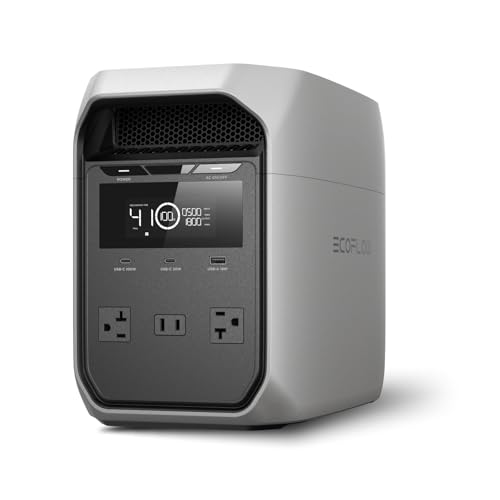
Capacity
1,024
Wh LiFePO4
AC Output
1,800
Watts (3,600W surge)
Solar Input
500
Watts max (one input)
Weight
26.7
Lbs
- ✓ Best for: fridge-and-router outage backup, desk UPS, car camping, a first 1kWh station on a budget
- ✗ Not for: big solar arrays, 12V car-socket gear, anyone who wants to add batteries later
Our editorial rating: 86/100 · Live price: $499.00
Delta 3 Classic vs Delta 3 Plus vs Delta 3 Max
This is the real question behind most “Delta 3 Classic” searches. The Classic and Plus share the same 1,024Wh battery and 1,800W inverter rating, so the difference is everything around them. The Delta 3 Max is a different size class at 2kWh. Capacity, output, solar, weight and ratings come from our product database; prices are live.
| Spec | Delta 3 Classic | Delta 3 Plus | Delta 3 Max |
|---|---|---|---|
| Capacity | 1,024 Wh | 1,024 Wh | 2,048 Wh |
| Continuous AC output | 1,800W | 1,800W | 2,400W |
| Max solar input | 500W (one input) | 1,000W (two inputs) | 500W (one input) |
| Extra-battery expansion | No | Yes | No |
| Outputs | 3 AC, 2 USB-C (100W max), 1 USB-A | More AC and DC ports, 140W USB-C | 4 AC, USB-C, USB-A, car socket (9 total) |
| 12V car socket | No | Yes | Yes |
| UPS switchover (advertised) | Under 10 ms | Under 10 ms | Under 10 ms |
| Weight | 26.7 lb | ~26 lb | ~45 lb |
| Our rating | 86/100 | 89/100 | 85/100 |
| Full review | This page | Review → | Review → |
| Price now | $499.00 | $719.00 | $899.00 |
Port details: Delta 3 Classic from EcoFlow’s product photos and The Solar Lab; Delta 3 Plus 140W USB-C from EcoFlow’s Amazon listing title. Gadget Gate’s comparison counts six output ports on the Classic against 13 on the Plus. Delta 3 Max ports are from our Delta 3 Max review.
Pick the Delta 3 Classic if…
- ✓ It will mostly charge from the wall and sit ready for outages
- ✓ Three AC outlets and three USB ports cover what you plug in
- ✓ 1kWh is enough for good, and you want the lowest price for it
- ✓ You want a sub-10 ms UPS for a router, modem or desktop
Pick the Delta 3 Plus if…
- ✓ You will charge from more than 500W of panels
- ✓ You may add an extra battery later
- ✓ You run a 12V fridge or other car-socket gear
- ✓ You need more outlets or a 140W USB-C for a big laptop
Right now the Delta 3 Plus is $719.00 on Amazon. If the gap is small when you shop, the Plus is the better long-term buy because of its solar input and expansion port. If the gap is large, the Classic gives you the same battery and inverter for less. Want 2kWh instead? The base Delta 3 Max doubles capacity but, like the Classic, has one solar input and no expansion. Our which EcoFlow Delta should I buy guide puts every Delta in one decision table.
EcoFlow Delta 3 Classic Specs
Core figures come from our product database. The rest are EcoFlow’s published US figures from its Amazon listing, cross-checked against Costco’s listing, the solarkontor and fraron spec sheets, and The Solar Lab.
| Battery | 1,024 Wh LiFePO4 (51.2V, 20Ah) |
| AC output | 1,800 W continuous, 3,600 W surge, pure sine wave; 3 outlets in the US (two grounded, one two-prong) |
| X-Boost | Up to 2,600 W for resistive heating devices at reduced power (US listing; European spec sheets say 2,400 W on 230V) |
| USB | 2× USB-C (100 W and 30 W), 1× USB-A |
| 12V car socket | None |
| AC recharge | 0–80% in about 45 minutes; full in about 1 hour |
| Solar input | One input, 500 W max, 11–60V, 15A (XT60) |
| UPS switchover | Under 10 ms (advertised) |
| Expansion | None |
| App | EcoFlow app over Wi-Fi and Bluetooth |
| Warranty | 3 years standard plus 2 more after registering in the EcoFlow app (5 total), per Costco and fraron |
| Weight | 26.7 lb (12.1 kg) |
| Model number | EF-DL3-C |
| Price now | $499.00 |
What we could not confirm: EcoFlow’s listing promises “10+ years of daily use” but we found no published cycle count for the Classic in two independent sources, so we leave it out. One comparison site lists the Classic at 15 lb; that is wrong. Costco and European spec sheets agree on 12.1 kg. Don’t confuse the Classic with the original Delta 3, which is a separate listing.
How Long Will the Delta 3 Classic Run? Real-World Runtimes
Estimates use 1,024Wh × 0.85, or about 870Wh usable after inverter losses, divided by the load. Fridges cycle on and off, so their figures use average draw rather than running watts.
| Load | Typical draw | Est. runtime |
|---|---|---|
| Smartphone | ~12Wh per charge | ~72 full charges |
| Wi-Fi router + modem | ~20W | ~43.5 hrs |
| CPAP (no humidifier) | ~40W | ~21.8 hrs |
| Efficient full-size fridge (average) | ~60W | ~14.5 hrs |
| Laptop + monitor + router | ~120W | ~7.3 hrs |
| Older full-size fridge (average) | ~150W | ~5.8 hrs |
| Fridge + router + LED lights | ~250W | ~3.5 hrs |
| Window AC (running) | ~500W | ~1.7 hrs |
| Microwave (1,000W, 5 min a meal) | ~85Wh per use | ~10 uses |
The pattern: a fridge and router get through an overnight outage, a CPAP without humidifier gets two to three nights, and a microwave or coffee maker is fine for short bursts within the 1,800W limit. The single 500W solar input can put back roughly half the battery in a few hours of good sun, which suits weekend trips but not running a fridge indefinitely. For appliance-by-appliance sizing see what can a solar generator run and can a solar generator run a refrigerator.
Who Should Buy the Delta 3 Classic, and Who Should Skip It
Buy it if you…
- • Want a first 1kWh station for outages and will recharge from the wall
- • Work from home and want a UPS-style backup for the router and desk
- • Car camp or tailgate with AC gear, a laptop and phones
- • Shop on price and value a big-brand app and warranty
Skip it if you…
- • Plan to charge from 600W or more of solar (the Delta 3 Plus takes 1,000W)
- • Want to add capacity later (Classic has no expansion port)
- • Run a 12V fridge or anything that plugs into a car socket
- • Need 2kWh or 240V: see the Delta chooser
- • Mostly need phones-and-laptop power: the River 2 Pro or River 3 Plus is lighter
Delta 3 Classic vs Anker SOLIX C1000 Gen 2, Jackery 1000 V2 and Bluetti AC180
The 1kWh stations people usually cross-shop against the Classic. Ratings are our editorial scores; prices are live.
| Model | Capacity | AC output | Solar in | Weight | Rating | Price | Amazon |
|---|---|---|---|---|---|---|---|
| EcoFlow Delta 3 Classic | 1,024 Wh | 1,800W | 500W | 26.7 lb | 86 | $499.00 | View → |
| EcoFlow Delta 3 Plus | 1,024 Wh | 1,800W | 1,000W | 26 lb | 89 | $719.00 | View → |
| Anker SOLIX C1000 Gen 2 | 1,024 Wh | 2,000W | 600W | 24.9 lb | 92 | $529.99 | View → |
| Jackery Explorer 1000 V2 | 1,070 Wh | 1,500W | 400W | 23 lb | 93 | $559.00 | View → |
| Bluetti AC180 | 1,152 Wh | 1,800W | 500W | 35.3 lb | 85 | $499.00 | View → |
vs Anker SOLIX C1000 Gen 2: more output (2,000W) and more solar (600W), and about 2 lb lighter. It is the stronger all-rounder in our scoring; the Classic wins only if it is clearly cheaper when you shop.
vs Jackery Explorer 1000 V2: lighter at 23 lb with slightly more capacity, but less output (1,500W) and less solar input. A better carry-to-camp pick; the Classic is the better outage pick. See our Jackery 1000 V2 review.
vs Bluetti AC180: similar output and the same 500W solar ceiling, with a little more capacity, but it weighs 35.3 lb. Unless the AC180 is much cheaper, the Classic is the easier unit to live with. Our Bluetti AC180 review has the details.
More 1kWh options are ranked in the best 1000Wh solar generators, and cheaper ones in best solar generators under $500.
Delta 3 Classic vs Delta 2: Is the Older Model Better?
The Delta 2 is the previous 1kWh Delta, and retailer spec sheets (Best Buy, Galaxus, Euronics) list it at 1,024Wh LiFePO4, 1,800W, 500W of solar input and about 27 lb, which is nearly identical to the Classic. Two things separate them. The Delta 2 accepts an extra battery (to roughly 3kWh) and has a 12V car socket; the Classic has a higher surge rating (3,600W), a sub-10 ms UPS and a 100W USB-C port. We do not rate the Delta 2, so it has no price link here. If you find one cheaper and want expansion, it is still a sensible buy. Otherwise the Classic is the newer design at a similar price point.
Delta 3 Classic Black Friday: What to Expect
EcoFlow’s Delta models have historically seen some of their deepest Amazon promotions in the Black Friday–Cyber Monday window, and deal-forum threads on Slickdeals have shown the Classic below its usual listing price before. That is a pattern, not a promise. The Classic is a newer listing with less price history than older Deltas. Our EcoFlow Black Friday tracker follows the live prices. If you also want panels, compare the bundle with buying the station and a panel separately.
EcoFlow Delta 3 Classic Pros & Cons
What We Like
- • Same 1,024Wh and 1,800W as the Delta 3 Plus for less
- • 3,600W surge handles fridge and tool start-ups
- • About 45 minutes to 80% from the wall
- • Sub-10 ms UPS for desk and network gear
- • LiFePO4 and a 5-year warranty (with app registration)
What Could Be Better
- • Not expandable: no extra-battery port
- • One 500W solar input, half the Plus
- • Only three AC outlets, one of them two-prong
- • No 12V car socket
- • 26.7 lb: heavier than the Jackery 1000 V2
We do not physically test products. Our 86/100 rating comes from our scoring matrix, applied to EcoFlow’s published specs, logged Amazon prices and Amazon customer reviews. It scores high on value and AC performance and loses points for solar input and expandability. More EcoFlow models are in the EcoFlow power station guide.
EcoFlow Delta 3 Classic FAQ
Is the EcoFlow Delta 3 Classic worth it?
Yes, if you want a 1kWh LiFePO4 power station mainly for outage backup or car camping and you will charge it from the wall. It has the same 1,024Wh capacity and 1,800W output as the Delta 3 Plus, a 3,600W surge rating, a sub-10 ms UPS and a 0-80% wall charge in about 45 minutes. It is not worth it if you want more than 500W of solar, a 12V car socket or the option to add batteries later. Those are the things the Delta 3 Plus adds.
What is the difference between the EcoFlow Delta 3 Classic and Delta 3 Plus?
Both hold 1,024Wh and run 1,800W continuously. The Delta 3 Plus takes twice the solar input (1,000W across two inputs vs one 500W input), accepts extra batteries, has a 140W USB-C port and many more outlets including a 12V car socket. The Classic has three AC outlets, two USB-C ports (100W and 30W), one USB-A port, no car socket and no expansion port. In exchange it usually costs noticeably less.
Is the EcoFlow Delta 3 Classic expandable?
No. The Delta 3 Classic has no extra-battery port, and The Solar Lab describes it as non-expandable. If you might want 2kWh or more later, the Delta 3 Plus accepts EcoFlow extra batteries. If you need 2kWh now, compare the Delta 3 Max and Delta 2 Max.
Delta 3 Classic vs Delta 2: which should I buy?
On paper they are close: both are 1,024Wh LiFePO4 stations with 1,800W output, 500W of solar input and a weight of about 27 lb. The older Delta 2 can take an extra battery for roughly 3kWh, and it has a 12V car socket. The Delta 3 Classic is newer, has a higher 3,600W surge rating, a faster sub-10 ms UPS and a 100W USB-C port. Buy the Delta 2 only if you want expansion and find it cheaper; otherwise the Classic is the more current design.
How long will the EcoFlow Delta 3 Classic run a refrigerator?
About 15 hours for an efficient modern full-size fridge averaging around 60W, and about 6 hours for an older fridge averaging around 150W. That assumes roughly 85% of the 1,024Wh capacity reaches the appliance. The 3,600W surge rating comfortably covers a fridge compressor start-up.
How fast does the EcoFlow Delta 3 Classic charge?
From a wall outlet, 0-80% takes about 45 minutes and a full charge about an hour, per EcoFlow's Amazon listing and Costco's product page. From solar, the single input accepts up to 500W (11-60V, 15A), which European retailer spec sheets put at roughly 2.5 hours for a full charge in ideal sun.
Can the EcoFlow Delta 3 Classic work as a UPS?
Yes. EcoFlow advertises a switchover under 10 ms when wall power drops, which is fast enough for most routers, modems and many desktop PCs. Very sensitive equipment can still notice a switchover, so test your own setup before relying on it.
Does the EcoFlow Delta 3 Classic have a 12V car outlet?
No. The Solar Lab lists no 12V car-style DC socket on the Classic, and EcoFlow's product photos show only three AC outlets, two USB-C ports and one USB-A port. If you run a 12V fridge or other car-socket gear, the Delta 3 Plus or the older Delta 2 is the better fit.
Sources: EcoFlow’s Amazon listing for the Delta 3 Classic (1,024Wh, 1,800W/3,600W surge, X-Boost 2,600W, sub-10 ms UPS, 100W USB-C, one-hour charge); Costco listing (12.1 kg / 26.7 lb, 0–80% in 45 minutes, 3+2-year warranty); solarkontor and fraron spec sheets (51.2V 20Ah, 500W solar at 11–60V 15A, USB-C 100W + 30W, model EF-DL3-C); The Solar Lab (non-expandable, three US AC outlets, no 12V socket); Gadget Gate’s Classic vs Plus port count; Best Buy, Galaxus and Euronics listings for Delta 2 figures; our Delta 3 Plus review and product database for Plus and Max figures. SolarGenAdvisor does not physically test products.