SolarGenAdvisor SolarGenAdvisor

Power Guide · Updated November 24, 2026

Power Station for Astrophotography: 12V Budgets, Cold Nights and Picks

A 1,000 Wh portable power station with a 12V/10A car socket runs a typical one-shot-color imaging rig for about 1.5 nights per charge; a cooled-camera rig with a mini PC needs about 2,000 Wh for two nights. Those are formula estimates from manufacturer ratings for mounts, dew heaters and cameras. Run the rig from the 12V port, not the AC outlet, and keep the station above freezing when you recharge it. Below: draw by device, a night budget for three rigs, why steady voltage matters to your mount, and dark-site tips.

As an Amazon Associate, SolarGenAdvisor earns from qualifying purchases made through links on this page, at no additional cost to you.

The Short Answer

Visual GoTo

~300 Wh per night

A mount plus one dew strap at full power, about 31W. A 288 Wh DC station covers most of a night, and all of it with the dew controller turned down.

One-shot-color imaging

~520 Wh per night

Mount, controller, cameras and two dew straps, about 55W. A 1,000 Wh station gives about 1.5 nights.

Cooled camera + mini PC

~980 Wh per night

About 103W with the cooler at full power. Pick 2,000 Wh for two nights, and check that the 12V port can carry the current.

What to check before buying

The 12V port rating

Look for a 12V car socket rated 10A, and for any shared limit across the 12V ports. Capacity is easy to compare; port limits are what catch astro rigs out.

How Much Power Astro Gear Draws

Astro gear is rated in amps at 12V, and the rating on the box is usually what the power supply must be able to deliver. Average draw while tracking is lower. The table gives each maker’s figure; the last column is the number we use in the night budget below. Watts = amps × 12.

Device Published figure (source) Planning amps
ZWO AM5 mount 12V at 0.4A standby, 0.6A tracking, 1.7A during GOTO; supply of at least 3A recommended (ZWO AM5 manual) 1.0A average
Sky-Watcher EQ6-R Pro DC 11–16V, 4A supply at 11V (Sky-Watcher EQ6-R manual, First Light Optics)
Sky-Watcher HEQ5 Pro 11–15V DC, 2A, tip positive (Sky-Watcher, First Light Optics)
Celestron CGX / Advanced VX CGX needs 12V with at least 4A (CGX manual). Celestron’s own example puts the CGX at about 3.0A and the Advanced VX at about 2.0A when slewing at top speed (Celestron dew controller manual)
Dew heater strap, 8–11 in scope Dew-Not 11 in: 1.57A, 18.8W (High Point Scientific listing). Celestron rings: 8 in 1.7A max, 11 in 2.5A max (Celestron) 1.6A at full power
Dew strap, guide scope About 1.0A in Celestron’s worked example (Celestron) 1.0A
ZWO ASI2600MC Pro (cooled) Cooler: 12V, 3A maximum. Camera alone: 4.7W maximum over USB. 12V/3A adapter recommended (ZWO ASI2600 manual, ZWO product page) 3.0A (full cooling)
ZWO ASIAIR Plus ZWO recommends an 11–15V supply rated 2–5A; the unit will not turn on below 9V or above 15V (High Point Scientific, quoting ZWO). That supply also feeds the four 12V outputs, so it is not the controller’s own draw, and we found no official figure for that 1.0A allowance
Mini PC or laptop Varies widely by model. The watt rating on the power adapter is a maximum, not the average while running capture software 2.0A (24W) allowance

Figures read November 16, 2026. "Planning amps" are our budgeting assumptions: the mount figure sits between the AM5’s published tracking and GOTO draw, because a mount spends most of the night tracking. The controller and PC lines are allowances, not published specs. Your own gear is the better number: many controllers and power boxes show live current, and that is what to size from.

Night Budget for Three Rigs

The method: Wh per night = total amps × 12V × hours, then rated Wh needed ≈ Wh per night ÷ 0.85. The 0.85 covers conversion losses, the station’s own standby use and some cold-weather margin; it is our assumption, and on a pure DC load it leans conservative. We assume an 8-hour session and dew straps at full power.

Rig What’s on it Total draw Wh per 8-hr night Rated capacity per night
Visual GoTo GoTo mount and one dew strap on an 8 in SCT or similar. No cameras. 2.6A / 31W 250 Wh ~300 Wh
One-shot-color imaging Mount, ASIAIR-type controller, uncooled OSC camera or DSLR on a dummy battery, guide camera, dew straps on the main and guide scopes. 4.6A / 55W 442 Wh ~520 Wh
Cooled camera + mini PC Mount, cooled camera with the cooler working hard, mini PC instead of a controller, dew straps on both scopes. 8.6A / 103W 826 Wh ~980 Wh

Nights per charge, by station

Power station Capacity Visual GoTo OSC imaging Cooled + mini PC Price
Anker SOLIX C300 DC 288 Wh 7.8 hrsmost of a night 4.4 hrsless than 1 night 2.4 hrsless than 1 night $269.99
Jackery Explorer 1000 V2 1,024 Wh 28 hrs3 nights 16 hrs1.5 nights 8.4 hrs1 night $559.00
EcoFlow Delta 3 Plus 1,024 Wh 28 hrs3 nights 16 hrs1.5 nights 8.4 hrs1 night $719.00
Anker SOLIX C2000 Gen 2 2,048 Wh 56 hrs6.5 nights 32 hrs3.5 nights 17 hrs2 nights $999.99

Formula estimates: capacity × 0.85 ÷ rig watts, with nights rounded down to the nearest half. Capacities come from our product database. Real draw changes with temperature (dew straps and a camera cooler both work harder on some nights than others), how often the mount slews, and your controller settings.

Three ways to stretch a charge. A dew controller set to 50% roughly halves the strap’s draw, and on a dry night that is often enough. A less aggressive camera setpoint makes the cooler work less than the full 3A. Charging a USB-C laptop or mini PC from a USB-C port skips the inverter entirely. Every one of these beats buying a bigger battery.

If you want one answer

For a one-shot-color rig, the Jackery Explorer 1000 V2 (93/100 in our scoring) is the one to price first: 1,024 Wh, a 12V/10A car port and 23.3 lb to carry from the car.

Why Steady 12V Matters to Your Mount

Mount makers publish a voltage window, and they mean it. Sky-Watcher’s EQ6-R manual says the supply must sit between 11V and 16V, that voltage outside that range “might cause permanent damage to the motor controller or the hand controller,” not to use an unregulated AC-to-DC adapter, and that if the voltage is too low “the motor controller will stop the motors automatically” (EQ6-R manual, section 4.4). ZWO’s AM5 sounds a buzzer when its input falls below 10V (AM5 manual). The HEQ5 Pro is specified at 11–15V (Sky-Watcher).

Lead-acid power tank

Voltage falls as it empties. Battery University’s table for a 12V lead-acid battery goes from 12.65V full to 12.24V at half charge and 11.89V empty, measured at rest (Battery University BU-903). While current flows, and in the cold, it sits lower still, close to the 11V floor a mount like the EQ6-R needs.

Power station 12V port

The batteries inside our picks run well above 12V (35.2V in the Jackery, 51.2V in the EcoFlow and the Anker C2000 Gen 2, per their manuals and spec pages), so the 12V socket is a converted output with a published voltage: 12V for Jackery and Anker, 12.6V for EcoFlow. That sits inside every mount window above.

LiFePO4 battery, direct

A 12V LiFePO4 battery holds a much flatter voltage than lead-acid over most of its charge (Battery University), which is why many imagers use one. You still need your own fuse, sockets and charger, which a power station already has.

Use the DC port, not the AC outlet

Plugging a 12V mount’s wall adapter into a power station’s AC outlet converts battery DC to 120V AC and then back to 12V DC, losing energy at each step, and an idling inverter uses power on its own. Run the mount, camera cooler and dew controller from the 12V car socket or DC5521 ports, and switch the AC inverter off unless something needs it. If a laptop has no USB-C charging, use the AC outlet; Jackery and EcoFlow list pure sine wave output for theirs, and the C300 DC has no AC outlet at all.

Port checklist

  • Socket rating. Look for 12V at 10A (120W) on the car socket. A cooled-camera rig at about 8.6A is close to that ceiling before the mount slews, so move the mini PC or laptop to USB-C.
  • Shared limits. The EcoFlow Delta 3 Plus caps all its 12V ports together at 126W (EcoFlow manual). Read the fine print before planning on several ports at once.
  • Barrel plugs. ZWO cameras and the AM5 use 5.5 × 2.1 mm, centre positive (ZWO, AM5 manual). Celestron recommends its threaded-barrel 5A adapter for the CGX (CGX manual), so check your mount’s plug before buying a cable.
  • Short, thick cables. Voltage drops along a long, thin 12V cable. Keep the station close to the pier or tripod and use a heavier-gauge cable for the run to your power box.

Cold Nights and LiFePO4

Winter skies are dark early and long, and that is when battery limits show. The rule is simple: these stations can run below freezing, but none of them may be charged below 0°C (32°F). Battery University explains why: charging lithium-ion cells below freezing plates metallic lithium on the anode, which causes permanent loss of performance and safety (Battery University BU-410). Each maker’s limits:

Power station Temperature limits 12V output Source
Jackery Explorer 1000 V2 Charge 0–45°C (32–113°F); discharge −10–45°C (14–113°F) One car port, 12V ⌀ 10A Jackery manual
EcoFlow Delta 3 Plus Charge 0–45°C (32–113°F); discharge −10–45°C (14–113°F) Car socket 12.6V ⌀ 10A + two DC5521 at 12.6V ⌀ 3A; 126W total across all 12V ports EcoFlow manual
Anker SOLIX C300 DC Charge 0–40°C (32–104°F); discharge −20–40°C (−4–104°F) One car socket, 12V ⌀ 10A (120W) Anker manual
Anker SOLIX C2000 Gen 2 Charge 0–40°C (32–104°F); discharge −20–40°C (−4–104°F) One car socket, 12V ⌀ 10A Anker spec page

Capacity drops in the cold, then comes back. Cold raises a battery’s internal resistance and lowers its capacity, and the loss applies only while the cell is cold: it recovers at room temperature (Battery University BU-502). Plan on fewer hours than the table above on a frosty night. The Jackery, EcoFlow and C300 DC manuals each describe a low-temperature warning that pauses the station until it warms up.

At the scope

Keep the station off frozen ground, on a mat or in the car, and out of the dew. Leave the vents clear.

Recharging

After a sub-zero night, let the station warm above freezing before plugging in panels or the car charger. Morning sun on a frozen box is the case to watch.

Below the limits

Jackery and EcoFlow list −10°C (14°F) as the lowest discharge temperature; Anker lists −20°C (−4°F). Colder than that, the station will stop until it warms.

Dark-Site Practicalities

Screens and LEDs

Dark adaptation takes about half an hour, and one glance at a bright light resets it (Sky at Night Magazine, astrophysicist Brian Koberlein). Rods are less sensitive to deep red, but brightness matters as much as colour. The pick stations’ screens can be switched off: the Jackery’s sleeps after 2 minutes idle, the Anker C300 DC’s after 30 seconds by default, and the EcoFlow’s toggles with one press (manuals linked in the table above). Status LEDs that stay lit can go under a strip of red film or tape. Both the Jackery and the C300 DC have built-in white lights; leave them off and use a dim red torch.

Fan noise

A 30–120W DC load is light work for these stations; heavy AC loads and fast charging make the most heat. Do the fast wall or solar charging in daylight. Anker lists 30 dB under 1,000W for the C2000 Gen 2 (Anker), and StorageReview lists under 30 dB at 600W for the Delta 3 Plus (StorageReview).

Weight to the pad

At a dark site you often carry everything from the car. The C300 DC is 6.17 lb, the Jackery 23.3 lb, the EcoFlow 27.6 lb and the C2000 Gen 2 41.7 lb. Add the weight of the mount and counterweights, and a 2 kWh box is something you set down once beside the car.

Star parties and multi-night trips

Daytime is free charging time. Using the same formula as our solar size calculator (daily Wh ÷ 4.5 sun hours × 1.3), replacing one night takes roughly 80W of panel for the visual rig, 130W for the one-shot-color rig and 240W for the cooled rig. Every pick except the C300 DC (100W solar input) takes that last figure. See our portable solar panel guide for folding panels. Check each event’s rules on generators and lights before you go.

Who Should Buy One

A power station makes sense if you

  • Image away from mains power and want regulated 12V, USB-C and AC in one box with its own charger and display.
  • Are replacing an ageing lead-acid power tank that no longer lasts the night.
  • Travel to multi-night star parties and want to recharge from solar during the day.
  • Also want the same battery for camping or home outages. Our camping power station guide covers that side.

You can probably skip it if you

  • Image from a backyard with an outdoor outlet; a good 12V mains supply is simpler.
  • Run a small tracker and camera from USB power banks only.
  • Want the lightest possible 12V battery and are happy to wire your own fuse and sockets. A 12V LiFePO4 battery is lighter per Wh, though you will need a separate charger.

Not sure how your rig adds up? Our power station sizing guide walks through the same arithmetic for any load, and the Starlink power guide covers running a dish beside the scope at a remote site.

Power Stations for Astrophotography

Ordered by how many astro rigs each one suits. Specs come from our product database, port ratings from each maker’s manual, scores are our editorial ratings, and prices are today’s Amazon prices.

Jackery Explorer 1000 V2
Best for most imaging rigs

Jackery Explorer 1000 V2

93/100
1,024 Wh 1,500W output 3,000W surge 400W solar in 23.3 lb

1,024 Wh at 23.3 lb, one of the lightest 1 kWh stations in our database. Its car port is rated 12V at 10A (Jackery manual), which covers a one-shot-color rig with room to spare: our formula gives about 1.5 nights of the imaging tier below per charge. The screen sleeps after two minutes. The limits: one 12V socket, so you need a distribution box or a powered controller for several barrel plugs, and solar input is 400W.

$559.00Current price on Amazon
Check Price on Amazon → Save to Amazon cartKeep it in your cart and come back to it anytime, on any device.
EcoFlow Delta 3 Plus
Best for multi-plug rigs and solar

EcoFlow Delta 3 Plus

89/100
1,024 Wh 1,800W output 3,600W surge 1,000W solar in 27.6 lb

The only pick with DC5521 barrel ports built in: two at 12.6V and 3A, plus a 12.6V/10A car socket (EcoFlow manual, StorageReview). A mount and a dew controller can plug straight in. Watch the shared cap: all 12V ports together top out at 126W. 1,000W of solar input is the most here, which matters at a week-long star party. 27.6 lb.

$719.00Current price on Amazon
Check Price on Amazon → Save to Amazon cartKeep it in your cart and come back to it anytime, on any device.
Anker SOLIX C300 DC
Lightest for visual and grab-and-go

Anker SOLIX C300 DC

86/100
288 Wh DC only 100W solar in 6.17 lb

288 Wh at 6.17 lb, with no AC inverter. It has a 12V/10A car socket and two 140W USB-C ports, so it can run a mount and charge a USB-C laptop at the same time (Anker manual). Our formula gives about 7.8 hours of the visual tier with the dew strap at full power, a full night with a dew controller turned down. Too small for a cooled camera. Keep its built-in white light off at the dark site.

$269.99Current price on Amazon
Check Price on Amazon → Save to Amazon cartKeep it in your cart and come back to it anytime, on any device.
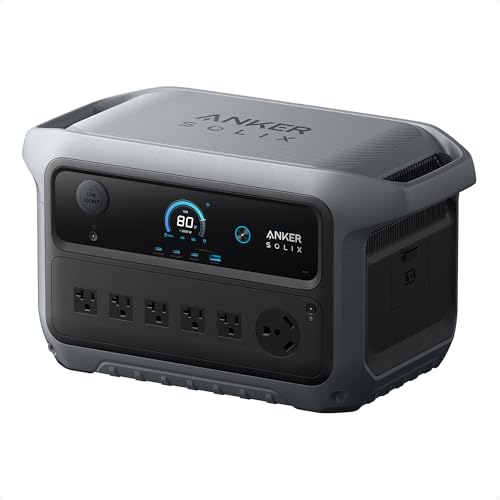
Anker SOLIX C2000 Gen 2
Best for cooled cameras and multi-night trips

Anker SOLIX C2000 Gen 2

90/100
2,048 Wh 2,400W output 4,000W surge 800W solar in 41.7 lb

2,048 Wh, 12V/10A car socket, 800W of solar input and 41.7 lb. Our formula gives about 2 nights of the cooled-camera tier, or about 3.5 nights of the one-shot-color tier. Anker lists 30 dB under 1,000W (Anker). It is a car-to-pad station, not one to carry far.

$999.99Current price on Amazon
Check Price on Amazon → Save to Amazon cartKeep it in your cart and come back to it anytime, on any device.

Prices shown are the current Amazon price.

Side-by-Side Comparison

Power station Our score Capacity 12V DC USB-C Solar in Weight Price
Jackery Explorer 1000 V2 93/100 1,024 Wh One car port, 12V ⌀ 10A USB-C up to 100W 400W 23.3 lb $559.00
EcoFlow Delta 3 Plus 89/100 1,024 Wh Car socket 12.6V ⌀ 10A + two DC5521 at 12.6V ⌀ 3A; 126W total across all 12V ports Two USB-C up to 140W 1,000W 27.6 lb $719.00
Anker SOLIX C300 DC 86/100 288 Wh One car socket, 12V ⌀ 10A (120W) Two USB-C up to 140W, one up to 100W 100W 6.17 lb $269.99
Anker SOLIX C2000 Gen 2 90/100 2,048 Wh One car socket, 12V ⌀ 10A Two USB-C up to 140W 800W 41.7 lb $999.99

Port ratings from each maker’s manual or spec page (linked in the cold-weather table); capacity, solar input, weight and scores from our product database. Scores are our editorial ratings, synthesized from published specs, Amazon pricing and Amazon customer reviews, not from testing.

Astrophotography Power FAQ

What size power station do I need for astrophotography?

Add up your 12V amps, multiply by 12 and by the hours you image, then divide by 0.85. By that formula a visual GoTo setup needs about 300 Wh per night, a one-shot-color imaging rig about 520 Wh and a cooled-camera rig with a mini PC about 980 Wh, assuming an 8-hour night with dew straps at full power. For most imagers that points to a 1,000 Wh station, or 2,000 Wh for cooled cameras over more than one night.

Can I run my telescope mount from a power station's car socket?

Yes, and it is the efficient way to do it. Our picks publish 12V or 12.6V on the car socket, inside the 11–16V window Sky-Watcher gives for the EQ6-R and the 11–15V window for the HEQ5 Pro. Check the socket's amp rating (10A on all four picks) against everything you plug in, including dew straps and a camera cooler, and use your mount's own 12V cable with the right plug.

Is a power station better than a lead-acid power tank for a telescope?

For most imagers, yes. A 12V lead-acid battery's resting voltage falls from about 12.65V full to 11.89V empty (Battery University), and lower while it delivers current. Sky-Watcher's EQ6-R manual says the motors stop automatically if voltage is too low, and its floor is 11V. A power station's 12V port is a converted output that holds its published voltage, and the LiFePO4 stations here hold far more energy than a typical power tank.

Can I charge a LiFePO4 power station below freezing?

No. Jackery, EcoFlow and Anker all list 0°C (32°F) as the lowest charging temperature for the stations on this page. Battery University explains that charging lithium-ion cells below freezing plates lithium metal on the anode and permanently harms the battery. You can run them below freezing (down to −10°C for Jackery and EcoFlow, −20°C for Anker), with reduced capacity until they warm up.

How long will a 1,000 Wh power station run a cooled astro camera rig?

About 8.4 hours by our formula, for a 1,024 Wh station running a mount, a cooled camera with the cooler at its 3A maximum, a mini PC and two dew straps (about 103W). That is one night. A gentler cooler setpoint and a dew controller turned down stretch it; a 2,000 Wh station roughly doubles it.

Do I need an AC inverter for astrophotography?

Usually not. Mounts, cooled cameras, dew controllers and ASIAIR-type controllers all run on 12V DC, and many laptops charge over USB-C. Running them from DC ports avoids converting to AC and back. Keep the inverter for a laptop or mini PC that only has a mains charger, and switch it off when you are done, because an idling inverter uses power too.

Top astro power pick ★
Check Amazon →

What to read next

Best solar generators for camping → Portable picks for dark-site trips, campsites and car camping, with runtime by trip length. What size do you need? → Add your appliances and get a capacity recommendation in a minute. Black Friday deal tracker → Today's Amazon prices on the models we track, through the Black Friday season.

Get our weekly power station research email

One product worth knowing about, one practical guide to sizing, solar setup, battery care or safety, and answers to reader questions, with sources cited. About two minutes a week; unsubscribe anytime.

Subscribe free on Substack → Opens Substack in a new tab. You sign up on Substack, which stores your address and sends the emails; we use the subscriber list only to send this newsletter. See our privacy policy.