
Brand Comparison · Updated November 2026
Jackery vs Anker SOLIX: Which Power Station Brand Fits You?
Short answer: choose Jackery if you'll carry the unit, and Anker SOLIX if you'll charge from solar or want to add batteries later. Jackery is lighter at every size we compare, and its Explorer 1000 v2 is our top-scoring 1 kWh station (93/100). Anker lists more continuous output at 1 kWh and 2 kWh, more solar input at every size from 1 kWh up, and expansion on its 2 kWh and 3 kWh models. Its F3000 is the higher-scoring home-backup unit (93/100). Below we compare them size by size, using specs from our product database and live Amazon prices.
As an Amazon Associate, SolarGenAdvisor earns from qualifying purchases made through links on this page, at no additional cost to you.
 By Jordan Park
Reviewed & approved by Juhi Sahni
|
Published: November 6, 2026
|
Updated:
|
How we score
Quick Verdict: Jackery or Anker?
Choose Jackery if…
- ✓ You'll carry it. Jackery is the lighter model at 300 Wh, 1 kWh, 2 kWh and 3 kWh in every pair below.
- ✓ You want our highest-scoring 1 kWh station (Explorer 1000 v2, 93/100) and slightly more capacity at that size.
- ✓ You want 3 kWh of 120V backup that's about 32 lb lighter than the Anker F3000 (HomePower 3000).
- ✓ You want a simple fixed-capacity unit with no expansion packs to manage (Explorer v2 and HomePower 3000).
Choose Anker SOLIX if…
- ✓ You want a faster wall recharge. Anker lists 49 minutes on the C1000 Gen 2 in UltraFast mode.
- ✓ You'll recharge from solar. Anker accepts 1.5× to 2.4× Jackery's solar input at 1 kWh, 2 kWh and 3 kWh.
- ✓ You may add batteries later. The C2000 Gen 2 expands to about 4 kWh and the F3000 to about 12.3 kWh.
- ✓ You want a TT-30 RV outlet in a 2 kWh box that weighs under 42 lb (C2000 Gen 2).
How we compare: our ratings and verdicts are AI-synthesized. They draw on manufacturer specs, published figures, logged Amazon prices and Amazon customer reviews, scored on the six-dimension matrix in our awards methodology. We did not test these units ourselves. Every score on this page comes from the same product database used across the site.
Anker SOLIX vs Jackery: How the Two Lineups Differ
Jackery's lineup has two halves. The Explorer v2 models (1000 v2, 1500 v2, 2000 v2) are fixed-capacity units built to be light: the 1000 v2 is listed at about 23.3 lb for 1,024 Wh. The Plus and HomePower models (2000 Plus, HomePower 3000, HomePower 3600 Plus, 5000 Plus) cover RV and home backup. The trade-off is solar input. Each Explorer v2 accepts 400W, and the HomePower 3000 accepts 1,000W.
Anker SOLIX leans toward output, charging speed and expansion. The C1000 Gen 2 and C2000 Gen 2 list higher continuous AC output and more solar input than the Jackery models of the same size, and both list a 10 ms UPS switchover on Anker's product pages. The C2000 Gen 2 and F3000 accept expansion batteries. The trade-off is weight: each Anker in our pairs is a little heavier at 300 Wh to 2 kWh, and the F3000 is much heavier than the HomePower 3000.
Every model compared here uses LiFePO4 (LFP) chemistry, including the small Jackery Explorer 300. Our LiFePO4 vs NMC guide explains what that means for cycle life. Both brands discount heavily in sale seasons, so compare today's price per Wh in the tables below. For each brand's full lineup, see our Jackery solar generator guide and Anker SOLIX buying guide.
Head-to-Head by Size: Every Jackery vs Anker Matchup
Each table pairs the closest current models by capacity. Specs come from our product database. Prices and price per Wh update from Amazon. Where a unit has no live price, you'll see a "Check price at Amazon" link instead.
About 300 Wh: Jackery Explorer 300 vs Anker SOLIX C300
| Spec | Jackery Explorer 300 | Anker SOLIX C300 (AC) |
|---|---|---|
| Capacity | 292 Wh | 288 Wh |
| AC output (continuous) | 300W | 300W |
| Weight | 7.5 lb | 9.1 lb |
| Wall recharge (published) | Not compared | 80% in about 50 min |
| Chemistry | LiFePO4 | LiFePO4 |
| SolarGenAdvisor score | 87/100 | 84/100 |
| Price per Wh (today) | $0.99/Wh | $1.74/Wh |
| Amazon price | $289.00 | $499.99 |
Check Jackery Explorer 300 price → · Check Anker SOLIX C300 (AC) price →
Verdict: both hold about 290 Wh and both have a 300W AC inverter, so the choice comes down to battery and extras. The Explorer 300 (87/100) is the lighter carry, and both use LiFePO4. The C300 (84/100). Anker lists a 600W SurgePad mode, backup power within 10 ms and a five-year warranty on its C300 page. The Amazon listing we compare bundles the C300 with a 60W panel. If you only charge phones, laptops and 12V gear, the DC-only C300 DC (86/100) drops the AC outlet entirely. Our C300 vs C300 DC review explains the difference.
1 kWh: Jackery Explorer 1000 v2 vs Anker SOLIX C1000 Gen 2
| Spec | Jackery Explorer 1000 v2 | Anker SOLIX C1000 Gen 2 |
|---|---|---|
| Capacity | 1,024 Wh | 1,024 Wh |
| AC output (continuous) | 1,500W | 2,000W |
| Surge / peak (published) | 3,000W | 3,000W |
| Weight | 23.3 lb | 24.9 lb |
| Max solar input | 400W | 600W |
| Best-case solar refill* | 2.6 h | 1.7 h |
| Wall recharge (published) | 1 h (app emergency mode); 1.7 h default | 49 min (UltraFast mode in the app) |
| Chemistry | LiFePO4 | LiFePO4 |
| Rated cycles (published) | 4,000 to 70% | 4,000 to 80% |
| Expandable | No | No |
| SolarGenAdvisor score | 93/100 | 92/100 |
| Price per Wh (today) | $0.55/Wh | $0.52/Wh |
| Amazon price | $559.00 | $529.99 |
Check Jackery Explorer 1000 v2 price → · Check Anker SOLIX C1000 Gen 2 price →
Verdict: this is the closest call on the page and the pair most shoppers search for ("Jackery 1000 vs Anker C1000"). The Explorer 1000 v2 scores 93/100 in our matrix and the C1000 Gen 2 scores 92/100. The Jackery is about 1.6 lb lighter and holds the same energy (1,024 Wh each). The Anker lists 2,000W of continuous output against 1,500W and 600W of solar input against 400W. Anker also lists a 49-minute full recharge in UltraFast mode and a 10 ms UPS switchover on its C1000 Gen 2 page. Jackery lists one hour in the app's emergency mode and 1.7 hours by default. Neither model can be expanded. Pick the Jackery for a lighter tent or car-camping kit, and the Anker to run an 1,800W kettle or to charge from a bigger array. Our Explorer 1000 v2 vs C1000 Gen 2 comparison goes deeper, and so do the Explorer 1000 v2 review and the C1000 review.
2 kWh: Jackery Explorer 2000 v2 vs Anker SOLIX C2000 Gen 2
| Spec | Jackery Explorer 2000 v2 | Anker SOLIX C2000 Gen 2 |
|---|---|---|
| Capacity | 2,042 Wh | 2,048 Wh |
| AC output (continuous) | 2,200W | 2,400W |
| Surge / peak (published) | 4,400W | 4,000W |
| Weight | 39.5 lb | 41.7 lb |
| Max solar input | 400W | 800W |
| Best-case solar refill* | 5.1 h | 2.6 h |
| Wall recharge (published) | Figures differ (see note) | 88 min at 1,800W |
| Chemistry | LiFePO4 | LiFePO4 |
| Rated cycles (published) | Not stated | 4,000 to 80% |
| Expandable | No | Up to about 4 kWh (BP2000 Gen 2) |
| RV outlet (TT-30) | No | TT-30, 20A (2,400W max) |
| SolarGenAdvisor score | 87/100 | 90/100 |
| Price per Wh (today) | $0.49/Wh | $0.73/Wh |
| Amazon price | $999.00 | $1,499.00 |
Check Jackery Explorer 2000 v2 price → · Check Anker SOLIX C2000 Gen 2 price →
Verdict: the C2000 Gen 2 (90/100) outscores the Explorer 2000 v2 (87/100) in our matrix. It has more continuous output (2,400W vs 2,200W) and twice the solar input (800W vs 400W). It also has a TT-30 RV outlet, rated at 20A and 2,400W on Anker's spec page, and expands to about 4 kWh with one BP2000 (Gen 2) battery. Anker lists a full wall recharge in 88 minutes at 1,800W, a figure The Solar Lab also reports. The Jackery is about 2 lb lighter and is the simpler, fixed-capacity unit. Published wall-charge times for the 2000 v2 differ between sources, so we don’t list one. If you run an RV on a 30A hookup, the Anker is the easier fit. See the C2000 Gen 2 review and the Explorer 2000 v2 review.
2 kWh expandable: Jackery Explorer 2000 Plus vs Anker SOLIX F2000
| Spec | Jackery Explorer 2000 Plus | Anker SOLIX F2000 |
|---|---|---|
| Capacity | 2,042 Wh | 2,048 Wh |
| AC output (continuous) | 3,000W | 2,400W |
| Surge / peak (published) | 6,000W | 2,800W |
| Voltage | 120V (240V with two units) | 120V |
| Weight | 61.5 lb | 67.2 lb |
| Max solar input | 1,400W | 1,000W |
| Chemistry | LiFePO4 | LiFePO4 |
| Expandable | Up to 24 kWh (with a second unit) | Up to 4,096 Wh (one expansion battery) |
| RV outlet (TT-30) | TT-30R, 25A max | Yes |
| SolarGenAdvisor score | 91/100 | 82/100 |
Searching "Jackery 2000 vs Anker F2000"? These are the older, heavier expandable 2 kWh models. Neither had a new-condition offer on Amazon when we checked on November 6, 2026, so we show their specs but don't recommend either here. The Explorer 2000 Plus (91/100) has more output (3,000W), more solar input (1,400W) and the higher expansion ceiling, up to 24 kWh with a second unit. Its TT-30R is limited to 25A, per Jackery's spec page. The F2000 (82/100) expands to 4,096 Wh with one expansion battery. For a current 2 kWh Anker, the C2000 Gen 2 above is the model we'd compare instead. It's about 25 lb lighter than the F2000 and takes the same 2,400W of AC load. More detail is in the Explorer 2000 Plus review and the F2000 review.
Home backup (3 kWh): Jackery HomePower 3000 vs Anker SOLIX F3000
| Spec | Jackery HomePower 3000 | Anker SOLIX F3000 |
|---|---|---|
| Capacity | 3,072 Wh | 3,072 Wh |
| AC output (continuous) | 3,600W | 3,600W |
| Voltage | 120V only | 120V (240V with two units) |
| Weight | 59.5 lb | 91.5 lb |
| Max solar input | 1,000W | 2,400W |
| Best-case solar refill* | 3.1 h | 1.3 h |
| Wall recharge (published) | 2.2 h (Jackery figure) | Under 3 h at 1,800W (Anker figure) |
| Chemistry | LiFePO4 | LiFePO4 |
| Rated cycles (published) | 4,000 to 70% | 4,000 |
| UPS switchover | ≤20 ms | 20 ms |
| Expandable | No | About 12.3 kWh per unit (3 BP3000 packs) |
| RV outlet (TT-30) | TT-30, 30A | TT-30R, 30A |
| SolarGenAdvisor score | 87/100 | 93/100 |
| Price per Wh (today) | $0.49/Wh | $0.55/Wh |
| Amazon price | $1,499.00 | $1,699.99 |
Check Jackery HomePower 3000 price → · Check Anker SOLIX F3000 price →
Verdict: both hold 3,072 Wh and both put out 3,600W of 120V power through a 30A TT-30 outlet, so this pair comes down to weight against growth. The F3000 (93/100) takes 2.4× the solar input (2,400W vs 1,000W). On a single unit it expands to about 12.3 kWh with three BP3000 batteries. Two F3000s paired through Anker's Double Voltage Hub give 240V and about 24.6 kWh in total. A single F3000 is 120V only, per Anker's F3000 page. The HomePower 3000 (87/100) weighs about 32 lb less (59.5 vs 91.5 lb), lists a UPS switchover of 20 ms or less, and works with a manual transfer switch for up to six home circuits. It can't be expanded. Pick the Jackery if one person needs to move it between rooms, and the Anker if you plan to add solar or batteries. We left out the surge row because the two brands publish surge differently: Anker lists both a 7,200W AC surge and a 4,860W SurgePad figure for the F3000. Have a qualified electrician install any transfer switch. See the HomePower 3000 review and the F3000 review.
Whole-home and 240V: Jackery 5000 Plus vs Anker F3800 Plus and S5000
Above 3 kWh, the brands' flagship units are built for whole-home backup rather than a head-to-head buy. The Jackery 5000 Plus (90/100) has 5,040 Wh, 7,200W of 120/240V output from one unit and expansion to 60 kWh. The Anker SOLIX F3800 Plus (90/100) has 3,840 Wh and 6,000W of 120/240V output, and pairs with Anker's Home Power Panel. It had no new-condition Amazon offer on November 6, 2026. The wheeled Anker SOLIX S5000 (91/100) lists 5,024 Wh and 4,500W of 120/240V output. Read the 5000 Plus review, the F3800 Plus review and the S5000 review, then use can a solar generator power a house to size the system.
*Best-case solar refill = capacity ÷ maximum rated solar input. That assumes full-sun panel output at the station's limit. Real-world solar charging usually takes noticeably longer because of panel angle, heat, clouds and charging taper. Sources for non-database figures (checked November 6, 2026): the Anker figures come from Anker's product pages for the C300, C1000 Gen 2, C2000 Gen 2 and F3000, cross-checked against retailer listings and The Solar Lab. The Jackery cycle, recharge, UPS and transfer-switch figures come from Jackery's product pages and current Amazon listings, cross-checked against retailer listings such as Best Buy. The HomePower 3000 and F3000 wall-recharge times are manufacturer figures we could not confirm with a second source. We didn't compare solar input at 300 Wh because published figures for the original Explorer 300 differ. "Not stated" means the listings we checked do not give the figure, so confirm it with the seller. Published cycle ratings are manufacturer figures, and the two brands use different end-of-life thresholds (Jackery 70%, Anker 80%), so they aren't directly comparable.
Which Is Better, Jackery or Anker? Key Differences at a Glance
| Category | Jackery | Anker SOLIX | Edge |
|---|---|---|---|
| Weight | 7.1 / 23.3 / 39.5 / 59.5 lb (300 Wh to 3 kWh) | 9.1 / 24.9 / 41.7 / 91.5 lb | Jackery |
| Continuous AC output | 1,500W (1 kWh); 2,200W (2 kWh); 3,600W (3 kWh) | 2,000W; 2,400W; 3,600W | Anker at 1–2 kWh; tie at 3 kWh |
| Solar input | 400W (1 and 2 kWh v2); 1,000W (HomePower 3000) | 600W; 800W; 2,400W | Anker |
| Fastest published wall recharge (1 kWh) | 1 h (app emergency mode) | 49 min (UltraFast mode) | Anker |
| Expansion (models compared) | None at 1–3 kWh; 2000 Plus to 24 kWh; 5000 Plus to 60 kWh | C2000 Gen 2 to about 4 kWh; F3000 to about 12.3 kWh per unit | Anker (at the sizes compared) |
| RV outlets (TT-30) | HomePower 3000 (30A); 2000 Plus (25A) | C2000 Gen 2 (20A); F3000 (30A) | Anker (TT-30 from 2 kWh) |
| Capacity at the same size | 1,024 Wh (1 kWh class) | 1,024 Wh (1 kWh class) | Draw |
| 240V from a single unit | 5000 Plus | F3800 Plus, S5000 (F3000 needs two units) | Draw |
| Battery chemistry | LiFePO4 across the compared lineup | LiFePO4 across the compared lineup | Anker at 300 Wh; draw above |
Runtime Math: How Long Each Model Runs Real Loads
Estimated hours = capacity (Wh) × 0.85 ÷ load (W). The 0.85 factor allows for inverter and conversion losses. A fridge's average draw is far below its running watts because the compressor cycles on and off, so use your own appliance's figure if you know it. Our solar size calculator will do this for a full load list.
| Model | CPAP, no humidifier (40W) | Router + lights (60W) | Fridge, avg (150W) | TV + laptop + fan (300W) | Microwave (1,000W) |
|---|---|---|---|---|---|
| Jackery Explorer 300 (292 Wh) | 6.2 h | 4.1 h | 1.7 h | 0.8 h | Over AC limit |
| Anker SOLIX C300 (AC) (288 Wh) | 6.1 h | 4.1 h | 1.6 h | 0.8 h | Over AC limit |
| Jackery Explorer 1000 v2 (1,024 Wh) | 22 h | 15 h | 5.8 h | 2.9 h | 0.9 h |
| Anker SOLIX C1000 Gen 2 (1,024 Wh) | 22 h | 15 h | 5.8 h | 2.9 h | 0.9 h |
| Jackery Explorer 2000 v2 (2,042 Wh) | 43 h | 29 h | 12 h | 5.8 h | 1.7 h |
| Anker SOLIX C2000 Gen 2 (2,048 Wh) | 44 h | 29 h | 12 h | 5.8 h | 1.7 h |
| Jackery HomePower 3000 (3,072 Wh) | 65 h | 44 h | 17 h | 8.7 h | 2.6 h |
| Anker SOLIX F3000 (3,072 Wh) | 65 h | 44 h | 17 h | 8.7 h | 2.6 h |
"Over AC limit" means the load is above the unit's continuous AC rating. These are estimates, not measurements. Actual runtime varies with the appliance, temperature and the unit's own idle draw.
Charging, Solar, Apps and Warranty
Which brand charges faster?
From the wall, the gap is small at 1 kWh. Anker lists 49 minutes for the C1000 Gen 2 in UltraFast mode, and Jackery lists one hour for the Explorer 1000 v2 in emergency mode. Both modes are switched on in each brand's app. From solar, Anker leads at every size from 1 kWh up. It accepts 600W on the C1000 Gen 2, 800W on the C2000 Gen 2 and 2,400W on the F3000, against 400W on Jackery's Explorer v2 models and 1,000W on the HomePower 3000. That puts the F3000's best-case solar refill near 1.3 hours, against about 3.1 hours for the HomePower 3000 (see the refill row in each table). Connectors differ by brand, so check that your panel's plug and voltage match the station before you buy. Our solar generator kits guide covers matched panel bundles.
Apps
Both brands put their fastest charging modes behind the app. Jackery's app on the Explorer 1000 v2 switches between the one-hour emergency charge and the 1.7-hour default, per Jackery's listing. Anker's app enables UltraFast charging on the C1000 Gen 2, per Anker's product page. We have not compared app stability ourselves, so read recent Amazon customer reviews for the specific model if remote control matters to you.
Warranty
Terms vary by model, region and seller, so check the specific listing. Jackery says eligible power stations bought on Jackery.com get a free two-year extension on top of the standard warranty (Jackery). Retailers such as Lowe's describe that as three years standard plus two with registration. Anker's C300 page lists a five-year warranty. The C1000 Gen 2 and C2000 Gen 2 pages we checked mention a warranty without stating the term, so confirm it with the seller before you buy.
Jackery or Anker? Which Should You Buy by Use Case

Camping and car camping
Edge: Jackery · Pick: Jackery Explorer 1000 V2 (93/100)
The Explorer 1000 v2 is the lighter 1 kWh unit and our top-rated station at this size. By our runtime math it runs a 40W CPAP for about 23 hours. Our camping power station guide has more options.
Amazon price: $559.00

Fast top-ups and higher-wattage tools
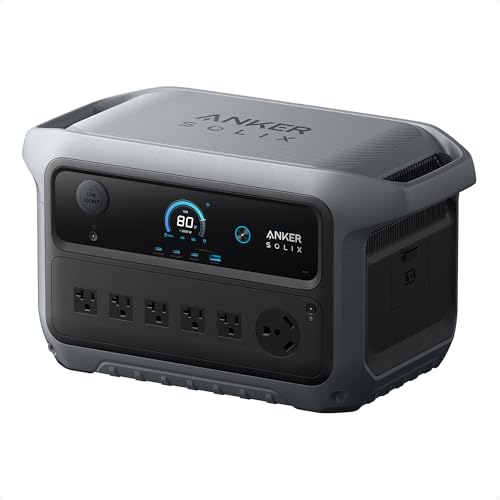
Edge: Anker · Pick: Anker SOLIX C1000 Gen 2 (92/100)
The C1000 Gen 2's 2,000W inverter runs loads the Jackery 1000 v2 can't, such as an 1,800W electric kettle. Its 49-minute UltraFast recharge suits short outages and quick turnarounds between trips.
Amazon price: $529.99
RV and van life
Edge: Anker · Pick: Anker SOLIX C2000 Gen 2 (90/100)
The C2000 Gen 2 adds a TT-30 outlet (20A), 800W of solar and a path to about 4 kWh, at 41.7 lb. The TT-30 port is rated for 2,400W, which covers most small-trailer loads but not a rooftop air conditioner plus other loads. Read our van-life power station picks for bigger builds.
Amazon price: $1,499.00

Lightest 2 kWh to keep in the car
Edge: Jackery · Pick: Jackery Explorer 2000 v2 (87/100)
If you want 2 kWh without managing expansion packs or big solar arrays, the Explorer 2000 v2 is the lighter, simpler box at 39.5 lb. Pair it with up to 400W of panels.
Amazon price: $999.00

Home backup you can grow
Edge: Anker · Pick: Anker SOLIX F3000 (93/100)
The F3000 matches the HomePower 3000's 3,600W of output and adds 2,400W of solar plus expansion to about 12.3 kWh on one unit. Pair two F3000s through Anker's Double Voltage Hub for 240V. For planning, see our home backup picks.
Amazon price: $1,699.99

Essential home backup in a lighter box
Edge: Jackery · Pick: Jackery HomePower 3000 (87/100)
The HomePower 3000 delivers the same 3,072 Wh and 3,600W in a unit about 32 lb lighter, with transfer-switch support for up to six circuits. That covers a fridge, furnace blower, lights and internet through an outage. Have a qualified electrician install any transfer switch.
Amazon price: $1,499.00
Pros, Cons and Who Should Skip Each Brand
Jackery
- ✓ Lighter model in every pair we compare, by up to 32 lb at 3 kWh
- ✓ Top-scoring 1 kWh station in our ratings (Explorer 1000 v2)
- ✓ 240V from one unit and 60 kWh expansion at the flagship size (5000 Plus)
- ✗ 400W solar limit on the fixed 1–2 kWh Explorer v2 models
- ✗ No expansion on the 1000 v2, 2000 v2 or HomePower 3000
Skip Jackery if you'll recharge mainly from a large solar array, or you want a 2–3 kWh unit you can add batteries to later.
Anker SOLIX
- ✓ More continuous output at 1 kWh and 2 kWh
- ✓ 1.5× to 2.4× the solar input from 1 kWh up
- ✓ Expansion on the C2000 Gen 2 and F3000; 10 ms UPS listed on the C-series Gen 2
- ✗ Heavier in every pair, most at 3 kWh (91.5 lb F3000)
- ✗ F3000 needs a second unit for 240V
Skip Anker if every pound counts on a carry-in campsite, or you need a 3 kWh unit one person can lift.
More Brand Comparisons
Our other head-to-heads use the same size-by-size format. Jackery vs EcoFlow and Jackery vs Bluetti cover Jackery's other big rivals, and Anker SOLIX vs EcoFlow and Bluetti vs Anker SOLIX do the same for Anker. Our full brand comparison puts every brand side by side. If you've already settled on Jackery, which Jackery should I buy narrows the choice to one model. Both brands have historically run their biggest discounts around Black Friday, so see our Jackery and Anker SOLIX deal pages before you buy.
Jackery vs Anker: Frequently Asked Questions
Which is better, Jackery or Anker?
Neither wins at every size. Jackery is lighter in every pair we compare and has the highest-scoring 1 kWh unit in our ratings (Explorer 1000 v2, 93/100). Anker lists more continuous output at 1 kWh and 2 kWh, more solar input from 1 kWh up, and expansion on its 2 kWh and 3 kWh models. Its F3000 scores 93/100 against 87/100 for the HomePower 3000. Choose Jackery to carry it, and Anker for solar charging, higher-wattage loads or a system you'll grow.
Jackery 1000 v2 vs Anker C1000 Gen 2: which should I buy?
Buy the Jackery Explorer 1000 v2 if weight matters most. It's about 1.6 lb lighter, holds the same energy (1,024 Wh each) and scores 93/100 against 92/100 in our matrix. Buy the Anker SOLIX C1000 Gen 2 if you need 2,000W of continuous output, 600W of solar input or the fastest wall recharge (49 minutes in UltraFast mode, per Anker). Neither can be expanded.
Jackery 2000 v2 vs Anker C2000 Gen 2: which is better?
The Anker C2000 Gen 2 scores higher in our matrix (90/100 vs 87/100). It has 2,400W of output against 2,200W and 800W of solar against 400W. It also adds a TT-30 RV outlet (20A) and expands to about 4 kWh. The Jackery Explorer 2000 v2 is about 2 lb lighter and keeps things simple with a fixed capacity.
Is Anker or Jackery better for home backup?
At 3 kWh, the Anker SOLIX F3000 if you want to grow the system, and the Jackery HomePower 3000 if you want the lighter unit. Both have 3,072 Wh, 3,600W of 120V output and a 30A TT-30 outlet. The F3000 adds 2,400W of solar and expands to about 12.3 kWh on one unit. Two paired F3000s give 240V and about 24.6 kWh. The HomePower 3000 is about 32 lb lighter and supports a transfer switch for up to six circuits, but it can't be expanded. For 240V from one unit, look at the Jackery 5000 Plus or the Anker F3800 Plus and S5000.
Do Jackery and Anker both use LiFePO4 batteries?
Yes. Every Anker SOLIX and Jackery model on this page, including the small Explorer 300, is listed with LiFePO4 (LFP) chemistry. Published cycle ratings use different thresholds: Jackery rates the Explorer 1000 v2 and HomePower 3000 at 4,000 cycles to 70%, and Anker rates the C1000 Gen 2 and C2000 Gen 2 at 4,000 cycles to 80%. These are manufacturer figures, so they aren't directly comparable.
Which brand charges faster from solar?
Anker, from 1 kWh up: 600W on the C1000 Gen 2, 800W on the C2000 Gen 2 and 2,400W on the F3000. Jackery accepts 400W on the Explorer 1000 v2 and 2000 v2 and 1,000W on the HomePower 3000. Among the older expandable models, the Jackery Explorer 2000 Plus (1,400W) beats the Anker F2000 (1,000W).
What warranty do Jackery and Anker offer?
It depends on the model, region and seller. Jackery says eligible power stations bought on Jackery.com get a free two-year extension on top of the standard warranty, which retailers describe as three years plus two. Anker's C300 page lists five years. The C1000 Gen 2 and C2000 Gen 2 pages we checked don't state a term. Confirm the warranty on the specific listing before you buy.
Can I use Anker solar panels with a Jackery, or mix their batteries?
You can't mix batteries. Expansion batteries work only with their own brand and model family. Mixing solar panels is possible within each station's input voltage and current limits, but the plugs differ by brand, so you may need a compatible adapter. Check the input range in the station's manual first.
Still Torn? Start With the 1 kWh Pair
Most buyers end up choosing between the Explorer 1000 v2 and the C1000 Gen 2. Compare today's prices, then decide between lighter weight and higher output.