
Head-to-Head · Updated November 2026
Jackery Explorer 300 vs 300 Plus: Which One to Buy
The short answer
- Buy the Explorer 300
- Today’s Explorer 300 is 292Wh of LiFePO4 with two AC outlets at 7.5 lb, and it is the one Jackery sells on Amazon [4][5].
- The 300 Plus is the app model
- 288Wh LiFePO4, one AC outlet, a 100W two-way USB-C port, app control and a 20 ms EPS mode at 8.27 lb [1][3]. Its Amazon listing showed “Currently unavailable” when we checked on November 9, 2026.
- Same inverter
- Both are rated 300W with a 600W peak, so they run the same devices; runtimes differ by minutes.
Jump to the spec table, runtimes or who should buy which.
As an Amazon Associate, SolarGenAdvisor earns from qualifying purchases made through links on this page, at no additional cost to you.
 By
Specs Side by Side
The Explorer 300 column comes straight from our product data for the listing Jackery sells on Amazon. The 300 Plus column comes from Jackery’s own manual, cross-checked against independent write-ups [1][2][3][4]. A dash means we could not confirm the figure from two sources.
| Spec | Explorer 300 (on Amazon) | Explorer 300 Plus |
|---|---|---|
| Capacity | 292 Wh | 288 Wh |
| Chemistry | LiFePO4 | LiFePO4 |
| Rated cycles | 4,000+ to 70% | 3,000 to 80% (manual); Jackery also cites 4,000 to ~70% |
| AC output | 300W (600W peak) | 300W (600W peak) |
| AC outlets | 2 | 1 |
| USB-C | 1 × 100W PD | 1 × 100W (in/out) + 1 × 15W |
| USB-A | 2 | 1 × 15W |
| 12V car port | Yes | Yes, 12V/10A |
| Solar input | 100W | 100W (via USB-C, 12–27V) |
| Weight | 7.5 lb | 8.27 lb |
| UPS / EPS | — (no switchover figure published) | EPS, within 20 ms (Jackery: “non-professional UPS”) |
| App | Not listed | Jackery app (Wi-Fi + Bluetooth) |
| Warranty | — | 3 years, plus 2 on registration |
| Our score | 87/100 | — (not in our Amazon product data) |
| Amazon price | $289.00 | Listing “Currently unavailable” (Nov 9, 2026) |
Explorer 300 ports, cycles and weight: Jackery’s Amazon listing, BackupPowerHub and The Gadgeteer [4][5]. 300 Plus: Jackery’s manual (ports, cycles, EPS, warranty), RV.com and BackupPowerHub [1][3][4]. One reviewer lists both 300 Plus USB-C ports at 100W; we follow Jackery’s manual (one 100W, one 15W). We found no two-source warranty term for the current Explorer 300, so check the listing.
5 Differences That Matter
- Outlets. The Explorer 300 has two AC outlets and the 300 Plus has one, so the 300 can run a CPAP and a lamp off the inverter at once. Both cap AC output at 300W either way.
- Weight. 7.5 lb against 8.27 lb: the Explorer 300 is 0.77 lb lighter.
- USB-C and charging. The 300 Plus charges through its 100W USB-C port (a solar panel or a USB-C charger) and also takes AC in; the Explorer 300 has one 100W USB-C output [1][4].
- App and EPS. Only the 300 Plus lists app control and a documented emergency switchover (within 20 ms). Jackery’s manual calls it a non-professional UPS function and warns against using it for equipment that needs uninterrupted power [1].
- Availability. The Explorer 300 is in stock on Amazon from Jackery. The 300 Plus listing showed “Currently unavailable” on November 9, 2026, and BackupPowerHub reports Jackery US no longer sells it [4]. We found no formal discontinuation notice.
Capacity is not a real difference: 292Wh vs 288Wh is about 1%. If you’re new to the unit, our watt-hour explainer shows how capacity turns into runtime.
Runtime Examples
We plan runtime as rated Wh × 0.85 ÷ device watts, allowing for conversion losses. That gives about 248 usable Wh on the Explorer 300 and 245 Wh on the 300 Plus. Device draws are typical planning figures, not measurements; check your own device’s label.
| Device | Typical draw | Explorer 300 | 300 Plus |
|---|---|---|---|
| CPAP, humidifier off | ~30W | ~8.3 h | ~8.2 h |
| CPAP, heated humidifier on | ~60W | ~4.1 h | ~4.1 h |
| LED camp lantern | ~10W | ~25 h | ~24 h |
| Laptop (charging + use) | ~60W | ~4.1 h | ~4.1 h |
| Wi-Fi router + modem | ~20W | ~12 h | ~12 h |
| 12V cooler (average) | ~45W | ~5.5 h | ~5.4 h |
| 32″ TV | ~50W | ~5.0 h | ~4.9 h |
| Phone charges | ~12 Wh each | ~20 | ~20 |
The 300W ceiling matters more than the 4 Wh gap. Kettles, hair dryers, coffee makers and space heaters are beyond both. A CPAP without the heated humidifier gets through a night on either; with the humidifier on, plan on a bigger battery, as our CPAP power station guide explains.
Charging Times
These are Jackery’s published figures as reported by the sources cited, not our measurements. Real solar times run longer in clouds, heat or with a tilted panel.
| Method | Explorer 300 | 300 Plus |
|---|---|---|
| Wall outlet | — (no figure for this version confirmed by two sources) | About 2 h [3][4] |
| 100W solar panel | About 2.8 h to 80% (Jackery) [4] | 100W max input [1][4]; about 2.9 h at a steady 100W before losses (our arithmetic) |
| 12V car socket | — | About 5.5 h [3][4] |
Panel compatibility differs: the 300 Plus takes solar through USB-C with a DC7909-to-USB-C adapter, per Jackery’s manual [1]. Check the connector and voltage before buying a third-party panel.
Best For: CPAP, Camping, Laptops
One CPAP night
Tie. At ~30W with the humidifier off, both give about ~8.3 h. The Explorer 300’s second outlet lets a phone charger or lamp share the inverter; the 300 Plus’s EPS can sit on wall power and switch over if the grid drops.
Tent and car camping
Explorer 300: lighter at 7.5 lb, with two AC outlets and a car port for a 12V cooler. Our under-$500 guide ranks it against other small stations.
Phones and laptops
Both have a 100W USB-C port, enough for most laptops without the inverter. If you only charge a laptop and phone, or need something you can fly with, a laptop power bank under 100Wh is the right tool.
App monitoring
300 Plus only, if you find one. In-stock 300 Wh stations with a published UPS switchover are listed below.
Who Should Buy Which
Explorer 300 if you…
- ✓ Want to buy new today from Jackery on Amazon
- ✓ Need two AC outlets
- ✓ Carry it by hand and want the lighter unit
- ✓ Don’t need an app
300 Plus if you…
- ✓ Find one new or refurbished at a fair price
- ✓ Want app monitoring and a documented 20 ms EPS
- ✓ Like recharging over USB-C from a laptop-style charger
- ✓ Value Jackery’s 3-year (plus 2 on registration) warranty terms
Our verdict
Get the Explorer 300. It matches the 300 Plus on chemistry, inverter rating and capacity, adds a second AC outlet, weighs less, and is the version you can order new on Amazon. The 300 Plus is a sound choice too, but only if you find one and want its app and EPS. Neither replaces a 1 kWh station for a fridge or heated humidifier. Full details are in our Jackery Explorer 300 review.
Explorer 290, 300D and the Original 300
Original Explorer 300. The first Explorer 300 was a 293Wh lithium-ion unit at 7.1 lb [6][4]. If a used or third-party listing says 293Wh, it is that older model, not today’s LiFePO4 version.
Explorer 290. A 290Wh lithium-ion model with a 200W inverter (400W surge) and one AC outlet at 7.5 lb, per Jackery’s manual; BackupPowerHub reports it is discontinued [7][8]. Both 300s add 100W of continuous output and LiFePO4 cells. The smaller Explorer 240 is an older 200W-class model too; we did not find enough current US sources to compare it in detail.
Explorer 300D. A newer DC-only model: 288Wh LiFePO4 with USB-C, USB-A and 12V outputs but no AC outlet, at about 2.5 kg (5.5 lb) [9][10]. It suits phones, laptops and a 12V CPAP cord, but not anything with a wall plug. It is not in our Amazon product data, so this page has no score or Amazon link for it.
Every current model, small to whole-home, is compared in our Jackery solar generator guide.
As a Holiday Gift
A small Jackery makes sense for a camper, a CPAP user or anyone who loses power a few times a year. Give the Explorer 300: it is the one you can order new, it has no app to set up, and at 7.5 lb it is easy to hand over. It is currently $289.00 on Amazon. Our Jackery Black Friday page lists the rest of the lineup with live prices.
In-Stock 300 Plus Alternatives
If you wanted the 300 Plus for its UPS-style switchover, these two LiFePO4 stations in the same size class publish a 10 ms switchover and were in stock on Amazon at our last check.
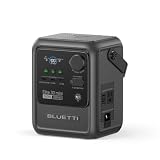
288Wh · 300W (600W peak) · 7.3 lb. Same 288Wh LiFePO4 and 300W (600W surge) class as the 300 Plus, a touch lighter than the Explorer 300, with a published 10 ms UPS switchover and a built-in retractable USB-C cable.
Price: $219.99

288Wh · 300W (600W peak) · 9.1 lb. Three AC outlets, two 140W USB-C ports, a 10 ms UPS and a 5-year warranty, sold on Amazon with a 60W panel; heavier than either Jackery.
Price: $499.99
Explorer 300 vs 300 Plus FAQ
What is the difference between the Jackery Explorer 300 and 300 Plus?
Both are LiFePO4 stations rated 300W with a 600W peak. The Explorer 300 sold on Amazon has 292Wh, two AC outlets, one 100W USB-C port and weighs 7.5 lb. The 300 Plus has 288Wh, one AC outlet, a 100W two-way USB-C port plus a 15W USB-C, app control and a 20 ms EPS mode, and weighs 8.27 lb.
Which is better, the Jackery 300 or the 300 Plus?
For most buyers, the Explorer 300: same inverter and chemistry, one more AC outlet, 0.77 lb lighter, and it is the one in stock on Amazon. The 300 Plus is worth it if you find one and want its app and emergency switchover.
Is the Jackery Explorer 300 Plus discontinued?
We found no formal notice from Jackery. Its Amazon listing showed “Currently unavailable” on November 9, 2026, and BackupPowerHub reports that Jackery US no longer sells it. Treat it as hard to find new.
Can the Jackery 300 or 300 Plus run a CPAP all night?
Usually, with the heated humidifier off. At about 30W, Wh × 0.85 ÷ 30 gives roughly ~8.3 h on the Explorer 300 and ~8.2 h on the 300 Plus. With the humidifier on (about 60W), it drops to about ~4.1 h, short of a full night.
How long do they take to charge?
The 300 Plus charges from a wall outlet in about 2 hours and from a 12V car socket in about 5.5 hours, and it accepts up to 100W of solar through USB-C. Jackery quotes about 2.8 hours to 80% for the Explorer 300 on a 100W panel; we could not confirm a wall-charge time for the current Explorer 300 from two sources.
Does either one work as a UPS?
The 300 Plus has an EPS mode that switches to battery within 20 ms, and Jackery’s manual calls it a non-professional UPS function without 0 ms switching, so don’t rely on it for desktop PCs or medical equipment that cannot tolerate any interruption. We found no published switchover figure for the current Explorer 300.
What is the Jackery Explorer 300D?
A DC-only sibling: 288Wh of LiFePO4 with USB-C, USB-A and a 12V socket but no AC outlet, at about 2.5 kg (5.5 lb). It suits phones, laptops and 12V devices; choose the Explorer 300 if you need a wall-style plug.
Is the Explorer 300 the same as the Explorer 290?
No. The Explorer 290 is an older 290Wh lithium-ion model with a 200W inverter (400W surge) and one AC outlet. Both current 300-class models use LiFePO4 and a 300W inverter. A 293Wh Explorer 300 is the original lithium-ion version, not today’s model.
Can I take a Jackery 300 or 300 Plus on a plane?
No. The FAA forbids lithium batteries over 160Wh on passenger aircraft, in carry-on or checked bags, and both are close to 300Wh. Batteries of 101–160Wh need airline approval, so a laptop power bank under 100Wh is the travel option.
Is a Jackery 300 a good gift?
For a camper, a CPAP user or someone who wants outage backup for a phone, router and lights, yes. The Explorer 300 is the easier gift because it is sold new on Amazon and needs no app setup. It will not run a fridge overnight or anything with a heating element.
Air travel rules: [11]
Sources
Explorer 300 specs come from our product data, which follows Jackery’s Amazon listing for this model; 300 Plus specs come from Jackery’s manual and the reviews below. Runtimes are our arithmetic on those figures. Our score is AI-synthesized from published specs, logged Amazon prices and Amazon customer reviews; nothing here was measured by us. Last reviewed November 18, 2026.
- Jackery, Explorer 300 Plus user manual (model JE-300B): 288Wh, about 8.27 lb, 3,000 cycles to 80%+, 300W rated / 600W surge, one 100W two-way USB-C and one 15W USB-C, 15W USB-A, 12V/10A car port, 100W USB-C solar input, EPS switchover within 20 ms, Jackery app, 3-year warranty plus 2 years on registration
- Jackery, Explorer 300 Plus spec page (Philippines site)
- RV.com, Jackery Explorer 300 Plus review (Sep 2023): 288Wh LiFePO4, 8.27 lb, about 2 hours from a wall outlet, about 5.5 hours from a 12V car port, app control
- BackupPowerHub, Jackery Explorer 300 vs 300 Plus (Nov 2026): current Explorer 300 at 292Wh LFP, two AC outlets, one 100W USB-C, two USB-A, 7.5 lb, 4,000+ cycles to 70%, about 2.8 h to 80% on a 100W panel; 300 Plus no longer sold by Jackery US
- The Gadgeteer, Jackery Explorer 300 (292Wh LiFePO4, 7.5 lb), July 2026
- Notebookcheck, original Jackery Explorer 300 (293Wh lithium-ion, 7.1 lb)
- Jackery, Explorer 290 manual sheet: 290Wh lithium-ion, 200W continuous / 400W surge, 7.5 lb
- BackupPowerHub, Jackery Explorer 290 vs 300 (Explorer 290 discontinued; 200W, lithium-ion)
- Jackery UK, Introducing the Explorer 300D: DC-only, 288Wh LiFePO4, USB-C/USB-A/12V outputs, 300W total, 2.5 kg
- T3, Jackery Explorer 300D announcement (DC-only power station, 288Wh LiFePO4, 2.5 kg)
- FAA PackSafe, Lithium batteries (over 160Wh forbidden on passenger aircraft; 101–160Wh needs airline approval)