
Head-to-Head · Updated November 2026
EcoFlow Delta 2 vs Delta 3: What Changed, and What to Buy Now
Short answer: the Delta 3 is the direct replacement. It keeps the Delta 2's 1,024 Wh, 1,800W output and 500W solar input. It adds a higher surge rating (3,600W vs 2,700W), a full wall charge in 56 minutes instead of 80, a sub-10 ms UPS instead of about 30 ms, and expansion to about 5 kWh instead of 3 kWh. Amazon listed the Delta 2 as "Currently unavailable" when we checked on November 7, 2026, so the real choice is the Delta 3, the Delta 3 Plus or the cheaper Delta 3 Classic.
As an Amazon Associate, SolarGenAdvisor earns from qualifying purchases made through links on this page, at no additional cost to you.
 By Jordan Park
Reviewed & approved by Juhi Sahni
|
Published: November 7, 2026
|
Updated:
|
Which EcoFlow Delta
Quick Verdict: Delta 2 or Delta 3?
EcoFlow Delta 2
Not rated · Currently unavailable on Amazon
- ✓ Same 1,024 Wh and 1,800W continuous output as the Delta 3
- ✓ Two more outputs (15 vs 13), from an extra pair of USB-A ports
- ✓ Can take a Delta 3 Series Smart Extra Battery, so owners have an upgrade path
- ✗ About 30 ms switchover, slower wall charging and a lower surge rating
- ✗ No new-condition Amazon offer when we checked, so we don't link it or quote a price
Keep yours if it still holds its charge and a 30 ms switchover doesn't bother your gear. Add a battery (below) rather than replace it.
EcoFlow Delta 3 — the winner
88/100 in our scoring
- ✓ 3,600W surge against 2,700W, for motors and compressors that spike at start-up
- ✓ 1,500W AC charging, full in 56 minutes (EcoFlow figure)
- ✓ Sub-10 ms UPS switchover for routers, PCs and NAS boxes
- ✓ Expands to about 5 kWh, and is rated for 4,000 cycles to 80% vs 3,000+
- ✗ Still only 500W of solar input. For more, see the Delta 3 Plus
Bottom line
If you're buying new, buy the Delta 3. It's the same size of battery with faster charging, a real UPS and more room to expand. Pay more for the Delta 3 Plus only if you'll charge from a large solar array. Save with the Delta 3 Classic only if you'll never add a battery. Already own a Delta 2? You probably don't need to replace it.
How we compare: our ratings and verdicts are AI-synthesized from manufacturer specs, published figures, logged Amazon prices and Amazon customer reviews. They're scored on the six-dimension matrix in our awards methodology. We did not test these units ourselves. The Delta 2 has no score because it's no longer sold new on Amazon.
Delta 2 vs Delta 3 Specs Side by Side
These are published figures. Delta 3 capacity, output, surge, weight and solar input come from our product database. Everything else comes from EcoFlow's listings and the spec sheets cited under the table. A check mark marks the stronger unit on that row.
| Spec | Delta 2 | Delta 3 |
|---|---|---|
| Capacity | 1,024 Wh | 1,024 Wh |
| Continuous AC output | 1,800W | 1,800W |
| Surge | 2,700W | 3,600W ✓ |
| Outputs | 15 outputs, including 6 AC ✓ | 13 outputs, including 6 AC |
| USB-C | 2 × 100W | 2 × 100W |
| AC charging | 1,200W; 0–80% in 50 min, full in 80 min | 1,500W; full in 56 min ✓ |
| Solar input | 500W (11–60V, 15A, one input) | 500W (11–60V, one input) |
| UPS switchover | About 30 ms (EPS, per retailer listings) | Under 10 ms ✓ |
| Expansion | One extra battery: about 2 kWh (Delta 2 or Delta 3 Series pack) or about 3 kWh (Delta Max pack) | One extra battery: about 2 kWh (Delta 3 or Delta 2 pack), about 3 kWh (Delta 2 Max pack) or about 5 kWh (Delta Pro 3 pack) ✓ |
| Rated cycles (published) | 3,000+ to 80% | 4,000 to 80% ✓ |
| Chemistry | LiFePO4 (LFP) | LiFePO4 (LFP) |
| Weight | 27 lb (12 kg) ✓ | 27.6 lb |
| Dimensions | 15.7 × 8.3 × 11 in | 15.7 × 8.0 × 11.2 in |
| SolarGenAdvisor score | Not rated | 88/100 |
| Price per Wh (today) | — | — |
| Amazon price | Currently unavailable | Check price at Amazon → |
Sources (checked November 7, 2026): Delta 2 figures come from EcoFlow's Amazon listing (1,024Wh, 1,800W, 500W solar, 0–80% in 50 min, 0–100% in 80 min, 1–3 kWh, 3,000+ cycles, 15 outputs), the EcoFlow DELTA 2 spec sheet (2,700W surge, 1,200W AC charging, 11–60V 15A solar, one DELTA 2 or DELTA Max extra battery, 12 kg / 27 lb, 400 × 211 × 281 mm) and MakeUseOf's Delta 2 review (same surge, solar, weight and one-battery limit). The Delta 2's EcoFlow listing gives no switchover time; the 30 ms figure is from retailer listings such as Inet. Delta 3 figures come from EcoFlow's Amazon listing, the Solaris spec table for the EFDELTA3-US (27.6 lb, 3,600W surge, 1,500W AC in, 11–60V 500W solar, under 10 ms, 13 outputs, 5 kWh with four extra-battery families) and WebstaurantStore's EFDELTA3-US listing (10 ms or less, same battery families). solarkontor's DELTA 3 series check confirms one solar input on the Delta 3 against two on the Plus. We left out X-Boost because the Delta 3's sources disagree (2,200W in the Solaris spec table, "over 2,600W" in EcoFlow's marketing copy).
What Changed From the Delta 2 to the Delta 3
EcoFlow kept the size and moved almost everything around the battery forward. Here's each change and what it means in use.
Capacity and output: same battery, more surge
Both hold 1,024 Wh and run 1,800W continuously, so day-to-day runtime is the same. The difference is surge: 3,600W on the Delta 3 against 2,700W on the Delta 2. Surge is the short burst a fridge compressor, pump or power tool pulls as it starts. More headroom means fewer overload trips with those loads, though it doesn't raise the 1,800W you can run continuously.
Charging: full in 56 minutes instead of 80
The Delta 3 accepts up to 1,500W from the wall, against 1,200W on the Delta 2. EcoFlow quotes a full charge in 56 minutes for the Delta 3. For the Delta 2 it quotes 50 minutes to 80% and 80 minutes to full. In practice, both refill between storms or overnight. The Delta 3 matters most when you need to top up quickly between outages or before you leave for a trip.
Solar: unchanged at 500W
This is the one spec that didn't move. Both units take up to 500W of solar on a single 11–60V input. In full sun, 500W refills 1,024 Wh in about 2 hours at best, and real-world charging usually takes longer. If solar is your main charging source, the Delta 3 Plus is the upgrade that matters, with 1,000W across two inputs. Our Delta 3 Plus review covers it in full.
UPS: under 10 ms vs about 30 ms
Plugged into the wall, both pass power through and switch to battery when the grid drops. The Delta 3 is listed at under 10 ms. The Delta 2's EPS switchover is about 30 ms, per retailer listings. The shorter the gap, the less chance a desktop PC, router or NAS restarts when the grid drops. If a desk or network setup is the reason you're buying, that alone favors the Delta 3. Neither is rated as a zero-transfer UPS for medical equipment; see our power station vs UPS guide.
Expansion and battery compatibility
Each unit has one extra-battery port. The Delta 2 takes one Delta 2 Extra Battery (about 2 kWh total) or one Delta Max Extra Battery (about 3 kWh total), but not both, per EcoFlow's spec sheet and MakeUseOf. The Delta 3 takes one pack from a wider list: a Delta 3 or Delta 2 extra battery (about 2 kWh), a Delta 2 Max extra battery (about 3 kWh) or a Delta Pro 3 Smart Extra Battery (about 5 kWh).
The Delta Pro 3 pack claim checks out. The Delta 3's Amazon listing says it expands "up to 5kWh with DELTA 3, DELTA Pro 3, and DELTA 2 Max battery packs." That is unusual for a 1 kWh unit, so we checked it. The Solaris and WebstaurantStore spec listings for the US model (EFDELTA3-US) both name the Delta Pro 3 extra battery as compatible. StorageReview's Delta 3 Plus spec table lists the same pack as the route to 5 kWh on the Plus. The 5 kWh figure is simply 1,024 Wh plus the Delta Pro 3 pack's 4,096 Wh. That pack is a large, heavy battery built for the Delta Pro 3, so for most owners the Delta 2 Max pack is the more practical 3 kWh route. We couldn't reach EcoFlow's own US site to confirm it a third way, so check the listing for your exact pack before you buy.
Two traps to know about: the Delta 3 Classic has no extra-battery port at all, and the Delta 3 Max can't be expanded either. For every pack-and-station pairing in the Delta lineup, see our EcoFlow extra battery guide; for other brands, our expandable power station guide.
Battery life and build
Both use LiFePO4 cells. EcoFlow rates the Delta 3 for 4,000 cycles to 80% capacity and the Delta 2 for 3,000+, and both listings mention five years of EcoFlow customer service. These are manufacturer figures. At one full cycle a day, either rating is many years of use. The Delta 3 is a little heavier (27.6 lb vs 27 lb) and has two fewer outputs, because it drops the Delta 2's second pair of USB-A ports. Both keep six AC outlets, two 100W USB-C ports and a 12V car socket.
Already Own a Delta 2? Expand It Before You Replace It
If your Delta 2 still holds its charge, the cheapest upgrade is more battery, not a new station. EcoFlow's Delta 3 Series Smart Extra Battery (1,024 Wh) lists the Delta 2 as compatible, alongside the Delta 3, Delta 3 Plus and Delta 3 1500. It also lists the Delta 3 Classic as not compatible. That doubles a Delta 2 to about 2 kWh on its one extra-battery port. EcoFlow says the Delta 3 pack is about a third smaller and lighter than the old Delta 2 Extra Battery. Adorama's listing gives the same Delta 2 compatibility.

EcoFlow Delta 3 Series Smart Extra Battery (1,024 Wh)
Fits the Delta 2, Delta 3 and Delta 3 Plus, per its listing. It doesn't fit the Delta 3 Classic. Not rated: we score power stations, not add-on packs.
When replacing makes more sense: your Delta 2 is reset by 30 ms outages on a PC or network rack, you want past 3 kWh, or the battery has noticeably faded. In those cases the Delta 3 fixes the switchover and the ceiling. You can keep the Delta 2 as a second station for the garage or the car. If you're buying a used or refurbished Delta 2 instead, our refurbished solar generator guide covers what to check and how big the discount needs to be.
Delta 3 vs Delta 3 Plus vs Delta 3 Classic: Which Replacement?
All three hold 1,024 Wh and run 1,800W. They differ in solar input, expansion and price. Specs come from our product database and prices update from Amazon.
| Spec | Delta 3 | Delta 3 Plus | Delta 3 Classic |
|---|---|---|---|
| Capacity / output | 1,024 Wh / 1,800W | 1,024 Wh / 1,800W | 1,024 Wh / 1,800W |
| Surge | 3,600W | 3,600W | 3,600W |
| Max solar input | 500W (11–60V, one input) | 1,000W (two 500W inputs) | 500W (one input) |
| Expansion | One extra battery: about 2 kWh (Delta 3 or Delta 2 pack), about 3 kWh (Delta 2 Max pack) or about 5 kWh (Delta Pro 3 pack) | Same packs as the Delta 3, to about 5 kWh | None (no extra battery port) |
| UPS | Under 10 ms | Under 10 ms | Under 10 ms |
| USB-C | 2 × 100W | Up to 140W | 100W |
| Weight | 27.6 lb | 27.6 lb | 26.7 lb |
| SolarGenAdvisor score | 88/100 | 89/100 | 86/100 |
| Price per Wh (today) | — | $0.70/Wh | $0.45/Wh |
| Amazon price | Check price at Amazon → | $719.00 | $462.00 |

Best Delta 2 replacement
EcoFlow Delta 3
88/100 in our scoring
The like-for-like upgrade: same size and solar input as the Delta 2, plus the faster charging, sub-10 ms UPS and 5 kWh ceiling. The right pick for most Delta 2 shoppers.

Best for solar charging
EcoFlow Delta 3 Plus
89/100 in our scoring
Doubles solar input to 1,000W over two inputs and adds faster USB-C, with the same battery options. It also scores highest of the three (89/100). Worth the extra only if you'll run a big array. Read the Delta 3 Plus review.
Amazon price: $719.00
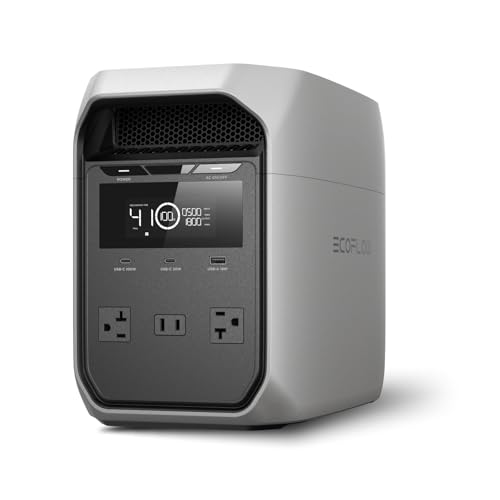
Lowest cost, no expansion
EcoFlow Delta 3 Classic
86/100 in our scoring
Same 1,024 Wh and sub-10 ms UPS for less, but only three AC outlets, no 12V car socket and no extra-battery port. Buy it only if 1 kWh will always be enough. Read the Delta 3 Classic review.
Amazon price: $462.00
Delta 2 vs Delta 3 Plus
The Plus fixes the Delta 2's biggest limit, its 500W solar ceiling. It takes 1,000W over two inputs, so a large array can refill it in about half the time in full sun. It shares the Delta 3's 1,500W wall charging, sub-10 ms UPS and 5 kWh expansion list. It weighs 27.6 lb and scores 89/100 in our scoring against 88/100 for the Delta 3; compare price per Wh in the table above. Pick the Plus if you camp off-grid or charge from a roof-style array. Otherwise the plain Delta 3 covers the same jobs.
Delta 2 vs Delta 3 Max (and the Delta 2 Max)
If you've outgrown 1 kWh, compare 2 kWh stations rather than adding a pack. The Delta 3 Max (85/100) doubles capacity to 2,048 Wh with 2,400W of output, but it can't be expanded and keeps a single 500W solar input. The Delta 3 Max Plus (87/100) adds 3,000W of output, 1,000W of solar and expansion. The previous-generation Delta 2 Max (85/100) was in stock on Amazon on November 9, 2026, and it still expands to 6,144 Wh with two of its own extra batteries. Our Delta 2 Max runtime table shows what each added pack is worth in hours. Our which EcoFlow Delta should I buy guide lines up the whole family.
Runtime Math: Delta 2 and Delta 3, With and Without an Extra Battery
Estimated hours = capacity (Wh) × 0.85 ÷ load (W). The 0.85 factor allows for inverter and conversion losses. A fridge's average draw is far below its running watts because the compressor cycles, so use your own appliance's figure if you know it. Our solar size calculator does this for a full load list. Every setup below is capped at the station's 1,800W AC output.
| Setup | Router + lights (60W) | Fridge, avg (150W) | TV + laptop + fan (300W) | Microwave (1,000W) | Space heater (1,500W) |
|---|---|---|---|---|---|
| Delta 2 or Delta 3 alone (1,024 Wh) | 15 h | 5.8 h | 2.9 h | 0.9 h | 0.6 h |
| Delta 2 or Delta 3 + Delta 3 Series Extra Battery (2,048 Wh) | 29 h | 12 h | 5.8 h | 1.7 h | 1.2 h |
| Delta 2 + Delta Max Extra Battery (3,040 Wh) | 43 h | 17 h | 8.6 h | 2.6 h | 1.7 h |
| Delta 3 + Delta 2 Max Extra Battery (3,072 Wh) | 44 h | 17 h | 8.7 h | 2.6 h | 1.7 h |
| Delta 3 + Delta Pro 3 Extra Battery (5,120 Wh) | 73 h | 29 h | 15 h | 4.4 h | 2.9 h |
These are estimates, not measurements. Actual runtime varies with the appliance, temperature and the station's own idle draw. Extra-battery totals are the station's capacity plus the pack's listed capacity.
Is the EcoFlow Delta 2 Still Worth It in 2026?
As a unit you already own, yes. It has the same battery size and continuous output as the Delta 3, and it can still grow with a current extra battery. As a purchase, it's harder to justify. Amazon had no new-condition offer when we checked, so a Delta 2 today means a used, refurbished or third-party unit, and that's only worth it at a clear discount to a new Delta 3. When we checked on November 7, 2026, the Delta 3 was sold by Amazon.com and carried a limited-time deal flag. EcoFlow's Delta line has historically been discounted around Amazon sale events, but deals come and go, so compare today's price rather than counting on one. Our EcoFlow power station guide covers the rest of the lineup.
Buy the Delta 3 if…
- ✓ You want a 1 kWh station for outages, camping or a desk, and you're buying new
- ✓ You need a switchover fast enough for a PC, router or NAS
- ✓ You might add a battery later, up to about 5 kWh
Skip it if…
- ✗ Your Delta 2 works fine. Add a Delta 3 Series Extra Battery instead
- ✗ Solar is your main power source. The Delta 3 Plus takes twice the input
- ✗ You already need 2 kWh and more than 1,800W. Look at the Delta 3 Max Plus
Delta 2 vs Delta 3: Frequently Asked Questions
What is the difference between the EcoFlow Delta 2 and Delta 3?
Both hold 1,024 Wh and run 1,800W continuously, with 500W of solar input. The Delta 3 adds a higher surge rating (3,600W vs 2,700W), 1,500W wall charging with a full charge in 56 minutes (vs 80), a sub-10 ms UPS switchover (vs about 30 ms), a 4,000-cycle rating (vs 3,000+) and expansion to about 5 kWh (vs about 3 kWh). The Delta 2 has two more outputs, 15 vs 13.
Can you still buy the EcoFlow Delta 2?
Not new from Amazon. When we checked on November 7, 2026, Amazon listed the Delta 2 as "Currently unavailable" with no new-condition offer. You may find used or refurbished units elsewhere. For a new 1 kWh EcoFlow, the Delta 3 is the direct replacement.
Can I use a Delta 3 extra battery with my Delta 2?
Yes. EcoFlow's Delta 3 Series Smart Extra Battery (1,024 Wh) lists the Delta 2 as compatible, along with the Delta 3, Delta 3 Plus and Delta 3 1500. It takes a Delta 2 to about 2 kWh. The Delta 2 has one extra-battery port, so you can add one pack, not two. The same pack does not fit the Delta 3 Classic.
Does the Delta 3 work with Delta Pro 3 batteries?
Yes, according to EcoFlow's Amazon listing and US retailer spec listings for the EFDELTA3-US. One Delta Pro 3 Smart Extra Battery (4,096 Wh) takes the Delta 3 to about 5 kWh, the highest figure EcoFlow lists for it. A Delta 2 Max extra battery gives about 3 kWh, and a Delta 3 or Delta 2 extra battery about 2 kWh. Confirm the pairing on the battery's listing before you buy.
Delta 2 vs Delta 3 Plus: which is better?
The Delta 3 Plus, on almost every spec. It takes 1,000W of solar across two inputs against the Delta 2's 500W, accepts 1,500W from the wall against 1,200W, switches over in under 10 ms and expands to about 5 kWh. It is also the highest-scoring of the three Delta 3 models on this page (89/100). If you won't use the extra solar input, the plain Delta 3 (88/100) covers the same jobs for less.
Is the EcoFlow Delta 2 worth it in 2026?
If you already own one, yes. It has the same capacity and continuous output as the Delta 3 and can still take a current extra battery. As a purchase, only at a clear discount to a new Delta 3. A used or refurbished Delta 2 gives up the faster UPS, quicker charging, higher surge and higher expansion ceiling.
Replacing a Delta 2? Start With the Delta 3
Same size, faster charging, a real UPS and a 5 kWh ceiling. Step up to the Plus only if you'll charge from a big solar array.
SolarGenAdvisor does not physically test products. Specs are published figures from the sources cited on this page, checked November 7, 2026.