
Product Review · Updated October 2026
DJI Power 2000 Review: 3,000W and 2 kWh for Base Camps, Creators and Outages
The DJI Power 2000 is a 2,048Wh LiFePO4 power station with 3,000W of continuous output, four USB-C ports, a 10 ms UPS switchover and expansion to 22,528Wh. It is DJI's biggest power station and a strong pick for base camps, vans, film sets and drone pilots who need fast field charging. The catches: it weighs about 48.5 lb with no wheels, DJI publishes no surge rating, and solar charging only works through an optional DJI adapter. It scores 86/100 in our scoring.
As an Amazon Associate, SolarGenAdvisor earns from qualifying purchases made through links on this page, at no additional cost to you.
 By
DJI Power 2000 Verdict & Quick Specs

Capacity
2,048
Wh LiFePO4
AC Output
3,000
Watts continuous (no surge listed)
Max Expansion
22,528
Wh with 10 batteries
Weight
48.5
Lbs (approx. 22 kg)
- ✓ Best for: car-camping base camps, vans, film and drone shoots, outage backup that can grow past 20 kWh
- ✗ Not for: carrying any distance, or plugging solar panels straight in without buying an adapter
Our editorial rating: 86/100 · Live price: $1,299.00
On Amazon, DJI sells the standalone Power 2000 (linked on this page) and a separate Mavic 3 Series Fast Charge Combo that bundles a drone-battery charging cable. Our links point to the standalone unit.
Who Should Buy the DJI Power 2000 (and Who Should Skip It)
Buy it if you…
- ✓ Run a car-camping base camp, van or RV and want 2 kWh that stays quiet (see quietest generators for camping)
- ✓ Fly DJI drones — the SDC ports fast-charge DJI drone batteries with the right cable
- ✓ Need 3,000W for an induction cooktop, kettle, espresso machine or power tools
- ✓ Charge laptops and cameras all day over four USB-C ports (two at 140W)
- ✓ Want a station that can grow into serious outage backup, up to 22.5 kWh
Skip it if you…
- ✗ Carry your station from the car — the Anker SOLIX C2000 Gen 2 holds the same 2,048Wh at 41.7 lb
- ✗ Want a 1 kWh weekend unit — the DJI Power 1000 V2 is about 17 lb lighter
- ✗ Charge mostly from solar and don't want a proprietary adapter — most rivals have built-in solar inputs
- ✗ Need a confirmed TT-30 RV outlet — DJI's spec sheet doesn't name one (see the FAQ)
DJI Power 2000 Specs
Core figures from our product database. The rest come from DJI's spec page and launch press release, each confirmed by at least one independent review (sources at the bottom of the page).
| Battery capacity | 2,048 Wh |
| Chemistry / cycle life | LiFePO4 (LFP), rated to keep over 80% capacity after 4,000 cycles |
| AC output | 3,000 W continuous, 4 AC outlets, 100–120 V / 25 A (US model). DJI lists no separate surge figure. |
| USB | 4 × USB-C (2 at up to 140 W, 2 at up to 65 W); 4 × USB-A (up to 24 W with one port in use) |
| SDC ports | 2 full SDC ports (drone battery charging, expansion batteries, solar and car adapters) |
| AC recharge | 0–80% in about 55 min; about 90 min to full (DJI US figures; fast mode draws up to 1,800 W) |
| Solar input | No built-in input. Up to 1,800 W through DJI's optional 1.8kW Solar/Car Super Fast Charger; up to 400 W through the smaller Solar Panel Adapter Module |
| Car charging | Up to 1,000 W with DJI's optional 1kW Super Fast Car Charger (DJI figure) |
| UPS switchover | 10 ms (DJI figure) |
| Noise | No higher than about 30 dB in Standard Recharge Mode (DJI figure) |
| Expansion | Up to 10 × DJI Power Expansion Battery 2000 (2,048 Wh each), 22,528 Wh total |
| Operating temperature | Discharge 14°F to 113°F; recharge 32°F to 113°F |
| App | DJI Home app over Wi-Fi and Bluetooth (no dongle needed) |
| Warranty | 3 years standard, with 2 more years after first connecting in the DJI Home app, per MacRumors and DJI dealer listings. Terms vary by region and seller, so check DJI's current terms. |
| Size / weight | 17.6 × 8.9 × 12.8 in; about 48.5 lb (22 kg) |
| Price now | $1,299.00 |
On surge: DJI publishes no surge rating for the Power 2000. TheSolarLab reports it handled surges of around 3,600W in its testing, but that is one reviewer's result, not a manufacturer spec. Plan loads around the 3,000W continuous rating. Our database lists surge equal to continuous for that reason.
DJI Power 2000 Solar Charging: What You Need to Buy
Like the smaller Power 1000 V2, the Power 2000 has no built-in solar input. Panels connect through an optional DJI adapter plugged into one of the two SDC ports. You have two options:
- • DJI Power 1.8kW Solar/Car Super Fast Charger: up to 1,800W of solar through its XT90 port, according to DJI's launch press release, Newsshooter and GearBrain. DJI claims a full charge in about 75 minutes at that rate. Run solar and an RV alternator together and DJI splits it into up to 1,200W solar plus 600W from the vehicle.
- • DJI Power Solar Panel Adapter Module (MPPT): MacRumors reports up to 400W per adapter, and says it is designed for DJI-certified Zignes panels. Other panels need a converter.
What this means for a camper: the 1,800W ceiling is among the highest in the 2 kWh class, and TheSolarLab calls it one of the best solar-to-battery ratios it has seen. But you pay for the adapter on top of the station, and solar shares the two SDC ports with expansion batteries and car charging. At about 70% real-world panel output, a 1,800W array would refill the battery in roughly 1.6 peak sun-hours; a more typical 400W camping kit would take about 7.3. If you want to plug panels straight in, the Bluetti Elite 200 V2 (1,200W) and Anker SOLIX C2000 Gen 2 (800W) have built-in inputs.
Panel wiring and sizing basics: solar panel setup guide.
DJI Power 2000 Expansion Battery: How Far It Scales
The Power 2000 accepts up to ten DJI Power Expansion Battery 2000 packs at 2,048Wh each, for 22,528Wh in total (DJI press release, MacRumors, TheSolarLab). That is the same expansion battery the Power 1000 V2 uses, though the smaller unit tops out at five. DJI also says the expansion battery lets the system recharge faster, at up to 3,000W combined.
For most campers one extra battery is the realistic ceiling: it doubles capacity to about 4 kWh, enough for two to three days of a camp fridge, lights and devices without any solar. Ten batteries is a home-backup or film-set configuration. Compare that with the Anker SOLIX C2000 Gen 2, which expands to about 4kWh with one Anker battery, and the base EcoFlow Delta 3 Max, which can't be expanded at all. Amazon lists the expansion battery on its own: see the Expansion Battery 2000 on Amazon.
Is the DJI Power 2000 Too Heavy for Camping? Weight and Noise
At about 48.5 lb (DJI lists 22 kg), the Power 2000 is a car-camping and base-camp station, not something you hike in. It has two fixed handles and no wheels. AppleInsider and MacRumors both list the weight as the main drawback, and MacRumors calls it impractical for camping or hiking. DJI sells a Power Series hand truck, which TechRadar reviewed alongside the unit; GearBrain notes it is offered as part of a bundle.
Context matters, though. Per watt-hour it is lighter than the Power 1000 V2 (about 42 Wh/lb vs 33 Wh/lb), and it is on par with the Bluetti Elite 200 V2 (48.5 lb). The Anker SOLIX C2000 Gen 2 (41.7 lb) and Jackery Explorer 2000 v2 (39.5 lb) are the lighter 2 kWh options.
Noise: DJI says it runs no louder than about 30 dB in Standard Recharge Mode, a manufacturer figure rather than an independent reading. Reviewers agree it is quiet: TheSolarLab calls it virtually silent, and MacRumors says it could barely hear it. That makes it easy to live with next to a tent or in a van overnight. See how battery stations compare with gas inverters in our quietest generator for camping guide.
How Long Will the DJI Power 2000 Run a Fridge, CPAP or Starlink?
Estimates use 2,048Wh × 0.85 (about 1,741Wh usable after inverter losses) divided by the load. TheSolarLab reported about 84% efficiency, so 0.85 is a fair estimate. It also reported an idle draw of about 17W with the AC inverter on, so switch AC off when you don't need it.
| Load | Typical draw | Est. runtime |
|---|---|---|
| Smartphone | ~12Wh per charge | ~145 full charges |
| CPAP (no humidifier) | ~40W | ~43.5 hrs |
| 12V camping fridge (average) | ~45W | ~38.7 hrs |
| Starlink Standard (average) | ~60W | ~29.0 hrs |
| Laptop | ~60W | ~29.0 hrs |
| Full-size fridge (average while cycling) | ~150W | ~11.6 hrs |
| Window AC (small, running) | ~500W | ~3.5 hrs |
| Induction cooktop (medium) | ~1,200W | ~1.5 hrs |
| Electric kettle | ~1,500W | ~1.2 hrs |
In practice, that is about a day and a half of a 12V camp fridge running nonstop, roughly five 8-hour CPAP nights without the humidifier, or about 11 hours of a full-size fridge in an outage. Add solar during the day and a camp fridge can run indefinitely. Starlink sizing details are in our power station for Starlink guide. The full appliance list is in what can a solar generator run.
DJI Power 2000 vs DJI Power 1000 V2
These are DJI's two current stations, and they share the same expansion battery and app. Figures below come from our database and DJI's published specs.
| Spec | Power 2000 | Power 1000 V2 |
|---|---|---|
| Capacity | 2,048 Wh | 1,024 Wh |
| Continuous output | 3,000 W | 2,600 W |
| USB-C | 2 × 140 W + 2 × 65 W | 2 × 140 W |
| AC recharge to 80% | ~55 min | ~37 min |
| Max expansion | 10 batteries, 22,528 Wh | 5 batteries, about 11.2 kWh |
| Weight | 48.5 lb | 31.3 lb |
| Our rating | 86/100 | 87/100 |
| Price | $1,299.00 | $399.98 |
Our take: pick the Power 1000 V2 for weekend camping and anything you carry more than a few steps. Pick the Power 2000 if you run multi-day base camps, power tools or induction cooking, or want outage backup without adding batteries right away. Both have historically sold below list on Amazon, so compare live prices; when the gap narrows, the 2000 gives you twice the battery. Read the full DJI Power 1000 V2 review.
DJI Power 2000 vs EcoFlow Delta 3 Max, Anker, Bluetti and Jackery
All six are 2 kWh-class LiFePO4 stations. Specs and ratings come from our product database. DJI lists no surge figure, so its surge cell reads “not listed”. The other solar figures are built-in inputs; the DJI's needs an adapter.
| Model | Capacity | Output / surge | Solar in | Weight | Rating | Price |
|---|---|---|---|---|---|---|
| DJI Power 2000 | 2,048 Wh | 3,000W / not listed | 1,800W* | 48.5 lb | 86 | $1,299.00 Check Price → |
| Anker SOLIX C2000 Gen 2 | 2,048 Wh | 2,400W / 4,000W | 800W | 41.7 lb | 90 | $999.99 Check Price → |
| Bluetti Elite 200 V2 | 2,074 Wh | 2,600W / 3,900W | 1,200W | 48.5 lb | 91 | $899.00 Check Price → |
| EcoFlow Delta 3 Max | 2,048 Wh | 2,400W / 4,800W | 500W | 45 lb | 85 | $899.00 Check Price → |
| Jackery Explorer 2000 v2 | 2,042 Wh | 2,200W / 4,400W | 400W | 39.5 lb | 87 | $999.00 Check Price → |
| EcoFlow Delta 2 Max | 2,048 Wh | 2,400W / 4,800W | 1,000W | 50 lb | 85 | $1,049.00 Check Price → |
* Via DJI's optional 1.8kW Solar/Car Super Fast Charger; up to 400W with the smaller Solar Panel Adapter Module.
vs EcoFlow Delta 3 Max: the DJI has 600W more output and expands to 22.5 kWh, while the base Delta 3 Max can't add batteries. The EcoFlow is about 3.5 lb lighter and takes solar directly through a built-in 500W input. Read the EcoFlow Delta 3 Max review.
vs Anker SOLIX C2000 Gen 2: the Anker is one of the lightest 2 kWh options here at 41.7 lb, has a TT-30 RV outlet and a built-in 800W solar input, and rates 90 in our scoring. The DJI counters with more output and much bigger expansion. See the Anker SOLIX C2000 Gen 2 review.
vs Bluetti Elite 200 V2: the same weight as the DJI with 1,200W of built-in solar and a 3,900W surge rating. It is the top-rated station in this table (91). Read the Bluetti Elite 200 V2 review.
vs Jackery Explorer 2000 v2: about 9 lb lighter, but with less output (2,200W), 400W of solar and no expansion. It suits buyers who value carrying over headroom. See the Jackery Explorer 2000 v2 review.
The whole class, ranked: best 2000Wh solar generators.
Best DJI Power 2000 Alternatives
If the Power 2000's weight, adapter-only solar or current price doesn't suit you, these 2 kWh stations rated on our site are worth a look.
Lighter, with built-in solar and a TT-30
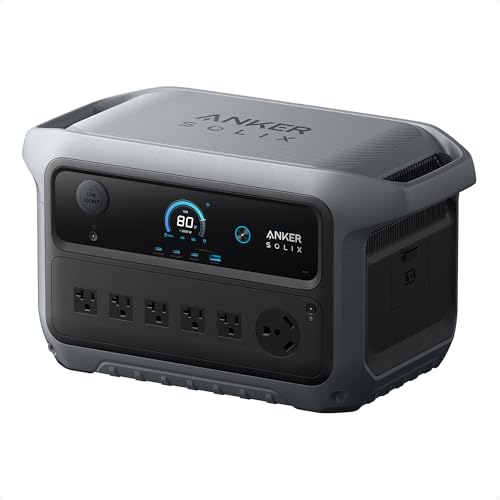
Anker SOLIX C2000 Gen 2
2,048Wh · 2,400W · 41.7 lb · 90/100
Same 2,048Wh in a lighter box, with a TT-30 RV outlet and solar that plugs straight in. Expands to about 4kWh. Full review.
Price: $999.99

Highest rated in this class
Bluetti Elite 200 V2
2,074Wh · 2,600W · 48.5 lb · 91/100
Built-in 1,200W solar input and a 3,900W surge rating at the same weight as the DJI. Full review.
Price: $899.00

The one to carry
Jackery Explorer 2000 v2
2,042Wh · 2,200W · 39.5 lb · 87/100
At 39.5 lb it is the lightest 2 kWh pick here, for buyers who move their station often. Full review.
Price: $999.00

Fast-charging, no adapters
EcoFlow Delta 3 Max
2,048Wh · 2,400W · 45 lb · 85/100
Built-in solar input and fast AC recharging, but no battery expansion. Full review.
Price: $899.00
DJI Power 2000 Pros & Cons
What We Like
- • 3,000W continuous output — the highest of the 2 kWh stations in our comparison
- • Expands to 22,528Wh with up to ten DJI expansion batteries
- • Four USB-C ports (two at 140W) plus four USB-A
- • Quiet — DJI claims about 30 dB in Standard Recharge Mode; reviewers agree
- • 10 ms UPS, 4,000-cycle LFP rating, and up to 1,800W solar with DJI's charger
What Could Be Better
- • About 48.5 lb with no wheels — a two-handed lift
- • Solar needs an optional DJI adapter — no direct panel input
- • No published surge rating
- • Only two SDC ports, shared by solar, car charging and expansion
- • Cramped AC outlets and no built-in light (TheSolarLab)
Final Verdict: Should You Buy the DJI Power 2000?
The DJI Power 2000 scores 86/100 in our scoring matrix. It is excellent on output, expandability and battery chemistry, and good on portability for its capacity. It loses points on solar charging, which needs a paid adapter, and on value at full list price. That puts it level with the EcoFlow Delta 2 Max and Delta 3 Max and a few points behind the Anker C2000 Gen 2 and Bluetti Elite 200 V2.
It is the right buy for a specific camper: someone who drives to camp, wants to run real appliances, flies DJI drones, or wants a station that can grow into serious home backup. Price is the swing factor. The Power 2000 has historically sold well below list on Amazon, and deal trackers such as Slickdeals have logged Amazon discounts of more than 40% several times since launch. That is a past pattern, not a promise, so check the live price before you decide. For lighter alternatives, see our best solar generators for camping.
DJI Power 2000 FAQ
Is the DJI Power 2000 worth it?
For campers running a base camp, van and RV travelers, film crews and DJI drone pilots who want 2 kWh with a lot of headroom, yes. It pairs 2,048Wh of LiFePO4 with 3,000W of continuous output, four USB-C ports, a 10 ms UPS switchover and expansion to 22,528Wh. Skip it if you carry your station far (about 48.5 lb, no wheels) or want to plug solar panels straight in, because solar needs an optional DJI adapter. It scores 86/100 in our scoring, and its value depends heavily on price: it has historically sold well below list on Amazon.
How much does the DJI Power 2000 weigh?
DJI lists it at approximately 22 kg, which is about 48.5 lb. TechRadar and TheSolarLab quote the same 48.5 lb, and MacRumors rounds it to about 50 lb. It has two fixed handles but no wheels. That is lighter per watt-hour than the DJI Power 1000 V2, but it is a two-handed lift from the car to the campsite.
Can the DJI Power 2000 charge from solar panels?
Yes, but only through an optional DJI adapter, because the unit has no built-in solar input. DJI's 1.8kW Solar/Car Super Fast Charger accepts up to 1,800W of solar through its XT90 port, and DJI claims a full charge in about 75 minutes at that rate. MacRumors reports that the smaller Solar Panel Adapter Module handles up to 400W and is designed for DJI-certified Zignes panels. Budget for the adapter before buying panels.
How long does the DJI Power 2000 take to charge?
DJI says the US model reaches 80% in about 55 minutes from a wall outlet using its fast charging mode, and about 90 minutes to full per Newsshooter's launch coverage. TheSolarLab reported about an hour and a half on a standard wall plug. MacRumors notes the fastest mode draws up to 1,800W and tripped a fuse on a shared 15-amp circuit, so use a dedicated outlet.
Is the DJI Power 2000 expandable?
Yes. It accepts up to ten DJI Power Expansion Battery 2000 packs (2,048Wh each) for a total of 22,528Wh, according to DJI's launch press release, MacRumors and TheSolarLab. Expansion batteries connect through the SDC ports, which are also used for solar and car charging adapters.
DJI Power 2000 vs DJI Power 1000 V2: which should I buy?
The Power 1000 V2 has half the capacity (1,024Wh) and 2,600W of output at about 31.3 lb. The Power 2000 doubles the battery to 2,048Wh, raises output to 3,000W and adds two more USB-C ports for about 17 lb more. Choose the 1000 V2 for weekend camping and carrying; choose the 2000 for multi-day base camps, outages and higher-wattage tools. In our scoring the 1000 V2 rates 87 and the 2000 rates 86.
DJI Power 2000 vs EcoFlow Delta 3 Max: which is better?
Both hold about 2 kWh of LiFePO4. The DJI has more output (3,000W vs 2,400W) and expands to 22,528Wh, while the base Delta 3 Max cannot add batteries. The EcoFlow is lighter (45 lb vs about 48.5 lb) and has a built-in 500W solar input with no adapter to buy. In our scoring the DJI rates 86 and the Delta 3 Max 85.
Does the DJI Power 2000 have a TT-30 RV outlet?
We could not confirm one. DJI's US spec sheet lists four AC outputs rated at 100-120V and 25A in total but does not name the outlet types. TheSolarLab describes one of the four as a 30A RV plug. If you plan to plug an RV shore cord in directly, check the outlet on DJI's product page or with the seller before buying.
Sources: DJI Power 2000 specs (2,048Wh LFP, 4,000 cycles to 80%, approx. 22 kg, ports, 120V/25A AC, USB-C ratings, temperatures, Wi-Fi/Bluetooth); DJI Store (3,000W output, 80% in 55 minutes, 22,528Wh expansion); DJI launch press release (1,800W solar via the 1.8kW charger, 1,000W car charging, 10 ms UPS, Standard Recharge Mode noise, ten expansion batteries); Newsshooter (US price at launch, 90 minutes to full, 30 dB); TechRadar review (dimensions, 48.5 lb, hand truck); MacRumors review (about 50 lb, 1,800W fast charging on a 15-amp circuit, 400W Solar Panel Adapter Module for Zignes panels, warranty); TheSolarLab review (about 84% efficiency, ~17W idle, ~3,600W surge in its testing, outlet layout); GearBrain review (1.8kW charger, hand truck bundle); AppleInsider review (weight as the main drawback); Heliguy DJI Power series comparison (ports, expansion count, Power 1000 V2 comparison); Slickdeals Amazon deal posts (historical discounts). SolarGenAdvisor does not physically test products. Ratings are AI-assisted syntheses of specs, Amazon pricing and published reviews, scored with our scoring matrix and reviewed by our editor.