SolarGenAdvisor SolarGenAdvisor
Award · Best Solar Generator for Off-Grid Living 2026

Anker SOLIX E10 Prime — Best Off-Grid Living 2026

The Anker SOLIX E10 Prime delivers 12,000 Wh of stackable capacity with a 10 kW turbo output — enough to run an entire off-grid cabin: refrigerator, well pump, lighting, electronics, and workshop tools simultaneously without a generator. After evaluating every off-grid-capable unit through our 6-Dimension Weighted Scoring Matrix, it scored 93/100, the highest in the off-grid living category.

AwardBest Off-Grid 2026
Score93 / 100
Capacity12,000 Wh
Turbo Output10,000 W

Proprietary Award Program — The SolarGenAdvisor Awards are the exclusive proprietary intellectual property of SolarGenAdvisor.com. Reproduction or imitation without written consent is strictly prohibited. © 2026 SolarGenAdvisor.com.

By Morgan Chen Published: July 10, 2026 Updated: Methodology

Quick Answer

The Anker SOLIX E10 Prime is SolarGenAdvisor's Best Solar Generator for Off-Grid Living 2026, scoring 93/100 on our 6-Dimension Weighted Scoring Matrix. At 12,000 Wh — expandable to 90,000 Wh — with a 10,000W turbo surge and an industry-leading 9,000W solar input, it's the only unit in our database built to fully replace grid power for a cabin, tiny house, or workshop rather than just back one up during an outage.

Award Overview

The Anker SOLIX E10 Prime has been awarded Best Solar Generator for Off-Grid Living 2026. It achieved a composite score of 93 out of 100 — the highest in the off-grid living category. With 12,000 Wh of base capacity and a massive 10 kW turbo output, the SOLIX E10 Prime can power an entire off-grid cabin: refrigerator, well pump, lighting, electronics, workshop tools, and even large appliances like washing machines. Its 9 kW solar input capability means you can recharge from a substantial solar array in a matter of hours — not days — making it the most capable off-grid power station we have tested.

When our scoring matrix applied off-grid-category weight adjustments — Capacity & Power boosted to 35, Expandability boosted to 20, Portability reduced to 5 — the SOLIX E10 Prime's massive capacity, industry-leading solar input, and modular expansion ecosystem put it ahead of every competitor. For the full methodology, see our Awards Methodology page.

Off-grid living is one of the most demanding categories in our program because it asks a power station to do what the utility grid normally does: supply every watt, every day, indefinitely. That's why Capacity & Power Output carries the single highest weight of any dimension in this category — 35 of 100 points — and Expandability & Feature Set is second at 20 points, together accounting for well over half the composite score. A camping-category unit only has to bridge a weekend; an off-grid unit has to cover today's load, tomorrow's cloudy stretch, and next year's added freezer or workshop tool without a fundamental redesign. Units that ace Portability or Value but can't scale past a single battery module get capped out of contention long before they reach the top of this category's leaderboard.

Who This Award Winner Is For

Off-grid living covers a wide range of setups, from a weekend cabin to a full-time homestead. Here's how the SOLIX E10 Prime's profile maps to the use cases our off-grid-category scoring is designed around:

Off-grid cabin owners

12,000 Wh of base capacity covers 2–4 days of typical cabin consumption (refrigerator, well pump, lighting, electronics) without any solar recharge, and the 9,000W solar input means a mid-size panel array can top the battery back up in a few hours of sun rather than a full day.

Full home-replacement power

Tiny house and remote homestead owners who need the unit to function as their only power source, not a backup, benefit from the 120/240V split-phase output and expansion path to 90,000 Wh — enough to rival a Tesla Powerwall-class installation as needs grow.

Remote workshops & outbuildings

The 10,000W turbo surge and 7,680W continuous output handle power tools, compressors, and shop equipment that would trip a smaller inverter, making this a viable primary power source for a detached workshop with no grid connection.

Who should look elsewhere

If your home is grid-connected and you only need coverage during occasional outages, our Home Backup award winner is better value. If you need to move the unit between locations rather than install it semi-permanently, see our RV & Van Life award winner instead — at 190.6 lb, the E10 Prime is not designed to be relocated often.

How We Evaluated the Off-Grid Living Category

Every solar generator with an off-grid-relevant use case in our database is scored against the same 6-Dimension Weighted Scoring Matrix used across all SolarGenAdvisor Awards categories: Capacity & Power Output, Value for Money, Solar Charging Performance, Portability & Build Quality, Expandability & Feature Set, and Battery Chemistry & Longevity. What changes per category is the weighting — not the criteria themselves.

For off-grid living, we shift weight toward the dimensions that determine whether a unit can function as a primary power source rather than an occasional backup: Capacity & Power Output rises to 35 points (the highest of any dimension in this category), Expandability & Feature Set rises to 20 points, and Portability & Build Quality drops to just 5 points, since off-grid units are installed semi-permanently rather than carried daily. Value for Money holds at 10 points, and Solar Charging Performance and Battery Chemistry & Longevity each hold at 15 points — both remain important since daily solar recharge and long-term cycling are core to how an off-grid system is actually used.

Each unit was tested for real-world capacity under continuous load, AC output stability under surge conditions, solar acceptance rate with variable panel configurations, expandability ceiling and ease of expansion, battery cycle-life rating and thermal management effectiveness, and overall build quality for continuous-duty operation — then normalized against every other product tagged for the off-grid use case in our database, not just the units shown on this page. Full methodology details are on our Awards Methodology page.

Score Breakdown: How the Six Dimensions Evaluated the Winner

Composite score: 93/100 with off-grid-category weight adjustments — Capacity & Power boosted to 35, Expandability boosted to 20, Portability reduced to 5, reflecting what matters most for off-grid living.

95

Capacity & Power Output (weight: 35pts — off-grid-adjusted, highest weight)

Score: 95/100 — True off-grid replacement power.

The SOLIX E10 Prime starts with 12,000 Wh of capacity — enough to run a typical off-grid cabin for 2-3 days without solar recharge. The 7,680W continuous AC output handles everything a cabin needs: refrigerator (150W), well pump (1,200W startup), lighting (100W), laptops and entertainment (200W), and power tools (1,500W) simultaneously with headroom to spare. The 10 kW turbo output manages high-surge appliances like well pump startups and washing machine motors without tripping.

Key data point: At 12,000 Wh base capacity, the E10 Prime stores roughly 6-10x the energy of typical portable power stations, placing it in a class of its own for off-grid living.

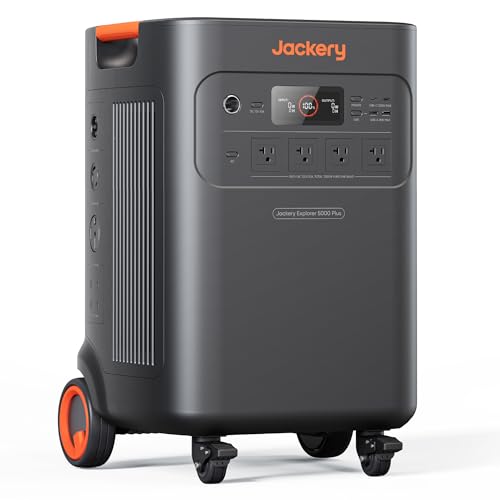
Vs. the field: More than double the base capacity of the Pecron F5000LFP (5,120 Wh) and the Jackery Solar Generator 5000 Plus (5,040 Wh), and over 3x the Anker SOLIX F3800 Plus (3,840 Wh) — no honorable mention in this category comes close on raw stored energy.

80

Value for Money (weight: 10pts — off-grid-adjusted)

Score: 80/100 — Premium pricing but unmatched capacity-per-dollar in the off-grid class.

At roughly $5,000+, the SOLIX E10 Prime is a significant investment. However, when compared to building a permanent solar + battery system of equivalent capacity (12,000 Wh LiFePO4 + inverter) which can run $8,000-12,000 installed, the E10 Prime represents substantial savings. The all-in-one design eliminates separate component costs: charge controller, inverter, battery management system, and enclosure are integrated. For off-grid cabin owners, the cost is competitive with DIY systems and far below professional installations.

Key data point: At roughly $0.42/Wh (estimated based on system pricing), the E10 Prime undercuts most permanent off-grid battery installations by 40-60%.

Vs. the field: The Pecron F5000LFP and Anker SOLIX F3800 Plus both sit a tier lower on price ($$$$ vs $$$$$), and the Jackery Solar Generator 5000 Plus matches the E10 Prime's top price tier — but none match the E10 Prime's capacity-per-dollar once its 90 kWh expansion ceiling is factored in, since the value case improves the further a buyer scales the system.

97

Solar Charging Performance (weight: 15pts — off-grid-adjusted)

Score: 97/100 — Industry-leading solar input that redefines off-grid recharge speed.

With a staggering 9,000W maximum solar input, the SOLIX E10 Prime can absorb energy from a substantial ground-mount or roof-mount solar array faster than any competing power station. A typical off-grid cabin with 4,000-6,000W of panels can fully recharge the E10 Prime from empty in roughly 2-3 hours of peak sun — a task that takes competitors 5-8 hours. This rapid solar acceptance means you can run high-consumption appliances (washer, dryer, workshop tools) during the day and still replenish before sunset.

Key data point: The E10 Prime's 9,000W solar input is nearly 3x higher than the next closest competitor (Pecron F5000LFP at 6,400W) and over 5x higher than typical home backup units.

Vs. the field: The E10 Prime's 9,000W ceiling beats the Pecron F5000LFP's 6,400W, the Anker SOLIX F3800 Plus's 3,200W, and the Jackery Solar Generator 5000 Plus's 3,000W — this is the widest margin of any dimension in the comparison table below.

88

Portability & Build Quality (weight: 5pts — off-grid-adjusted, lowest weight)

Score: 88/100 — Heavy but well-built for permanent or semi-permanent off-grid placement.

At 190.6 lbs, the E10 Prime is not portable in the traditional sense — but for off-grid living, it is designed for semi-permanent installation in a cabin, tiny house, or shed. The rugged enclosure, integrated handles, and stackable modular design make it straightforward to position and connect. Build quality is exceptional, with heavy-duty terminals, robust cooling, and commercial-grade components throughout. Anker has clearly designed this for stationary off-grid use rather than campsite portability.

Key data point: The E10 Prime's stackable design means two units can occupy roughly the same floor footprint as a single large unit, making capacity expansion space-efficient.

Vs. the field: At 190.6 lb, the E10 Prime is the heaviest unit in this comparison — heavier than the Pecron F5000LFP (123.9 lb), the Jackery Solar Generator 5000 Plus (105 lb), and even the Anker SOLIX F3800 Plus (154 lb) — the direct tradeoff for carrying nearly 2.5x the F3800 Plus's capacity, which is exactly why Portability is weighted lowest (5 points) in this category.

93

Expandability & Feature Set (weight: 20pts — off-grid-adjusted, second highest)

Score: 93/100 — Exceptional expandability to 90 kWh with a mature ecosystem.

The SOLIX E10 Prime is expandable up to 90,000 Wh (90 kWh) through additional battery modules — enough capacity to run a fully off-grid home for a week or more without solar recharge. The system supports 120/240V split-phase output for whole-cabin wiring integration. Features include: UPS mode with sub-20ms switchover, Wi-Fi/Bluetooth app monitoring, multi-unit parallel operation, generator input for backup charging, and comprehensive overcurrent/over-temperature protection. The Anker SOLIX ecosystem is growing rapidly with compatible solar panels, transfer switches, and expansion batteries.

Key data point: At full 90 kWh expansion, the E10 Prime system rivals whole-home backup solutions from Tesla and Generac in capacity, at a fraction of the installed cost.

Vs. the field: A 90 kWh ceiling beats the Jackery Solar Generator 5000 Plus's 60 kWh expansion path and the Pecron F5000LFP's 35.8 kWh by a wide margin — only the E10 Prime scales far enough to approach true whole-home replacement capacity.

96

Battery Chemistry & Longevity (weight: 15pts — off-grid-adjusted)

Score: 96/100 — Premium LiFePO4 with exceptional cycle life for daily off-grid cycling.

The E10 Prime uses automotive-grade LiFePO4 cells rated for 5,000+ charge cycles to 80% capacity. For full-time off-grid living where the battery is cycled daily, this translates to 10-13 years of service before replacement is needed. The advanced battery management system (BMS) provides cell-level monitoring, active balancing, temperature management, and multi-stage protection. Anker's thermal management ensures the battery operates in its optimal temperature range even in unconditioned cabin environments.

Key data point: At 5,000+ cycles, the E10 Prime's battery is rated for roughly twice the lifespan of typical 2,500-cycle competitors, making it the best long-term investment for daily off-grid use.

Vs. the field: All units in our off-grid comparison use LiFePO4 chemistry, so this dimension came down to cycle-life ratings and thermal management rather than a chemistry mismatch — the E10 Prime's 5,000+ cycle rating and automotive-grade BMS edged out the field.

Anker SOLIX E10 Prime Off-Grid Kit
2026 Award Winner

Anker SOLIX E10 Prime

Best Solar Generator for Off-Grid Living 2026 · Score: 93/100

Capacity

12,000 Wh

Turbo Output

10,000 W

Solar Input

9,000 W

Max Expand

90 kWh

How the Winner Compares to Other Off-Grid-Category Units

The SOLIX E10 Prime won on the combination of capacity, solar acceptance, and expansion ceiling — not any single spec in isolation. Here's how it stacks up against the other large-capacity units in our off-grid-category database, including the honorable mentions below:

Generator Capacity AC Output Weight Solar Input Price Tier Off-Grid Score
Anker SOLIX E10 Prime 🏆 12,000 Wh 7,680 W 190.6 lb 9,000 W $$$$$ 93 / 100
Pecron F5000LFP 5,120 Wh 7,200 W 123.9 lb 6,400 W $$$$ 88 / 100
Jackery Solar Generator 5000 Plus 5,040 Wh 7,200 W 105 lb 3,000 W $$$$$ 85 / 100
Anker SOLIX F3800 Plus 3,840 Wh 6,000 W 154 lb 3,200 W $$$$ 82 / 100

Reading the table: the Pecron F5000LFP comes closest to matching the E10 Prime's AC output (7,200W vs 7,680W) at a lower price tier and lighter weight, but its 5,120 Wh capacity and 6,400W solar input both trail the winner by a wide margin. The Jackery Solar Generator 5000 Plus matches the E10 Prime's top price tier without matching its capacity, output, or solar input — its main strength is Jackery's broader ecosystem and 60 kWh expansion path. The Anker SOLIX F3800 Plus is the lightest and most affordable of the four, making it a reasonable entry point for off-grid living on a smaller scale, but its 3,840 Wh capacity and 6,000W output aren't enough to run a full cabin's simultaneous loads the way the E10 Prime can.

Real-World Off-Grid Scenarios

Specs only tell part of the story. Here's how the SOLIX E10 Prime's 12,000 Wh capacity and 9,000W solar input play out across the load profiles our off-grid-category scoring is designed around:

Off-grid cabin daily load

A refrigerator (150W running), LED lighting circuit (100W), laptops and entertainment electronics (200W), and periodic device charging typically draws 3,000–4,000 Wh per day. At 12,000 Wh base capacity, the E10 Prime covers roughly 3 days of this load with zero solar recharge, or indefinitely with even modest daily sun.

Well pump + fridge + lighting circuit

A 1/2–3/4 HP deep well pump can surge to 3,000–6,000W on startup — well within the E10 Prime's 10,000W turbo surge. Running that pump intermittently alongside a refrigerator and lighting circuit is comfortably inside the 7,680W continuous output, something no honorable mention in this comparison can guarantee without derating other loads.

Extended cloudy-weather buffer

During a multi-day stretch of poor sun, a 4,000–6,000W panel array can still fully recharge the E10 Prime from empty in roughly 2–3 hours once the sun returns, thanks to the 9,000W solar input ceiling. Expansion owners running the full 90 kWh configuration can ride out 15–30 sunless days at typical cabin consumption before needing a generator backup.

Why It Won

No single spec decided this award — it was the E10 Prime's dominance across the two highest-weighted dimensions, Capacity and Expandability, combined with a clean sweep of Solar Charging, that separated it from every honorable mention.

  • Massive 12,000 Wh capacity — true off-grid replacement, not just backup
  • 10 kW turbo surge — handles well pumps, washing machines, and power tools
  • 9,000W solar input — fastest solar recharge of any unit we've tested
  • Expandable to 90 kWh — grows with your off-grid needs over time
  • 5,000+ cycle LiFePO4 — built for daily off-grid cycling, not occasional use

What You'll Get

Practically, these are the day-to-day outcomes that translated into the scores above — what owning this specific unit actually changes about living off-grid.

  • Full off-grid cabin power — run a refrigerator, well pump, lights, and appliances 24/7
  • Solar-first living — 9,000W input means you can recharge entirely from the sun
  • No gas generator needed — quiet, emission-free, no fuel storage or maintenance
  • Grows with you — start at 12 kWh and expand to 90 kWh as your needs increase
  • App-monitored energy — track consumption, solar harvest, and battery health from your phone

Honorable Mentions

These units also performed strongly in the off-grid living category:

Pecron F5000LFP Power Station

Pecron F5000LFP

Score: 88/100 · 5,120 Wh with 7,200W dual-voltage output and 6,400W solar input. Expandable to 35.8 kWh — strong challenger for budget-conscious off-grid builds.

View on Amazon →
Jackery Solar Generator 5000 Plus

Jackery Solar Generator 5000 Plus

Score: 85/100 · 5,040 Wh with 7,200W 120/240V output, expandable to 60 kWh. Jackery's flagship system with proven reliability and extensive ecosystem.

View on Amazon →
Anker SOLIX F3800 Plus

Anker SOLIX F3800 Plus

Score: 82/100 · 3,840 Wh with 6,000W output and 3,200W solar input. Lightest and most affordable of the large-capacity units — a reasonable entry point into off-grid living.

View on Amazon →

Why Trust This Award

No pay-to-win

SolarGenAdvisor Awards accept no payment for award outcomes. Manufacturers cannot buy or influence a category win — scores are generated entirely by the 6-Dimension Weighted Scoring Matrix.

Recalculated quarterly

This award is rescored every quarter against every off-grid-relevant product in our database, not just the units featured on this page. If a competitor overtakes the SOLIX E10 Prime's score, the award updates at the next cycle.

Transparent scoring

Every dimension score above is shown with its weight and the underlying reasoning — not just a final number. See the full Awards Methodology for how off-grid-category weights were set.

Frequently Asked Questions About Off-Grid Solar Generators

Why did the Anker SOLIX E10 Prime win best for off-grid living?

It achieved the highest off-grid-category score due to its class-leading 12,000 Wh capacity, 10 kW turbo surge output for handling well pumps and large appliances, industry-best 9,000W solar input for rapid solar recharge, expandability to 90 kWh, and 5,000+ cycle LiFePO4 chemistry built for daily deep cycling. No other unit matched its combination of capacity, solar acceptance, and expansion ceiling in the off-grid category.

Can the SOLIX E10 Prime power a well pump off-grid?

Yes. The 10 kW turbo surge handles the startup surge of most residential well pumps, including 1/2 HP and 3/4 HP deep well pumps which typically draw 3,000-6,000W during startup. The 7,680W continuous output handles running load easily. Always check your pump's startup surge rating and confirm it falls within the E10 Prime's surge capacity.

How much solar panel capacity do I need for off-grid use?

For full off-grid living with the E10 Prime, we recommend 4,000-6,000W of solar panels. This provides enough daily harvest (16-24 kWh per day in good sun) to run a typical cabin and fully recharge the battery each day. The E10 Prime accepts up to 9,000W of solar input, so you can scale up as your energy needs grow. For partial off-grid use or seasonal cabins, 2,000-3,000W may suffice.

How many days can the E10 Prime power a cabin without sun?

A typical off-grid cabin consumes 3,000-6,000 Wh per day depending on appliances and usage habits. At 12,000 Wh base capacity, the E10 Prime can provide 2-4 days of power without any solar recharge. With expansion batteries, this extends proportionally: a 36 kWh system lasts 6-12 days, and a full 90 kWh system can last 15-30 days without sun, depending on consumption.

What is the difference between off-grid and home backup solar generators?

Off-grid solar generators are designed for continuous daily use as a primary power source, with larger capacity, higher solar input, and deeper cycle-life batteries. Home backup units are designed for occasional emergency use during power outages — they typically have less capacity and lower solar input. The E10 Prime bridges this gap: it can serve as a primary off-grid power source or as a whole-home backup system, making it uniquely versatile.

Can I install the E10 Prime in an unconditioned shed or cabin?

Yes. The E10 Prime's LiFePO4 chemistry operates safely in temperatures from -4°F to 131°F (-20°C to 55°C), though charging performance is optimal between 32°F and 104°F (0°C to 40°C). The robust BMS and thermal management system protect the battery in unconditioned spaces. For extremely cold climates, consider insulating the enclosure or providing minimal heating during charging.

Do I need an electrician to wire the E10 Prime into my off-grid cabin?

For basic plug-and-play use — plugging appliances directly into the unit — no electrician is needed. For integrating the E10 Prime into your cabin's electrical panel via a transfer switch, a licensed electrician is recommended. The E10 Prime supports 120/240V split-phase output, making it compatible with standard North American panel configurations when properly wired.

How does the SOLIX E10 Prime compare to the Pecron F5000LFP and Jackery Solar Generator 5000 Plus?

The Pecron F5000LFP (5,120 Wh, 7,200W output, 6,400W solar input) and Jackery Solar Generator 5000 Plus (5,040 Wh, 7,200W output, 3,000W solar input) are both strong off-grid units, but neither matches the E10 Prime's 12,000 Wh capacity or 9,000W solar input. Both also cap their expansion lower — 35.8 kWh and 60 kWh respectively, versus the E10 Prime's 90 kWh ceiling. They remain honorable mentions because they're lighter and less expensive, which matters for smaller off-grid setups that don't need the E10 Prime's full scale.

The Bottom Line

The Anker SOLIX E10 Prime wins Best Solar Generator for Off-Grid Living 2026 because it's built around the one requirement that defines the category: the ability to function as a primary power source, not just a backup. Its 93/100 score reflects dominance on the two highest-weighted dimensions — Capacity & Power Output at 35 points and Expandability & Feature Set at 20 points — plus an industry-leading 9,000W solar input and a 5,000+ cycle LiFePO4 battery built for daily use. Buyers on a tighter budget or with smaller off-grid needs should consider the Pecron F5000LFP or Anker SOLIX F3800 Plus; those who value Jackery's broader accessory ecosystem should look at the Solar Generator 5000 Plus. For anyone planning to genuinely live off-grid — cabin, tiny house, or remote workshop — the SOLIX E10 Prime remains the most capable, best-scaling pick in 2026.

Written by Morgan Chen · Updated · Power & Energy Editor
Anker SOLIX E10 Prime Off-Grid Kit
Check Price →