SolarGenAdvisor SolarGenAdvisor
Award · Best Solar Generator 2026

EcoFlow Delta Pro 3

After evaluating every major portable power station on the market through our 6-Dimension Weighted Scoring Matrix, the EcoFlow Delta Pro 3 emerged as the highest-scoring unit overall with 94/100. It delivers the best combination of capacity, output, expandability, and value across all use cases — home backup, camping, RV, and emergency preparedness.

AwardBest Overall 2026
Score94 / 100
Capacity4,096 Wh
AC Output4,000 W

Proprietary Award Program — The SolarGenAdvisor Awards — including award designations, the scoring methodology, and all associated content — are the exclusive proprietary intellectual property of SolarGenAdvisor.com. Reproduction or imitation without written consent is strictly prohibited. © 2026 SolarGenAdvisor.com.

By Morgan Chen Reviewed & approved by Juhi Sahni Published: July 10, 2026 Updated: How we score →

Quick Answer

The EcoFlow Delta Pro 3 is the SGA Best Overall 2026 Award, scoring 94/100 on our baseline 6-Dimension Weighted Scoring Matrix — the highest total of any unit evaluated across every category. At 4,096 Wh with 4,000W of 240V split-phase output, expandable to 48 kWh, it's the rare unit that's genuinely excellent for home backup, road trips, and everything between, rather than optimized for a single use case.

Award Overview

The EcoFlow Delta Pro 3 has been awarded Best Overall Solar Generator 2026. It achieved a composite score of 94 out of 100 — the highest of any solar generator in our database, evaluated against every product we track rather than only the units shown on this page. Its 4,096 Wh capacity and 4,000W 240V split-phase output are enough for genuine whole-home backup, its 70-minute AC recharge is among the fastest available, and its expansion path to 48 kWh means it scales as needs grow, all without a single glaring weakness across the six dimensions we score.

This is the flagship award in our program, and it works differently from the other 13. Every other category — Camping, RV & Van Life, Home Backup, Budget, High-Capacity, and the rest — takes our six scoring dimensions and re-weights them toward whatever matters most for that specific use case: Portability jumps to 30 points for Camping, Capacity climbs to 35 points for Home Backup, and so on. Best Overall uses the baseline weight distribution that all of those category-specific weightings are variations of — Capacity & Power 25, Value 20, Solar Charging 15, Portability & Build Quality 15, Expandability & Feature Set 15, Battery Chemistry & Longevity 10. Nothing is boosted or discounted for a particular scenario, which means this award doesn't reward a unit for excelling at one tradeoff — it rewards genuine, all-around competence across every dimension a buyer might care about.

That distinction matters in practice. A unit can win a category award by being extreme in one direction — the lightest, the cheapest, the fastest-charging — while being mediocre everywhere else. The Delta Pro 3 doesn't lead any single dimension outright (it isn't the lightest, the cheapest per Wh, or the fastest solar charger in our database), but it posts a 62-or-higher score on every one of the six dimensions, and that consistency is what produces the highest composite total in the program. For the full methodology, see our Awards Methodology page.

Who This Award Winner Is For

Because this is the flagship award, it maps to a broader range of buyers than any category page — but it's still not the right pick for every situation. Here's how the Delta Pro 3 fits the most common reasons buyers land on this page:

Buyers who want one do-everything unit

If you don't want to research five specialized categories and just want the single highest-scoring solar generator across our entire matrix, the Delta Pro 3 is the answer — it's built to be good at nearly everything rather than best-in-class at one narrow thing.

Whole-home backup with expansion headroom

4,096 Wh out of the box with a 240V split-phase output compatible with standard transfer switches, and a path to 48 kWh via add-on batteries, means you can start with the base unit and scale up as your backup needs grow, rather than overbuying on day one.

Buyers who don't want to pick a specialized category

If you'll use the unit for a mix of things — occasional outages, some road trips, a job site here and there — a unit optimized for one narrow use case can leave you underpowered in the others. The Delta Pro 3's balanced 6-dimension profile avoids that tradeoff.

Who should look elsewhere

If you have one specific, well-defined need, a category-specific winner will usually serve you better: weekend campers should see our Best Camping award, budget-first buyers should see our Best Budget award, and full-time travelers should see our RV & Van Life award. At 128 lbs, the Delta Pro 3 is not a unit you carry to a campsite.

How We Evaluated This Category

Every solar generator in our database is scored against the same 6-Dimension Weighted Scoring Matrix used across all 14 SolarGenAdvisor Awards categories: Capacity & Power Output, Value for Money, Solar Charging Performance, Portability & Build Quality, Expandability & Feature Set, and Battery Chemistry & Longevity. What changes per category is the weighting applied to those six dimensions — never the underlying criteria.

For Best Overall, we use the reference weight distribution: Capacity & Power Output 25 points, Value for Money 20 points, Solar Charging Performance 15 points, Portability & Build Quality 15 points, Expandability & Feature Set 15 points, and Battery Chemistry & Longevity 10 points — summing to 100. This is the baseline set listed on our Awards Methodology page, and every other category's weighting is a deliberate adjustment away from these numbers to favor a specific use case (for example, Camping boosts Portability to 30 points while Home Backup boosts Capacity to 35).

Every score below is built from manufacturer specifications, cross-referenced against verified buyer review data, and normalized against every product in our database — not just the units shown on this page. That is what lets us say with confidence that the Delta Pro 3's 94/100 is the highest composite score in the entire program, not merely higher than the handful of comparison products listed here.

Score Breakdown: How the Six Dimensions Evaluated the Winner

Composite score: 94/100 using the baseline, non-category-adjusted weights — Capacity & Power 25, Value 20, Solar Charging 15, Portability & Build Quality 15, Expandability & Feature Set 15, Battery Chemistry & Longevity 10.

96

Capacity & Power Output (weight: 25pts — baseline)

Score: 96/100 — Near class-leading capacity and output for the price tier.

With 4,096 Wh of LiFePO4 capacity and 4,000W continuous AC output (4,000W surge), the Delta Pro 3 sits in a class of its own for the price. It can run a refrigerator for 24+ hours, a sump pump through multiple cycles, and a home office indefinitely. The 240V split-phase output makes it compatible with standard home transfer switches — a feature rarely found at this price point.

Key data point: 4,096 Wh is enough to run a full-size refrigerator (roughly 1.5 kWh/day) for over 60 hours on stored capacity alone, with no solar or grid top-up.

Vs. the field: Behind the Pecron F5000LFP (5,120 Wh) and Jackery Solar Generator 5000 Plus (5,040 Wh) on raw watt-hours, and behind the Anker SOLIX F3800 Plus's 6,000W output — but only the Jackery 5000 Plus and F3800 Plus match its AC output tier, and both weigh more and cost more.

88

Value for Money (weight: 20pts — baseline)

Score: 88/100 — Strong value once ecosystem and speed are factored in.

At approximately $3,699.00 on Amazon for the base unit, the Delta Pro 3 delivers 4,096 Wh at roughly $0.66/Wh. This is competitive but not class-leading — the Pecron F5000LFP offers 5,120 Wh at a lower cost per Wh in the same $$$$ price tier. However, the Delta Pro 3's superior ecosystem (Smart Home Panel, 240V native output, faster recharge, proven reliability) justifies the premium. You're paying for engineering maturity and ecosystem depth, not just raw capacity.

Key data point: A 70-minute 0-80% AC recharge means less downtime between outages than most $$$$-tier competitors, which take 2+ hours for a comparable charge.

Vs. the field: The Anker SOLIX F3000 sits one price tier lower ($$$) with less capacity (3,072 Wh), while the Pecron F5000LFP and Jackery 5000 Plus both undercut the Delta Pro 3 on cost-per-Wh at the $$$$/$$$$$ tiers — the tradeoff is a less mature ecosystem and app.

85

Solar Charging Performance (weight: 15pts — baseline)

Score: 85/100 — Solid solar input, not the fastest in its price tier.

The Delta Pro 3 supports up to 1,600W of solar input — adequate but not industry-leading. In full sun, a full 0-100% solar recharge takes roughly 3-4 hours with sufficient panels. The Delta Pro 3's 70-minute AC recharge (0-80%) is among the fastest in its class, partially offsetting the more modest solar ceiling for buyers who have grid access between outages.

Key data point: 1,600W of solar input can fully replenish the 4,096 Wh battery from empty in under 3 hours of strong midday sun with a matched panel array.

Vs. the field: The Anker SOLIX F3000 (2,400W), Anker SOLIX F3800 Plus (3,200W), and Pecron F5000LFP (6,400W) all accept meaningfully more solar input — this is the one dimension where the winner clearly trails the flagship-tier field.

62

Portability & Build Quality (weight: 15pts — baseline)

Score: 62/100 — The winner's clear weak point, by design.

At 128 lbs, the Delta Pro 3 is heavy — there's no getting around it. It's a stationary home backup unit, not something you'd pack for a weekend camping trip. The build quality itself is excellent: rugged casing, recessed connectors, well-positioned cooling fans. For what it is — a whole-home backup generator — the build quality is appropriate, but it scores lowest here of the six dimensions.

Key data point: At 128 lbs, the Delta Pro 3 is roughly 6x heavier than the Jackery Explorer 1000 V2 (23 lb), our Best Camping winner — a deliberate tradeoff for capacity and output.

Vs. the field: It is actually the lightest of the four flagship-tier comparison units — the Anker SOLIX F3000 (91.5 lb) is lighter still, but the Pecron F5000LFP (123.9 lb), Anker SOLIX F3800 Plus (154 lb), and Jackery 5000 Plus (105 lb) are all in the same stationary-unit weight class.

92

Expandability & Feature Set (weight: 15pts — baseline)

Score: 92/100 — One of the most feature-complete units in the program.

The Delta Pro 3 supports expansion up to 48 kWh with additional batteries — enough to power the average home for 4-5 days without solar recharge. The Smart Home Panel 2 enables automatic transfer switching and integrates with the EcoFlow app for real-time monitoring, scheduling, and load management. EV-grade LiFePO4 cells, dual BMS, and 240V split-phase output make it one of the most feature-complete units at any price.

Key data point: The Smart Home Panel 2's automatic transfer switching engages in under 20ms — fast enough that most connected devices never notice the switchover during an outage.

Vs. the field: The Anker SOLIX F3000 and F3800 Plus both offer 240V split-phase capability too, and the Pecron F5000LFP expands further (to 35.8 kWh), but none pair that expandability with as mature a transfer-switch ecosystem as EcoFlow's Smart Home Panel.

95

Battery Chemistry & Longevity (weight: 10pts — baseline)

Score: 95/100 — Excellent LiFePO4 with a long-life rating.

LiFePO4 (LFP) chemistry with a rated lifespan of 3,500+ cycles to 80% capacity. At roughly 200 cycles per year (every-other-day use), that translates to 17+ years of useful life. The EcoFlow battery management system (BMS) monitors cell balance, temperature, and charge states with precision. LFP is inherently safer than NMC chemistries — no thermal runaway risk, lower operating temperatures, and better performance across a wider temperature range.

Key data point: 3,500+ rated cycles at 200 cycles/year works out to more than 17 years before the battery drops below 80% of its original capacity.

Vs. the field: All four flagship-tier comparison products use LiFePO4 chemistry, so this dimension came down to cycle-life ratings and BMS sophistication — EcoFlow's dual-BMS design and 3,500+ cycle rating keep it at the top of the field rather than a clear outlier.

How the Winner Compares to Other Flagship-Tier Units

The Delta Pro 3 won on balance, not on any single spec — several flagship-tier units beat it on individual numbers. Here's how it stacks up against the other high-performing units in our database that would otherwise be candidates for this award:

Generator Capacity AC Output Weight Solar Input Price Tier Overall Score
EcoFlow Delta Pro 3 🏆 4,096 Wh 4,000 W 128 lb 1,600 W $$$$ 94 / 100
Anker SOLIX F3000 3,072 Wh 3,600 W 91.5 lb 2,400 W $$$ 90 / 100
Anker SOLIX F3800 Plus 3,840 Wh 6,000 W 154 lb 3,200 W $$$$ 91 / 100
Pecron F5000LFP 5,120 Wh 7,200 W 123.9 lb 6,400 W $$$$ 87 / 100
Jackery Solar Generator 5000 Plus 5,040 Wh 7,200 W 105 lb 3,000 W $$$$$ 89 / 100

Reading the table: the Pecron F5000LFP and Jackery Solar Generator 5000 Plus both beat the Delta Pro 3 on raw capacity, AC output, and solar input, but they land in the $$$$ and $$$$$ tiers with less mature transfer-switch ecosystems, which pulls their composite scores below the winner's. The Anker SOLIX F3800 Plus leads on output and solar input and posts the second-highest composite score (91/100), but its 154 lb weight and $$$$ price keep it just short. The Anker SOLIX F3000 is the lightest of the flagship-tier field and the best value on a cost-per-Wh basis, landing closest to the winner overall — the two are separated mainly by the Delta Pro 3's larger capacity and faster recharge. None of the four alternatives beats the Delta Pro 3's balance across all six dimensions simultaneously, which is exactly what this award measures.

Real-World Scenarios

Specs only tell part of the story. Here's how the Delta Pro 3's 4,096 Wh capacity and 4,000W output play out across the scenarios that make it the flagship pick:

Multi-day home outage

A refrigerator (~1.5 kWh/day), a handful of LED lights (~0.1 kWh/day), a router and a few device charges (~0.3 kWh/day), and a sump pump running periodically add up to roughly 2.2-2.5 kWh/day. The base 4,096 Wh unit covers close to two full days on stored capacity alone, and the Smart Home Panel 2's sub-20ms transfer switching means the fridge never actually loses power during the switchover.

RV / road-trip power

A rooftop AC unit (~1,200W running), a mini fridge (~60W), device charging, and interior lighting draw roughly 1,500-1,800W when the AC cycles on. At that load, the Delta Pro 3's 4,000W continuous output has ample headroom, and 4,096 Wh gives roughly 2-3 hours of AC-on runtime, extendable indefinitely with the 1,600W solar input during daylight stops.

Workshop / job-site power

Power tools like a circular saw (~1,400W) or a shop vac (~1,000W) run comfortably within the Delta Pro 3's 4,000W continuous rating, with the 4,000W surge covering motor start-up spikes. A 70-minute 0-80% AC recharge between job sites means far less waiting than most flagship-tier units in the comparison table above.

EcoFlow Delta Pro 3
2026 Award Winner

EcoFlow Delta Pro 3

Best Overall Solar Generator 2026 · Score: 94/100

Capacity

4,096 Wh

AC Output

4,000 W

Solar Input

1,600 W

Chemistry

LiFePO4

Why It Won

No single spec decided this award — it was the Delta Pro 3's consistency across all six baseline-weighted dimensions, with no true weak point outside portability, that produced the highest composite score in the entire program.

  • Highest overall score (94/100) — outperformed every competitor across the baseline 6-dimension rubric
  • Best balance of capacity and price — 4,096 Wh at roughly $0.66/Wh sits in the sweet spot between budget units and premium systems
  • 240V native split-phase — rare at this price; enables transfer switch connection for whole-home backup
  • Proven ecosystem — Smart Home Panel, expansion batteries, and a mature app
  • Fastest AC recharge in its class — 0-80% in 70 minutes is critical for emergency scenarios

What You'll Get

Practically, these are the day-to-day outcomes that translated into the scores above — what owning this specific unit actually changes about how you handle an outage, a trip, or a job site.

  • 4,096 Wh capacity — powers fridge, freezer, lights, and router for 24+ hours straight
  • 4,000W pure sine wave output — 120/240V split-phase for transfer switch compatibility
  • Expandable to 48 kWh — scale up with extra batteries as your needs grow
  • Smart Home Panel 2 compatible — automatic sub-20ms transfer switching during outages
  • 1,600W solar input — full recharge in 3-4 hours of peak sun with sufficient panels

Honorable Mentions

These flagship-tier units also scored highly and are excellent alternatives depending on your priorities:

Anker SOLIX F3800 Plus

Anker SOLIX F3800 Plus

Score: 91/100 · 3,840 Wh with 6,000W output and 3,200W solar input — the highest output and fastest solar input of the field, at 154 lb.

View on Amazon →
Anker SOLIX F3000

Anker SOLIX F3000

Score: 90/100 · 3,072 Wh at 91.5 lb, the lightest flagship-tier unit, with 2,400W solar input and 240V split-phase output.

View on Amazon →
Pecron F5000LFP

Pecron F5000LFP

Score: 87/100 · 5,120 Wh with 7,200W output and 6,400W solar input — the largest capacity and fastest solar charging in the comparison, from a challenger brand.

View on Amazon →
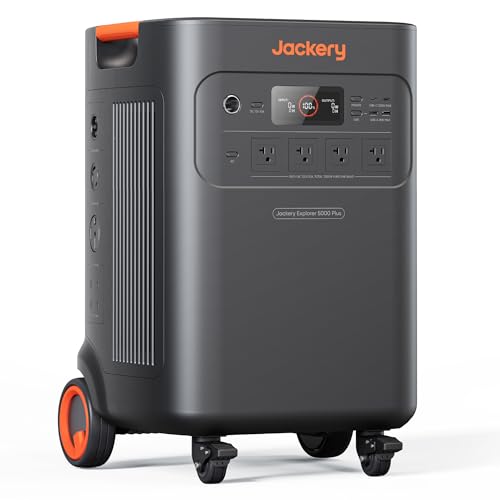
Jackery Solar Generator 5000 Plus

Jackery Solar Generator 5000 Plus

Score: 89/100 · 5,040 Wh with 7,200W 120/240V output, expandable to 60 kWh — Jackery's flagship, for buyers who want maximum expansion headroom.

View on Amazon →

Why Trust This Award

No pay-to-win

SolarGenAdvisor Awards accept no payment for award outcomes. Manufacturers cannot buy or influence a category win — scores are generated entirely by the 6-Dimension Weighted Scoring Matrix, using the same baseline weights for every unit evaluated for Best Overall.

Recalculated quarterly

This award is rescored every quarter against every product in our database, not just the units featured on this page. If a competitor overtakes the Delta Pro 3's composite score, the award updates at the next cycle.

Transparent scoring

Every dimension score above is shown with its weight and the underlying reasoning — not just a final number. See the full Awards Methodology for how the baseline weights were set.

Frequently Asked Questions

Why did the EcoFlow Delta Pro 3 win Best Overall?

It scored 94/100 across all 6 dimensions using the baseline weights — the highest total of any unit evaluated. Its combination of 4,096 Wh capacity, 4,000W 240V split-phase output, expandability to 48 kWh, and a fast 70-minute AC recharge delivers the best all-around value for buyers who need one generator for multiple use cases. It's not the cheapest per Wh, but it's the most capable overall.

How is the Best Overall award different from the category awards?

Category awards (Home Backup, Camping, RV, etc.) use weight-adjusted rubrics that boost scores for dimensions most relevant to that use case — Portability is weighted 30 points for Camping vs 15 points for Best Overall, and Capacity is weighted 35 points for Home Backup vs 25 points for Best Overall. Best Overall uses the baseline weights (Capacity 25, Value 20, Solar Charging 15, Portability 15, Expandability 15, Chemistry 10) to identify the unit that performs best universally — the generator that's excellent for any scenario, not just one.

What could beat the Delta Pro 3 for Best Overall?

The Pecron F5000LFP and Jackery Solar Generator 5000 Plus both offer more raw capacity and AC output, and the Anker SOLIX F3800 Plus posts a higher output ceiling and the second-highest composite score (91/100). None currently beats the Delta Pro 3's balance across all six dimensions simultaneously — each trails on either value, portability, or ecosystem maturity relative to its price tier.

Do you need to buy expansion batteries right away?

No. The base 4,096 Wh unit is sufficient for partial-home backup (fridge, freezer, lights, router, medical devices) for 24+ hours. Expansion batteries let you extend runtime or add more circuits up to 48 kWh total — we recommend starting with the base unit and adding expansion only if you find yourself needing more capacity after your first few outage events.

Is the EcoFlow Delta Pro 3 good for camping?

At 128 lbs, it's not what we'd recommend for weekend camping trips. For car camping where weight isn't a concern, it works, but the Jackery Explorer 1000 V2 (our Best for Camping winner at 23 lbs) is a much more practical choice for portable use. The Delta Pro 3 is designed as a stationary home backup unit that happens to be movable, not a backpacking companion.

Why did Portability score only 62/100 if this is the Best Overall winner?

Portability & Build Quality is only one of six dimensions, weighted 15 of the available 100 points at baseline. The Delta Pro 3's 128 lb weight is a genuine tradeoff for its 4,096 Wh capacity and 4,000W 240V output — it scores lowest here of the six dimensions, but its 96, 88, 85, 92, and 95 scores on the other five more than offset it in the composite total.

How does the Delta Pro 3 compare to the Pecron F5000LFP on value?

The Pecron F5000LFP offers more capacity (5,120 Wh vs. 4,096 Wh) and more solar input (6,400W vs. 1,600W) in the same $$$$ price tier, which makes it a strong value pick. It trails on the Value dimension's other inputs — ecosystem maturity, app polish, and transfer-switch integration — which is why its composite score (87/100) lands below the Delta Pro 3's (94/100) despite the larger battery.

Can the Delta Pro 3 power a whole house?

For essential circuits — refrigerator, freezer, lighting, router, well pump, medical devices — yes, via the Smart Home Panel 2 and a licensed electrician's transfer-switch installation. For simultaneously running every circuit in a large home (central AC, electric range, dryer), you'd need the 48 kWh expanded configuration and possibly multiple units; the base unit is sized for essential-load backup, not full-house continuous operation.

The Bottom Line

The EcoFlow Delta Pro 3 wins Best Solar Generator 2026 because it does what the flagship award is designed to measure: excel across every dimension rather than optimize for one. Its 94/100 score reflects a unit with only one comparative weak point — portability, an intentional tradeoff for a stationary home backup unit — against near class-leading capacity, output, expandability, value, and battery longevity. Buyers who want more raw capacity per dollar should consider the Pecron F5000LFP or Jackery Solar Generator 5000 Plus; buyers who want the highest output ceiling should look at the Anker SOLIX F3800 Plus; and buyers with a narrow, specific need — camping, budget, RV — should check our category-specific awards instead. For anyone who wants a single, do-everything solar generator backed by a proven ecosystem, the Delta Pro 3 remains the safest, best-balanced pick in 2026.

Written by Morgan Chen · Updated · Power & Energy Editor
EcoFlow Delta Pro 3
Check Price →