Why did the Anker SOLIX F3000 win the Best Emergency Solar Generator award?
The F3000 earned 92/100 using our emergency-adjusted scoring matrix, which places extra weight on Capacity & Power Output (35pts) — the heaviest weight of any dimension in the category — plus Solar Charging (15pts) and Battery Chemistry (15pts). It scored 97/100 in battery chemistry thanks to its LiFePO4 cells and ultra-low 1.6W idle draw, which is 3–5x better than competitors. Its 6,000W hyper-fast recharge (0–100% in 1.3 hours) and 2,400W solar input also gave it a decisive edge for multi-day outage scenarios where recharge windows are short.
Why is Capacity weighted so much higher in this category than others?
In our emergency/outage weighting, Capacity & Power Output carries 35 of 100 points — far more than in our camping (20pts) or RV (varies) categories. This is an editorial category adjustment: since there's no published weight row for this category on our Awards Methodology page yet, we set weights specific to the outage use case. Blackout endurance — how many hours or days a unit can keep essentials running — is the entire point of emergency preparedness equipment, so it gets the heaviest weight in the matrix.
What makes a solar generator "indoor safe"?
An indoor-safe solar generator produces zero exhaust fumes, has no carbon monoxide emissions, and uses battery chemistry that won't off-gas toxic compounds. The Anker SOLIX F3000 uses LiFePO4 (lithium iron phosphate) chemistry, which is inherently thermally stable and doesn't pose the fire or gas hazards associated with older NMC chemistries or gasoline generators. It can safely operate in a garage, basement, or living space without ventilation, making it ideal for emergency scenarios where you can't run equipment outside (e.g., during a hurricane or extreme cold).
Can the F3000 power a CPAP machine during an outage?
Yes, absolutely. A typical CPAP machine draws 30–60 watts, so the F3000's 3,072 Wh capacity can run a CPAP for 50–100 hours on a single charge — that's roughly a week of nightly use. The F3000's pure sine wave output is fully compatible with CPAP motors and humidifiers, and its silent operation means you can keep it in the bedroom without noise disruption. The low idle draw also means the unit won't waste significant power between CPAP cycles, maximizing overnight runtime.
How long does it take to recharge the F3000 during a multi-day outage?
Recharge time depends on your available power sources. With AC wall power (1,800W), a full 0–100% charge takes approximately 2 hours. With AC + solar combined at the full 6,000W rate, it takes just 1.3 hours. With solar only (2,400W input), expect 1.5–2.5 hours of peak sun for a full charge. During a multi-day outage, the typical strategy is to run a gas generator for 1–2 hours to top off the F3000, then let the solar panels handle the remaining charge during the day — keeping both noise and fuel consumption to a minimum.
Is the Anker SOLIX F3000 good for hurricane season?
Yes, the F3000 is an excellent choice for hurricane season preparedness. Its 3,072 Wh capacity can run a refrigerator for 42+ hours, keeping food safe through the most critical post-hurricane period. The 2,400W solar input means you can recharge during daytime (when hurricanes typically pass and skies clear), and the built-in wheels let you roll it outside after the storm passes for direct solar charging. The 240V dual-unit pairing option also means you can scale up for whole-home backup if you're in a region that faces extended post-hurricane outages lasting 1–2 weeks.
Can the F3000 run a refrigerator and freezer during an outage?
Yes, a standard refrigerator (150–300W running) and a chest freezer (100–200W running) are well within the F3000's 3,600W continuous output capacity. In practice, the F3000 can power a refrigerator for approximately 42 hours, a chest freezer for 60+ hours, or both simultaneously for roughly 24–30 hours on a single charge. The pure sine wave inverter ensures sensitive compressor electronics run smoothly without clicking or stalling. With solar panels, you can extend this runtime indefinitely during daylight hours, making the F3000 a true long-term outage solution.
How does the F3000 compare to the OUPES Guardian 6000 for a permanent home-backup setup?
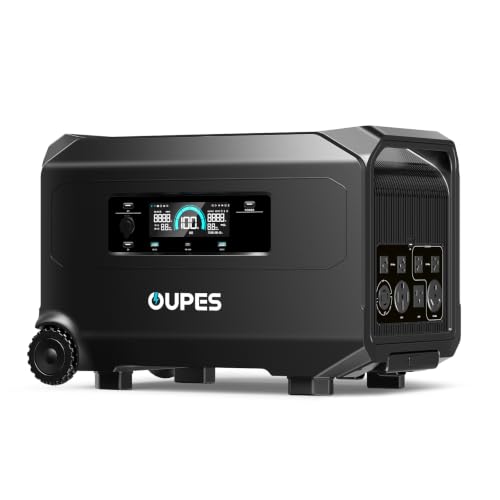
The OUPES Guardian 6000 (4,608 Wh, transfer-switch ready, expandable to 41 kWh) is a strong pick if you're planning a permanent transfer-switch installation from day one. The F3000 counters with a faster 6,000W combined recharge rate, a lower 1.6W idle draw, and its own UPS-mode automatic transfer that doesn't require a dedicated switch — which is why it scored higher overall (92 vs. 83) despite the Guardian 6000's larger capacity and built-in transfer-switch readiness.

 By
By